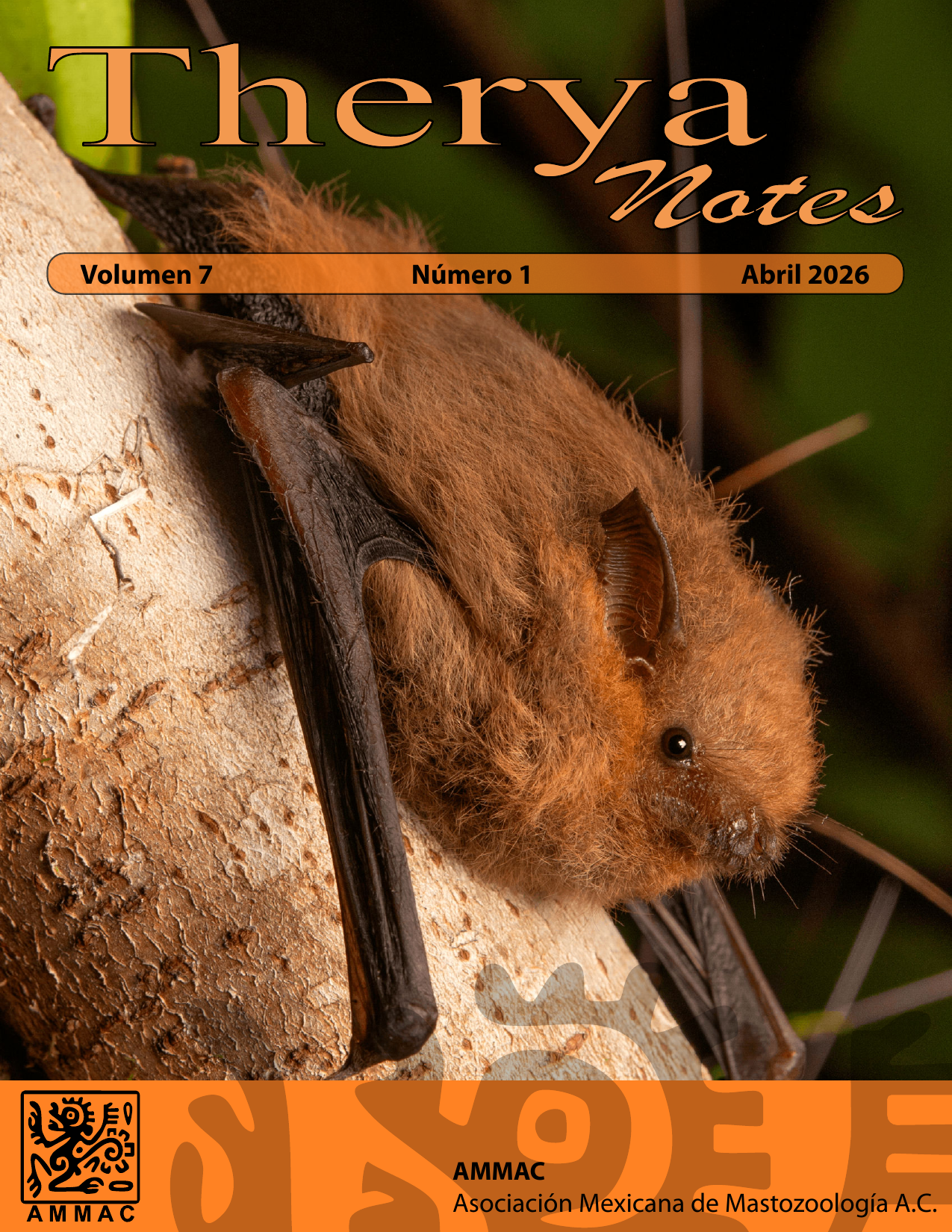
Enhancing the knowledge of Herpailurus yagouaroundi for its conservation in Morelos, México
DOI:
https://doi.org/10.12933/therya_notes-25-234Keywords:
Camera trapping, dry forest, endangered species, jaguarundi, photographic capture rate, protected natural area, Sierra de HuautlaAbstract
The jaguarundi is one of the six wild feline species found in Mexico and is considered threatened, with population trends indicating a decline. It is a species difficult to capture, with very few recorded sightings. More studies on its ecology are needed. The data were obtained through photo-trapping samplings conducted at six ejidos (communal landholdings) within the Sierra de Huautla Biosphere Reserve (REBIOSH), in southern Morelos, from 2015 to 2022, using between 35 and 61 camera traps on each 30-60 day sampling periods. The cameras were deployed on sampling grids with a minimum separation of 500 m. We obtained 25 records of the species in 15 different sites within the REBIOSH. On average, its photographic capture rate in this protected natural area (PNA) was 0.63 ± 0.67 individuals per 1,000 trap days. Most of these new records were obtained in wide ravines within large fragments (ranging from 80 to over 1,500 ha) of preserved continuous dry forest, at altitudes below 1,200 m above sea level, and during the daytime. This increases knowledge of the species’ distribution in Morelos and provides evidence that, in the REBIOSH, this species has a persistent population with a wide distribution,
especially in its southern and northeastern portions, although it is low in abundance. We provide concrete suggestions to help conserve it within this PNA and in the state of Morelos.
Downloads
Published
How to Cite
Issue
Section
License
Copyright (c) 2026 Therya Notes

This work is licensed under a Creative Commons Attribution-NonCommercial-NoDerivatives 4.0 International License.
THERYA NOTES is based on its open access policy allowing free download of the complete contents of the magazine in digital format. It also authorizes the author to place the article in the format published by the magazine on your personal website, or in an open access repository, distribute copies of the article published in electronic or printed format that the author deems appropriate, and reuse part or whole article in own articles or future books, giving the corresponding credits. The Creative Commons CC BY-NC-SD license is used.