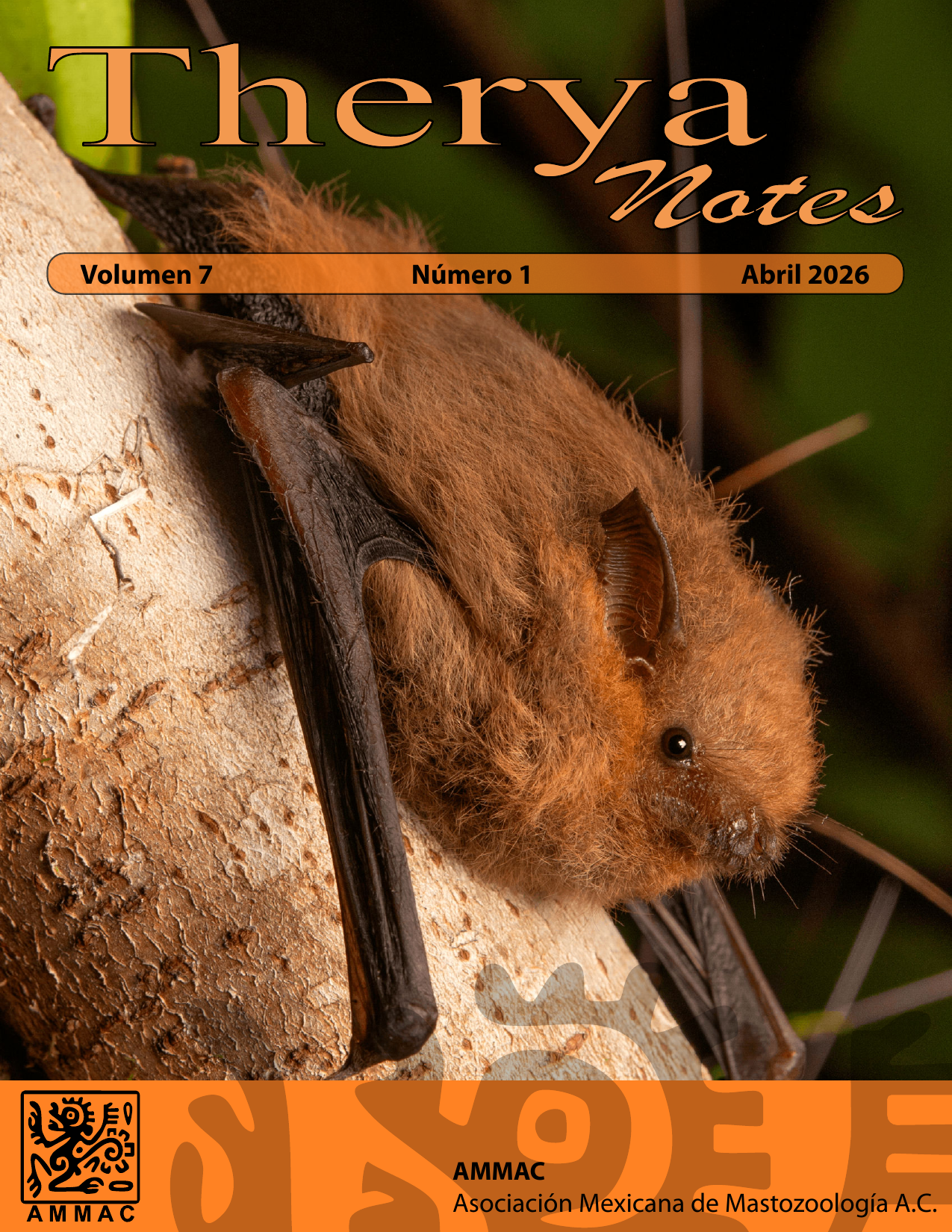
Noteworthy acoustic records of Eumops ferox (Chiroptera: Molossidae) and Mormoops megalophylla (Chiroptera: Mormoopidae) in Mexico
DOI:
https://doi.org/10.12933/therya_notes-24-225Keywords:
Baja California Peninsula, echolocation, insectivorous bats, northernmost record, TamaulipasAbstract
Eumops ferox is a molossid previously considered restricted to the Neotropical region south of the Trans-Mexican Volcanic Belt. Mormoops megalophylla is a widespread distributed mormoopid species but restricted in the Baja California Peninsula to Baja California Sur. This note reports notable records of these two species in northern Mexico. By employing Robust Quadratic Discriminant Analysis and Welch’s ANOVA, we analyzed and identified free-flying bat echolocation calls recorded during monthly surveys from January to November 2023 in two regions: Llera de Canales, Tamaulipas, and the Volcanic Complex “Las Tres Vírgenes” in Baja California Sur. Taxonomic identities were determined using frequency and temporal acoustic parameters. A total of 52 echolocation passes from E. ferox were documented in Llera de Canales, Tamaulipas, situated 170 km northwest of its closest previously known record and over 450 km north of its currently recognized distribution range. Additionally, 6 passes of M. megalophylla were identified in “Las Tres Vírgenes”, located 35 km northwest of the nearest prior record. The E. ferox record extends its known range into northeastern Mexico, while the M. megalophylla record marks the northernmost occurrence of the species on the Baja California Peninsula. These findings enhance our knowledge of the distribution of both species in Mexico.
Downloads
Published
How to Cite
Issue
Section
License
Copyright (c) 2026 Therya Notes

This work is licensed under a Creative Commons Attribution-NonCommercial-NoDerivatives 4.0 International License.
THERYA NOTES is based on its open access policy allowing free download of the complete contents of the magazine in digital format. It also authorizes the author to place the article in the format published by the magazine on your personal website, or in an open access repository, distribute copies of the article published in electronic or printed format that the author deems appropriate, and reuse part or whole article in own articles or future books, giving the corresponding credits. The Creative Commons CC BY-NC-SD license is used.