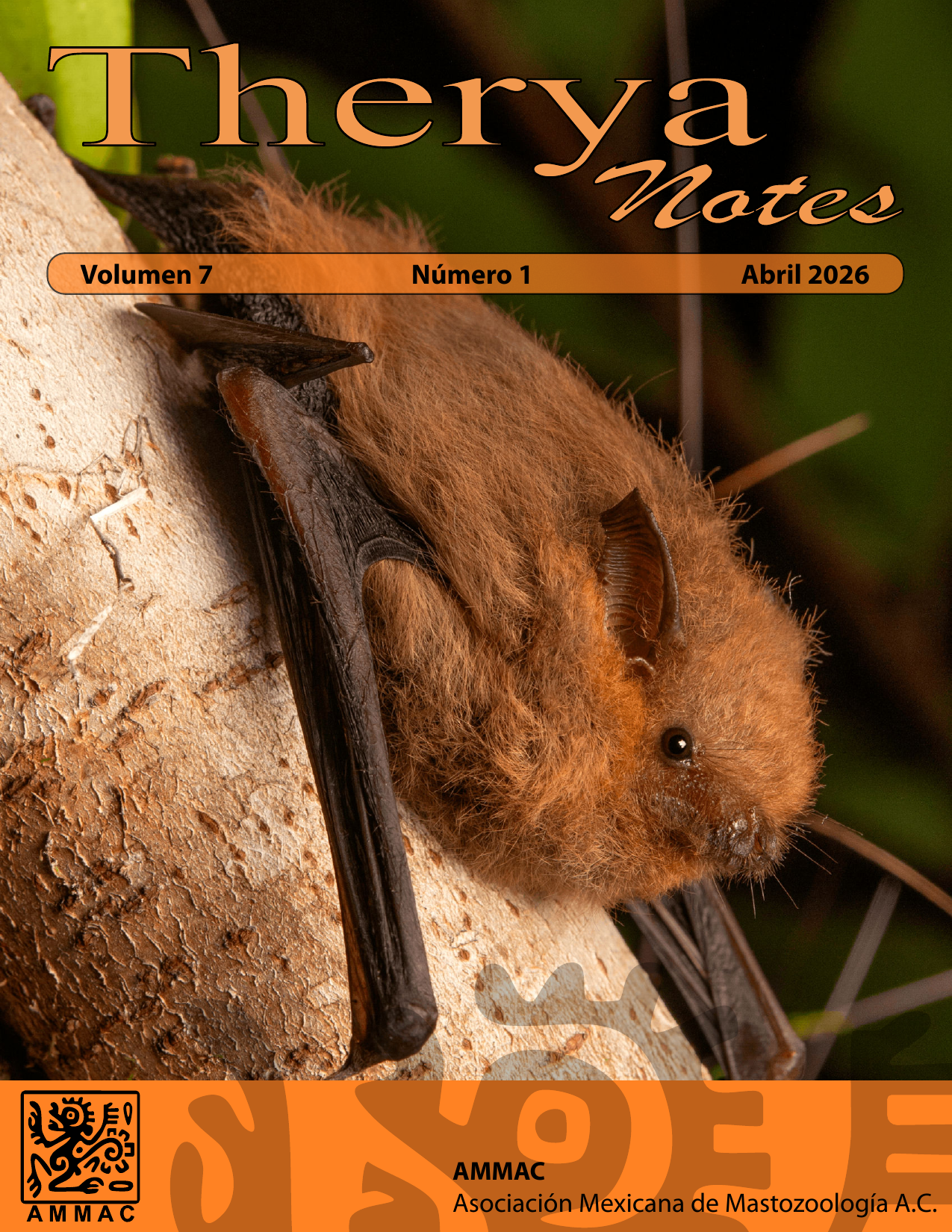
New bat (Mammalia: Chiroptera) records from Nicaragua: First records of Pteronotus psilotis, Dermanura azteca and Uroderma davisi
DOI:
https://doi.org/10.12933/therya_notes-25-228Keywords:
Central America, Centronycteris, Davis's tent-making bat, Dermanura, Honduran fruit-eating bat, range extension, Aztec fruit-eating batAbstract
Understanding species distributions is key for conservation and management, as well as necessary to examine their ecological associations. In recent decades, the increasing survey efforts across Nicaragua have expanded the known ranges of many Mesoamerican bat species. Here we aim to fill gaps in known distribution of bat species across their distribution in Nicaragua and Central America. We used single and triple high nets to capture bats in different vegetation formations across Nicaragua. We measured and identified each individual bat and compared their location to previously known localities available in international repositories. We provide the first record of Pteronotus psilotis (Dobson 1878), Dermanura azteca K. Andersen 1909, and Uroderma davisi R. J. Baker and McDaniel 1972. We also provide new records of Centronycteris centralis Thomas 1912, and Artibeus inopinatus Davis and Carter 1964. Our findings fill important gaps in the known distribution of the species. With our current additions, this elevates the number of bat species recorded in Nicaragua to 116. We recommend more capture and acoustic sampling efforts, specifically in areas near the north and southern borders of the country that have been historically underrepresented in surveys.
Downloads
Published
How to Cite
Issue
Section
License
Copyright (c) 2026 Therya Notes

This work is licensed under a Creative Commons Attribution-NonCommercial-NoDerivatives 4.0 International License.
THERYA NOTES is based on its open access policy allowing free download of the complete contents of the magazine in digital format. It also authorizes the author to place the article in the format published by the magazine on your personal website, or in an open access repository, distribute copies of the article published in electronic or printed format that the author deems appropriate, and reuse part or whole article in own articles or future books, giving the corresponding credits. The Creative Commons CC BY-NC-SD license is used.