First record of Perimyotis subflavus in Nuevo León, Mexico with additional ecological notes on hibernacula
DOI:
https://doi.org/10.12933/therya_notes-24-216Keywords:
cave, hibernation, Sierra Madre Oriental, torpor, VespertilionidaeAbstract
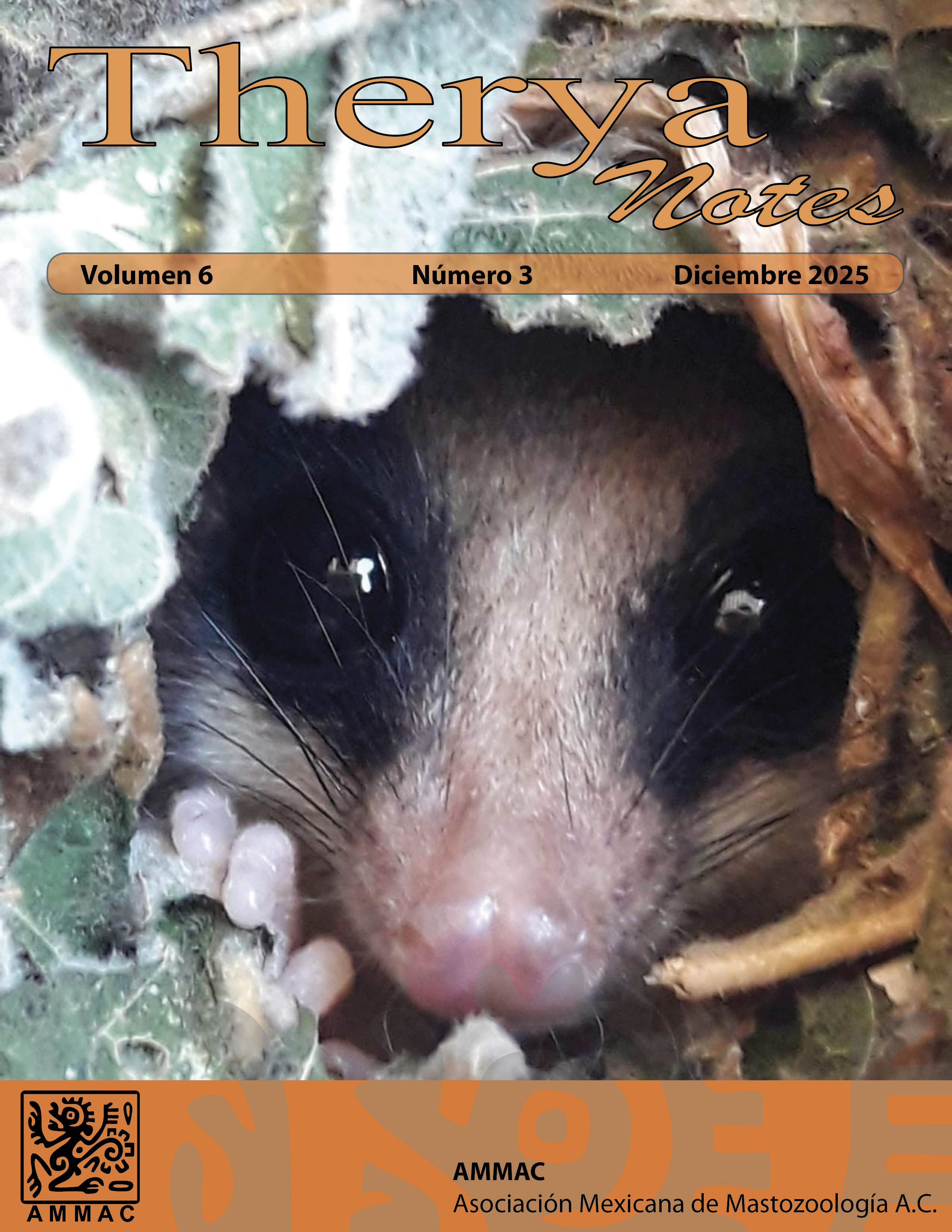
Perimyotis subflavus, is a species that is currently listed as Vulnerable by the IUCN Red List due to the population decline that is causing the White-Nose Syndrome (WNS). However, in Mexico, its ecology and distribution are poorly understood. Despite its distribution in Mexico being mainly in the east, in Nuevo León has never been recorded until now. The individual’s capture was done during a speleologist exploration on March 18th, 2025, in a cave in Laguna de Sánchez, Santiago, Nuevo León. We described the microclimatic characteristics of the roost by measuring the temperature and relative humidity. We also measured individuals fur temperature and roost’s surface temperature where the bat was roosting. Our observation of P. subflavus is the first one in the Nuevo León state. The individual was an adult non-reproductive male in an apparent torpid state. Its fur temperature was 11.1°C, and the roost surface temperature was 13.1°C. The cave’s microclimate at the moment of the capture had a temperature of 12.5°C and a relative humidity of 79.8%. The nearest historical observation of P. subflavus in Tamaulipas state is 146.63 km from our record and 251.08 km from the record in Coahuila state. With our new addition, Nuevo León now has 36 bat species already recorded. The individual was apparently torpid, meaning there are conditions suitable for WNS growth, as it demonstrates that northeast of Mexico could be vulnerable to WNS invasion. Our finding underscores the urgent need to continue studying bat populations in these poorly surveyed regions to anticipate potential threats and establish effective conservation strategies.
Downloads
Published
How to Cite
Issue
Section
License
Copyright (c) 2025 Therya Notes

This work is licensed under a Creative Commons Attribution-NonCommercial-NoDerivatives 4.0 International License.
THERYA NOTES is based on its open access policy allowing free download of the complete contents of the magazine in digital format. It also authorizes the author to place the article in the format published by the magazine on your personal website, or in an open access repository, distribute copies of the article published in electronic or printed format that the author deems appropriate, and reuse part or whole article in own articles or future books, giving the corresponding credits. The Creative Commons CC BY-NC-SD license is used.