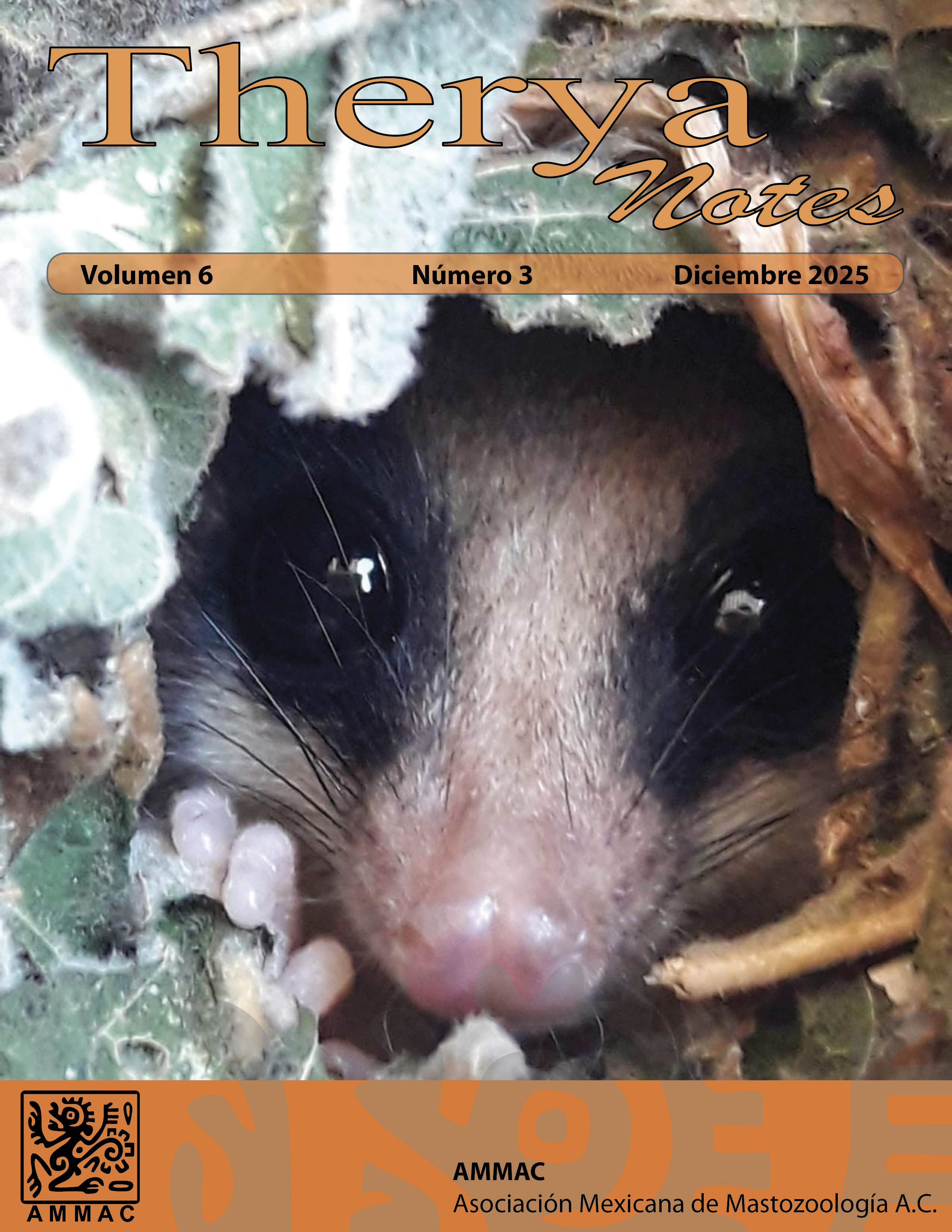
Noteworthy records of the martucha (Potos flavus) defining its northernmost Pacific distribution
Noteworthy records of the martucha in Mexico
DOI:
https://doi.org/10.12933/therya_notes-24-223Keywords:
Area fidelity, kinkajou, Michoacán, Procyonidae, water sourceAbstract
The kinkajou (Potos flavus) is a nocturnal arboreal carnivore, well adapted to forest canopies through its prehensile tail and flexible joints. Its distribution and ecology along the Mexican Pacific slope remain poorly understood due to its cryptic behavior. This study aims to define the species’ geographic range in this region more precisely. We reviewed all historical and recent records from scientific collections, digital platforms, and literature. Recent records were obtained through camera trap monitoring. Spatial data were analyzed using GIS to determine distribution by ecoregion and municipality. Records were categorized as historical (before 2000), contemporary (2001-2020), and recent (2021-2024), each included coordinates, habitat, and behavioral observations when available. The records confirm the species’ presence along northwestern Michoacán, including new localities extending its known range into Coahuayana. Historical evidence (1889) indicates past presence in the Balsas Basin, though no recent records exist there. Current distribution spans the Sierra Madre del Sur to coastal Michoacán. Camera traps revealed ground activity and site fidelity near springs during the dry season. This study refines the known distribution of Potos flavus, confirming its persistence despite recent forest loss and maintaining its Pacific northern limit. New behavioral observations suggest adaptations to hot, dry conditions, emphasizing the importance of conserving the species in its northernmost, drier range, where environmental pressures may shape its ecological responses.
Downloads
Published
How to Cite
Issue
Section
License
Copyright (c) 2025 Therya Notes

This work is licensed under a Creative Commons Attribution-NonCommercial-NoDerivatives 4.0 International License.
THERYA NOTES is based on its open access policy allowing free download of the complete contents of the magazine in digital format. It also authorizes the author to place the article in the format published by the magazine on your personal website, or in an open access repository, distribute copies of the article published in electronic or printed format that the author deems appropriate, and reuse part or whole article in own articles or future books, giving the corresponding credits. The Creative Commons CC BY-NC-SD license is used.