First record of nesting of marsupial Tlacuatzin (Didelphidae) in wasp combs
DOI:
https://doi.org/10.12933/therya_notes-24-210Keywords:
Behavior, Deciduous forests, Mixteca region, Oaxaca, Polybia, RefugeAbstract
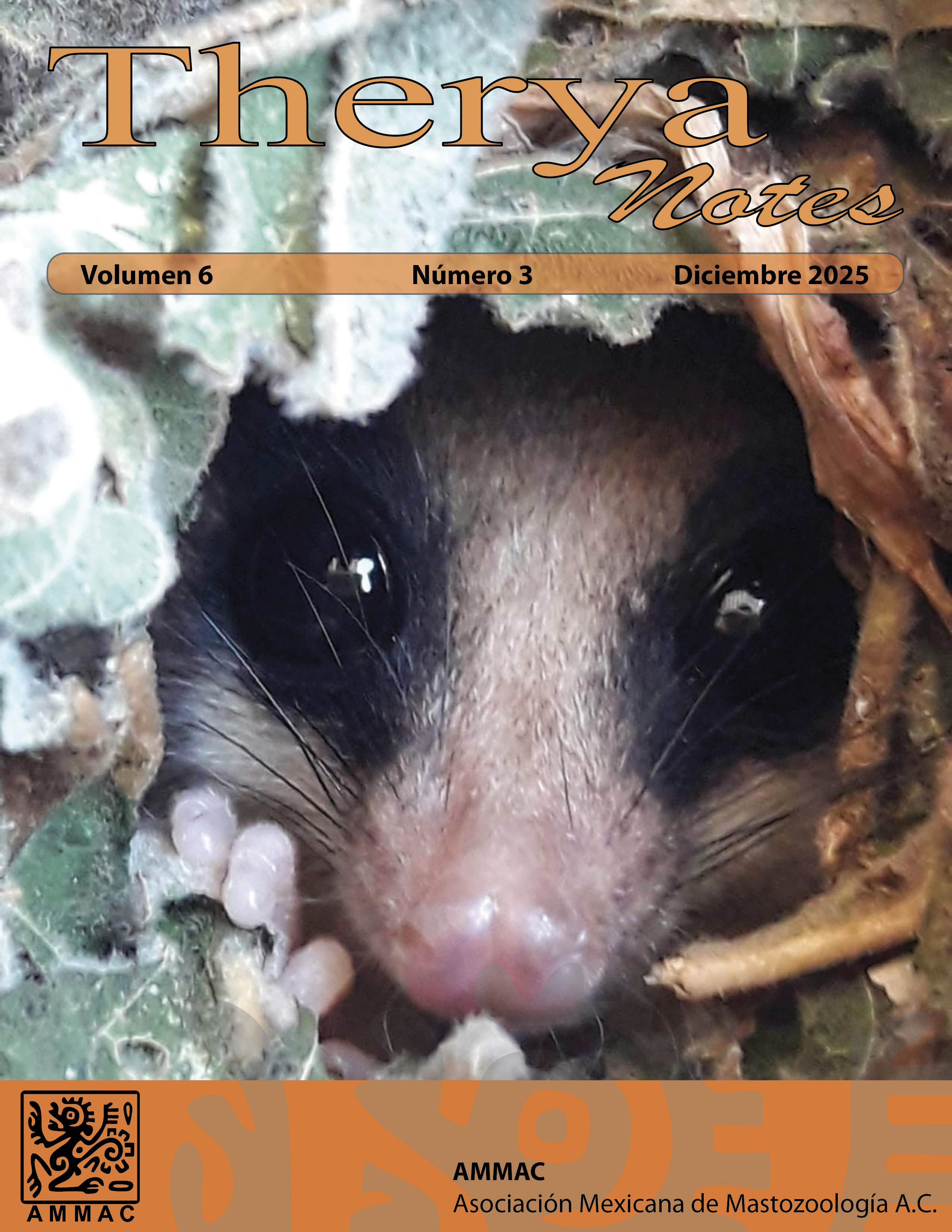
Mammals construct, reuse, or adapt nests for purposes such as maternity, rest, and protection from environmental factors. American marsupials can either construct their own nests or occupy those abandoned, but the use of wasp combs as structural support has not been previously observed. In this study, we document the construction of a nest by a small Neotropical marsupial utilizing a wasp comb as support. While carrying out field surveys at Yerba santa, Municipality of Yosondúa, Oaxaca, México, we were noticed by residents of a wasp nest. We went to the sighting site to measure the height of the branch supporting the nest. The nest was examined, measurements were taken (length, width, and diameter of the entrance), and photographic records were obtained of the small mammal inside. The wasp nest was located on a thin branch 4 m above the ground. It measured 25 cm in length and 15 cm in width, with an entrance opening of 7 cm positioned on the underside. Inside a single individual of a small marsupial was observed. The individual was identified as Tlacuatzin balsasensis based on its small size, brownish slightly gray dorsal fur and yellow buff underparts, and geographic range. The nest fitted to known descriptions of Tlacuatzin nests, as the size, entrance, and location above the ground. However, the base material consisted of wasp comb, an animal-built material. Wasp nests provide robust material that may also offer environmental protection and refuge from predators for the small marsupial. To our knowledge, this represents the first recorded instance of a mammal nesting in a wasp nest.
Downloads
Published
How to Cite
Issue
Section
License
Copyright (c) 2025 Therya Notes

This work is licensed under a Creative Commons Attribution-NonCommercial-NoDerivatives 4.0 International License.
THERYA NOTES is based on its open access policy allowing free download of the complete contents of the magazine in digital format. It also authorizes the author to place the article in the format published by the magazine on your personal website, or in an open access repository, distribute copies of the article published in electronic or printed format that the author deems appropriate, and reuse part or whole article in own articles or future books, giving the corresponding credits. The Creative Commons CC BY-NC-SD license is used.