THERYA NOTES 2026, Vol. 7:250-254
First record of the white-eared cotton rat (Sigmodon leucotis)
for the state of Tlaxcala, Mexico
Primer registro de la rata algodonera de orejas blancas (Sigmodon leucotis) para el estado de Tlaxcala, México
Edwin Batalla-González1, 2*, Diego Alexis Prado-Ángeles1, Alan Jhosefat Vázquez-Reyna1, and Sergio Leonardo Porto-Ramírez1, 2
1Engineering for the Management, Restoration and Conservation of Ecosystems (IMRCE). Dr. Liceaga 7, C. P. 06720, Ciudad de México, México. E-mail: edwin.batalla.imrce@gmail.com (EBG); diego.prado.imrce@gmail.com (DAPA); jhosefat.vazquez.imrce@gmail.com (AJVR); sergio.porto.imrce@gmail.com (SLPR).
2Instituto de Biología, Universidad Nacional Autónoma de México (UNAM). Circuito zona deportiva S/N, C. P. 04510, Ciudad de México, México.
*Corresponding author
The white-eared cotton rat (Sigmodon leucotis) is a rodent endemic to Mexico, typically inhabiting montane forests and grasslands throughout the Trans-Mexican Volcanic Belt and major mountain ranges. The species typically inhabits pine, pine-oak, cloud forests, and mountain grasslands or meadows. Despite its presence in neighboring states, formal records for Tlaxcala were previously absent. We monitored terrestrial fauna within a solar park in San Antonio Techalote, Hueyotlipan, Tlaxcala, Mexico. We conducted systematic daily surveys between solar panels year-round, utilizing hand-capture techniques. We report the first records of S. leucotis in the state. Three male individuals were captured during surveys conducted in March and April 2026 within grasslands adjacent to agricultural areas. Somatic measurements of one specimen (total length: 215 mm; tail: 85 mm; hind foot: 31 mm; ear: 21 mm) and external diagnostic features, the whitish inner ear surface and tail scale width, confirm the identification. This finding expands the known geographical distribution of the species and contributes to the mammalian checklist of Tlaxcala. Furthermore, this record highlights the importance of environmental monitoring programs associated with renewable energy projects as valuable and complementary sources of biological information for regional biodiversity management.
Key words: Cricetidae; distribution; endemic species; first record; Sigmodon leucotis; Tlaxcala.
La rata algodonera de orejas blancas (Sigmodon leucotis) es un roedor endémico de México que habita en bosques montanos y pastizales a lo largo del Eje Neovolcánico Transversal y las principales cadenas montañosas. La especie habita principalmente bosques de pino, pino-encino, nubosos, así como pastizales o praderas de montaña. A pesar de su presencia en estados vecinos, no existían registros previos para Tlaxcala. Se llevaron a cabo monitoreos de fauna terrestre dentro de un parque solar en San Antonio Techalote, Hueyotlipan, Tlaxcala, México. Se realizaron muestreos sistemáticos diarios entre los paneles solares durante todo el año, utilizando técnicas de captura manual. Reportamos los primeros registros de S. leucotis en el estado. Se capturaron tres machos en muestreos de marzo y abril de 2026 en pastizales adyacentes a zonas agrícolas. Las medidas somáticas de un ejemplar (longitud total: 215 mm; cola: 85 mm; pata trasera: 31 mm; oreja: 21 mm) y rasgos diagnósticos externos, oreja interna blanquecina y ancho de escamas caudales, confirman la identificación. Este hallazgo amplía la distribución geográfica conocida de la especie y contribuye al listado de mamíferos de Tlaxcala. Asimismo, este registro resalta la importancia de los programas de monitoreo ambiental asociados a proyectos de energía renovable como fuentes valiosas y complementarias de información biológica para la gestión de la biodiversidad regional.
Palabras clave: Cricetidae; distribución; especie endémica; primer registro; Sigmodon leucotis; Tlaxcala.
© 2026 Asociación Mexicana de Mastozoología, www.mastozoologiamexicana.org
The white-eared cotton rat (Sigmodon leucotis) is a cricetid rodent endemic to Mexico. It is a medium-sized rodent characterized by grayish-brown dorsal coloration and a white venter with dark gray underfur (Ceballos 2014). It is distinguished from other congeners by having a tail notably shorter than the head-and-body length (Shump and Baker 1978).
Its distribution ranges from the Sierra Madre Occidental in southern Chihuahua to the Sierra Madre Oriental in south-central Nuevo León, extending southeast through the Trans-Mexican Volcanic Belt to the Sierra Madre del Sur in Oaxaca (Shump and Baker 1978; Villa-Ramírez and Cervantes 2002; Ramírez-Pulido et al. 2005). Within this range, the species is generally associated with pine, pine-oak, and montane cloud forests, as well as mountain grasslands and meadows. It occurs within an altitudinal range of 1,800 to 3,000 m (Shump and Baker 1978; Villa-Ramírez and Cervantes 2002; Ramírez-Pulido et al. 2005). To date, S. leucotis has been recorded in Aguascalientes, Chihuahua, Mexico City, Durango, Guanajuato, Guerrero, Hidalgo, Morelos, State of Mexico, Nuevo León, Oaxaca, Puebla, Querétaro, and Zacatecas (Shump and Baker 1978; Villa-Ramírez and Cervantes 2002; Almazán-Catalán et al. 2005; Ramírez-Pulido et al. 2005; Mejenes-López et al. 2010). Although Tlaxcala is surrounded by states with confirmed occurrences and falls well within the species expected environmental envelope, a distributional gap has persisted due to the absence of empirical evidence. The nearest known historical record is located approximately 47 km to the west-northwest in the neighboring State of Mexico. To the best of our knowledge, no verifiable records of S. leucotis have been documented for the state of Tlaxcala in either peer-reviewed literature or institutional gray literature databases; thus, this record directly bridges this spatial gap in the central Trans-Mexican Volcanic Belt.
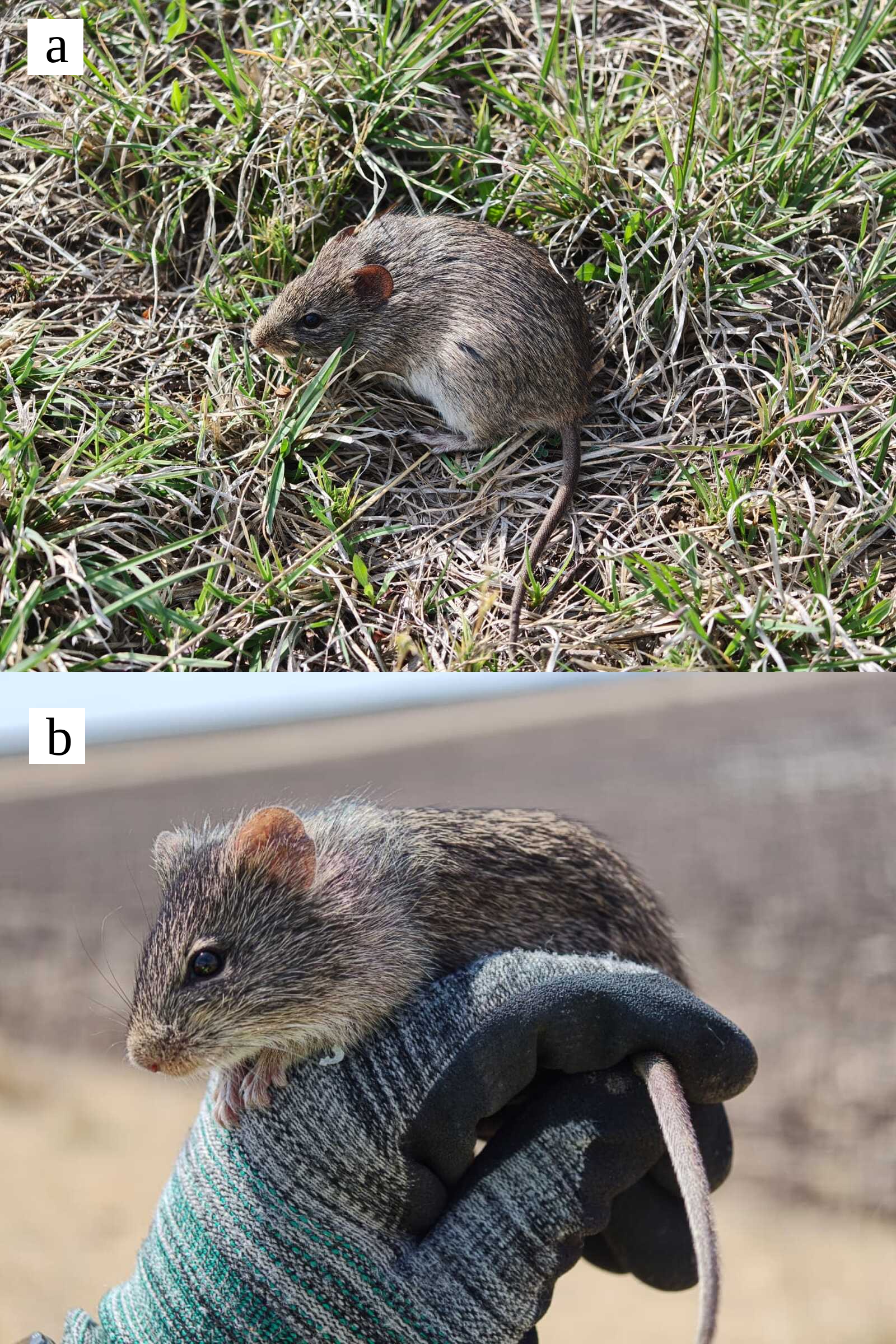
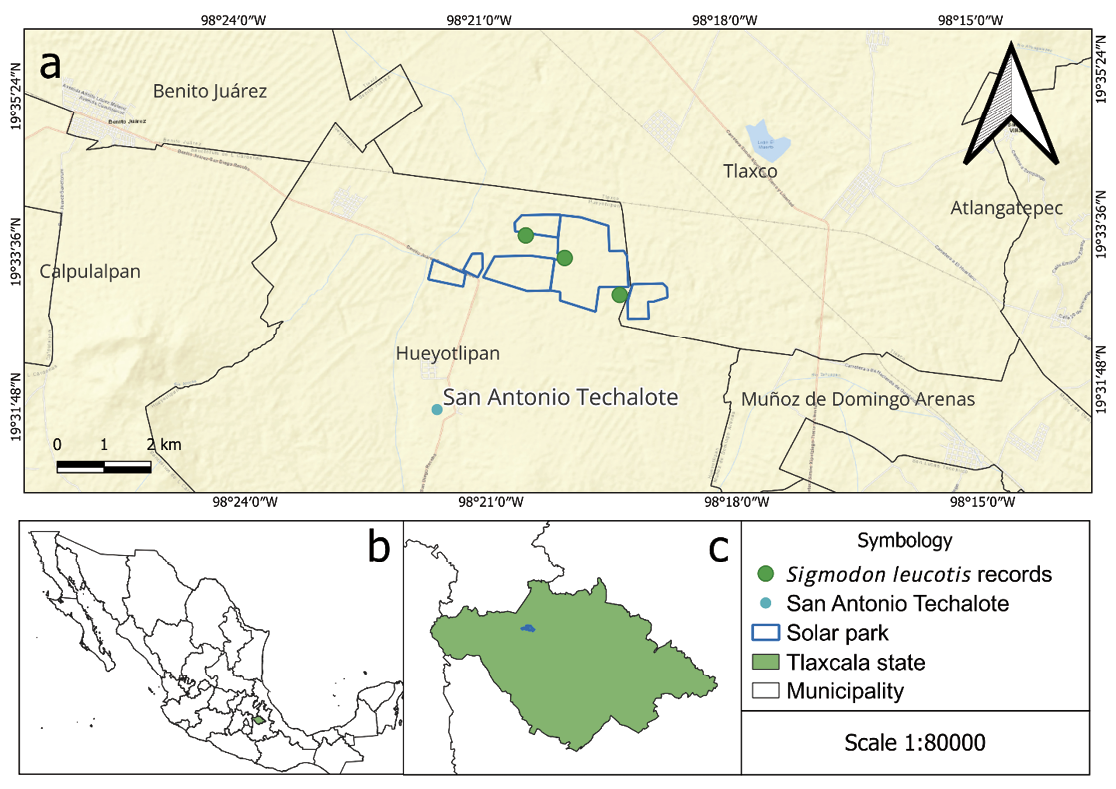
The records were obtained during terrestrial fauna monitoring conducted within the solar park, located in San Antonio Techalote, Hueyotlipan, Tlaxcala, Mexico (Figure 1). Monitoring was conducted through daily systematic surveys among the solar panels year-round, following hand-capture techniques, according to the ethical protocols for the use of wild mammals in research and education (Sikes et al. 2016). Three individuals of S. leucotis were captured. To confirm species identification, morphological measurements were recorded for one individual, including total length, tail length, hind foot length, ear length, and tail scale width (Figure 2). Morphometric processing of the remaining two individuals was omitted due to handling-time constraints associated with environmental monitoring protocols within the solar power facility. All captured individuals were photographed and subsequently released.
During surveys conducted in March and April 2026, three male individuals of S. leucotis were recorded in grassland habitats at San Antonio Techalote, Tlaxcala, across an elevation range of 2,520–2,546 m. Capture coordinates were 19°33’07.93” N, 98°19’21.12” W (10 March 2026; 2,542 m), 19°33’51.03” N, 98°20’28.58” W (25 March 2026; 2,520 m), and 19°33’37.70” N, 98°20’04.38” W (13 April 2026; 2,546 m). Somatic measurements were recorded for the first captured individual, whereas handling-time restrictions during environmental monitoring protocols at the solar facility precluded somatic measurements of the remaining two.
Somatic measurements of the evaluated individual shown in Figure 2 were as follows: total length 215 mm, tail length 85 mm, head-body length 130 mm, hind foot length 31 mm, and ear length 21 mm, with a tail scale width of 0.7 mm. Externally, the captured individual exhibited the key diagnostic characters for the species: coarse, grizzled brownish-gray dorsal pelage contrasting with a paler grayish-buffy ventral pelage; distinctly pale, grayish-white ears (a primary diagnostic trait distinguishing S. leucotis from other congeners); pale gray to whitish upper surfaces of the hind feet; and a tail dark on the back and lighter on the bottom, sparsely haired tail with visible scales (Figure 2; Shump and Baker 1978; Hall 1981; Álvarez-Castañeda and González-Ruiz 2015; Álvarez-Castañeda 2024).
The morphological characteristics of the measured specimen from Tlaxcala show close congruence with physical descriptions and morphometric ranges established for S. leucotis in the literature (Shump and Baker 1978; Ceballos 2014; Álvarez-Castañeda and González-Ruiz 2015; Álvarez-Castañeda 2024). Specifically, the hind foot length (31 mm) falls directly within the upper range reported for adult S. leucotis (26–31 mm; Shump and Baker 1978; Ceballos 2014). Although both the head-body length (130 mm) and total body length (215 mm) of our specimen are marginally below the lower limits reported for fully grown adults (head-body length: 132–157 mm; total body length: 225-252 mm; Shump and Baker 1978; Ceballos 2014; Álvarez-Castañeda and González-Ruiz 2015), this minor variation likely reflects an individual in a young-adult stage or natural intraspecific variation, while maintaining the somatic proportions typical of the species. In agreement with a key diagnostic trait for S. leucotis, the tail length of our specimen (85 mm) is shorter than the head-body length (130 mm; Shump and Baker 1978). The tail is also sparsely haired, distinctly bicolored, and exhibits a scale width of 0.7 mm, which falls squarely within the diagnostic range of 0.5 to 0.75 mm established for the species (Shump and Baker 1978; Álvarez-Castañeda and González-Ruiz 2015).
Regarding ear and pelage traits, the ear length of 21 mm and the pale, grayish-white coloration of its inner surface align with the primary diagnostic feature of S. leucotis. Finally, the coarse, grizzled brownish-gray dorsal coat and contrasting pale grayish-buffy underside observed in our specimens correspond to the typical pelage patterns described for populations of S. leucotis across the Trans-Mexican Volcanic Belt (Shump and Baker 1978; Ceballos 2014; Álvarez-Castañeda 2024).
This new record confirms its possible geographic distribution and increases the number of mammal species recorded in Tlaxcala. Located just 47 km from the nearest known population in the State of Mexico, this finding suggests that the species’ absence in Tlaxcala was a sampling artifact rather than a true ecological barrier, highlighting the environmental continuity of high-elevation grasslands and agricultural transition zones across regional state borders. Although the state has historically lacked an exhaustive checklist, 69 mammal species had been documented previously, including 29 species of the order Rodentia (Ceballos et al. 2005; Fernández et al. 2007); thus, this record contributes directly to updating regional biodiversity knowledge. Ultimately, this discovery underscores the importance of environmental monitoring programs associated with renewable energy facilities as complementary and valuable sources of biological information (Porto-Ramírez et al. 2025).
Acknowledgments
We thank L. Cardona and T. Mijangos for their support with the administrative procedures and for their valuable comments on this document. We are also grateful to A. Sánchez-Caballero for his insightful observations and suggestions during the preparation of the manuscript. Finally, we express our gratitude to the anonymous reviewers for their thorough evaluation and constructive comments, which greatly improved the quality of this work.
Literature cited
Almazán-Catalán, J. A., C. Sánchez-Hernández, and Ma. De L. Romero-Almaraz. 2005. Registros sobresalientes de mamíferos del Estado de Guerrero, México. Acta Zoológica Mexicana (nueva serie) 21:155–157.
Álvarez-Castañeda, S. T. 2024. Mammals of North America: Volume 2. Systematics and Taxonomy. Springer Nature. Cham, Switzerland.
Álvarez-Castañeda, S. T, and N. González-Ruiz. 2015. Guía para identificar los mamíferos de México. Centro de Investigaciones Biológicas del Noreste/Escuela Nacional de Ciencias Biológicas/Universidad Autónoma Metropolitana. Ciudad de Méxcio, México.
Ceballos, G. 2014. Mammals of Mexico. Johns Hopkins University Press. Baltimore, EE. UU.
Ceballos, G., et al. 2005. Diversidad y conservación de los mamíferos de México. Pp. 21–49 In Los mamíferos silvestres de México (Ceballos G. and G. Oliva, eds.). CONABIO Fondo de Cultura Económica. Ciudad de México, México.
Fernández, J. A., F. A. Cervantes, and M. C. C. Vargas. 2007. New distributional records for mammals from Tlaxcala, Mexico. The Southwestern Naturalist 52:328–333.
Hall, E. R. 1981. The mammals of North America: Volume 2. Systematics and Taxonomy. Springer Nature. Cham, Switzerland.
Mejenes-López, S. De M. A., et al. 2010. Los mamíferos en el estado de Hidalgo, México. Therya 1:161–188.
Porto-Ramírez, S. L., et al. 2025. New observations of Erethizon dorsatum, Taxidea taxus, and Castor canadensis in a Northern Mexico wind farm complex. Propuesta Ambiental 3: 7–13.
Ramírez-Pulido, J., et al. 2005. Sigmodon leucotis. Pp. 801-803 in Los mamíferos silvestres de México (Ceballos G. and G. Oliva, eds.). CONABIO Fondo de Cultura Económica. Ciudad de México, México.
Shump, K. A., Jr., and R. H. Baker. 1978. Sigmodon leucotis. Mammalian Species 96:1–2.
Sikes, R. S., and the Animal Care and Use Committee of the American Society of Mammalogists. 2016. 2016 Guidelines of the American Society of Mammalogists for the use of wild mammals in research and education. Journal of Mammalogy 97:663–688.
Villa-Ramírez, B., and F. A. Cervantes. 2002. Los mamíferos de México. Iberoamérica. Distrito Federal, México.
Associate editor: Daily Martínez-Borrego
Submitted: May 29, 2026; Reviewed: October 21, 2026
Accepted: October 26, 2026; Published on line: November 11, 2026
DOI: 10.12933/therya_notes-25-262
ISSN 2954-3614
Figure 1. Geographic location of the three records of the white-eared cotton rat (Sigmodon leucotis) in the state of Tlaxcala, Mexico. a) Location of records by locality. b) Contextual location of Tlaxcala within Mexico. c) State of Tlaxcala, the blue shaded polygon indicates the area of the Solar Park.
Figure 2. Male individuals of the white-eared cotton rat (Sigmodon leucotis) recorded in the municipality of San Antonio Techalote, Tlaxcala, Mexico. a) General view of one of the recorded specimens; b) specimen handled for the recording of somatic measurements.