THERYA NOTES 2026, Vol. 7:221-227
Updated records and distribution of Vampyrum spectrum
and Chrotopterus auritus (Chiroptera: Phyllostomidae)
in Panama: conservation implications
Actualización de los registros y distribución de Vampyrum spectrum y Chrotopterus auritus (Chiroptera: Phyllostomidae)
en Panamá: implicaciones para la conservación
Nelson Guevara1, Alexandra Achille1,2*, y Mariana Suarez1,2
1Grupo de Investigación, Fundación Biomundi. Brisas del Lago, Los Pilones, 24 de Diciembre, C. P. 07109, Ciudad de Panamá, Panamá, Provincia de Panamá. E-mail: nelson2295@hotmail.com (NG), alexandraachille47@gmail.com (AA), msuarezc3006@gmail.com (MS)
2Escuela de Biología, Facultad de Ciencias Naturales, Exactas y Tecnología, Universidad de Panamá, Campus Central Octavio Méndez Pereira. Vía Transístmica, C. P. 07096, Provincia de Panamá. Ciudad de Panamá, Panamá.
*Corresponding author
Vampyrum spectrum and Chrotopterus auritus are two Neotropical carnivorous bats considered rare across much of their range, with limited data available for Panama. The objective of this study was to update and analyze historical and recent records of both species in the country. To verify voucher specimens, we reviewed bat records housed in the Vertebrate Museum of the University of Panama (MUVP) and the Smithsonian Institution (USNM). The new record was obtained from an individual captured in mist nets placed within a pasture near Lake Bayano, a humid tropical biogeographic transition zone. The bat was photographed and released immediately, preventing the collection of morphometric data. For Vampyrum spectrum, 21 individuals were documented, of which 17 correspond to specimens deposited in scientific collections. In the case of Chrotopterus auritus, 22 individuals were recorded, with 19 preserved specimens. Most records for both species were concentrated between the 1950s and 1990s. Revealing prolonged temporal gaps and scarce reports after 2010. The study also provides the most recent known record of Vampyrum spectrum in Panama, corresponding to an adult male accidentally captured in 2020 near Lake Bayano, in the province of Panama.
Key words: Chiroptera; conservation; deforestation; distribution; Phyllostominae, Spectral bat, Wolly false vampire bat.
Vampyrum spectrum y Chrotopterus auritus son dos murciélagos carnívoros neotropicales considerados raros en gran parte de su distribución, con información limitada para Panamá. El objetivo de este estudio fue actualizar y analizar los registros históricos y recientes de ambas especies en el país. Se revisaron los registros de murciélagos depositados en las colecciones del Museo de Vertebrados de la Universidad de Panamá y del Smithsonian Institution para verificar especímenes de referencia. El nuevo registro se obtuvo mediante redes de niebla instaladas en un pastizal cercano al Lago Bayano, una zona de transición biogeográfica con clima tropical húmedo. El individuo capturado fue fotografiado y liberado sin tomar medidas morfométricas. Para V. spectrum, se documentaron 21 individuos, de los cuales 17 corresponden a especímenes depositados en colecciones científicas. En el caso de C. auritus, se registraron 22 individuos, con 19 especímenes preservados. La mayoría de los registros de ambas especies se concentró entre las décadas de 1950 y 1990. Evidenciando vacíos temporales prolongados y escasos reportes posteriores a 2010. Se aporta además el registro más reciente conocido de V. spectrum en Panamá, correspondiente a un macho adulto capturado incidentalmente en 2020 en los alrededores del Lago Bayano, provincia de Panamá.
Palabras claves: Chiroptera; conservación; deforestación; distribución; murciélago espectral; falso vampiro orejón; Phyllostominae.
© 2026 Asociación Mexicana de Mastozoología, www.mastozoologiamexicana.org
When referring to carnivorous bats in the Neotropics, two emblematic species are immediately recognized: the spectral bat, Vampyrum spectrum Linnaeus 1758, and the woolly false vampire bat, Chrotopterus auritus (Peters 1856), both members of the subfamily Phyllostominae (Wilson and Mittermeier 2019). These are among the largest phyllostomid bats, reaching body masses of approximately 100 g or more, and are characterized by a predominantly vertebrate-based diet that include a wide variety of birds, lizards, and small mammals such as rodents and bats (Reid 2009). Vampyrum spectrum has been reported preying upon mammals weighing up to 150 g (Reid 2009).
Vampyrum spectrum is distributed from southern Mexico through Central America and across northern and central South America to Brazil, including Trinidad and Tobago, the Guianas, and Jamaica (Medellín 2019a). It is primarily associated with well-preserved tropical forests, although it may also occur in swamps and partially open areas adjacent to mature forests. The species is considered highly sensitive to anthropogenic disturbance, especially deforestation and habitat fragmentation (Medellín 2019a).
In contrast, C. auritus ranges from southern Mexico (including Veracruz, Oaxaca, and the Yucatán Peninsula) through Central America to Paraguay and northern Argentina (Medellín 2019b). Although also sensitive to human disturbance and consequently rare in many localities, this species occupies a broader range of habitats, including lowland rainforests, tropical dry forests, cloud forests, and other tropical ecosystems from sea level to approximately 2,200 m elevation (Medellín 2019b).
Despite their ecological importance as apex predators and indicator species of preserved forests (Medellín 2000; Gual-Suárez et al. 2019), and their wide geographic distribution, detailed information on the local distribution and natural history of both species remains limited in several regions, including Panama, where records are scarce and scattered. Here, we synthesize the available information on V. spectrum and C. auritus in Panama, review their natural history in the country, and provide a new record of V. spectrum, contributing baseline knowledge relevant to their ecology and conservation.
Study area. Panama covers 75,845 km² and is in the intertropical zone of the Northern Hemisphere, between North and South America (7°12’9°39’ N, 77°09’83°03’ W). Owing to its geographic position, the country represents an important biogeographic corridor facilitating species exchange between both subcontinents (ANAM 2010).
The climate is predominantly tropical, warm, and humid, particularly in the lowlands, where mean annual tem-
peratures range from 24 to 34 °C and two marked seasons occur: a dry season and a rainy season (Samudio and Pino 2014). In contrast, mountainous regions above ~800 m
elevation present cooler subtropical to premontane con-ditions, reaching elevations above 3,000 m (ANAM 2010).
The influence of both the Pacific and Atlantic oceans has promoted high environmental heterogeneity, reflec-
ted in seven terrestrial ecoregions, more than 30 vegetation types, and 52 river basins (ANAM 2010).
For data compilation, we reviewed the mastozoological collection of the Museo de Vertebrados de la Universidad de Panamá (MUVP) and consulted records of bats collected in Panama and deposited at the National Museum of Natural History, Smithsonian Institution (USNM), to verify voucher specimens. Other national collections, such as those at the Gorgas Memorial Institute for Health Studies, were not examined because the curators in charge did not grant access to the material or the associated data. In addition, a review was conducted of the data collected by the Global Biodiversity Information Facility (GBIF), which complemented the reviews that had already been carried out. Through this review, data were added for specimens deposited at the Cleveland Museum of Natural History (CMNH), the American Museum of Natural History (AMNH), the Royal Ontario Museum (ROMM), Louisiana State University, the Museum of Zoology (LSUMZ), Museum of Southwestern Biology (MSB).
The new record was obtained using two mist nets (12 × 2.5 m) set in a pasture area surrounding Lago Bayano, located in Chepo District, Panamá province. This region is characterized by a warm tropical climate, with mean annual temperatures ranging from 26 to 28 °C and is surrounded by humid tropical and secondary forests within a bio-geographic transition zone between Darién and central Panama (ANAM 2010).
Finally, to create the historical distribution maps for both species, land-use data provided by the National Environmental Information System of Panama’s Ministry of the Environment were used (MiAmbiente 2026).
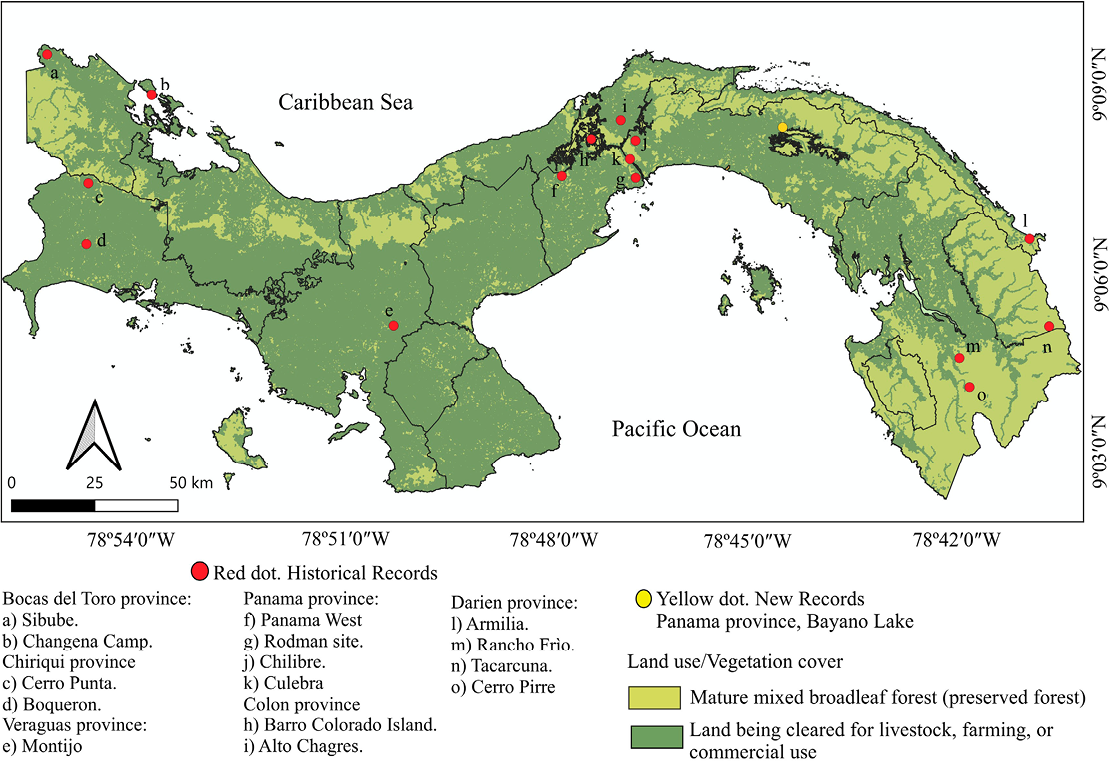
In Panama, Vampyrum spectrum has been documented from 21 individuals, of which 17 correspond to collected specimens deposited in mastozoological collections (Table 1). Likewise, 82 % of the records were collected between the 1960s and 1990s, with only three observations after 2010. Between these periods, there is an information gap of approximately 22 years, with no additional reports until 2015. In 2020, we documented the most recent confirmed record of the species in Panama, represented by an adult scrotal male (Figure 2). This record resulted from an incidental capture during nocturnal surveys conducted for the management of the common vampire bat, Desmodus rotundus. The individual was photographed to document the occurrence and subsequently released, precluding the collection of morphometric measurements and other biological data.
In contrast, C. auritus has been recorded on 22 occasions (Table 2), with a total of 19 specimens deposited in mastozoological collections. Similarly, 87% of the records are concentrated between the 1950s and 1990s, with very few records dating from 2000 onward, with isolated reports from various areas of Panama.
Finally, between both species, V. spectrum exhibits a discontinuous distribution in Panama, with records from the provinces of Darién, Panamá, Western Panama, Colón, Veraguas, Bocas del Toro, Chiriquí and Guna Yala (Figure 1). In contrast, C. auritus appears to be largely restricted to Darién province, with two more cases in the provinces of Panama and Colón; and a single case reported in the provinces of Bocas del Toro and Los Santos (Figure 3).
These results confirm that Vampyrum spectrum and Chrotopterus auritus remain among the least-documented Philostomidae bats in Panama, along with other species of the genus Chiroderma, Centurio senex, and Glyphonycteris silvestrys (Reid 2009). The low frequency of historical records, the prolonged time gaps, and the scarcity of recent observations could be due to the fact that both species have naturally low population densities, as suggested by Medellín (1989), which are characterized by their wide ranges of activity and limited detectability—traits typically associated with large predators within Neotropical bat communities (Reid 2009).
For Vampyrum spectrum, the concentration of records between the 1960s and 1990s followed by a marked subsequent decline coincides with substantial land-use changes that have occurred in Panama during recent decades. This species depends on mature forests, large tree cavities, and landscapes with high ecological integrity, conditions necessary for roosting and vertebrate prey availability (Navarro and Wilson 1982; Tirira 2017). The progressive reduction of these environments may partially explain the decline in recent reports.
Deforestation in Panama has been widely recognized as a major driver of landscape transformation. According to FAO (2020), Panama lost approximately 68,000 ha of forest between 2010 and 2020, whereas Global Forest Watch (2024) estimated a cumulative tree-cover loss exceeding 250,000 ha between 2001 and 2023, particularly in Darién, eastern Pana-
ma, and parts of Bocas del Toro. These areas overlap with historically important localities for both species. Resulting fragmentation reduces connectivity among forest patches, decreases natural roost availability, and alters prey abun-dance, which may disproportionately affect large carnivorous bats with specialized habits (Meyer et al. 2016).
For C. auritus, the apparent concentration of records in Darién reinforces the importance of this province as one of the last strongholds of continuous forest in Panama. Darién contains some of the most extensive remnants of tropical moist forest in the country and maintains higher ecological integrity than the more transformed central and western regions (MiAmbiente 2023). The persistence of C. auritus in this area likely reflects its dependence on structurally complex forests where it forages on small vertebrates, large insects, and other bats (Bonato et al. 2004).
However, the low number of recent records does not necessarily imply a severe population decline. Both species are notoriously difficult to capture using conventional sampling methods. Understory mist nets tend to underestimate species that fly in canopy, use open flyways, or readily detect nets (Kalko and Handley 2001). In addition, V. spectrum and C. auritus may maintain extensive foraging ranges and considerable nightly movements, reducing encounter probability during short surveys. Thus, their apparent rarity may reflect a combination of true low abundance and methodological detection bias. The incidental capture of V. spectrum during an operation tar-geting Desmodus rotundus is particularly illustrative. Such findings suggest that sampling efforts focused on nuisance or sanitary species may provide valuable information on rare non-target taxa. It also highlights the need to comple-ment mist-netting with modern techniques such as passive acoustic monitoring, radiotelemetry, thermal cameras, and canopy nets, tools that have increased detection of elusive bats in other tropical systems (Hintze et al. 2016).
From a biogeographic perspective, the discontinuous distribution of V. spectrum may be related to the hete-rogeneous availability of mature forests and functional corridors nationwide. The apparent restriction of C. auritus to the Darien region could suggest either high ecological sensitivity or a bias in historical regional sampling. However, when comparing this with the findings of Brigham et al. (2018), who demonstrated that the species could persist in small protected areas embedded within anthropogenic matrices it seems plausible that its absence from other areas of Panama is due more to the low detectability typical of these carnivores in mist nets than to an actual inability to tolerate moderately modified landscapes. This can be seen in the only recorded occurrence of this species in the province of Los Santos, at Cerro Hoya, an area subject to severe anthropogenic impact. Deforestation in this area has reduced the native vegetation to fragmented forest patches.
From a conservation standpoint, both species may be considered potential indicators of forest integrity due to their high trophic position, broad spatial requirements, and sensitivity to disturbance. Conservation of extensive continuous forest blocks, protection of hollow trees used as roosts, and reduction of deforestation in Darién and eastern Panama should be strategic priorities. Without effective management actions, the combination of habitat loss and limited detectability could lead to silent local extirpation before sufficient data exists to document them.
Acknowledgments
To the director of the Vertebrate Museum at Ricardo Perez University for granting us access and providing support in the examination of the bats housed there. To J. Hanson for providing support in the examination of specimens held in international collections. To K.Cerrud for reporting the sighting and providing a photograph of the Vampyrum spectrum specimen captured at Lake Bayano.
Literature cited
Anam. 2010. Atlas ambiental de la República de Panamá. Gobierno de la República de Panamá. Panamá, Panamá.
Bonato, V., K. G. Facure, and W. Uieda. 2004. Food habits of Chrotopterus auritus in southeastern Brazil. Mammalia 68:305–308.
Brigham, R. M., et al. 2018. Observations on the roosting and foraging behavior of Woolly False Vampire Bats, Chrotopterus auritus, in Belize. Carribean Naturalist 50:1-12.
Castillo, M.A., A. Chavarría, and C. Valoy. 2016. Diversidad y abundancia de murciélagos de los bosques primarios y zonas de amortiguamiento en el área de Rancho Frío, Parque Nacional Darién. Bachelor’s thesis. Universidad de Panamá. Panamá, Panamá
Food and Agriculture Organization of the United Nations (FAO). 2020. Global Forest Resources Assessment 2020. Panama report. FAO.
Global Forest Watch. 2024. Panama tree cover loss data. World Resources Institute. Washington, USA.
Gual-Suárez, F., J. B. Morales-Malacara, and R. A. Medellín. 2019. Movement ecology of the carnivorous woolly false vampire bat (Chrotopterus auritus) in southern Mexico. PLOS ONE 14(7):e0220504.
Handley, C. O. Jr. 1966. Checklist of the mammals of Panama. Pp. 762-763 in Ectoparasites of Panama (Wenzel, R. L. and V. J. Tipton, eds.). Field Museum of Natural History. Chicago, EE. UU.
Hintze, F., et al. 2016. Acoustic surveys and bat detectability in tropical forests. Methods in Ecology and Evolution 7:721–730.
Kalko, E. K. V., and C. O Handley. 2001. Neotropical bats in the canopy: diversity, community structure, and implications for conservation. Plant Ecology 153:319–333.
Medellín, R. A. 1989. Population biology and conservation of bat communities in Mexico. Journal of Mammalogy 70:693–702.
Medellín, R. A. 2000. Bat diversity and abundance in tropical rainforest fragments in Laguna de Terminos, Campeche, Mexico. Oryx 34:131-143.
Medellín, R. A. 2019a. Vampurym spectrum. Pp. 509 in Handbook of the Mammals of the World (Wilson, D. E. and R. A. Mittermeier, eds.). Lynx Edicions. Barcelona, Spain.
Medellín, R. A. 2019b. Chrotopterus auritus. Pp. 508 in Handbook of the Mammals of the World (Wilson, D. E. and R. A. Mittermeier, eds.). Lynx Editions. Barcelona, Spain.
Meyer, C. F. J., M. J. Struebig, and M. R. Willig. 2016. Responses of tropical bats to habitat fragmentation, logging, and deforestation. Biological Reviews 91:1143–1163.
Ministerio de Ambiente de Panamá (MiAmbiente). 2023. Estado de los bosques de Panamá 2023. Gobierno de Panamá. Panamá, Panamá.
Ministerio de Ambiente de Panamá (MiAmbiente). 2026. Datos abiertos y geoservicios. Gobierno de Panamá. https://sinia.gob.pa/datos-abiertos-y-geoservicios/. Accessed July 20, 2026.
Navarro, D., and D. E. Wilson. 1982. Vampyrum spectrum in Mammalian Species 1:1–4.
Peterson, R.L. and P. Kirmse. 1969. Notes on Vampyrum spectrum, the false vampire bat, in Panama. Canadian Journal of Zoology 47:140–142.
Reid, F. A. 2009. A field guide of the mammals of Central American & southeast Mexico. Oxford University Press. New York, USA.
Samudio, R., and J. L. Pino. 2014. Historia de la Mastozoología en Panamá. Pp. 329-344 in Historia de la Mastozoología en Latinoamérica, las Guayanas y el Caribe (Ortega J., J. M. Martínez, and D. G. Tirira, eds.). Editorial Murciélago Blanco and Asociación Ecuatoriana de Mastozoología. Quito, Ecuador.
Samudio, R., and Carrión de Samudio, J. 2018. Alto Chagres. Red Latinoamericana y del Caribe para la Conservación de los Murciélagos (RELCOM). Ciudad de Panamá, Panamá.
Tirira., D. 2017. Mamíferos del Ecuador guía de campo. Murciélagos Blanco Press. Quito, Ecuador.
Wilson, D. E., & R. A. Mittermeier (eds.). 2019. Handbook of the Mammals of the world volume 9. Lynx Edition. Barcelona, Spain.
Associate editor: Jorge Ayala Berdón
Submitted: May 27, 2026; Reviewed: August 24, 2026
Accepted: September 22, 2026; Published online: October 7, 2026
DOI: 10.12933/therya_notes-25-258
ISSN 2954-3614
Table 1. Historical records of the spectral bat (Vampyrum spectrum) in Panama. M: male; F: female; A: adult; J: juvenile; N. S: not specified
|
Province/Location |
Source |
Year |
Sex-Age |
|
Panama: Culebra |
CMNH:Mammals:7803 |
1930 |
F-A |
|
Darien: Tacarcuna, Village Camp |
USNM 309373 Handley 1966 |
1959 |
M-A |
|
Bocas del Toro: Rio Changena Camp |
USNM 319373 Handley 1966 |
1961 |
F-A |
|
Bocas del Toro: Sibube |
USNM 335159 Handley 1966 |
1963 |
M-A |
|
Bocas del Toro: Sibube |
USNM 335160 Handley 1966 |
1963 |
F-A |
|
Bocas del Toro province, Sibube |
USNM 335161 Handley 1966 |
1963 |
F-A |
|
Guna Yala: San Blas, Armila, Quebrada Venado |
USNM 335162 Handley 1966 |
1963 |
F-A |
|
Guna Yala: San Blas, Armila, Quebrada Venado |
USNM 335163 Handley 1966 |
1963 |
F-A |
|
Chiriqui: Boqueron |
Handley 1966 |
No date |
N. S |
|
Panama: Canal Zone, Rodman Depot |
USNM 396402 |
1967 |
M-A |
|
Chiriqui: Bugaba, Cerro Punta |
ROMM45335 Peterson and Kirme 1969 |
1968 |
F-A |
|
Colón: Isla Barro Colorado |
USNM 503833 |
1973 |
M-A |
|
Darien: Cerro Pirre |
LSUMZ:Mammals:25561 |
1982 |
N. S |
|
Panama: Chilibre |
MVUP0533 |
1985 |
M-A |
|
Chiriqui: Boqueron |
AMNH:M-18707 |
1901 |
M-A |
|
Chiriqui: Boqueron |
AMNH:M-18708 |
1901 |
F-A |
|
Veraguas: Montijo, Nuri |
USNM 575471 |
1993 |
M-A |
|
Western Panama |
Dina GBIF data |
2001 |
F-J |
|
Darién, Pinogana, Rancho Frio Station |
Castillo et al 2016 |
2015 |
F-A |
|
Colon: Chagres National Park, Alto Chagres |
Samudio and Carrion De Samudio 2018 |
2018 |
M-A |
|
Panama: Bayano Lake |
This article |
2020 |
M-A |
Figure 1. Current and historical capture sites for V. Spectrum.
Table 2. Historical records of the Wolly false vampire bat (Chrotopterus auritus) in Panama. M: male; F: female; A: adult; J: juvenile; N. S: not specified.
|
Province/Location |
Source |
Year |
Sex-Age |
|
Panama: Cerro Azul |
USNM 305204 Handley 1966 |
1957 |
F-M |
|
Darien: Tacarcuna |
USNM 309372 Handley 1966 |
1958 |
M-A |
|
Guna Yala: San Blas, Armilia, Quebrada Venado |
USNM 335157 Handley 1966 |
1963 |
M-A |
|
Guna Yala: San Blas, Armilia, Quebrada Venado |
USNM 335158 Handley 1966 |
1963 |
M-A |
|
Guna Yala: San Blas, Armilia, Quebrada Venado |
USNM 335151 Handley 1966 |
1963 |
M-A |
|
Guna Yala: San Blas, Armilia, Quebrada Venado |
USNM 335152 Handley 1966 |
1963 |
M-A |
|
Guna Yala: San Blas, Armilia, Quebrada Venado |
USNM 335153 Handley 1966 |
1963 |
M-A |
|
Guna Yala: San Blas, Armilia, Quebrada Venado |
USNM 335154 Handley 1966 |
1963 |
F-M |
|
Guna Yala: San Blas, Armilia, Quebrada Venado |
USNM 335155 Handley 1966 |
1963 |
M-A |
|
Guna Yala: San Blas, Armilia, Quebrada Venado |
USNM 335156 Handley 1966 |
1963 |
M-A |
|
Darien: Cerro Mali |
USNM 337976 |
1964 |
F-A |
|
Darien: Cerro Mali |
USNM 337977 |
1964 |
F-A |
|
Darien: Cerro Mali |
USNM 519868 |
1964 |
F-A |
|
Darien: Cerro Mali |
USNM 519869 |
1964 |
M-A |
|
Darien: Jaque, River Jaque |
USNM 362400 |
1966 |
M-A |
|
Darien: Jaque, River Jaque |
USNM 362401 |
1966 |
M-A |
|
Colon: Pina |
MVUP1003 |
1996 |
M-A |
|
Colon: Cristobal, Fort Sherman |
GBIF data |
1966 |
F-A |
|
Veraguas-Los Santos: Cerro Hoya |
MSB:Mamm:94370 |
2000 |
M-A |
|
Bocas del Toro: Changuinola, Teribe |
GBIF data |
2013 |
M-A |
|
Darien: Pinogana, Rancho Frio Station |
Melquiades Castillo et al. 2016 |
2015 |
M-A |
|
Darien: Pinogana, Rancho Frio Station |
MSB:Mamm:311626 |
2015 |
M-A |
|
Colon: Chagres National Park, Alto Chagres |
Samudio and Carrion De Samudio 2018 |
2018 |
N. S |
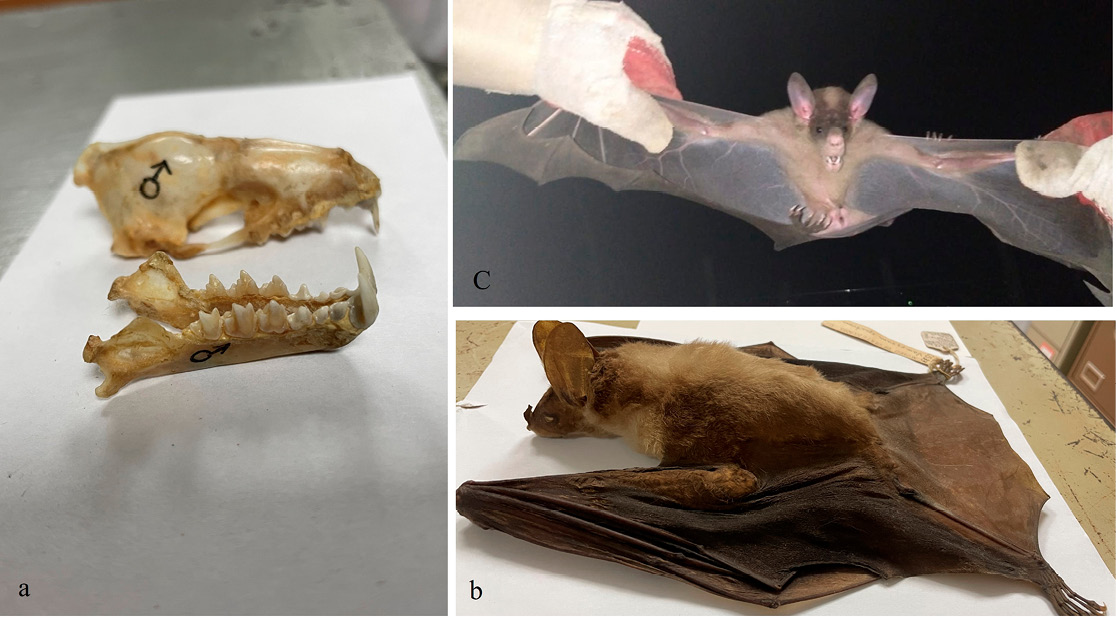
Figure 2. Vampyrum spectrum (Linnaeus1758). a and b) Specimen (MVUP0533) from the Vertebrate Museum of the University of Panama; c) New individual reported from Lake Bayano.
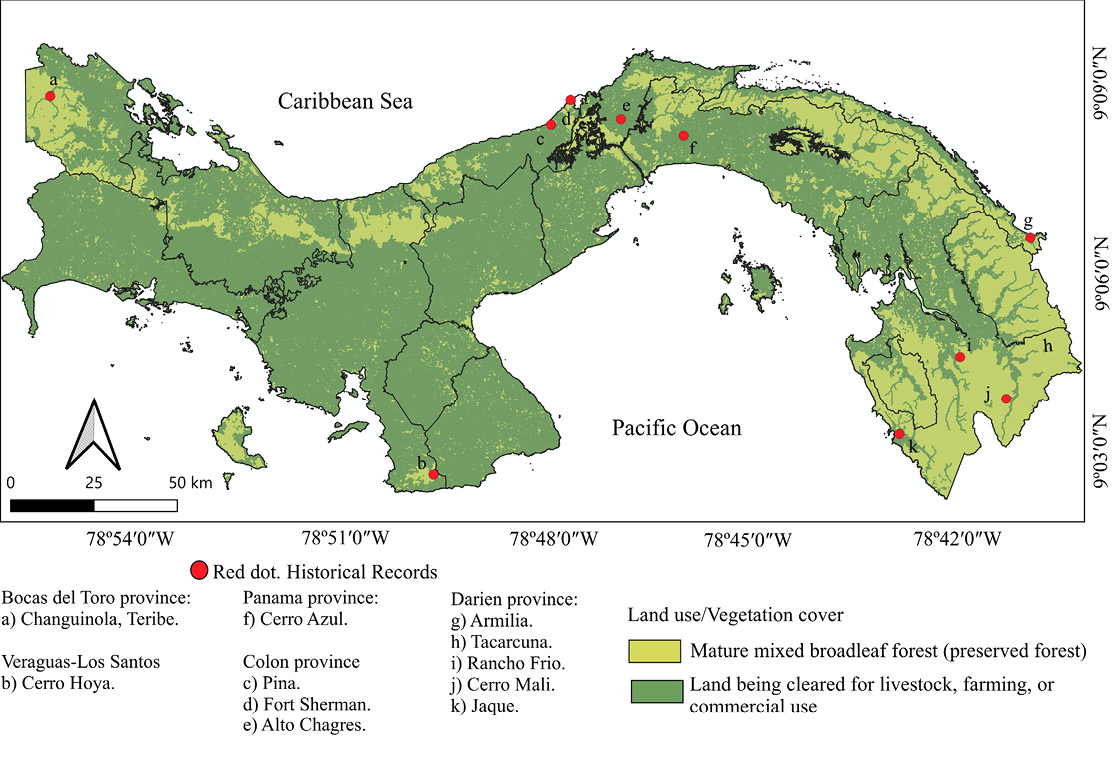
Figure 3. Current and historical capture sites for C. auritus.