THERYA NOTES 2026, Vol. 7:176-179
Exotic prey and anthropogenic trophic subsidies
in the diet of Puma concolor in Chile
Presas exóticas y subsidios tróficos antropogénicos
en la dieta de Puma concolor en Chile
Jorge Leichtle*1 2
1Escuela de Medicina Veterinaria, Facultad de Ciencias Médicas, Universidad Bernardo O’Higgins, Santiago 8320165, Chile. Email: jleichtle@docente.ubo.cl
2Doctorado en Conservación y Gestión de la Biodiversidad, Facultad de Ciencias, Universidad Santo Tomás, Santiago 8370003, Chile.
*Corresponding author
I analyzed how the invasion of exotic species is reshaping the diet of the puma (Puma concolor) across different ecosystems in Chile. I explored whether, due to its trophic plasticity, the puma is incorporating exotic prey and anthropogenic trophic subsidies, potentially altering traditional ecological relationships. I conducted a review of the scientific literature on puma diet in Chile, identifying records of exotic prey consumption, including lagomorphs, livestock, wild boar, invasive rodents, and salmonids, and analyzed studies addressing hyperpredation and trophic subsidies. Evidence showed that pumas have incorporated exotic species into their diet, including lagomorphs in central Chile, wild boar in southern Chile, and salmon in Argentine Patagonia near the Chilean border. The use of food resources associated with human-modified environments was documented, along with a potential ecological scenario compatible with hyperpredation. The trophic plasticity of pumas in Chile reflects the reconfiguration of food webs driven by biological invasions and anthropogenic subsidies. These processes could alter predator-prey dynamics and increase human-wildlife conflicts, although they may also contribute to the partial regulation of some invasive species. This study highlights the importance of understanding these emerging interactions for wildlife management and conservation and recommends continued monitoring to evaluate future ecological changes.
Key words: adaptive management; biological invasions; hyperpredation; native fauna; trophic subsidies.
Se analizó cómo la invasión de especies exóticas está reconfigurando la dieta del puma (Puma concolor) en distintos ecosistemas de Chile. Se exploró cómo el puma, debido a su plasticidad trófica, estaría incorporando presas exóticas y subsidios tróficos antropogénicos, lo que podría alterar las relaciones ecológicas tradicionales. Se realizó una revisión de la literatura científica sobre la dieta del puma en Chile, identificando registros de consumo de especies exóticas como lagomorfos, ganado, jabalíes y salmones, y se analizaron estudios sobre hiperdepredación y subsidios tróficos. Se evidenció que el puma ha incorporado especies exóticas a su dieta, como lagomorfos en Chile central, jabalíes en el sur de Chile y salmones en la Patagonia argentina, cerca de la frontera con Chile. Se documentó el uso de recursos alimentarios asociados con ambientes intervenidos y se identificó un escenario ecológico potencialmente compatible con procesos de hiperdepredación. La plasticidad trófica del puma en Chile refleja la reconfiguración de las redes alimentarias debido a la invasión biológica y a subsidios antrópicos. Esto podría generar cambios en las dinámicas depredador-presa y aumentar conflictos con humanos, aunque también podría contribuir a regular algunas especies invasoras. El estudio destaca la importancia de comprender estas interacciones emergentes para el manejo de fauna silvestre y recomienda monitoreos continuos ante posibles cambios futuros.
Palabras clave: fauna nativa; hiperdepredación; invasiones biológicas; manejo adaptativo; subsidios tróficos.
© 2026 Asociación Mexicana de Mastozoología, www.mastozoologiamexicana.org
Large carnivores play fundamental ecological roles in regulating ecosystems through direct and indirect effects on their prey and trophic networks (Ripple et al. 2014). In Chile, the puma (Puma concolor) is the country’s most widely distributed terrestrial predator and exhibits remarkable ecological adaptability, allowing it to persist in both natural environments and heavily modified landscapes (Iriarte and Jaksic 2017).
Across its distribution in the Americas, the puma is an opportunistic predator characterized by considerable dietary breadth and geographic variation in prey use. A range-wide meta-analysis identified at least 232 prey species, spanning mammals, birds, reptiles, and other vertebrates (Karandikar et al. 2022). Although medium- and large-sized mammals, particularly ungulates, generally provide most of the consumed biomass, pumas tend to rely on larger prey in temperate regions and on a broader diversity of smaller prey toward tropical latitudes (Iriarte et al. 1990; Karandikar et al. 2022). This continental variability illustrates the species’ capacity to adjust its diet according to local prey availability and environmental conditions.
In Chile, native mammals such as guanacos (Lama guanicoe), vicuñas (Vicugna vicugna), huemuls (Hippocamelus bisulcus), pudus (Pudu puda), and several rodent species have historically formed part of the puma diet, with marked geographic variation among ecosystems. However, landscape fragmentation, habitat loss, declines in native wildlife populations, and the expansion of invasive exotic species have profoundly altered trophic resource availability across different ecosystems of the country (Vallejos-Garrido et al. 2024).
Recent evidence suggests that pumas may be partially reorganizing their trophic niche in response to a new food supply increasingly dominated, in several systems, by introduced species and subsidies associated with human activities. In this context, the question arises as to whether biological invasions and anthropogenic trophic subsidies are partially reshaping the trophic ecology of pumas in Chile.
Between January and April 2026, we prepared a narrative commentary based on published evidence concerning the diet and trophic ecology of P. concolor in Chile and adjacent southern South American ecosystems. Scientific articles, books, and short communications indexed in Google Scholar, Scopus, and Web of Science were reviewed using combinations of the following keywords in English and Spanish: “Puma concolor”, “puma”, “diet”, “trophic ecology”, “exotic species”, “invasive species”, “biological invasions”, “livestock”, “wild boar”, “salmonids”, “lagomorphs”, and “Chile”.
Published records documenting the consumption of exotic prey or anthropogenic trophic subsidies by pumas in Chile and adjacent Argentine Patagonia were compiled, including introduced lagomorphs, domestic livestock, invasive rodents, wild boar, and salmonids. Additional studies addressing hyperpredation, trophic subsidies, and ecological responses of large carnivores in human-modified landscapes were also incorporated to provide ecological context for the observed interactions.
Only peer-reviewed publications and formally published academic sources directly related to Chile or adjacent southern South American ecosystems were considered. Due to the limited number of available records, the objective of this commentary was not to perform a systematic quantitative synthesis, but rather to provide an updated conceptual overview of emerging trophic interactions associated with biological invasions and anthropogenic landscape transformation.
In central Chile, the European rabbit (Oryctolagus cuniculus) and the European hare (Lepus europaeus) have become important components of the puma diet for decades (Iriarte et al. 1990). The high abundance of these introduced lagomorphs likely contributed to the persistence of pumas in highly fragmented Mediterranean landscapes, acting as relatively permanent energetic subsidies within altered ecosystems.
In the highlands of northern Chile, recent studies have shown a strong dependence on domestic livestock, particularly alpacas (Vicugna pacos) and sheep, whereas native species such as the mountain viscacha (Lagidium viscacia) continue to function as relevant complementary prey (Leichtle and Bonacic 2025). These findings illustrate how high-Andean pastoral systems may become anthropogenically subsidized ecosystems, where a substantial proportion of the biomass available to predators originates directly or indirectly from human activities.
Invasive rodents of the genus Rattus have also been occasionally recorded in the puma diet in Chile. Zúñiga and Muñoz-Pedreros (2014) documented the presence of Rattus rattus in feces collected from fragmented forests in southern Chile, specifically in the La Araucanía Region. However, its dietary representation was low, accounting for only 2.32 % of the total prey recorded, suggesting occasional consumption associated with anthropogenic environments.
In southern Chile, the expansion of wild boar (Sus scrofa) has generated potentially important new ecological interactions. Skewes et al. (2012) documented, for the first time, the European wild boar as prey of the puma in Chile based on fecal analyses and carcass surveys conducted in the Los Ríos Region. These authors reported that pumas preyed primarily upon juvenile individuals, suggesting an emerging trophic interaction between a native apex predator and one of the most problematic invasive species in southern Chile.
More recently, camera-trap records from southern Argentine Patagonia, near the Chilean border, documented active predation on Chinook salmon (Oncorhynchus tshawytscha) by pumas in fluvial ecosystems (Ciancio and Quinn 2026). This finding represents one of the first documented records of direct exploitation of invasive salmonids by a large terrestrial carnivore in South America and demonstrates the capacity of pumas to incorporate aquatic-derived resources into their diet. However, no published studies have yet formally documented this interaction in Chile.
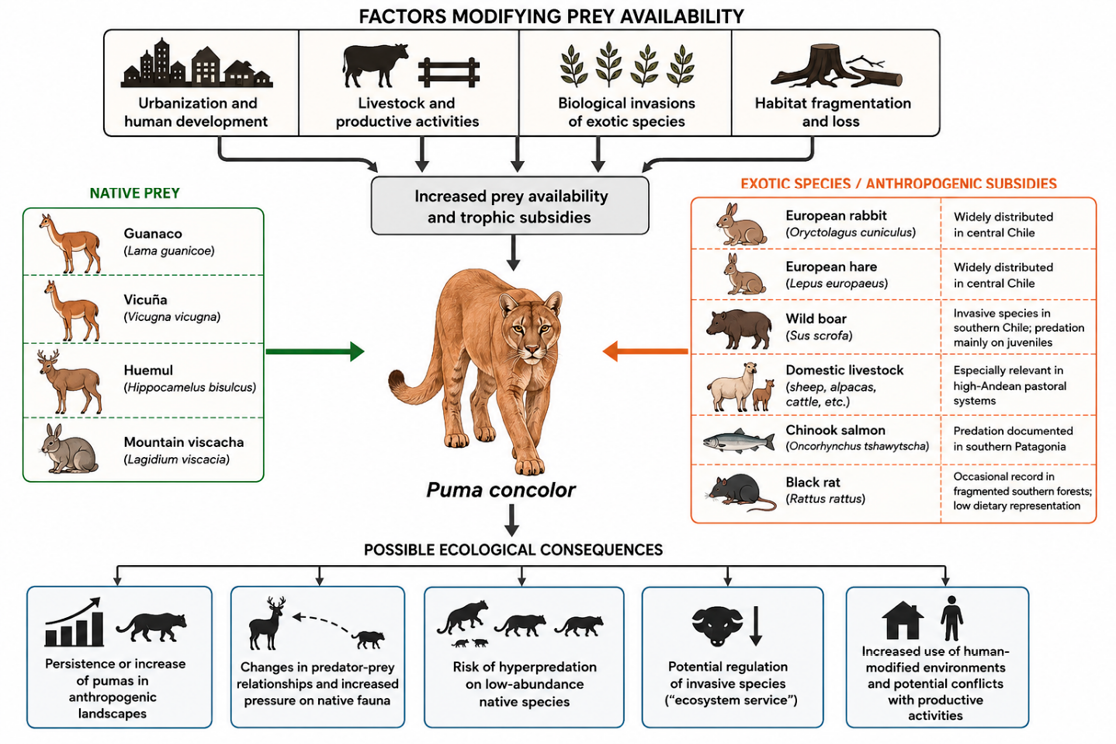
Collectively, these findings suggest that biological invasions and anthropogenic trophic subsidies are partially reshaping the trophic networks used by pumas across different ecosystems of Chile and adjacent Argentine Patagonia (Figure 1).
The incorporation of multiple exotic species into the puma diet could generate important modifications in the ecological dynamics of Chilean ecosystems. The abundance of introduced prey may partially decouple predators from the historical fluctuations of native fauna, allowing puma populations to persist or even increase in highly disturbed environments (Vallejos-Garrido et al. 2024).
Anthropogenic trophic subsidies, such as domestic livestock, introduced salmonids, and invasive wild boar, may also promote behavioral and spatial changes in pumas, favoring a greater use of human-modified environments and potentially increasing conflicts with productive activities. Likewise, these emerging interactions may facilitate hyperpredation processes. The abundance of exotic prey could sustain relatively high predator densities, indirectly increasing predation pressure on low-abundance native species such as the southern pudu (Pudu puda) and the huemul (H. bisulcus; Courchamp et al. 2000).
A well-documented empirical example consistent with this mechanism occurred in the California Channel Islands, where introduced feral pigs provided an abundant food resource for colonizing golden eagles, indirectly increasing predation pressure on native island foxes and contributing to their population decline (Roemer et al. 2001). However, a recent assessment of the available literature concluded that no published case has yet tested all the assumptions and predictions required to demonstrate hyperpredation unequivocally, because alternative mechanisms cannot generally be excluded (Cassini and Rivas 2024). Therefore, the Chilean cases described here should be regarded as potential scenarios compatible with hyperpredation rather than as evidence that the process is already occurring.
Conversely, the consumption of invasive species may also represent an indirect ecosystem service. Predation upon wild boar, rabbits, or salmonids could partially contribute to regulating some exotic populations, although the actual magnitude of this effect remains poorly understood in Chile.
In conclusion, the trophic ecology of pumas in Chile appears to be progressively reshaped by biological invasions and anthropogenic landscape transformation. The use of multiple exotic species within the puma diet reflects not only remarkable ecological plasticity, but also the emergence of novel trophic networks associated with human-dominated landscapes. Understanding these interactions is essential for interpreting the contemporary ecological role of pumas and for developing conservation strategies that integrate the effects of biological invasions, landscape transformation, and the changing dynamics among predators, native fauna, and human activities.
Acknowledgements
The author thanks the anonymous reviewers and the editorial team for their constructive comments and suggestions, which contributed to improving the manuscript. This narrative commentary was developed as part of the author’s studies in the Doctoral Program in Conservation and Biodiversity Management, Faculty of Sciences, Universidad Santo Tomás, Chile. It also forms part of the activities of the Semillero de Investigación en Conservación y Biodiversidad of the School of Veterinary Medicine, Universidad Bernardo O’Higgins, Chile..
Literature cited
Cassini, M. H., and L. Rivas. 2024. Hyperpredation as a mechanism responsible for the impact of introduced populations on native biodiversity. Acta Oecologica 125:104035.
Ciancio, J. E., and T. P. Quinn. 2026. Chinook salmon predation by pumas in Patagonia: Ecological implications of a novel trophic interaction. Canadian Journal of Zoology 104:1–6.
Courchamp, F., M. Langlais, and G. Sugihara. 2000. Rabbits killing birds: Modelling the hyperpredation process. Journal of Animal Ecology 69:154–164.
Iriarte, A., and F. M. Jaksic. 2017. Los carnívoros de Chile. Ediciones Flora & Fauna Chile y Centro UC CAPES, Pontificia Universidad Católica de Chile. Santiago, Chile.
Iriarte, A., et al. 1990. Biogeographic variation of food habits and body size of the American puma. Oecologia 85:185–190.
Karandikar, H., et al. 2022. Dietary patterns of a versatile large carnivore, the puma (Puma concolor). Ecology and Evolution 12:e9002.
Leichtle, J., and C. Bonacic. 2025. Unraveling the ecological interactions: Exploring prey selection and human-wildlife conflicts in the diet of pumas (Puma concolor) in the highlands of the Tarapacá Region, Chile. Caldasia 47:e115971.
Ripple, W. J., et al. 2014. Status and ecological effects of the world’s largest carnivores. Science 343:1241484.
Roemer, G. W., et al. 2001. Feral pigs facilitate hyperpredation by golden eagles and indirectly cause the decline of the island fox. Animal Conservation 4:307–318.
Skewes, O., et al. 2012. El jabalí europeo (Sus scrofa): Un invasor biológico como presa reciente del puma (Puma concolor) en el sur de Chile. Revista Chilena de Historia Natural 85:227–232.
Vallejos-Garrido, P., et al. 2024. Where is dinner? The spatiality of the trophic niche of terrestrial mammalian carnivores in Chile, a systematization for their conservation. Revista Chilena de Historia Natural 97:8.
Zúñiga, A. H., and A. Muñoz-Pedreros. 2014. Hábitos alimentarios de Puma concolor (Carnivora, Felidae) en bosques fragmentados del sur de Chile. Mastozoología Neotropical 21:157–161.
Associate editor: José Manuel Mora Benavides
Submitted: May 10, 2026; Reviewed: July 30, 2026
Accepted: August 11, 2026 ; Published on line: August 20, 2026
DOI: 10.12933/therya_notes-25-250
ISSN 2954-3614
Figure 1. Conceptual framework illustrating how biological invasions and anthropogenic factors modify the diet of the puma (P. concolor) in Chile. Native prey, exotic species, and trophic subsidies are represented, together with the potential ecological consequences derived from these emerging interactions, including hyperpredation, increased use of human-modified environments, and the potential regulation of some invasive species.