THERYA NOTES 2026, Vol. 7:170-175
First documented record of Bassariscus astutus
visiting Agave inflorescences in Mexico
Primer registro de Bassariscus astutus visitando
inflorescencias de Agave en México
Stephanie Ortega-García1, and Mariana Vallejo1*
1Jardín Botánico, Instituto de Biología, Universidad Nacional Autónoma de México, Coyoacán, Ciudad de México, México. SO-G correo: stephanie.ortega@st.ib.unam.mx, MV correo: mariana.vallejo@ib.unam.mx, Tel. 5556229045
*Corresponding author
Floral visitors of Agave species have traditionally been considered to consist primarily of insects, bats, and birds; however, recent studies suggest that non-flying mammals play a more frequent role in pollination than previously recognized. The objective of this study was to document the visit of Bassariscus astutus to agave inflorescences and evaluate the behaviors performed during those visits. Camera trapping was used to record floral visitors to different species of agaves in the IB-UNAM Botanical Garden, Mexico City. Between May 2024 and July 2025, nine individuals of six Agave species were monitored, accumulating a total of 1,512 h of recording. Visits of B. astutus were recorded on three species (A. americana, A. inaequidens, and A. salmiana), visitation events lasted from 20 s to 10 min. Individuals moved across the panicles, consumed nectar directly from the flowers, and captured associated moths, without causing apparent damage to reproductive structures. The results suggest that B. astutus uses Agave inflorescences as an opportunistic resource, exploiting both nectar and flower-associated insects. Together with previous observations, these observations are consistent with a dual-resource foraging strategy. Although its role as a pollinator cannot be confirmed, its behavior indicates potential incidental pollen transfer. This study constitutes the first documented record in Mexico of B. astutus consuming Agave nectar, expanding knowledge of its diet and highlighting the importance of non-flying mammals within Agave plant–animal interaction networks.
Key words: Asparagaceae; botanical garden; diet; entomophagy; ringtailed cat; therophily.
Los visitantes florales del género Agave han sido atribuidos principalmente a insectos, murciélagos y aves; sin embargo, estudios recientes sugieren que los mamíferos no voladores podrían participar con mayor frecuencia de lo previamente reconocido en la polinización. El objetivo de este estudio fue documentar la visita de Bassariscus astutus a inflorescencias de agave y evaluar qué actividades realizaba en las mismas. Se utilizó fototrampeo para registrar visitantes florales a diferentes especies de Agave en el Jardín Botánico IB-UNAM, Ciudad de México. Entre mayo de 2024 y julio de 2025 se monitorearon nueve individuos de seis especies de Agave, acumulando 1,512 h de grabación. Se registraron visitas de B. astutus en tres especies (A. americana, A. inaequidens y A. salmiana), la duración de cada visita varió de 20 s hasta 10 min. Los individuos se desplazaron sobre las panículas, consumieron néctar directamente de las flores y capturaron polillas asociadas, sin causar daño aparente a las estructuras reproductivas. Los resultados sugieren que B. astutus utiliza las inflorescencias de Agave como un recurso oportunista, aprovechando tanto el néctar como los insectos asociados a las flores. En conjunto con observaciones previas, estos registros son consistentes con una estrategia de aprovechamiento dual. Aunque su papel como polinizador no puede confirmarse, su comportamiento indica un potencial de transferencia incidental de polen. Este estudio constituye el primer registro documentado en México del consumo de néctar de Agave por B. astutus, lo que amplía el conocimiento sobre su dieta y resalta la importancia de los mamíferos no voladores en las redes de interacción planta-animal del género Agave.
Palabras clave: Asparagaceae; cacomixtle; dieta; entomofagia; jardín botánico; terofilia.
© 2026 Asociación Mexicana de Mastozoología, www.mastozoologiamexicana.org
Among the pollinators and floral visitors of Agave species, insects such as bees and moths, as well as flying vertebrates (birds and bats), have traditionally been regarded as the main pollen vectors in this group (Trejo-Salazar et al. 2015; Ortega-García et al. 2026). However, in recent years, it has been recognized that pollination by non-flying mammals (therophily) is more common than previously thought (Kobayashi et al. 2019; Lai et al. 2024). Recently, visits by marsupials such as Didelphis virginiana and Tlacuatzin canescens to agaves have been recorded, which, due to the amount of pollen they can transport relative to their larger body size and the duration of their visits, could play a relevant role as pollinators (Arreola-Gómez and Mendoza 2020).
In addition to these records, Kuban and Schwartz (1985) reported the observation of a ringtail (Bassariscus astutus) visiting the inflorescence of Agave havardiana within Big Bend National Park, Texas, USA. In that note, the authors reported that the observed female moved among the panicles, apparently feeding on insects associated with flowers and, on repeated occasions, licked nectar from the inflorescences. To our knowledge, this constitutes the only published report of visits by B. astutus to Agave inflorescences.
Bassariscus astutus is a medium-sized, nocturnal, and climbing mammal. It is considered omnivorous; studies of its diet indicate that, although animal remains—mainly insects—constitute an important component of its feeding, plant elements also show high diversity and frequency (Nava-Vargas et al. 1999). The presence of floral material in stomach contents suggests that this species may intentionally consume nectar and pollen, which may represent an additional source of energy and protein.
During a study on the pollination of Agave salmiana in the central valleys of Mexico (Ortega-García et al. 2026), we recorded, through camera trapping, the visit of B. astutus to the inflorescence of this agave. However, the images obtained did not allow us to clearly determine the activity carried out by the animal, and no additional records were obtained to evaluate its behavior on the flowers. To clarify the possible role of B. astutus on Agave inflorescences, we conducted a targeted sampling in the Botanical Garden of the Institute of Biology of the National Autonomous University of Mexico (JB-IBUNAM), which houses an important living collection of Agave species and functions as a refuge for various species of wildlife, including B. astutus. The objective of this study was to document visits of B. astutus to Agave inflorescences and describe the behaviors performed during those visits, with particular attention to nectar feeding, insect predation, and potential interactions with floral reproductive structures.
The JB-IBUNAM is part of the Pedregal de San Ángel Ecological Reserve (REPSA), in the Coyoacán borough, southwest of Mexico City, Mexico (19°18’44” N, 99°11’46” W; 2,250 m asl).
To determine the activities carried out by B. astutus on agave inflorescences, weekly surveys were conducted in the living collections of the JB-IBUNAM, to locate individuals of the genus Agave that presented paniculate inflorescences in anthesis.
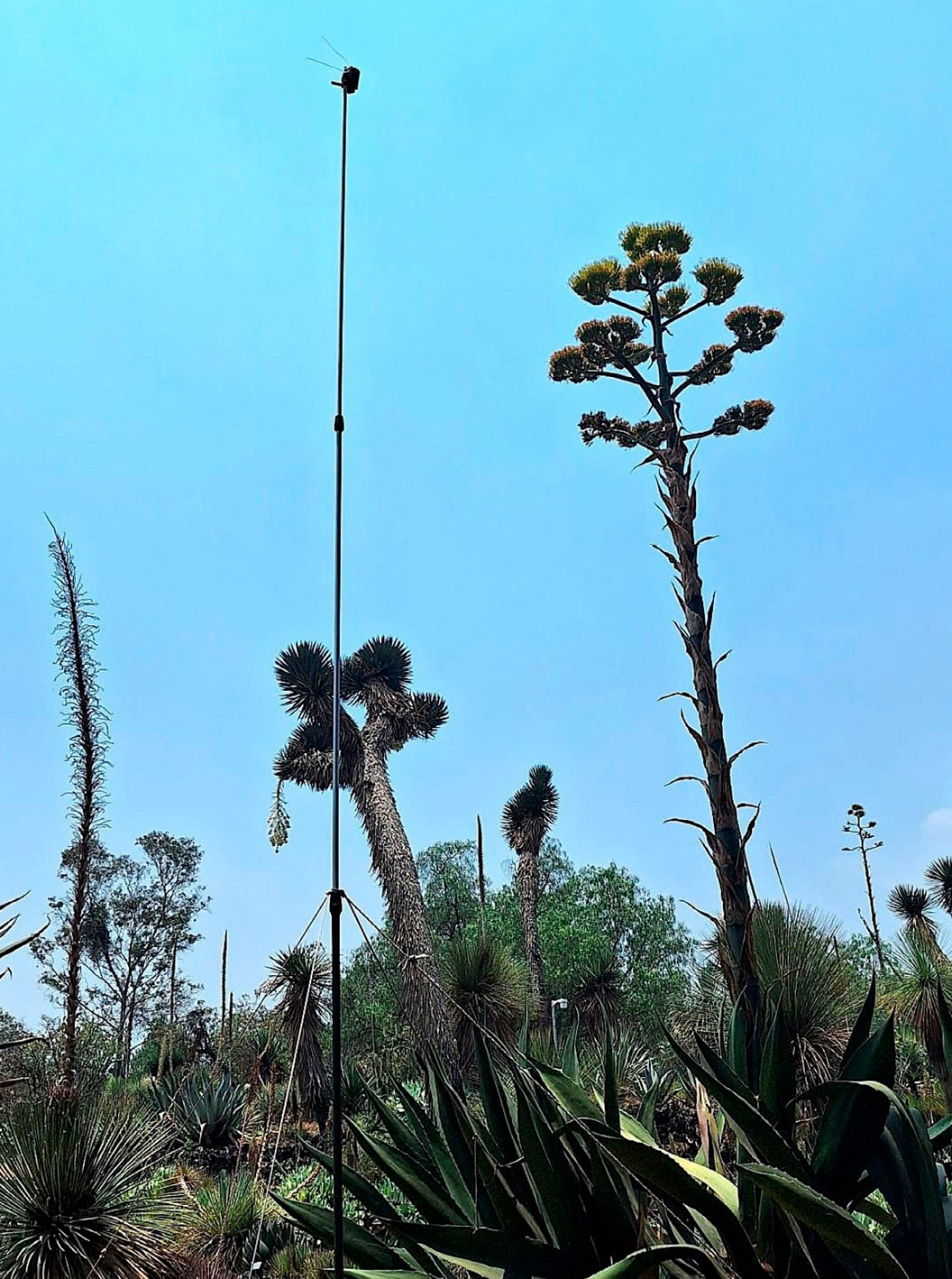
Once a flowering individual was identified, one camera trap (HC-801A model) was installed in front of the inflorescence and positioned to maximize the likelihood of recording floral visits. The camera trap was mounted on an extendable aluminum pole (2.67–7.20 m in length; BYP Model SKU 160565), which was secured to the ground using ropes (Figure 1). The height of the pole was adjusted according to the height of each inflorescence. Depending on terrain characteristics and the architecture of each plant, cameras were positioned approximately 1–3 m from the inflorescence.
Camera traps were programmed in video-only mode to record 20-s videos upon activation, with a 5-s interval between consecutive recordings. Infrared illumination was enabled to allow recording during nighttime periods. Each inflorescence was monitored for a minimum of five consecutive days.
Surveys were carried out between May 2024 and July 2025, during which nine flowering individuals representing six Agave species were monitored: A. salmiana (n = 3), A. americana (n = 1), A. inaequidens (n = 1), A. bovicornuta (n = 1), A. titanota (n = 1), and A. marmorata (n = 2). Agaves in which visits by B. astutus were recorded were spatially separated across living collections, with distances between visited individuals ranging from approximately 65 to 125 m.
The monitored agaves produced tall paniculate inflorescences (2.5–9 m in height; Torres-García et al. 2022), characterized by massive flowering displays in which dozens of flowers may open simultaneously on a single panicle. These floral displays provide abundant rewards for flower visitors, with reported nectar volumes ranging from 0.2 to 2.8 ml per flower and nectar concentrations ranging from 9 to 37 °Brix (Ornelas et al. 2002; Estrella Ruiz 2005; Rodríguez et al. 2015; Ortega-García et al. 2026), making flowering agaves an important food resource for a variety of nectar-feeding animals. Although agaves can reproduce vegetatively, sexual reproduction contributes to gene flow and depends largely on animal-mediated pollination, which is generally more effective than autonomous self-pollination (Estrella Ruiz 2005; García-Mendoza 2007). Therefore, follow-up observations were conducted after flowering in individuals visited by B. astutus to determine whether fruits developed and whether feeding activities caused apparent damage to reproductive structures.
From a total of 1,512 hr of recording, B. astutus was recorded during three independent visitation events (A. americana, A. inaequidens, and A. salmiana), accumulating a total of 11 min 20 s of video footage. Individual visitation events ranged from 20 s to 10 min in duration. Nectar feeding was recorded on A. americana and A. inaequidens, whereas predation on sphingid moths was observed on A. salmiana (Figure 2, https://youtu.be/TVuE1IGpqZk).
In subsequent weeks, the three inflorescences visited by B. astutus were revisited after flowering. In all cases, fruits developed on the visited panicles. One fruiting panicle of A. americana was examined to verify the presence of seeds. After opening several capsules, both white and black seeds were observed; the latter are considered viable (Trejo et al. 2024; Figure 3). These observations suggest that nectar-feeding by B. astutus does not appear to damage floral reproductive structures or prevent fruit development.
The present study provides the first documented record in Mexico of B. astutus consuming nectar from Agave inflorescences and capturing moths associated with the flowers. Although Kuban and Schwartz (1985) previously described a similar interaction involving A. havardiana in Texas, published records of this behavior remain extremely scarce. Nevertheless, the occurrence of nectar feeding on Agave flowers in geographically distinct regions and involving different Agave species suggests that this behavior may not be restricted to a single locality or plant species. This possibility is further supported by the broad geographic overlap between the distribution of B. astutus and numerous species of Agave. Bassariscus astutus occurs from the southwestern USA through most of Mexico, whereas the species in which nectar feeding has been documented (A. havardiana, A. americana, A. inaequidens, and A. salmiana) are distributed across regions that fall within its range (IUCN 2025). Furthermore, the currently available records originate from contrasting environments, including a protected natural area in Texas (Kuban and Schwartz 1985) and an urban ecological reserve in central Mexico. Together, these observations suggest that opportunities for interaction between ringtails and flowering agaves may be widespread in both natural and human-modified habitats, even though they remain rarely documented. The apparent scarcity of records may reflect the nocturnal and elusive habits of B. astutus, as well as the logistical challenges associated with monitoring tall agave inflorescences.
The low frequency of visits detected relative to the sampling effort indicates that Agave inflorescences are unlikely to constitute a major component of the diet of B. astutus, but rather a seasonal resource used opportunistically. This pattern agrees with previous dietary studies describing B. astutus as a flexible omnivore capable of adjusting its diet according to local and temporal resource availability. In insular populations of the Gulf of California, for example, it has been observed to consume more intensively the most abundant resources of each season, including insects and fruits (Rodríguez-Estrella et al. 2000). Similarly, Nava-Vargas et al. (1999) documented a diverse diet composed of arthropods, small vertebrates, and plant material. From this perspective, agave flowering may represent a temporary pulse of high-energy resources.
Nectar provides a readily available source of sugars and water, which may be especially valuable for nocturnal mammals in seasonal environments, where liquid resources are not always constant. In other groups of non-flying mammals, nectar consumption has been proposed to function as a rapidly assimilated energy supplement rather than as an exclusive food source (Wiens et al. 1983). For B. astutus, a species with high mobility and nocturnal activity, nectar could complement a diet based mainly on animal prey and fruits, reducing foraging effort during flowering periods.
In addition to direct nectar consumption, our obser-vations show that agave inflorescences function as sites of insect concentration, particularly nocturnal lepidopterans. Together with the observations of Kuban and Schwartz (1985), who reported nectar feeding and insect capture during the same visitation event, these records suggest that flowering agaves may provide multiple resources that can be exploited by B. astutus, including both carbohydrate-rich nectar and protein-rich insect prey. This possibility has received little attention in studies of floral ecology, where visitors are often classified solely as mutualists or antagonists, without considering that a single visitor may exploit multiple resources within the same reproductive structure.
From a pollination standpoint, various studies have shown that non-flying mammals can play relevant roles as pollen vectors when their body size, mobility, and duration of visits favor contact with reproductive structures (Goldingay 1990; Carthew and Goldingay 1997). In Agave, Arreola-Gómez and Mendoza (2020) recorded marsupials visiting inflorescences with potential for pollen transfer. In our study, B. astutus actively moved among floral branches, inserting its snout into flowers and repeatedly brushing against anthers and stigmas, behavior consistent with incidental pollen transfer.
However, it is important to distinguish between a floral visitor and an effective pollinator. Mere presence on flowers or contact with anthers does not demonstrate reproductive contribution. Demonstrating such a role would require quantifying pollen loads and viability, movement patterns among compatible individuals, and reproductive success attributable to its visits. Fruit production and the presence of viable seeds in visited inflorescences indicate that these visits did not appear to interfere with plant reproduction, but they do not allow causal attribution, since bats, birds, and insects may have acted simultaneously.
The results also have implications for understanding interaction networks in urban and peri-urban environments. The Botanical Garden and the REPSA function as refuges for native fauna within an urban matrix, where generalist species such as B. astutus can take advantage of floral resources offered by living collections of nectar-producing plants. This suggests that urban green spaces not only conserve species but also ecological interactions that frequently remain undocumented. Because similar resources and habitat conditions occur elsewhere in the city, the relevance of this interaction may extend beyond the JB-IBUNAM and REPSA. Because agaves are present in a variety of urban green spaces in Mexico City, including publicly accessible interstitial spaces (Hare and Peña del Valle Isla 2021), floral resources from flowering agaves may be available in habitats beyond the study area. In Mexico City, agaves are also promoted as part of urban revegetation planting initiatives (SEDEMA 2025), increasing their presence in parks, gardens, ecological reserves, and other green spaces. Likewise, B. astutus has been documented in multiple natural areas embedded within the urban matrix of Mexico City (Hernández Romero et al. 2024). Because this species can persist in human-modified environments, flowering agaves established in urban green spaces may provide similar foraging opportunities. Although the frequency of these interactions outside the study area remains unknown, their occurrence in other urban habitats deserves further investigation.
Finally, the apparent rarity of these records likely reflects both observational limitations and gaps in natural history knowledge. Many nocturnal interactions between mammals and flowers remain poorly documented due to the lack of continuous monitoring. Future studies integrating systematic camera trapping, pollen analysis on fur, and spatial tracking of individuals will allow a more precise evaluation of whether B. astutus acts solely as an opportunistic consumer or also as an occasional pollinator of Agave species.
Acknowledgments
We thank Dr. Abisaí García, Curator of the Agavaceae and Nolinaceae Collection at JB-IBUNAM, for his support in carrying out this project. We also thank Oswaldo Flores Molina for his assistance with fieldwork. We are grateful to the Executive Secretariat of the REPSA for the permits granted. SO-G acknowledges the Postdoctoral Fellowships for Mexico program of SECIHTI. This study was carried out with project PAPIIT IN219824, UNAM. The authors used artificial intelligence tools to assist in the English translation of this manuscript.
Literature cited
Arreola-Gómez, R., and E. Mendoza. 2020. Marsupial visitation to the inflorescences of the endemic Agave cupreata in western Mexico. Western North American Naturalist 80:563–568.
Carthew, S. M., and R. L. Goldingay. 1997. Non-flying mammals as pollinators. Trends in Ecology & Evolution 12:104–108.
Estrella Ruiz, J. P. 2005. Biología de la polinización de Agave salmiana Otto & Salm-Dick en el Valle de Tehuacán-Cuicatlán, México. BSc Thesis. Universidad Nacional Autónoma de México.
García-Mendoza, A. J. 2007. Los agaves de México. Ciencias 87:14–23.
Goldingay, R. L. 1990. The foraging behaviour of a nectar feeding marsupial, Petaurus australis. Oecologia 85:191–199.
Hare, M., and A. Peña del Valle Isla. 2021. Urban foraging, resilience and food provisioning services provided by edible plants in interstitial urban spaces in Mexico City. Local Environment 26:825–846.
Hernández Romero, P. C., et al. 2024. Species richness and ecological connectivity of the mammal communities in urban and peri-urban areas at Mexico City. Urban Ecosystems ٢٧:1781–1794
IUCN. 2025. The IUCN Red List of Threatened Species. Version 2025-2. https://www.iucnredlist.org. Accessed on 19 June 2026.
Kobayashi, S., et al. 2019. Civet pollination in Mucuna birdwoodiana (Fabaceae: Papilionoideae). Plant Ecology 220:457–466.
Kuban, J. F., and G. G. Schwartz. 1985. Nectar as a diet item of the ringtail cat. The Southwestern Naturalist 30:311–312.
Lai, S., et al. 2024. Canids as pollinators? Nectar foraging by Ethiopian wolves may contribute to the pollination of Kniphofia foliosa. Ecology 105:e4470.
Nava-Vargas., J. D. Tejero, and C. B. Chávez. 1999. Hábitos alimentarios del cacomixtle Bassariscus astutus (Carnivora: Procyonidae) en un matorral xerófilo de Hidalgo, México. Anales del Instituto de Biología, Serie Zoología ٧٠:٥١–٦٣.
Ornelas, J. F., et al. 2002. Nectar oasis produced by Agave marmorata Roezl. (Agavaceae) lead to spatial and temporal segregation among nectarivores in the Tehuacán Valley, México. Journal of Arid Environments 52: 37-51.
Ortega-García, S., E. Maya-Elizarrarás, and M. Vallejo. 2026. Zoopollination of pulque agave crop (Agave salmiana) in the central valleys of Mexico. Botanical Sciences 104:346–360.
Rodríguez-Estrella, R., Á. Rodríguez-Moreno, and K. Grajales-Tam. 2000. Spring diet of the endemic ring-tailed cat (Bassariscus astutus insulicola) population on an island in the Gulf of California, Mexico. Journal of Arid Environments 44:241–246.
SEDEMA (Secretaría del Medio Ambiente de la Ciudad de México). 2025. Reto Verde. Gobierno de la Ciudad de México. Available at: https://sedema.cdmx.gob.mx/programas/programa/reto-verde. Accessed 21 June 2026.
Torres García, I., et al. 2022. Agave americana L. Agave angustifolia Haw. Agave atrovirens Karw. ex Salm-Dyck. Agave asperrima Jacobi. Agave bovicornuta Gentry. Agave cupreata Trel. & A. Berger. Agave hookeri Jacobi. Agave inaequidens K. Koch. Agave karwinskii Zucc. Agave kerchovei Lem. Agave lechuguilla Torr. Agave mapisaga Trel. Agave marmorata Roezl Agave maximiliana Baker Agave montana Villareal Agave potatorum Zucc. Agave rhodacantha Trel. Agave salmiana Otto ex Salm-Dyck Agave scaposa Gentry Agave tequilana FAC Weber Agave .... Pp 1-52 in Ethnobotany of the Mountain Regions of Mexico (Casas, A. and Blancas-Vázquez, J. J. eds). Springer International Publishing. Cham, Switzerland.
Trejo, L., et al. 2024. Diversity of reproductive characters, seed set, and viability of Agave seeds used for pulque production and their wild relatives in Tlaxcala, Mexico. Genetic Resources and Crop Evolution 71:2877–2903.
Trejo-Salazar, R. E., E. Scheinvar, and L. E. Eguiarte. 2015. ¿Quién poliniza realmente los agaves? Diversidad de visitantes florales en tres especies de Agave (Agavoideae: Asparagaceae). Revista Mexicana de Biodiversidad 86:358–369.
Wiens, D., et al. 1983. Nonflying mammal pollination of southern Africa proteas: a non-coevolved system. Annals of the Missouri Botanical Garden 70:1–31.
Associate editor: David Valenzuela-Galván
Submitted: May 08, 2026; Reviewed: July 29, 2026
Accepted: August 05, 2026
Published on line: August 20, 2026
Figure 3. Fruits (a) and seeds (b) of Agave americana are shown, including viable (black) and non-viable (white) seeds, from an individual where Bassariscus astutus fed on nectar. Photo (a): Stephanie Ortega-G.; Photo (b): Oswaldo Flores M.
DOI: 10.12933/therya_notes-25-249
ISSN 2954-3614
Figure 1. Camera-trap installation used to monitor Agave inflorescences. The camera was mounted on an extendable aluminum pole and stabilized with ropes anchored to the ground, allowing continuous recording of floral visitors on inflorescences located several meters above ground level.
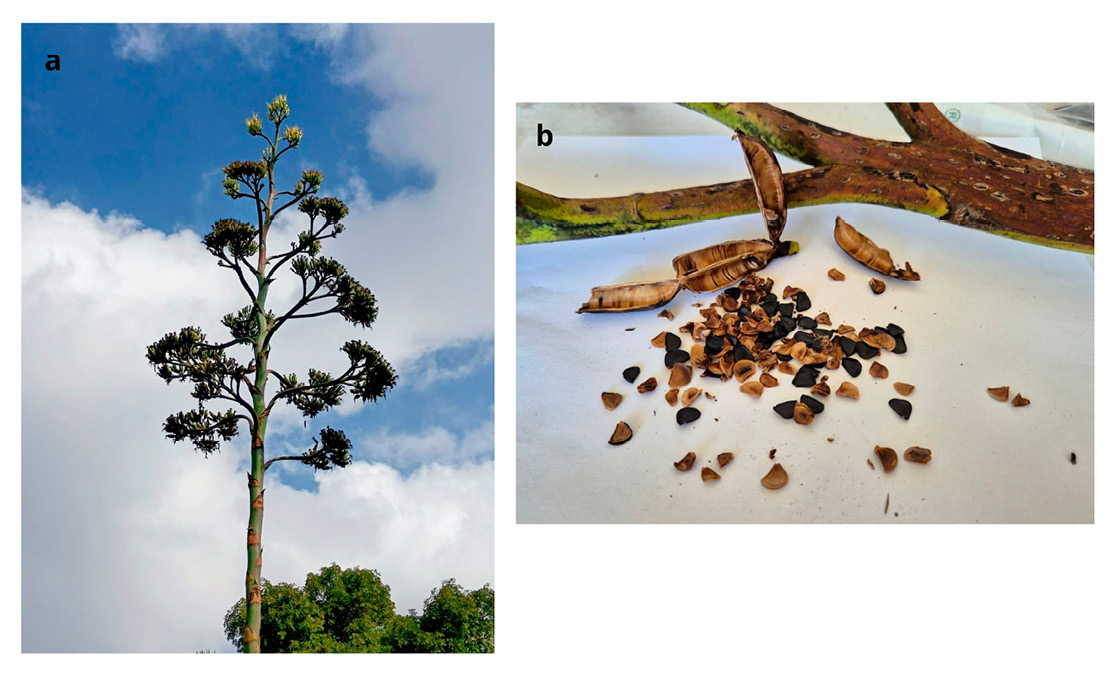
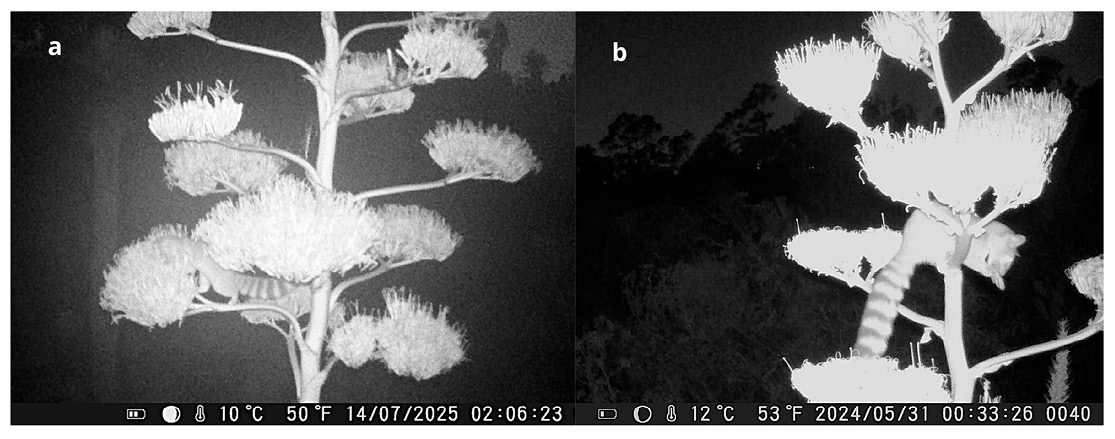
Figure 2. Camera-trap images of Bassariscus astutus visiting Agave inflorescences. (a) Individual feeding on nectar from the flowers of Agave americana. (b) Individual feeding on a hawkmoth (Lepidoptera: Sphingidae) associated with the flowers of Agave salmiana.