THERYA NOTES 2026, Vol. 7:186-193
Born in a culvert: reproductive notes on Mimon cozumelae (Chiroptera: Phyllostomidae) during road construction in southeastern Mexico
Nacidos en un drenaje: notas reproductivas de Mimon cozumelae (Chiroptera: Phyllostomidae) durante la construcción de una carretera en el sureste de México
José D. Cú-Vizcarra1, Griselda Escalona-Segura2, and Karla P. Borges-Jesús1*
1Independent researcher. Circuito Niza, 1, Bello Horizonte, 24070, San Francisco de Campeche, Campeche, México. E-mail: jcvizcarra104@gmail.com (JDC-V), karlaborges83@gmail.com (KPB-J).
2Departamento de Conservación de la Biodiversidad, El Colegio de la Frontera Sur (ECOSUR). Avenida Rancho Polígono 2-A, Ciudad Industrial, Lerma, 24500, San Francisco de Campeche, México. E-mail: gescalon@ecosur.mx (GE-S).
*Corresponding author
The reproductive cycle in bats is closely synchronized with resource availability and may be particularly sensitive to anthropogenic disturbance during energetically demanding stages such as mating, pregnancy, and lactation. In human-modified landscapes, road culverts can provide suitable roosting conditions for bats; however, evidence of their use as mating and maternity roosts remains limited. We documented the reproductive stages of the threatened bat Mimon cozumelae over a one-year period (August 2024 - July 2025) in a road culvert in southeastern Mexico undergoing structural modifications as part of an active road-widening project. Monthly daytime inspections were conducted through direct observations, photographic records, and camera-trap monitoring to assess reproductive stages and associated behaviors. We did not detect any evidence of reproductive stages such as copulation, lactation, or juvenile development between September and April, a period when construction activities included pipe installation, headwall construction, paving, and related infrastructure works. Reproductive stages were documented from May to July, when copulatory events, males with erect penises, lactating females carrying pups, and volant juveniles were observed despite ongoing construction activities associated with the completion of the road-widening project, including road-lighting activation. Despite prolonged disturbance associated with construction activities, the colony continued to inhabit the culvert throughout the study period, suggesting consistent use of this anthropogenic structure under sustained disturbance. These observations provide evidence of multiple reproductive stages of M. cozumelae in a road culvert during active infrastructure development and suggest that road culverts may provide suitable conditions for bats during sensitive reproductive stages. Our observations highlight the ecological importance of road culverts as potential mating and maternity roosts for bats in human-modified landscapes. Recognizing the ecological value of these structures during infrastructure planning can help mitigate impacts on bat populations.
Key words: anthropogenic structures; copulation; diurnal roost; mating; maternity roost; reproductive stages; road ecology; threatened species.
El ciclo reproductivo en los murciélagos está estrechamente sincronizado con la disponibilidad de recursos y puede ser particularmente sensible a la perturbación antropogénica durante etapas de alta demanda energética como el apareamiento, la gestación y la lactancia. En paisajes modificados por el ser humano, los drenajes carreteros pueden ofrecer condiciones de refugio adecuadas para los murciélagos. Sin embargo, la evidencia de su uso como refugios de apareamiento y maternidad sigue siendo limitada. Documentamos las etapas reproductivas del murciélago amenazado Mimon cozumelae durante un año (agosto de 2024 - julio de 2025) en un drenaje carretero del sureste de México, el cual se encontraba sometido a modificaciones estructurales como parte de un proyecto activo de ampliación de la carretera. Se realizaron inspecciones mensuales diurnas mediante observaciones directas, registros fotográficos y monitoreo con cámara trampa para evaluar las etapas reproductivas y los comportamientos asociados. No detectamos evidencia de etapas reproductivas como cópula, lactancia o desarrollo de juveniles, entre septiembre y abril, periodo en el que las actividades de construcción incluyeron instalación de tuberías de concreto, construcción del muro de cabeza, pavimentación y otras obras de infraestructura relacionadas. Documentamos etapas reproductivas de mayo a julio, cuando se observaron eventos de cópula, machos con el pene erecto, hembras lactantes con crías y juveniles voladores, a pesar de las actividades de construcción en curso asociadas con la finalización del proyecto de ampliación de carretera, incluyendo la activación del alumbrado vial. A pesar de la perturbación prolongada asociada con las actividades de construcción, la colonia continuó habitando el drenaje durante todo el periodo de estudio, lo que sugiere un uso constante de esta estructura antropogénica bajo condiciones de disturbio sostenido. Estas observaciones aportan evidencia de múltiples etapas reproductivas de M. cozumelae en un drenaje carretero durante el desarrollo activo de infraestructura vial y sugieren que estas estructuras pueden ofrecer condiciones adecuadas para los murciélagos durante etapas reproductivas sensibles. Nuestras observaciones destacan la importancia ecológica de los drenajes carreteros como potenciales refugios de apareamiento y maternidad para los murciélagos en paisajes modificados por el ser humano. Reconocer el valor ecológico de estas estructuras durante la planificación y desarrollo de infraestructura vial puede contribuir a mitigar los impactos sobre las poblaciones de murciélagos.
Palabras clave: apareamiento; cópula; ecología de carreteras; especies amenazadas; estructuras antropogénicas; etapas reproductivas; refugio de maternidad; refugio diurno.
© 2026 Asociación Mexicana de Mastozoología, www.mastozoologiamexicana.org
DOI: 10.12933/therya_notes-25-252
ISSN 2954-3614
Reproduction is a central component of bat life history, influencing population dynamics, colony structure, and long-term species persistence. Reproductive success in bats is shaped by multiple intrinsic and extrinsic factors, including body size, roost characteristics, microclimate, latitude, seasonal climatic variation, resource availability, and anthropogenic disturbance (Kunz and Lumsden 2003; Fleming et al. 2020; Weinberg et al. 2025). In most species, reproductive cycles are closely synchronized with seasonal environmental variation, particularly food availability, so that energetically demanding stages such as late pregnancy, parturition, and lactation coincide with periods of increased prey abundance (Fleming et al. 1972; Cumming and Bernard 1997; Estrada and Coates-Estrada 2001). However, reproductive processes can also be sensitive to anthropogenic disturbance, which may alter behavior, colony dynamics, and reproductive timing. Available evidence suggests that some bat species can adapt to human-modified environments by forming large colonies, modifying roost-switching behavior through the use of artificial roosts, and, in some cases, altering the timing of reproductive events such as births (Lausen and Barclay 2006; Streicker et al. 2013; Russo and Ancillotto 2015; Weinberg et al. 2025).
Roosting ecology encompasses a set of ecological patterns and mechanisms that drive the evolution of key bat traits, including pelage coloration, resting posture, flight maneuvers, and habitat specialization (Boerma and Swartz 2024). In Neotropical bats, several species have evolved morphological and behavioral adaptations to occupy natural roosts such as caves, trees, leaves, and termite nests (Kunz 1982). However, in human-modified landscapes where natural roosts may be limited or degraded, anthropogenic structures can acquire increasing ecological relevance as alternative roosts. Because diurnal roosts provide stable microclimatic conditions and protection during sensitive reproductive stages, including mating, pregnancy, parturition, lactation, and juvenile development, roost selection can strongly influence bat persistence in anthropized environments (Kunz 1982; Kunz and Fenton 2003; Kunz and Lumsden 2003).
Consequently, bats increasingly use anthropogenic structures such as bridges, buildings, and road culverts (Sippola et al. 2026). The occupation of these structures often depends on the availability of surrounding resources such as food and water. When disturbance is low and suitable environmental conditions are present, they may serve not only as temporary roosts but also as permanent sites that support different reproductive stages. Despite their increasing use by bats, reproductive dynamics within road infrastructure remain poorly documented, particularly in the Neotropics (Torres-Flores and Santos-Moreno 2017; Sippola et al. 2026).
Several bat species have been reported using road culverts as diurnal roosts, mating sites, maternity sites, and as highway underpasses (Gorecki et al. 2020; Detweiler and Bernard 2023; González-Gallina et al. 2025). One such species is Mimon cozumelae, a phyllostomid bat distributed from southern Mexico to northern Colombia. In Mexico, it is classified as Threatened (A) under the environmental regulation NOM-059-SEMARNAT-2010, reflecting its rarity and low abundance (Ortega and Arita 1997; SEMARNAT 2019). In contrast, at the global scale, the species is listed as Least Concern on the IUCN Red List due to its wide distribution, presumed large population, and low likelihood of decline (Arroyo-Cabrales et al. 2015).
This gleaning insectivore feeds primarily on arthropods but may also consume small vertebrates and occasional fruits (Ortega and Arita 1997; Gual-Suárez and Medellín 2021). Available evidence suggests that reproductive stages, including copulation, pregnancy, lactation, and juvenile development, occur between March and July, with births occurring at the onset of the rainy season and juveniles becoming independent by the end of August. Females are seasonally monoestrous and typically produce a single offspring per year (Ortega and Arita 1997; Wilson and Mittermeier 2019; Fleming et al. 2020; Romo-Hernández et al. 2024). Information on male reproductive biology in M. cozumelae remains scarce, however, males possess erectile tissues associated with copulatory function (Neuweiler 2000; Orr et al. 2022). Despite its conservation relevance in Mexico, information on its reproductive cycle remains scarce, with most studies conducted in cave systems (Hall and Dalquest 1960; Knox et al. 1973; Navarro López 1982; Romo-Hernández et al. 2024).
Because temporal resource availability largely determines this relatively narrow reproductive window, disturbances during this critical period may disproportionately affect colony stability and reproductive success, particularly when colonies occupy anthropogenic structures exposed to construction activities. Understanding the occurrence of reproductive stages in bat populations inhabiting road infrastructure is therefore important for minimizing impacts on reproductive populations during infrastructure development and for integrating bat conservation into infrastructure planning and management processes.
Here, we report observations of reproductive stages and associated behaviors of Mimon cozumelae inhabiting a road culvert during an active road-widening project. Using non-invasive approaches, including direct observations, photographic records, and camera-trap monitoring, we document reproductive stages and associated behaviors within this anthropogenic roost.
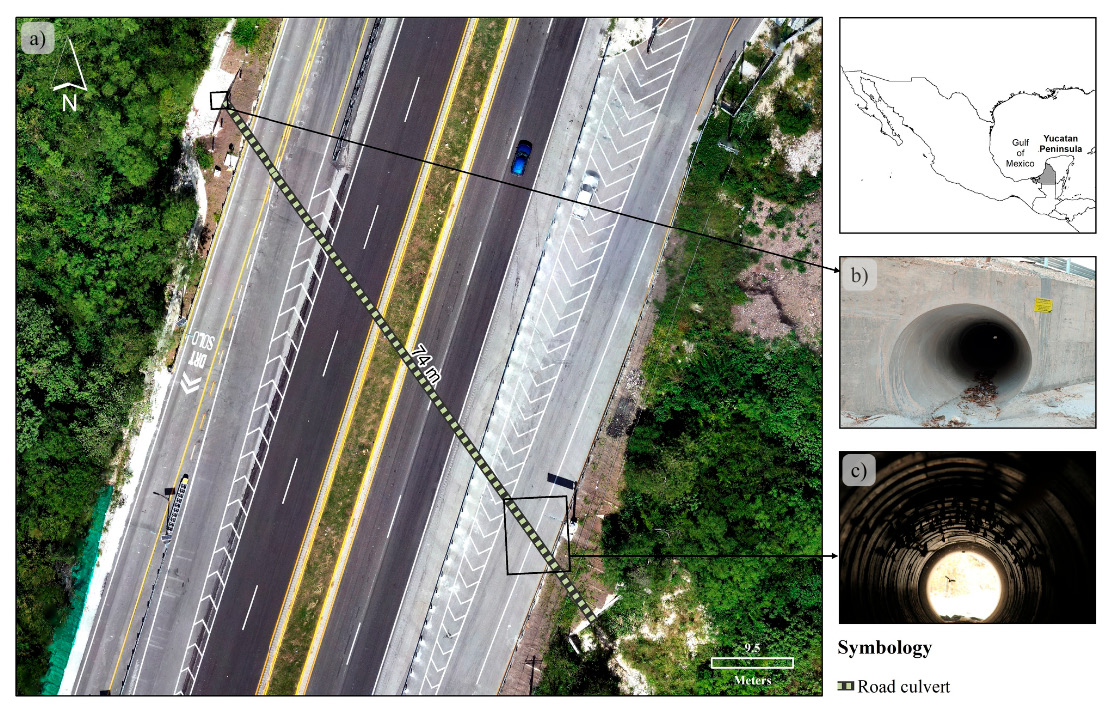
We conducted observations at least once per month between August 2024 and July 2025 in a pipe culvert located in Campeche, Mexico, during a road-widening project (Figure 1). This study was part of a broader project that assessed the effects of road construction on the emergence patterns of M. cozumelae.
The culvert consists of reinforced concrete pipes (1.5 m in diameter) installed on an approximate 2% slope. Originally, the culvert was approximately 57 m long; however, as part of the road-widening project, it was extended on both sides, reaching a total length of 74 m (Figure 1). The surrounding landscape is dominated by medium deciduous and semi-deciduous forests. The regional climate is strongly seasonal, with a dry season from November to May and a rainy season from June to October.
We conducted daytime inspections inside the culvert to assess reproductive stages under the permit issued by the Secretariat of Environment and Natural Resources (SEMARNAT; SBRA/DGVS/01998/25). To minimize distur-bance, inspections lasted no longer than 40 minutes. No individuals were captured, handled, or marked. A total of 17 daytime visits and two nocturnal visits were conducted. During the first inspection in August 2024, roost counts revealed a colony of about 90 individuals inside the culvert. Individuals were identified based on distinctive morphological characteristics, including long and pointed ears, white wingtips, and a broad elongated nose leaf (Ortega and Arita 1997).
We determined reproductive stages and social behaviors through direct observations supported by a digital camera, photographic records, and camera-trap monitoring based on previously described reproductive indicators for the species (Romo-Hernández et al. 2024). Copulatory events were identified through direct behavioral observations, including repeated male-female interactions and characteristic face-to-face postures consistent with copulation. Additionally, we used qualitative criteria to distinguish juveniles from adults. We identified juveniles based on pelage coloration and body size; compared to adults, young individuals exhibited darker and less dense pelage and were smaller in size (Brunet-Rossinni and Wilkinson 2009).
Photographs were obtained using a Digital Single-Lens Reflex camera (Canon EOS Rebel T6i; Canon Inc., Tokyo, Japan), equipped with a Canon EF-S 55-250 mm F/4-5.6 IS II. Depending on the conditions inside the culvert, photographs were taken using flash, headlamp illumination, or ambient light at distances ranging from approximately 1 to 5 m from the individuals. Although photographic quality varied with conditions inside the culvert, the integrated camera screen facilitated real-time behavioral observations and confirmed reproductive stages and behaviors.
We conducted camera-trap monitoring only twice to document pup behavior. We deployed a UOVisionUV557 camera trap inside the culvert for two-hour nocturnal periods immediately after evening emergence, resulting in a total sampling effort of four hours. Before deployment, the first author inspected the culvert to identify the location of pups. We positioned the camera trap on a tripod on the culvert floor approximately 1 m from the pups to record pup behavior and adult-pup interactions. The camera trap was configured in video mode using AVI format (.AVI) at a resolution of 640 × 480 pixels and 20 frames per second, recording 60-second videos using no-glow infrared LEDs.
Given the non-invasive approach based on direct observations, reproductive stages and age classes could only be confidently assigned to conspicuous and directly observable stages and behaviors, including copulation events, lactation, the presence of pups, and volant juveniles. Consequently, finer reproductive stages (e.g., pregnancy stages) and more detailed age categories could not be reliably distinguished. In addition, other reproductive events may have gone undetected due to the limitations inherent in the non-invasive approach. Although both males and females were observed during daytime inspections, it was not possible to determine their sex ratio or the proportion of reproductive individuals within the colony.
During the road-widening project, we documented multiple reproductive stages of M. cozumelae. No reproduc-tive stages were observed between September and April, during a period when construction activities included pipe installation, headwall construction, foundation preparation, subgrade preparation, paving, construction of concrete light-pole bases, Armco barrier installation, construction of a concrete apron at the culvert west entrance, and other related infrastructure works. In contrast, copulation, lactation, pups, and juveniles were observed from May to July (Figure 2). These observations began during the late dry season, whereas pups and juveniles were recorded at the onset of the rainy season. During this period, construction activities remained ongoing and included road-lighting activation, installation of concrete fence posts, headwall construction at the east entrance of the culvert, and the completion of the road-widening project.
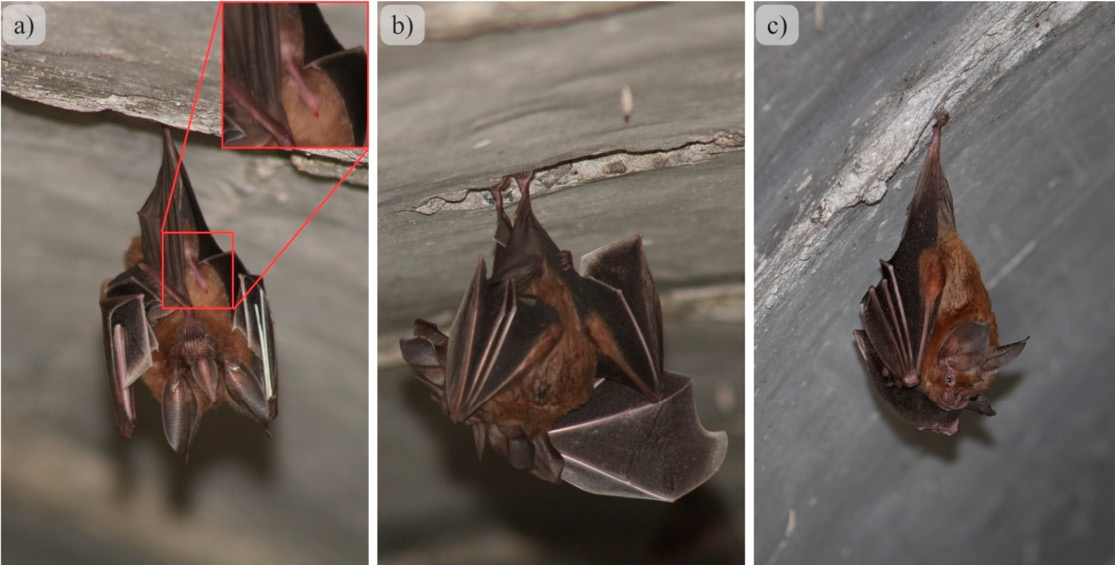
We documented copulation on May 3, 2025, during the final months of construction, when males with erect penises were observed concurrently with copulatory events (Figure 3). The presence of erect penises during these observations was interpreted as suggestive of reproductive behavior. During copulation, the male approached and positioned himself behind the female for a few seconds. Subsequently, both individuals adopted a face-to-face posture, during which the female extended her wings into an embracing position (Figure 3).
Behavioral observations associated with maternal care were recorded in early June 2025. Lactating females carrying offspring were recorded (Figure 3; Video 1). Pups were dropped off on the culvert, and an adult was observed grooming a pup, although the identity of the groomer could not be determined (Video 2). Two pups were also observed exhibiting active searching behavior characterized by repeated movements of the ears and leaf-nose. Adults often visited the pups during the night (Videos 2-4), and a possible nursing event was recorded (Video 4). In all adult-pup interactions, the arriving adult extended its wings into an embracing posture toward the pup. By late June and July, pups and volant juveniles were present.
This study documents the reproductive stages of the threatened bat Mimon cozumelae inhabiting a road culvert within a human-modified environment, providing new insights into the species’ reproductive ecology and roost use. These observations suggest that culvert may function as a mating and maternity roost for M. cozumelae and further expand current knowledge of the ecological plasticity of this poorly known species.
Our observations suggest that the reproductive stages of M. cozumelae followed a seasonal pattern consistent with increased resource availability in the Neotropics (Estrada and Coates-Estrada 2001; Willig and Presley 2023). We recorded copulatory events in May during the late dry season, whereas we observed lactating females, pups, and volant juveniles after the onset of the rainy season in June, when insect abundance typically increases.
The reproductive stages documented in this study are broadly consistent with previously reported reproductive records for M. cozumelae. Copulatory events were observed in May, whereas lactating females carrying pups, pups, and volant juveniles were recorded from June to July. Similarly, pregnant females have been reported during April in Veracruz and Yucatan, Mexico (Wilson 1979; Romo-Hernández et al. 2024), and lactating females and females carrying their pups have been documented from June to August across the Yucatan Peninsula, Honduras, and Guatemala (Rick 1968; Knox et al. 1973; Valdez and LaVal 1971; Navarro López 1982; Romo-Hernández et al. 2024), suggesting a broadly conserved reproductive schedule.
During inspections, we occasionally observed mothers carrying pups and pups temporarily dropped off inside the culvert, suggesting that females temporarily left the roost to forage and later returned to nurse and care for their pups, a behavior documented in other Phyllostomid species (Geipel et al. 2013). However, given the non-invasive approach based on direct observations, it was not possible to quantify the frequency of these behaviors or evaluate variation among individuals or across reproductive stages. Grooming interactions between adults and pups were also observed and may contribute to mother–pup recognition in dense colonies (Gustin and McCracken 1987; Balcombe and McCracken 1992), although grooming is not necessarily restricted to mothers in this species (Romo-Hernández et al. 2024).
The culvert remained occupied throughout the road construction period despite sustained anthropogenic disturbance, suggesting repeated roost use and a certain degree of behavioral tolerance to human activity. Such persistence may reflect the ecological importance of the culvert, as suitable roosts can be a limiting resource for many bat species (Gorecki et al. 2025). However, because colony composition and individual relocation to nearby culverts were not assessed, movements among nearby roosts cannot be excluded. Future studies evaluating colony dynamics and roost fidelity are necessary to better understand the long-term use of road infrastructure by M. cozumelae.
The observation of copulatory events, lactating females carrying pups, pups, and volant juveniles inside the culvert during active road construction suggests that this anthropogenic structure may function as a mating and maternity roost for M. cozumelae. The occurrence of multiple reproductive stages within the same structure highlights the close relationship between reproductive processes and roost use, and suggests that road culverts may provide suitable conditions for bats during sensitive stages of their reproductive cycle. Because road culverts are rarely considered potential mating and maternity roosts in environmental planning, our observations contribute to the growing evidence that anthropogenic structures may support reproductive populations of bats in human-modified landscapes.
Our findings underscore the need to incorporate bats inhabiting road structures into road infrastructure planning and environmental assessments. Proactive strategies, such as evaluating and monitoring culverts before, during, and after construction activities, as well as the implementation of evidence-based mitigation measures, could help identify bat colonies and minimize impacts on reproductive populations. Recognizing drainage infrastructure as poten-tial roosting habitat for bats represents an important step toward integrating biodiversity conservation into road development.
Further research is needed to better understand how construction activities may influence reproductive stages, roost use, and colony dynamics in M. cozumelae, to inform evidence-based management and public policy. Although direct capture and handling would ideally allow more precise determination of colony structure, these approa-ches may not be advisable under conditions of ongoing disturbance associated with infrastructure development. In this context, we encourage the implementation of non-invasive monitoring approaches, including direct observa-tions, photographic records, and camera-trap monitoring, which can provide valuable information while minimizing additional disturbance to bat colonies.
Acknowledgments
We thank E. N. Pérez León for field assistance during two daytime inspections. We also thank all individuals and institutions who contributed to bat conservation efforts during the road construction project, particularly the Secretaría de la Defensa Nacional (SEDENA), KeyCapital, Mota-Engil México, Mangle Soluciones Ambientales, and El Colegio de la Frontera Sur (Ecosur). We sincerely thank the reviewers for their comments and constructive suggestions, which helped improve our manuscript.
Literature cited
Arroyo-Cabrales, J., et al. 2015. Mimon cozumelae. The IUCN Red List of Threatened Species: e.T136561A21991024. https://www.iucnredlist.org/species/136561/21991024. Accessed on 20 March 2026.
Balcombe, J. P., and G. F. McCracken. 1992. Vocal recognition in Mexican free-tailed bats: do pups recognize mothers? Animal Behaviour 43:79–87.
Boerma, D. B., and S. M. Swartz. 2024. Roosting ecology drives the evolution of diverse bat landing maneuvers. iScience 27:110381.
Brunet-Rossinni, A. K., and G. S. Wilkinson. 2009. Methods for age estimation and the study of senescence in bats. Pp. 315- 325, in Ecological and behavioral methods for the study of bats (Kunz, T. H., and S. Parsons, eds). The Johns Hopkins University Press. Baltimore, USA.
Cumming, G. S., and R. T. F. Bernard. 1997. Rainfall, food abundance and timing of parturition in African bats. Oecologia 111:309–317.
Detweiler, L. W., and R. F. Bernard. 2023. Wildlife use of anthropogenic structures: a comprehensive review of bridge use by bats. Acta Chiropterologica 25:135–157.
Estrada, A., and R. Coates-Estrada. 2001. Species composition and reproductive phenology of bats in a tropical landscape at Los Tuxtlas, Mexico. Journal of Tropical Ecology 17:627–646.
Fleming, T. H., et al. 1972. Three Central American bat communities: structure, reproductive cycles, and movement. Ecology 53:555–569.
Fleming, T. H., et al. 2020. Phyllostomid bats: a unique mammalian radiation. The University of Chicago Press. Chicago, USA.
Geipel, I., et al. 2013. Postweaning maternal food provisioning in a bat with a complex hunting strategy. Animal Behaviour 85:1435–1441.
González-Gallina, A., et al. 2025. Bats underneath: assessing Neotropical bat use of highway underpasses using photo-trapping. Journal of Mammalogy 106:1412–1424.
Gorecki, V., M. Rhodes, and S. Parsons. 2020. Roost selection in concrete culverts by the large-footed myotis (Myotis macropus) is limited by the availability of microhabitat. Australian Journal of Zoology 67:281–289.
Gorecki, V., S. Parsons, and R. Maggini. 2025. Culvert design and position in the landscape predict the presence of trawling bat culvert roosts in an urban environment. Urban Ecosystems 28:149.
Gual-Suárez, F., and R. A. Medellín. 2021. We eat meat: a review of carnivory in bats. Mammal Review 51:540–558.
Gustin, M. K., and G. F. McCracken. 1987. Scent recognition between females and pups in the bat Tadarida brasiliensis mexicana. Animal Behaviour 35:13–19.
Hall, R., and Dalquest, W. 1960. The mammals of Veracruz. University of Kansas. Lawrence, USA.
Knox, J. J., J. D. Smith, and H. H. Genoways. 1973. Annotated checklist of mammals of the Yucatán Peninsula, Mexico. I. Chiroptera. Occasional Papers, The Museum, Texas Tech University 13.
Kunz, T. H. 1982. Roosting ecology of bats. Pp. 1–55 in Ecology of bats (Kunz, T. H., ed.). Plenum Publishing Corporation. New York, USA.
Kunz, T. H., and M. B. Fenton (eds.). 2003. Bat ecology. The University of Chicago Press. Chicago, U.S.A.
Kunz, T. H., and L. F. Lumsden. 2003. Ecology of cavity and foliage roosting bats. Pp. 3–89 in Bat ecology (Kunz, T. H., and M. B. Fenton, eds.). University of Chicago Press. Chicago, U.S.A.
Lausen, C. L., And R. M. R. Barclay. 2006. Benefits of living in a building: big brown bats (Eptesicus fuscus) in rocks versus buildings. Journal of Mammalogy 87:362–370.
Navarro López, D. 1982. Mamíferos de la estación de biología tropical Los Tuxtlas, Veracruz. Tesis. Mexico.
Neuweiler, G. 2000. The biology of bats. Oxford University Press. Oxford, United Kingdom.
Orr, T. J., et al. 2022. Testing morphological relationships between female and male copulatory structures in bats. Integrative and Comparative Biology 62:602–612.
Ortega, J., and H. T. Arita. 1997. Mimon bennettii. Mammalian Species 549:1–4.
Rick, A. M. 1968. Notes on bats from Tikal, Guatemala. Journal of Mammalogy 49:516–520.
Romo-Hernández, K., et al. 2024. Group structure and diurnal behavior in a large colony of Mimon cozumelae in Yucatán, México. Therya 15:170–180.
Russo, D., and L. Ancillotto. 2015. Sensitivity of bats to urbanization: a review. Mammalian Biology 80:205–212.
Secretaría de Medio Ambiente y Recursos Naturales. 2019. Norma Oficial Mexicana NOM-059-SEMARNAT-2010, Protección ambiental–Especies nativas de México de flora y fauna silvestres–Categorías de riesgo y especificaciones para su inclusión, exclusión o cambio-Lista de especies en riesgo. México. November 14, 2010.
Sippola, E. A., et al. 2026. Impacts of bat use of anthropogenic structures on bats and humans. Conservation Biology 40:e70037.
Streicker, D. G., R. Franka, F. R. Jackson, And C. E. Rupprecht. 2013. Anthropogenic roost switching and rabies virus dynamics in house-roosting big brown bats. Vector-Borne and Zoonotic Diseases 13:498–504.
Torres-Flores, J. W., and A. Santos-Moreno. 2017. Inventory, features, and protection of underground roosts used by bats in Mexico. Acta Chiropterologica 19:439–454.
Valdez, R., and R. K. LaVal. 1971. Records of bats from Honduras and Nicaragua. Journal of Mammalogy 52:247–250.
Weinberg, M., et al. 2025. Urban fruit bats give birth earlier in the season compared to rural fruit bats. BMC Biology 23:31.
Willig, M. R., and S. J. Presley. 2023. Reproductive phenologies of phyllostomid bat populations and ensembles from lowland Amazonia. Journal of Mammalogy 104:752–769.
Wilson, D. E. 1979. Reproduction in Neotropical bats. Pp. 317–378 in Biology of bats of the New World family Phyllostomidae (Baker, R.J., Jr. J. K. Jones, and D. C. Carter, eds.). Special Publications The Museum Texas Tech University. Texas, U.S.A.
Wilson, D. E., And R. A. Mittermeier (eds.). 2019. Handbook of the mammals of the world. Vol. 9: Bats. Lynx Edicions. Barcelona, Spain.
Associate editor: Beatríz del S. Bolívar Cimé
Submitted: March 27, 2026; Reviewed: August 12, 2026
Accepted: August 26, 2026
Published online: September 14, 2026
Figure 1. Study area in southeastern Mexico showing the road culvert inhabited by Mimon cozumelae during road construction. (a) Location and total length (74 m) of the reinforced concrete pipe culvert within the highway infrastructure. (b) West entrance of the culvert used by the colony as a diurnal roost. (c) Interior view of the culvert showing the spatial distribution of bats within the structure.
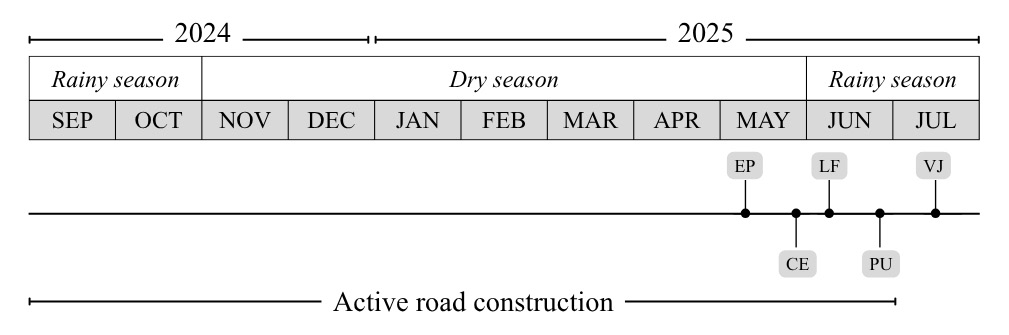
Figure 2. Schematic timeline of reproductive stages and associated behaviors of Mimon cozumelae recorded inside a road culvert during road construction in southeastern Mexico. Abbreviations: EP = males with erect penises; CE = copulatory events; LF = lactating female; PU = pups; VJ = volant juveniles.
Figure 3. Reproductive events of Mimon cozumelae documented in a culvert during road construction. (a) Adult male with an erect penis (May 3, 2025). (b) Copulation event (May 3, 2025). (c) Lactating female with offspring (June 1, 2025).
Appendix list
Appendix 1. Video 1-4. Reproductive behavior of Mimon cozumelae recorded inside a road culvert in southeastern Mexico during active road construction. (1) Lactating female carrying an offspring (June 1, 2025). (2) Adult individual grooming a pup (June 5, 2025). (3) Two pups exhibiting active searching behavior characterized by repeated movements of the ears and leaf-nose, followed by the approach of an adult toward one pup (June 9, 2025). (4) Possible nursing event (June 9, 2025). Video content can be viewed at https://zenodo.org/records/19373730.