THERYA NOTES 2026, Vol. 7:194-198
Behavioral patterns of a coordinated attack by a group of Procyon lotor on a bat in an urban coastal lagoon in Mexico
Patrones de comportamiento de un ataque coordinado de un grupo de Procyon lotor sobre un murciélago en una laguna costera urbana en México
Sergio Aguilar Olguín¹, José Gerardo Vargas Valencia¹, María Fernanda Rebolledo Vélez2,
María Cruz Rivera Rodríguez3, and María Magdalena Ramírez-Martínez4*
¹Laboratorio de Biotecnología Marina, Facultad de Ciencias Marinas, Universidad de Colima. Carretera Manzanillo - Barra de Navidad km 19.5, CP 28868, El Naranjo Manzanillo. Colima, México. E-mail: saguilar14@ucol.mx (SAO), jvargas5@ucol.mx (JGV).
2Centro Universitario de la Costa Sur (Sede Melaque), Universidad de Guadalajara. Calle Gómez Farías 82, CP 48980, Jaluco - San Patricio Melaque. Cihuatlán, Jalisco, México. E-mail: mrebolledov.24@gmail.com (MFRV).
3Unidad de Manejo de Fauna Silvestre Centro Ecológico de Cuyutlán “El tortugario”, Campamento Tortuguero S/N, Cuyutlán, CP 28350. Armería, Colima, México. E-mail: mrivera4@ucol.mx (MCRR).
4Universidad de Guadalajara, Centro Universitario de la Costa Sur, Departamento de Ciencias de la Salud y Ecología Humana, Laboratorio de Ecología de Zoonosis. Av. Independencia Nacional 151, CP 48900. Autlán de Navarro, Jalisco, México. E-mail: mmagdalena.ramirez@academicos.udg.mx (MMRM).
*Corresponding author
Ecological interactions between opportunistic mammals and bats emerge as a consequence of anthropogenic pressure and forced cohabitation in urban areas. During a wildlife diversity monitoring program in the Valle de las Garzas lagoon, Colima, Mexico, systematic camera-trapping was used to document interspecific interactions within a fragmented environment. Camera traps operated continuously for 24 h during 30 days and were programmed to record 20-s videos with a 1-s trigger interval; no bait or attractants were used. On November 20, 2025, at 18:16 h, a coordinated attack by three individuals of Procyon lotor on a fruit bat (Artibeus sp.) was recorded. The event lasted 20 seconds; following a failed flight attempt from a low perch (< 1 m), the bat fell to the ground, prompting two raccoons to actively return and initiate a simultaneous aggression, followed by a third individual. The camera was inspected 10 days after the event. Despite killing the specimen, the procyonids did not consume or further manipulate it. This represents the first record in Mexico of such coordinated attack behavior on a free-ranging fruit bat. The lack of consumption suggests the event reflects ecological dominance or territorial aggression resulting from high population density in urban wetlands, highlighting the remarkable behavioral plasticity of P. lotor under anthropogenic pressure.
Key words: Artibeus, camera-trapping, Colima, ecological dominance, raccoon, urban wetland.
Las interacciones ecológicas entre mamíferos oportunistas y quirópteros emergen frecuentemente como consecuencia de la presión antrópica y la cohabitación forzada en áreas urbanas. Durante un monitoreo de diversidad de mastofauna en la Laguna Valle de las Garzas, Colima, México, se empleó fototrampeo sistemático para documentar interacciones interespecíficas en un entorno fragmentado. Las cámaras operaron 24 hrs por 30 días continuos y fueron programadas para grabar videos de 20 s con intervalo de activación de 1 s; no se utilizó cebo ni atrayente. El 20 de noviembre de 2025, a las 18:16 h, se registró un ataque coordinado de tres individuos de Procyon lotor sobre un murciélago frugívoro (Artibeus sp.). El evento duró 20 segundos; tras un intento de vuelo fallido desde una percha a baja altura (< 1 m), el murciélago cayó al suelo, momento en el que dos mapaches regresaron de forma activa e iniciaron una agresión simultánea, seguidos por un tercer individuo. La cámara fue revisada 10 días después de que ocurrió el evento. A pesar de dar muerte al espécimen, los prociónidos no lo consumieron ni manipularon posteriormente. Este constituye el primer registro en México de este despliegue de conductas de ataque coordinado sobre un murciélago frugívoro en libertad. La ausencia de consumo sugiere que el evento responde a mecanismos de dominancia ecológica o agresión territorial derivados de la alta densidad poblacional en humedales urbanos, resaltando la notable plasticidad conductual de P. lotor ante la presión antropogénica.
Palabras clave: Artibeus, Colima, dominancia ecológica, fototrampeo, humedal urbano, mapache.
© 2026 Asociación Mexicana de Mastozoología, www.mastozoologiamexicana.org
Interspecific ecological interactions and the spatio-temporal dynamics of species are critical factors for understanding community structure in fragmented ecosystems. In urbanized environments, the Northern Raccoon (Procyon lotor) acts as an opportunistic mesocarnivore of the family Procyonidae, possessing a generalist diet and behavioral plasticity that allows it to exploit resources across natural, peri-urban, and urban landscapes (Guerrero et al. 2000; Wilson and Mittermeier 2009). This adaptive capacity can generate significant impacts on local fauna, altering mortality rates of various potential prey species (McAlpine et al. 2011).
Previous reports of interactions between raccoons and bats have been documented sporadically, primarily in the context of roosting sites. Early technical records described prehistoric raccoon predation on hibernating bats of the genus Myotis in Indiana, USA (Munson and Keith 1984). Subsequently, selective consumption of insectivorous bats affected by white-nose syndrome was reported in Canada, where raccoons discarded the wings and consumed only the body (McAlpine et al. 2011). Recently, similar behavior was documented in Central Europe, where P. lotor, as an invasive species, predates on bats in hibernacula (Cichocki et al. 2021).
Despite these reports, there are information gaps regarding coordinated attacks in Neotropical environments, particularly outside of hibernation sites. The use of camera-trapping has facilitated the recording of atypical feeding behaviors in western Mexico, such as the predation of iguanas (Ctenosaura pectinata) by raccoons in areas where apex predators have been displaced (Ortega-Álvarez et al. 2025). The objective of this work is to describe the behavioral patterns of a coordinated, non-predatory attack by a group of raccoons on a fruit bat in a highly anthropized coastal wetland of the Mexican Pacific.
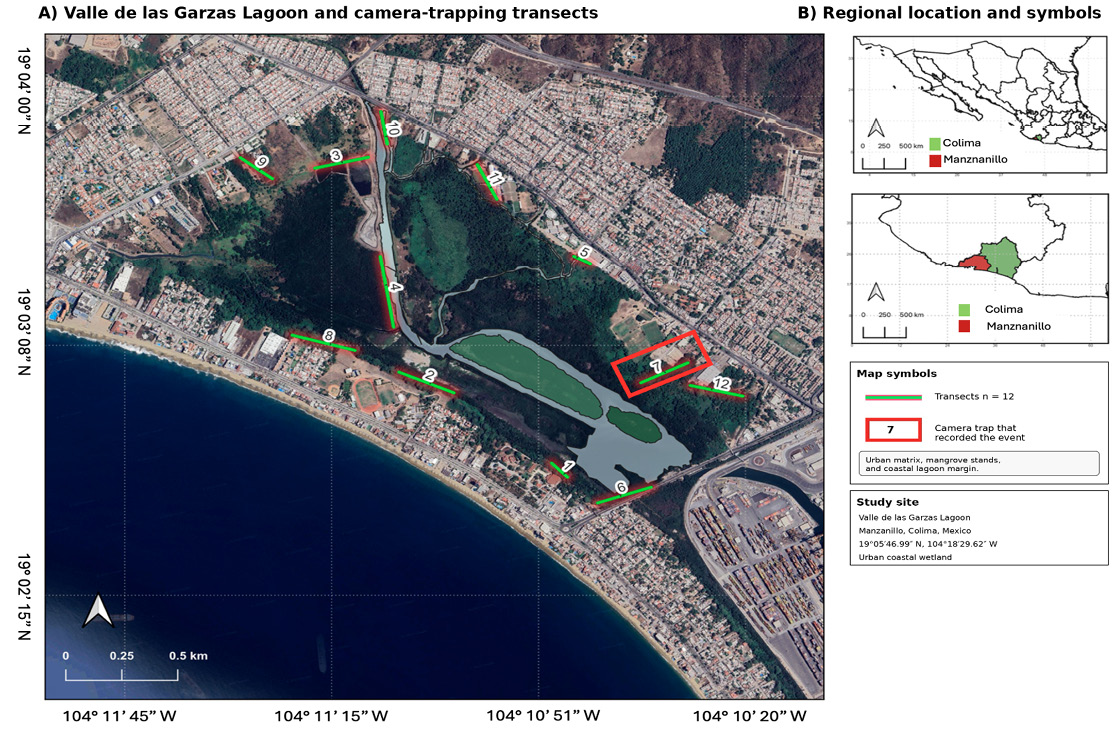
The study was conducted at the Valle de las Garzas Lagoon (19°05’46.99” N, 104°18’29.62” W), located in the coastal zone of Manzanillo, Colima, Mexico, this Lagoon is a strategic ecosystem situated at sea level, where marine and terrestrial influences converge within the Tropical and Subtropical Dry Broadleaf Forests ecoregion (Olson et al. 2001). This landscape is shaped by an Aw climate, which corresponds to a tropical savanna environment with dry winters according to the updated Köppen-Geiger classification (Kottek et al. 2006; Rzedowski 2006). Under this classification, the lagoon experiences a warm and sta-ble temperature range, with a mean annual temperature of 25.2 °C, monthly mean temperatures ranging from approxi-mately 23.7 to 26.6 °C, and mean annual precipitation of 1,098 mm, concentrated mainly during the summer rainy season (Peel et al. 2007; Climate-Data.org 2026). This fundamental thermal condition sustains the complex dynamics of the aquatic and subaquatic vegetation found along this portion of the Mexican Pacific (Rzedowski 2006). However, is currently a fragmented wetland impacted by port and urban infrastructure in Manzanillo, Colima. The area serves as a receptor for runoff and treated greywater from the surrounding micro-basin (López-Rodríguez et al. 2025). Vegetation is dominated by mangroves (Laguncularia racemosa and Rhizophora mangle), with presence of tropical dry forest species including Ficus microchlamys, Guazuma ulmifolia, Pithecellobium dulce and P. lanceolatum (Jiménez-Ramón et al. 2016; Figure 1).
The record was obtained during a medium-sized mammal diversity monitoring program, twelve camera traps (Browning Model BTC-5PX-1080 Birmingham, Alabama) were deployed at 12 different sites within the lagoon at a height of 1 m. Each camera remained installed for 30 consecutive days before inspection, and the sampling effort was expressed as trap-days, where one trap-day corresponded to one 24-hr period in which one camera operated correctly and uninterruptedly. Cameras operated continuously for 24 hr and were configured to record 20-s videos with a 1-s trigger interval (Chávez et al. 2013; Ambiente-CONAF 2021; Notario-Rincon et al. 2026). No food bait, olfactory lure, or other attractant was used at the camera-trapping stations.
To avoid overcounting consecutive detections, independent events were defined as records of the same species at the same camera station separated by at least 30 min, a criterion commonly applied in camera-trapping studies to reduce temporal pseudoreplication (Mosquera-Muñoz et al. 2014; Peral et al. 2022). Using this criterion, 14 independent raccoon capture events and one bat capture were recorded on the same transect before the attack, suggesting frequent use of this section of the wetland by raccoons.
We have a sampling effort of 360 trap-days. On November 20, 2025, at 18:16 hr, the attack sequence was recorded. Initially, a pair of raccoons passed in front of the camera without detecting a fruit bat (Artibeus sp.) perched on a shrub branch less than 1 m high. Upon sensing the proximity of the raccoons, the bat attempted to take flight but fell to the ground approximately 1 m from its original location.
Triggered by the falling movement, two raccoons immediately turned back aggressively; Figure 2 shows a characteristic “blurred eye” in one individual, confirming a swift and active turn toward the fallen specimen. These two individuals initiated a simultaneous and coordinated attack, joined seconds later by a third individual. The entire event lasted 20 seconds. The video can be found on the YouTube channel (https://www.youtube.com/watch?v=L3ubYu6f8IA).
After killing the bat, the three raccoons abandoned the site without engaging in any consumption or trophic manipulation (Figure 3). The camera was inspected on November 30, 2025, 10 days after the recorded event. During field inspection, the carcass was found at the site. A technical inspection confirmed that the specimen was an adult of the genus Artibeus; however, sex could not be determined because diagnostic external reproductive characters were not evident in the recovered remains. No evident external injuries (such as tears or loss of limbs), reinforcing the non-consumptive nature of the attack.
The recorded event differs qualitatively from previous reports that occurred in different ecological contexts: 1) dense, mixed-growth forest in New Brunswick, Canada, where raccoons consumed bats affected by white-nose syndrome (McAlpine et al. 2011), and 2) a landscape composed of forests, wetlands, and agricultural areas in Central Europe, where invasive P. lotor preyed upon hibernating bats in underground roosts (Cichocki et al. 2021). In contrast, the event reported here occurred in a highly anthropized mangrove-dominated coastal lagoon of the Mexican Pacific, outside a hibernaculum and without subsequent consumption of the bat.
This rarely observed behavior may be linked to high raccoon population densities in urban wetlands. In these environments, competition for space and habituation to anthropogenic stimuli can exacerbate territorial aggression or aggressive exploratory responses to sudden movements by other species. The simultaneous participation of multiple individuals suggests social complexity in the attack patterns of P. lotor that had not been previously described for interactions with bats in the Neotropics.
In conclusion, this record evidences the remarkable behavioral plasticity of the raccoon in the Mexican Pacific. The described interaction highlights how anthropogenic pressure in coastal wetlands alters traditional interactions between mesocarnivores and bats, promoting aggressive behaviors that do not necessarily serve a trophic function but rather a reaffirmation of dominance within the urban ecosystem.
Acknowledgment
We thank the volunteers who participated in checking the camera traps. We also thank the staff at “El Tortugario” for their support, as well as the anonymous reviewers and editorial team who helped improve the quality of this document with their suggestions.
Literature cited
Ambiente–CONAF, M. O. M. (2021). Manual de uso de trampas cámaras para el monitoreo de carnívoros nativos y exóticos. Encargado a: M. Sc. Nicolás Lagos Silva. Financiado en el marco del proyecto GEFSEC ID, 5135.
Chávez, C. et al. 2013. Manual de fototrampeo para estudio de fauna silvestre: El jaguar en México como estudio de caso. Alianza WWF-Telcel; Universidad Nacional Autónoma de México. Ciudad de México, México.
Cichocki, J. et al. 2021. Predation of invasive raccoon (Procyon lotor) on hibernating bats in the Nietoperek reserve in Poland. Mammalian Biology 101:57–62.
Climate-Data.org. 2026. Clima Manzanillo (México). Climate-Data.org. https://es.climate-data.org/america-del-norte/mexico/colima/manzanillo-764310/
Guerrero, S., Sandoval, M. R., and Zalapa, S. S. 2000. Determinación de la dieta del mapache (Procyon lotor hernandezii Wagler, 1831) en la costa sur de Jalisco, México. Acta Zoológica Mexicana (n.s.) 80:211–221.
Jiménez-Ramón, G. A. et al. 2016. Descripción de los ecosistemas en la zona costera. Pp 139-170. in La Biodiversidad en Colima. Estudio de Estado (Comisión Nacional para el Uso y Conoicmiento de la Biodiversidad ed.). CONABIO. Ciudad de México, México.
Kottek, M. et al. 2006. World Map of the Köppen-Geiger climate classification updated. Meteorologische Zeitschrift 15: 259–263.
López-Rodríguez, D., et al. 2025. Port Growth and Socioen-vironmental Implications in a Coastal Lagoon: Case of Laguna del Valle de las Garzas, Mexico. Pp 1-27 in Handbook of Sustainable Blue Economy (Lang, A., Eustachio, J., and M. A., Pimenta, eds.). Springer Nature. Cham, Switzerland.
McAlpine, D. F., et al. 2011. Consumption of bats (Myotis spp.) by raccoons (Procyon lotor) during an outbreak of white-nose syndrome in New Brunswick, Canada: Implications for estimates of bat mortality. The Canadian Field-Naturalist 125:257–260.
Mosquera-Muñoz, D. M., G. Corredor, P. Cardona, and I. Armbrecht. 2014. Fototrampeo de aves caminadoras y mamíferos asociados en el piedemonte de Farallones de Cali. Boletín Científico, Museo de Historia Natural, Universidad de Caldas 18:144–156.
Munson, P. J. and J. H. Keith. 1984. Prehistoric raccoon predation on hibernating Myotis, Wyandotte cave, Indiana. Journal of Mammalogy 65:152–155.
Notario-Rincon, D. et. al. 2026. Disentangling Multitrophic Interactions: How Vegetation Cover, Wild Boar, Deer, and Predators Shape Rodents Activity and Acorn Dispersal. Integrative Zoology
Olson, D. M., et al. 2001. Terrestrial ecoregions of the world: a new map of life on Earth: A new global map of terrestrial ecoregions provides an innovative tool for conserving biodiversity. BioScience 51:933–938.
Ortega-Álvarez, R. J. et al. 2025. Depredación de iguana mexicana de cola espinosa (Ctenosaura pectinata) por un mapache norteño (Procyon lotor) en el occidente de México. Mammalogy Notes 11:478.
Peel, M. C., B. L. Finlayson, and T. A. McMahon. 2007. Updated world map of the Köppen-Geiger climate classification. Hydrology and Earth System Sciences 11:1633–1644.
Peral, C., M. Landman, and G. I. H. Kerley. 2022. The inappropriate use of time-to-independence biases estimates of activity patterns of free-ranging mammals derived from camera traps. Ecology and Evolution 12: e9408.
Rzedowski, J., 2006. Vegetación de México. 1ra. Edición digital. Comisión Nacional para el Conocimiento y Uso de la Biodiversidad. Ciudad de México, México.
Wilson, D. E., and Mittermeier, R. A. 2009. Handbook of the mammals of the world. Lynx Editions. Barcelona, España.
Associate editor: Beatríz del S. Bolívar Cimé
Submitted: March 01, 2026;
Reviewed: August 05, 2026.
Accepted: August 20, 2026;
Published online: September 25, 2026
DOI: 10.12933/therya_notes-25-253
ISSN 2954-3614
Figure 1. Geographic location of the Valle de las Garzas Lagoon in the municipality of Manzanillo, Colima, Mexico. The map shows the 12 camera-trapping transects and the camera station where the attack event was recorded.
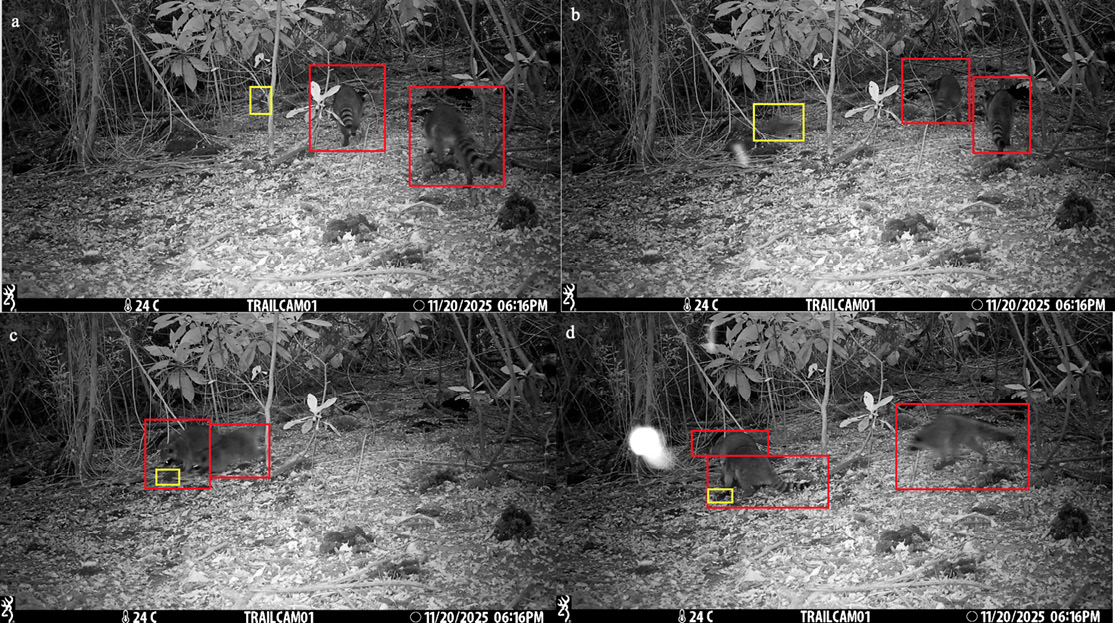
Figure 2. Four-panel sequence of the coordinated attack by Procyon lotor on a fruit bat (Artibeus sp.) recorded by camera trap in the Valle de las Garzas Lagoon, Manzanillo, Colima, Mexico: a) the bat is perched on low vegetation while raccoons pass in front of the camera; b) the bat attempts to fly and falls near the raccoons; c) two raccoons return and initiate the attack; d) the bat remains on the ground after the raccoons abandon the site. Red boxes indicate raccoons and yellow boxes indicate the bat. The complete video record is available on YouTube (https://www.youtube.com/watch?v=L3ubYu6f8IA).
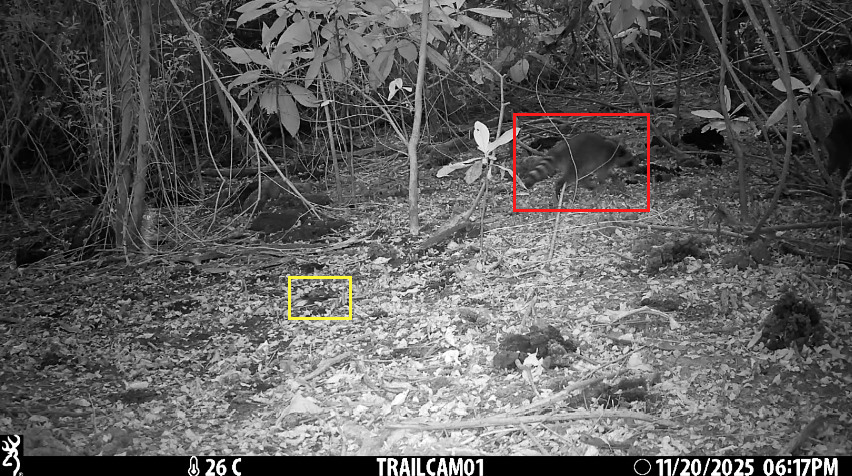
Figure 3. Final frame showing that the three raccoons abandoned the site after killing the bat, without subsequent consumption or trophic manipulation.