THERYA NOTES 2026, Vol. 7:180-185
Use of artificial drinking containers by mammals in a semi-arid area of Central Veracruz, Mexico
Uso de bebederos artificiales por mamíferos en una área semiárida del Centro de Veracruz, México
Emilio A. Suárez Domínguez1, Jimena Campuzano Barradas2, Carol-Anne Sánchez Contreras2,
Neyda Montes Rivera2, Oriana Domínguez Juárez3, Estela García Hernández3, and Julliana Barretto1*
1Museo de Zoología, Facultad de Biología – Xalapa, Universidad Veracruzana. H-ABEX, Universitario Gonzalo Aguirre Beltrán, S/N, Zona Universitaria, C.P. 91090, Xalapa, Veracruz, México. E-mail: emisuarez@uv.mx (EASD), E-mail: barrettojulliana@gmail.com (JB).
2Facultad de Biología-Xalapa, Universidad Veracruzana. H-ABEX, Universitario Gonzalo Aguirre Beltrán, S/N, Zona Universitaria, C.P. 91090, Xalapa, Veracruz, México. E-mail: jmncampuzano@gmail.com (JCB), E-mail: zS21011153@estudiantes.uv.mx (CASC), E-mail: zS22011055@estudiantes.uv.mx (NMR)
3Maestría en Ciencias Biológicas, Facultad de Biología-Xalapa, Universidad Veracruzana. H-ABEX, Universitario Gonzalo Aguirre Beltrán, S/N, Zona Universitaria, C.P. 91090, Xalapa, Veracruz, México. E-mail: cesargarcia152220@gmail.com (CEGP), E-mail: zS20013097@estudiantes.uv.mx (ODJ), E-mail: estelagh23@hotmail.com (EGH).
*Corresponding author
In arid and semi-arid environments, water scarcity is a constant challenge faced by wild vertebrates. To mitigate this, the strategy of installing artificial waterholes has been used. We hypothesize that wild mammals visit the artificial waterholes more frequently in the warmer than in the colder months in the Valle de Perote. The main goal of this study is registered mammals’ species that use artificial drinking containers in xerophytic scrubland within semi-arid zone at center of Veracruz, Mexico. Between April and July, October and November 2025, 12 artificial water containers were installed with a camera trap to record the date, time, number of occurrences, sighting coordinates and species of mammal individuals that drank water. Subsequently, the Photograph Visit Index (PVI) was calculated. Seven species belonging to six families and three orders of mammals were photographed. The species with the highest number of records was Mephitis macroura (PVI = 4.44). May and October were the months with the most species recorded by the camera traps. The installation of artificial water containers throughout warmest months can be a fundamental strategy for wild fauna maintenance, which could be useful as a platform for the conservation of these vertebrates in the Perote Valley, a site where water scarcity prevails.
Key words: Camara-traps; habits; scarcity of resources; water; xerophytic scrubland.
En ambientes áridos y semiáridos la escasez de agua es un factor constante que enfrentan los vertebrados silvestres. Para mitigarla se ha usado la estrategia de la instalación de bebederos artificiales. Hipotetizamos que los mamíferos silvestres visitan los bebederos artificiales con mayor frecuencia en los meses más calurosos que en los meses más fríos en el Valle de Perote. Nuestro objetivo fue registrar especies de mamíferos que usan bebederos artificiales en el matorral xerófilo del Valle de Perote, Veracruz, México. Se colocaron 12 bebederos acompañados de cámaras trampa, entre los meses de Abril y Julio, Octubre y Noviembre de 2025. Se registró la fecha, hora, número de aparición, coordenada de avistamiento y especie. Posteriormente, se obtuvo el índice de registros por fotografía (IRF). Se fotografiaron siete especies pertenecientes a seis familias y tres órdenes. La especie con mayor número de registros fue Mephitis macroura (IRF = 4.44). Mayo y octubre fueron los meses con más especies captadas por las cámaras trampa. La instalación de bebederos artificiales durante los meses más calurosos podría ser una estrategia fundamental para el mantenimiento de la fauna silvestre, que a la postre podría servir de plataforma para la conservación de estos vertebrados en el Valle de Perote, un sitio donde impera la escasez de agua.
Palabras clave: Agua; cámaras-trampas; escasez de recursos; hábitos; matorral xerófilo.
© 2026 Asociación Mexicana de Mastozoología, www.mastozoologiamexicana.org
Approximately 60 % of Mexico territory is represented by arid and semi-arid zones (Challenger and Soberón 2008), in which the dominant vegetation are natural grasslands and scrublands (Rzedowski 1978; Medrano 2012). At the center of Veracruz state, particularly at the Valle de Perote–Alchichica, even though other vegetation types could be found, such as grassland, pine forest, oyamel fir forest, among others, the xerophytic scrubland is considered of high biological value and endemism (Ellis and Martínez-Bello 2010; Garrido et al. 2017; Rivera-Hernández et al. 2019), since is located between Cofre de Perote and Sierra Norte de Puebla mountains (Medina and Angulo 1990).
The Valle de Perote presents extreme environmental conditions, temperature could reach up 34 °C at spring (from March to May) and -13 °C at winter (from December to February) (Peón 2017), while precipitation is markedly by rain scarcity between July and August, or oscillates below 20 mm between November and April (Peón 2017). These characteristics force local mammals to an evolutionary adjustment to semi-arid environment, especially for obtaining and storing water, which includes behavioral, morphological and physiological changes (Rymer et al. 2016); nevertheless, water scarcity could be a stress factor for animals altering their ecological dynamics (Hernández-Gómez et al. 2020; Chen et al. 2024; Schmied et al. 2025).
To mitigate the effects of scarcity of water on local fauna many strategies have been proposed by researchers like the use of artificial drinking containers (Fuller et al. 2014; Torre et al. 2019; Schmied et al. 2025). In addition to benefiting the local wildlife, the use of artificial drinking containers is also useful to obtain information about conservation actions on protected areas (Epaphras et al. 2008), maintenance and monitoring of animal populations (Sutherland et al. 2018), synergetic activities (Mandujano and Hernández-Gómez 2019), determine the distance traveled by the animals in search of water (Schmied et al. 2025), among others. The main goal of this study is to register mammals’ species that use artificial drinking containers in xerophytic scrubland within semi-arid zone at center of Veracruz, Mexico. Our hypothesis is that in the Valle de Perote, mammals visit artificial ponds more frequently in the warmer months (April and May) than in the colder months (June, July, October and November).
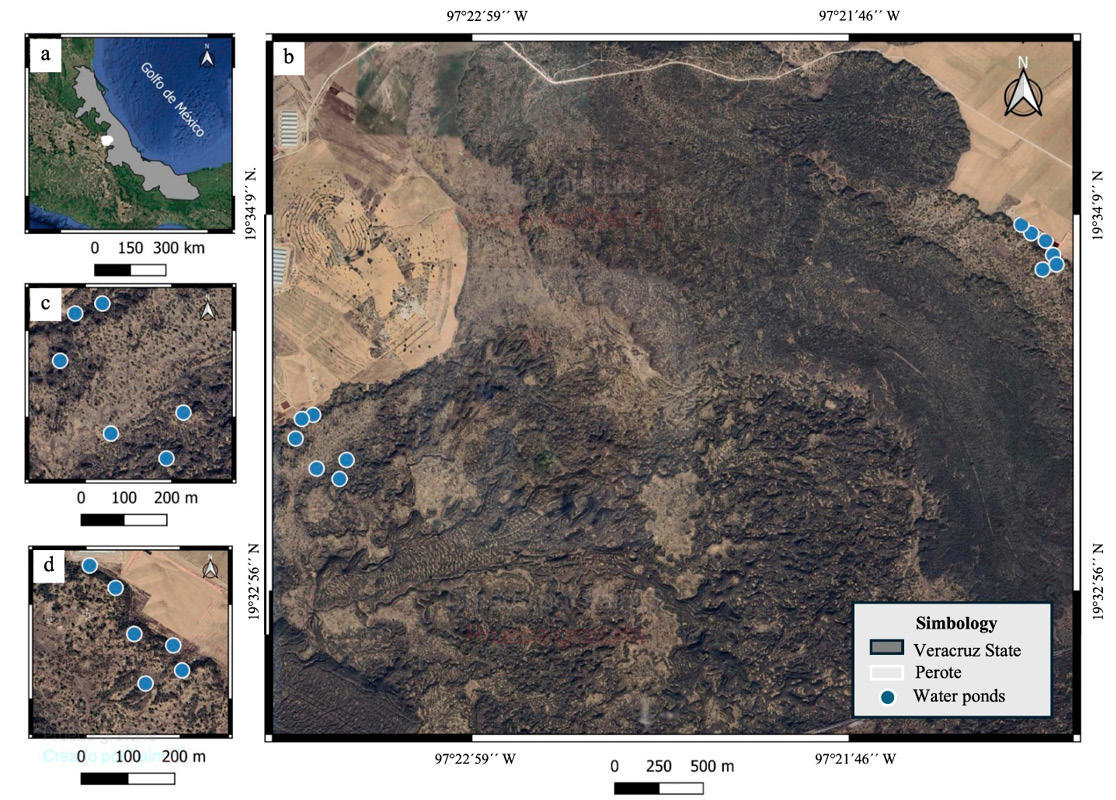
Field sampling was conducted at ejido of Frijol Colorado (19° 34’ 54’’ N, -97° 21’ 55’’ W), located at the Valle de Perote, Veracruz (Figure 1a), a transition zone between the Sierra Madre Oriental and the Mexican Plateau, at an altitude of 2,300 to 2,700 m above sea level (Garrido et al. 2017). The climate is temperate sub-humid, with an average annual temperature of 12 °C, being April and May more warm (mean average of 23.75 °C and 24.22 °C, respectively) and more cold between June-July (mean average of 20.01 °C and 20.70 °C, respectively) and October - November (mean average of 18.82 °C and 18.5 °C, respectively; CONAGUA 2025), and annual precipitation between 600 and 800 mm (Garrido et al. 2017; Peón 2017). Sampling was conducted in xerophytic scrubland zone (Figure 1b) characterized by presence of native arid vegetation, such as cactus of Opuntia and Yuca genus, typical of Valle de Perote biome (Medrano 2012).
Between April and July and October and November (totaling 6 months) of 2025, 12 artificial drinking containers were installed (Figure 1c and 1d), at variable distances, since in August and September data were lost due to cameras mechanicals failure. Pond consists of polyethylene containers of 52 cm in diameter, 42 cm deep and 110 l in capacity. Each container was filled with water and natural stones simulating steps to prevent small animals from drowning if they eventually fall into the container. Every five days per month, the artificial waterhole was drained for the removal of stagnant water, internal cleaning, rocks cleaning, and renewal of potable water (Figure 2).
A camera trap (Cuddebak IR-20 and MOULTRIE A-30) was installed 1 m away from each artificial pond, programmed to take photographs 24 hr a day with 5-s intervals between recordings, remaining in field for 10 days per month, totalizing 60 days of sampling. For each recording, the following information was obtained: geographical location, date, time, frequency of records and species. To identify mammal species, we used the guide of Aranda (2012) and personal experience based on morphological characteristics. In this study animals were not captured, nevertheless, field work was approved by Secretaría de Medio Ambiente y Recursos Naturales (SEMARNAT, SBRA/DGVS/02048/25).
The Photograph Visit Index (PVI) was calculated with the formula PVI = C/EM*100 trap-days, where C = number of captures or independent events photographed, EM = sampling effort (number of camera traps per monitoring day) and 100 trap days (Contreras-Moreno et al. 2024). Only independent records, defined here as consecutive photographs of different species and photographs of individuals of same species when the delay between two consecutive images exceeded 1 hr (Bautista-Ramírez et al. 2025).
From 720 days/trap of sampling effort, we obtained 56 records of seven species of medium terrestrial wild mammals, representing three orders and six families (Table 1). The species with the highest number of records was the skunk (Mephitis macroura, PVI = 4.44) and the lowest were ringtail (Bassariscus astutus) and rabbit (Sylvilagus sp.) with PVI = 0.13, respectively (Table 1).
Most of the records showed only one individual of one species using drinking containers. But records in October showed two events of rodents’ species co-ocurrence, one between two individuals of Neotoma mexicana, and another between individuals of Peromyscus sp. and N. mexicana (Figure 2).
Among sampling months, April and October have a greater number of species registered (N = 5), with 13 and 16 records, which provides the highest PVI of 10.8 and 13.3, res-pectively (Table 1). July was the only month with one species recorded (Table 1). The skunk was the species recorded throughout all months, except in July (Table 1). Most species were recorded between twilight and night, approximately between 17:00 and 05:00 hr, and only the rabbit (Sylvilagus) was recorded in the morning (07:00 hr, Table 1).
In this study we recorded for the first time the use of artificial drinking containers in Valle de Perote. Our hypothesis was partially accepted since we observed a difference of mammals´ records between months. Our data indicates the ecological value of artificial drinking containers for wild mammals´ biodiversity in Valle de Perote ecosystem.
Semi-arid zones, as Valle de Perote, usually have high solar radiation with wide temperature variations and water scarcity (Challenger and Soberón 2008), for which wild mammals have developed physiological or behavioral strategies to feed and hydrate (Fuller et al. 2014). Some of these strategies are nocturnal habits, such forage and moves, to avoid high temperatures, reducing energetic losses, and starvation or dehydration during the day (Fuller et al. 2014; Harris et al. 2015). This agrees with our data that show mammals species registered in Valle de Perote are mostly nocturnal (Aranda 2012; Monroy-Vilchis et al. 2011) and explains why most records were made during the dark hours. Also, such nocturnal habits were clearer during the warmest months of the year, April and May, when water scarcity was higher (Ochoa-Martínez et al. 2017; CONAGUA, 2025).
We recorded two events of co-occurrence of rodents at drinking containers. It has been documented that mammals´ co-occurrence at artificial drinking ponds is a rare event, even more between rodent species (López-Téllez et al. 2021). This is because usually rodents do not use drinking containers since they may actually obtain water from food (Cortés et al. 2000). Nevertheless, rodent co-occurrence could reflect the ability of wild fauna to take advantage of the presence of water reservoirs installed nearby shelter sites used by these animals, like rocks or agave plants (Schweiger et al. 2021). Moreover, water reservoirs could increase invertebrates prey variety and availability compensating for the low availability of food with high concentration of water, such as succulent or fruits of Opuntia genus (Picazo and García-Collazo 2019). All these suggestions should be taken with precaution since they are based on reduced records of rodent species.
In this study we recorded prey and predator species of mammals, in some cases, drinking from the same waterhole at different times. This coincidence could be related to predator behavior, such as bobcat, skunk, ringtail, and coyote, in their search for preys as rodents and rabbits, considered their primarily food (Grajales-Tam and González-Romero 2014; Picazo and García-Collazo 2019; Draper et al. 2022; Martínez-Calderas and Colima 2026). For example, coyote is a species that has adapted to climatic variations and has expanded its distribution range in order to obtain food (Gier 2009), whereas the bobcat presents a variable home range, reaching approximately 25 km2, depending on the availability and competition of resources (Monroy and Briones-Salas 2012; Elizalde-Arellano et al. 2012). Thus, we suppose that coyote and bobcat recorded in this sampling first detected the prey, mostly rodents, near drinking containers and then hydrated themselves in said containers.
The skunk (M. macroura) was the species with greater number of records using drinking containers, particularly in most warmer months (April = 4 and May = 16 records), which coincided with previous study that analyzed fauna visits to a natural well, conducted in a dry tropical forest in the center of Mexico (López-Tellez et al. 2021). Because of their omnivorous habit (mainly based on seeds and insects; Briones-Salas et al. 2023) skunks could find more available food nearby drinking containers which could explain a great number of records at the same waterhole.
We highlight the ecological importance of drinking fountains since they increase food availability and fauna interaction (Vinueza-Hidalgo et al. 2024). Because of this, it is important to choose well the site for drinking containers installation to avoid people encountering and hunting areas (Perez-Flores et al. 2021; Contreras-Moreno et al. 2025); to choose durable and good quality recipients with permanent maintenance to avoid ingestion of microplastics and zoonosis by wild fauna (Kolenda et al. 2022); and finally, to assurance local setting with natural materials, preferably, stones and logs to increase the probability of use by many species and to avoid eventual deaths by drowning, especially of small animals (Hernández-Gómez et al. 2020; Ovalle-Rivera et al. 2020).
The installation of artificial drinking containers in semi-arid zones like Valle de Perote could be an alternative for the maintenance and conservation of many wild fauna species, being a useful tool for evaluating vertebrate diversity, and thus, understanding more specific aspects of mammals´ ecology, behavior and physiology. These are essential to understanding the individual’s response to local environmental factors, such as temperature that in Valle de Perote could vary significantly between seasons, months or even between day and night.
Acknowledgments
We thank to U. A. Arizmendi Narvaez, K. P. García Melchor, students of Facultad de Biología, Xalapa, by their support in field work. To the Ejido commissioners of the study area and the GCM, S de R.L. de C.V. for the facilities and access to the sampling points. Additional gratitude to the Editor and anonymous reviewers for their thoughtful comments.
Literature cited
Aranda M. 2012. Manual para el rastreo de mamíferos silvestres de México. Apolo ediciones. Distrito Federal, México.
Bautista-Ramírez, P., et al. 2025. Community Monitoring: Promoting Conservation in Candelaria, Campeche, Mexico. Agro Productividad 18:149–61.
Briones-Salas, M., et al. 2023. The use of camera traps to study the hooded skunk Mephitis macroura (Carnivora: Mephitidae) abundance. Caldasia 45:332–340.
Challenger, A., and J. Soberón. 2008. Los ecosistemas terrestres. Pp. 87–108 in Capital natural de México (Soberón, J., Halffter, G., and J. Llorente-Bousquets, eds.) Volumen 1. Comisión Nacional para el Conocimiento y el Uso la Biodiversidad (CONABIO). Distrito Federal, México.
Chen, F., et al. 2024. Intersecting planetary health: Exploring the impacts of environmental stressors on wildlife and human health. Ecotoxicology and Environmental Safety 283:116848.
COMISIÓN NACIONAL DEL AGUA (CONAGUA). 2025. Información Estadística Metodológica, ESTACIÓN PEROTE 30128. https://smn.conagua.gob.mx/es/climatologia/informacion-climatologica/informacion-estadistica-climatologica
Contreras-Moreno, F. M., et al. 2024. Use of artificial water troughs by deer in the Maya forest, México. Therya 15:103–111.
Contreras-Moreno, F.M., et al. 2025. Use of artificial water sources by tapirs in the Maya Forest, Mexico. Revista Mexicana de Biodiversidad 96:e965483.
Cortés, A., M. Rosenmann, and F. Bozinovic. 2000. Water economy in rodents: evaporative water loss and metabolic water production. Revista Chilena de Historia Natural 73:311–321.
Draper, J., T. Rodgers, and J.K. Young. 2022. Beating the heat: ecology of desert bobcats. BMC Ecology and Evolution 22:25.
Elizalde-Arellano, C., et al. 2012. Home range size and activity patterns of bobcats (Lynx rufus) in the southern part of their range in the Chihuahuan Desert, Mexico. The American Midland Naturalist 168:247–264.
Ellis, E., and M. Martínez-Bello. 2010. Vegetación y uso de suelo Pp. 203–226 in Atlas del patrimonio natural, histórico y cultural de Veracruz (Florescano, E., and J. Ortiz-Escamilla, eds). Universidad Veracruzana. Veracruz, México.
Epaphras, A. M., et al. 2008. Wildlife water utilization and importance of artificial waterholes during dry season at Ruaha National Park, Tanzania. Wetlands ecology and management 16:183–188.
Gier, H. T. 2009. Coyote. Pp. 247–262 in The wild canids: their systematic, behavioral ecology and evolution (W. Fox ed.). Dogwise Publishing. Washington, USA.
Fuller, A., et al. 2014. Adaptation to heat and water shortage in large, arid-zone mammals. Physiology 29:159–167.
Garrido, G.Y., M.E. Nava-Bringas, and A. Ochoa-Martínez. 2017. Descripción del Valle de Perote. Pp. 19–32 in Valle de perote: Aspectos bioclimáticos y socioeconómicos (Ochoa-Martínez, C. A. cord.). Granjas Carroll y Arana ediciones. Xalapa, México.
Grajales-Tam, K.M., and A. González-Romero. 2014. Determinación de la dieta estacional del coyote (Canis latrans) en la región norte de la Reserva de la Biosfera Mapimí, México. Revista Mexicana de Biodiversidad 85:553–564.
Harris, G., et al. 2015. Weather and prey predict mammals’ visitation to water. PLoS One 10:e0141355.
Hernández-Gómez, C.A., et al. 2020. Uso de bebederos artificiales por pequeños roedores en un bosque tropical seco en Oaxaca, México. Mammalogy Notes 6:179–179.
Hofmann, G.S., et al. 2016. Implications of climatic seasonality on activity patterns and resource use by sympatric peccaries in northern Pantanal. International Journal of Biometeorology 60:421–433.
Kolenda, K., et al. 2022. Bottled & canned–Anthropogenic debris as an understudied ecological trap for small animals. Science of the Total Environment 837:1–8.
López-Téllez, C., et al. 2021. Vertebrates visiting natural waterholes in a tropical seasonal habitat in central México. Therya Notes 2:89–93.
Mandujano, S, and C. A. Hernández-Gómez. 2019. Use of artificial drinking containers by collared peccary during the dry season in a semi-arid tropical habitat in Central Mexico. Suiform Soundings 18:11–19.
Martínez-Calderas, J. M., and A. B. G. Colima. 2026. Puma (Puma concolor) and bobcat (Lynx rufus) diet overlap in northern Chihuahua. Therya 17:99–110.
Medina, M., and M. Angulo. 1990. Atlas climático del Municipio de Perote (Estado de Veracruz). Instituto Nacional de Ecología. Distrito Federal, México.
Medrano, F. G. 2012. Las zonas áridas y semiáridas de México y su vegetación. Instituto Nacional de Ecología y Secretaría de Medio Ambiente y Recursos Naturales. Distrito Federal, México.
Monroy‐Vilchis, O., et al. 2011. Fototrampeo de mamíferos en la Sierra Nanchititla, México. Revista de Biología Tropical 59:373–383.
Monroy, G., and M. Briones-Salas. 2012. Primeros datos sobre área de actividad de gato montés (Lynx rufus) en Oaxaca, México. Acta Zoológica Mexicana 28:471–474.
Ochoa-Martínez, C. A., et al. 2017. Valle de Perote: clima y eventos extremos. Pp. 31–52 in El impacto de las Ciencias de la Tierra en la Sociedad (Mora-González, I. ed.). Universidad Veracruzana. Veracruz, México.
Ovalle-Rivera, N.A., et al. 2020. Características de aguajes artificiales y su relación con el uso por la fauna silvestre en Coahuila, México. Agrociencia 54:825-842.
Peón, A. L. D. 2017. Climatología del municipio de Perote. Pp. 33–50 in Valle de Perote: Aspectos bioclimáticos y socioeconómicos (Ochoa-Martínez, C. A. cord.). Granjas Carroll and Arana ediciones. Xalapa, México.
Pérez-Flores, J., et al. 2021. Human-wildlife conflicts and drought in the greater Calakmul Region, Mexico: implications for tapir conservation. Neotropical Biology and Conservation 16:539-563.
Picazo, G. E. R. C., and R. García-Collazo. 2019. Comparación de la dieta del cacomixtle norteño, Bassariscus astutus, de un bosque templado y un matorral xerófilo, del centro de México. Biocyt: Biología, Ciencia y Tecnología 12:834–845.
Rivera-Hernández, J. E., et al. 2019. Flora y vegetación de la región semiárida de Acultzingo-Maltrata, Veracruz, México. Acta Botanica Mexicana 126:e1433.
Rymer, T.L., N. Pillay, and C. Schradin. 2016. Resilience to droughts in mammals: a conceptual framework for estimating vulnerability of a single species. The Quarterly Review of Biology 91:133–176.
Rzedowski, J. 1978. La vegetación de México. Limusa Ediciones. Distrito Federal, México.
Schmied, C., et al. 2025. Effect of human induced surface water scarcity on herbivore distribution during the dry season in Ruaha National Park, Tanzania. Wildlife Biology 1:1–14. e01131.
Schweiger, B. R., J. K. Frey, and J. W. Cain III. 2021. A case for multiscale habitat selection studies of small mammals. Journal of Mammalogy 102:1249–1265.
Sutherland, K., M. Ndlovu, and A. Pérez-Rodríguez. 2018. Use of artificial waterholes by animals in the southern region of the Kruger National Park, South Africa. African Journal of Wildlife Research 48:1–14.
Torre, I., et al. 2019. The efficiency of discarded drink containers for small mammal detection on a Mediterranean Mountain. Mammal Study 44:243–252.
Vinueza-Hidalgo, G. S., et al. 2024. Use of natural and artificial cavities by Neotropical mammals in a tropical wet forest of Costa Rica. Discover Conservation 1:1–13.
Associate editor: David Valenzuela-Galván
Submitted: February 26, 2026; Reviewed: July 28, 2026
Accepted: August 14, 2026; Published on line: August 27, 2026
DOI: 10.12933/therya_notes-25-251
ISSN 2954-3614
Figure 1. Study area of mammals’ species records by camara traps in artificial drinking containers between April and November 2025 in the Valle de Perote, Veracruz, Mexico. a) Localization of Valle de Perote, b) sampling area of xerophytic scrubland vegetation, and in detail, c and d) artificial drinking containers installed in the sampling area.
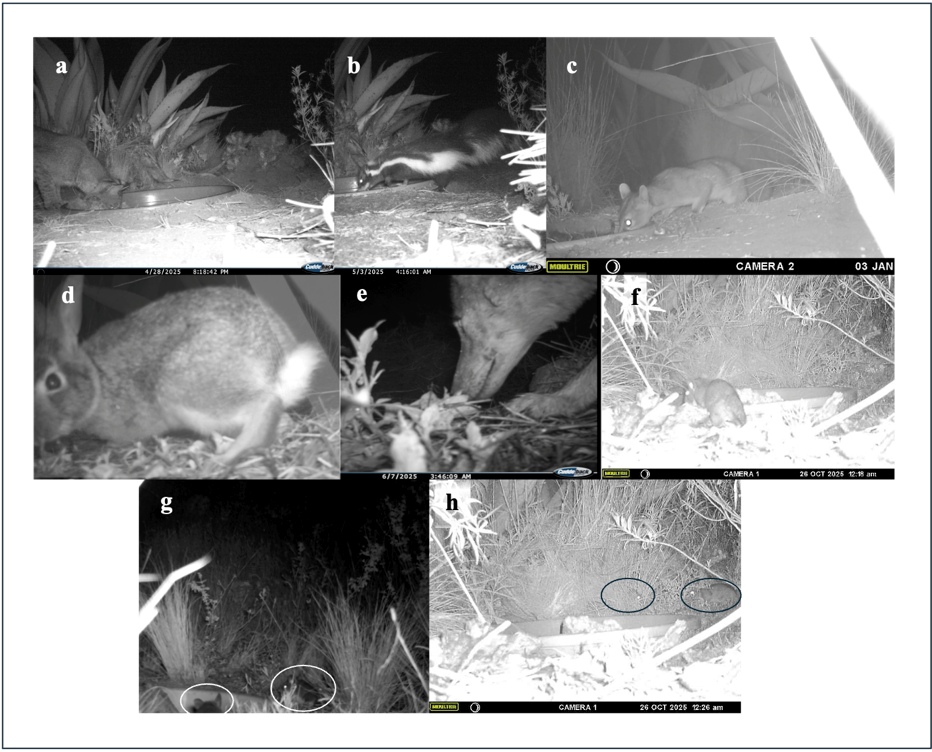
Figure 2. Mammals’ records by camara traps in artificial drinking containers between April and November 2025 in the Valle de Perote, Veracruz, Mexico. Records of a) bobcat (Lynx rufus), b) skunk (Mephitis macroura), c) ringtail (Bassariscus astutus), d) rabbit (Sylvilagus sp.), e) coyote (Canis latrans), f) Mexican woodrat (Neotoma mexicana), g) co-occurrence between mice (Peromyscus sp.) and h) co-occurrence between mouse (Peromyscus sp.) and Mexican woodrat (Neotoma mexicana).
Table 1. Mammals’ species records by camara traps in artificial drinking containers between April and November 2025 in the Valle de Perote, Veracruz, Mexico.
|
Taxa |
Dietary groups |
Time of record (range) |
Number of records |
Total |
PVI |
|||||
|
Apr |
May |
Jun |
Jul |
Oct |
Nov |
|||||
|
CARNIVORA |
||||||||||
|
Procyonidae |
||||||||||
|
Bassariscus astutus |
Carnivorous |
23:00 hr |
1 |
0 |
0 |
0 |
0 |
0 |
1 |
0.13 |
|
Canidae |
||||||||||
|
Canis latrans |
Carnivorous |
17:00-05:00 hr |
2 |
0 |
1 |
0 |
4 |
1 |
8 |
1.11 |
|
Felidae |
||||||||||
|
Lynx rufus |
Carnivorous |
20:00-01:00 hr |
3 |
4 |
0 |
1 |
1 |
0 |
9 |
1.25 |
|
Mephitidae |
||||||||||
|
Mephitis macroura |
Carnivorous |
19:00-05:00 hr |
4 |
16 |
2 |
0 |
8 |
2 |
32 |
4.44 |
|
RODENTIA |
||||||||||
|
Cricetidae |
||||||||||
|
Peromyscus sp. |
Omnivore |
21:00-04:00 hr |
3 |
0 |
0 |
0 |
0 |
0 |
3 |
0.41 |
|
Neotoma mexicana |
Omnivore |
21:00-22:00 hr |
0 |
0 |
0 |
0 |
2 |
0 |
2 |
0.27 |
|
LAGOMORPHA |
||||||||||
|
Leporidae |
||||||||||
|
Sylvilagus sp. |
Herbivorous |
07:00 hr |
0 |
0 |
0 |
0 |
1 |
0 |
1 |
0.13 |
|
Total |
13 |
20 |
3 |
1 |
16 |
3 |
56 |
|||
|
PVI |
10.8 |
16.6 |
2.5 |
0.8 |
13.3 |
2.5 |
||||