THERYA NOTES 2026, Vol. 7:260-265
First photographic record of black bear (Ursus americanus)
in Central San Luis Potosi, Mexico
Primer registro fotográfico de oso negro (Ursus americanus)
en el centro de San Luis Potosí, México
Nallely Martínez Sánchez1*, Sadoth Vázquez Mendoza2, Patricia De la Cruz Gallardo3,
Daniela M. Escanamé Díaz de León1, and Briseida López Álvarez1
1El Colegio de San Luis A.C., Parque Macul 155, Colinas del Parque, C.P. 78294 San Luis Potosí, S.L.P., México. E-mail: naxhely79@gmail.com (NMS); daniela.escaname.ddl@gmail.com (DMED); briseida.lopez@colsan.edu.mx (BLA)
2Instituto de Investigación de Zonas Desérticas – UASLP, De Altair 200, Col. del Llano, C.P. 78330 San Luis Potosí, S.L.P., México. E-mail: savazq70@hotmail.com (SVM)
3Facultad de Ingeniería – UASLP, Av. Dr. Manuel Nava 304, Zona Universitaria, C.P. 78210 San Luis Potosí, S.L.P., México. E-mail: patricia.dlcg03@gmail.com (PDG)
*Corresponding author
The black bear (Ursus americanus) has experienced a significant reduction in its historical distribution in Mexico; however, records within this historical range have recently been documented again, particularly in the central-eastern part of the country. This paper reports the first confirmed photographic record of U. americanus for the Sierra de Álvarez, in “ejido” Los Alamitos, municipality of Rioverde, San Luis Potosí. The record was obtained through a community monitoring scheme based on the use of camera traps installed in sites with previous evidence of medium and large mammal activity. The presence of one individual was documented in an environment dominated by pine forests, at an altitude between 1608 and 1785 meters above sea level. This sighting suggest recent dispersal of the species from northeastern populations to the central part of the country. The presence of protected natural areas in the region may be facilitating landscape connectivity and the movement of the species. These results highlight the importance of community monitoring and the conservation of biological corridors, such as the Sierra Madre Oriental Ecological Corridor (CESMO), for the long-term protection of the black bear in Mexico.
Key words: Black bear; camera traps; distribution; San Luis Potosí; Sierra Madre Oriental
El oso negro (Ursus americanus) ha experimentado una reducción significativa en su distribución histórica en México; sin embargo, en años recientes, se han documentado nuevamente registros dentro de su distribución histórica, particularmente en el centro-oriente del país. En este trabajo se reporta el primer registro fotográfico confirmado de U. americanus para la Sierra de Álvarez, en el ejido Los Alamitos, municipio de Rioverde, San Luis Potosí. El registro se obtuvo mediante un esquema de monitoreo comunitario basado en el uso de cámaras trampa, instaladas en sitios con evidencia previa de actividad de mamíferos medianos y grandes. Se documentó la presencia de un individuo en un ambiente dominado por bosques de pino, a una altitud entre los 1608 y 1785 m s.n.m. Este avistamiento sugiere procesos recientes de dispersión de la especie desde las poblaciones del noreste hacia el centro del país. La presencia de áreas naturales protegidas en la región, podría estar facilitando la conectividad del paisaje y el desplazamiento de la especie. Estos resultados resaltan la importancia del monitoreo comunitario y de la conservación de corredores biológicos como el Corredor Ecológico de la Sierra Madre Oriental (CESMO), para la protección a largo plazo del oso negro en México.
Palabras clave: cámara trampa; distribución; oso negro; San Luis Potosí; Sierra Madre Oriental
© 2026 Asociación Mexicana de Mastozoología, www.mastozoologiamexicana.org
The American black bear (Ursus americanus Pallas 1780) is the largest terrestrial carnivore in Mexico and the ursid with the widest distribution on the American continent (Leopold 1959; Aranda 2012, Aguilar et al. 2019). Its current distribution extends from the limits of boreal vegetation in northern Alaska and Canada to the temperate highland forests of northern Mexico (Delfín-Alfonso et al. 2011; Aguilar et al. 2019). In Mexico, before the mid-20th century, its distribution covered much of the mountain ranges, including extensive areas of the Sierra Madre Occidental in the northwestern portion of Mexico, encompassing the states of Chihuahua, Sonora, Sinaloa, Durango, Zacatecas, Nayarit and Aguascalientes; as well as the Sierra Madre Oriental, in the northeastern region of the country, encompassing the states of Coahuila, Nuevo León, Tamaulipas and San Luis Potosí (Rojas-Martínez and Juárez-Casillas 2013; Aguilar et al. 2019; Carrera-Treviño et al. 2015).
In the mid-20th century, there was a drastic decline in the distribution and abundance of U. americanus populations in Mexico, estimated at 20% (Juárez-Casillas and Varas 2013) mainly due to increased anthropogenic activities such as the expansion of the agricultural frontier, which promote habitat loss and fragmentation, direct hunting, and the use of poisons for predator control (Delfín-Alfonso et al. 2012); which caused the species’ populations to retreat to more inaccessible mountainous areas. By 1999, the then SEMARNAP estimated that the species’ range had been reduced by 80% (INE/SEMARNAP 1999; Carrera-Treviño et al. 2015). Currently, there are records that the reproductive populations of the black bear are mainly found in the states of Chihuahua and Sonora (Sierra Madre Occidental), as well as in Coahuila, Nuevo León, and Tamaulipas (Sierra Madre Oriental) (Aguilar et al. 2019). Due to this situation, the black bear is listed as an endangered species in Mexican Official Standard NOM-059-SEMARNAT-2010 (SEMARNAT 2012).
Despite the drastic reduction in the populations of this species, in the last two decades the presence of bears outside their currently known range has been documented. Some of these studies present evidence of the species’ presence in states in the central-eastern part of the country, such as Guanajuato, Querétaro, San Luis Potosí, and in the Los Mármoles National Park Protected Natural Area in Hidalgo, which is actually considered the southwestern limit of its distribution (Aguilar et al. 2019; Charre-Medellín et al. 2019). These findings suggest recent processes of natural dispersal from populations in the northeast through the Sierra Madre Oriental (Charre-Medellín et al. 2019). However, scientific information on the black bear in Mexico is still scattered and incomplete, and the precise limits of its current range are not entirely clear, underscoring the need for further research for effective conservation of the species (Juárez-Casillas and Varas 2013).
In the state of San Luis Potosí, the presence of black bears has been mentioned in general lists of mastofauna with a photograph of a bear illegally hunted in the Huasteca Potosina region (Martínez de la Vega 2022); some sightings have been reported near the city of Matehuala, without confirming the presence of a stable population (Juárez-Casillas and Varas 2013), and the state is considered a potential area for their distribution, based on the historical reconstruction of their distribution, particularly in relation to the Sierra Madre Oriental as indicated in the species’ PACE (Program for the Conservation of Species at Risk) (SEMARNAT/CONANP 2012; Rangel-Rojas 2023). However, during much of the 20th and early 21st centuries, the species was considered absent or locally extirpated due to a lack of direct evidence. In recent years, some studies have documented the expansion of the black bear’s distribution towards central-eastern Mexico, including confirmed records in neighboring states and specific mentions for San Luis Potosí based on indirect evidence or isolated observations (Aguilar et al. 2019; Charre-Medellín et al. 2019; Martínez de la Vega 2022).
Despite this, the scientific information available for the state remains scarce and fragmentary, particularly for regions such as the Sierra de Álvarez, in the central region of San Luis Potosí, whose possible function as a biological corridor between the northeast and center of the country has not been formally evaluated, despite the fact that this area is part of the Sierra Madre Oriental ecological corridor (CESMO; CONANP 2025).
The confirmation of the black bear’s presence in this region has multiple implications. From a conservation perspective, this record expands the known distribution of an endangered species (NOM-059-SEMARNAT-2010) and appears to provide evidence of natural recolonization processes, suggesting that the Sierra Madre Oriental is functioning as a dispersal corridor for the species (Charre-Medellín et al. 2021; SEMARNAT/CONANP 2012). This information allows for the identification of priority areas for conservation and landscape connectivity, enabling the achievement of habitat protection strategies inform decision-making and the design of conservation strategies at the state and regional levels for this species management.
However, the expansion of the black bear’s range also entails potential conflicts between humans and wildlife that must be properly managed. For example, in northern Mexico, the black bear is known to feed on crops such as corn and some fruit trees, and they are also accused of eating livestock, although there is no evidence to support this claim (Martínez-Muñoz 2001); and, to a lesser extent, posing risks to human safety (Juárez-Casillas and Varas 2013; SEMARNAT/CONANP 2012). These conflicts have led to their persecution and, in some cases, their death, which threatens the species’ recovery (SEMARNAT/CONANP 2012).
This paper presents evidence of the first confirmed photographic record of Ursus americanus in “ejido” Los Alamitos, located in the central portion of the Sierra de Álvarez, in the municipality of Rioverde, in the central region of San Luis Potosí. It also discusses its biogeographical and conservation implications in the context of the possible expansion of the species’ distribution in central-eastern Mexico. With this record we seek to contribute to the development of scientific strategies for the management and conservation of the black bear in this region of Mexico, promoting coexistence between human communities and this emblematic species.
The study area is located in “ejido” Los Alamitos , municipality of Rioverde, in the central-western portion of the state of San Luis Potosí, Mexico (21º 55´ 22” N, 99º 59´ 38” W), at an altitude of 1186 m above sea level. The area is part of the Sierra de Álvarez, a mountain range associated with the Sierra Madre Oriental, characterized by high environmental heterogeneity and a combination of physiographic and biogeographic elements from central and northeastern Mexico. The municipality of Rioverde is located in the Altiplanicie floristic province, associated with the physiographic provinces of the Sierra and Western Plains and the Huasteco Karst, which are home to various types of vegetation such as temperate forests, grasslands, and scrublands (Rzedowski and Reyna 1990; De-Nova et al. 2018). Specifically, in Los Alamitos, the predominant type of vegetation is pine and pine-oak forests, which allows for a sustainable forest management program, endorsed since 2020 by the National Forestry Commission (CONAFOR). Additionally, the locality borders directly on La Loma State Reserve Protected Natural Area, which conserves extensive areas of these forests in good condition, increasing the continuity of forest habitat in the region. The prevailing climate is semi-warm to temperate, with rainfall in the summer. The temperature ranges between 10 ºC and 26 ºC depending on the altitude, and the average annual precipitation is between 300 and 500 mm.
Since May 2023, Los Alamitos has been participating in a community project for the restoration and protection of watersheds, led by El Colegio de San Luis, which has given rise to a community biodiversity monitoring program. The program’s objective is to learn about and document the wildlife present in its territory. Previously, the presence of medium and large mammals had been recorded mainly through indirect evidence, such as tracks, droppings, and signs of activity. However, camera trapping has generated greater interest among the inhabitants of the community, as it allows them to obtain direct visual evidence of the species and their behavior.
Camera trapping is an indirect, effective, and non-invasive tool for monitoring cryptic or difficult-to-observe species. It allows the presence and activity of mammals to be recorded over time without altering their behavior (Karanth and Nichols 2002; Lynam 2002). The trail cameras used in this project were from the BROWNING-Trail Cameras brand, Strike Force Sub-micro series Full HD 1080P. A total of five camera traps were installed in the wooded area of the community, which were programmed just for continuous video recording. The location of the cameras was based on places identified by local residents as frequently used by wildlife and/or with small bodies of water; they were separated from each other by an average of 1.5 km, with an altitude difference between 1,400 and 1,800 m above sea level.
The cameras were placed in trees, at a height of approximately 40 to 75 cm above the ground, with the vegetation in front of each camera removed to prevent false activations due to the movement of vegetation in the wind. Each camera was georeferenced with a portable GPS and checked monthly from March 2023 to change the memory cards and batteries. During the office phase, the material obtained was reviewed manually, and databases were generated recording for each photo the species observed, the number of individuals, the capture site, the date, and the time.
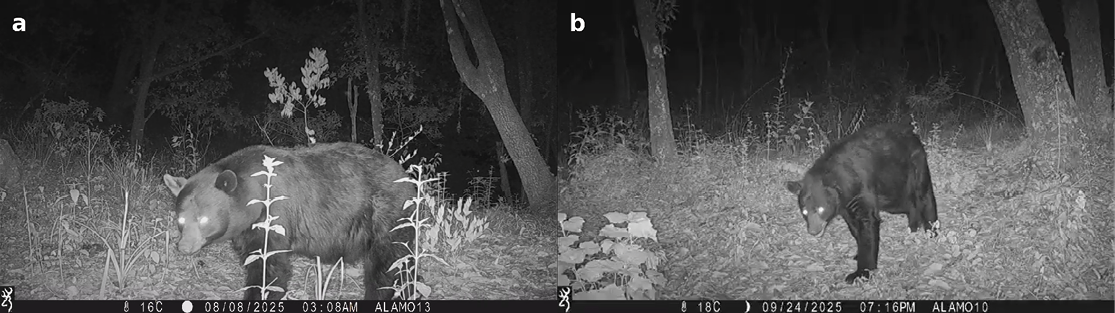
The presence of what appears to be a young male black bear was recorded by 3 of the 5 cameras installed between July and September 2025, at an altitude of between 1,608 and 1,785 m above sea level. The bear was active between 19:00 and 04:00 hr (Figure 1). Given the camera locations, the bear appears to be traveling in a north-south direction, and since there are no further recordings, it could simply be passing through during the rainy season (Figure 2). These cameras are located in an area of dense oak and pine forest, inaccessible by road only via makeshift trails through the undergrowth, a 3-hour walk from the nearest human settlement (“Ejido” Los Alamitos is 3.5 km away, and seasonal farming areas are 3 km away, both as the crow flies). It is important to note that locals had previously found traces (footprints and crop damage) attributable to more than one individual, but the presence of multiple individuals has not yet been confirmed by camera traps. However, this is the first evidence that the species has been visually documented in the region.
These photographic records of U. americanus in Los Alamitos “ejido” represent an updated contribution to the distribution of the species in central-eastern Mexico and add to the growing number of documented sightings in the region. Although this species has been considered absent or locally extirpated from this region due to a lack of direct evidence of its presence, our record falls within the species’ historical range (Leopold 1959; Carrera-Treviño et al. 2015; Juárez-Casillas and Varas 2013), which appears to represent a recolonization or expansion of the species’ currently recognized range. Charre-Medellín et al. (2021) reported the presence of black bears in the state of San Luis Potosí, specifically in Tamasopo and in the Sierra de Álvarez Flora and Fauna Protection Area, both within the Sierra Madre Oriental, these records were based on indirect evidence, such as bear skin remains and signs of predation attributable to the species, without direct records of live individuals. Additionally, these records date back to 2000 and 2009, respectively, making this 2025 sighting particularly important, as it suggests the possible continued presence of black bears in the region, in areas of dense forest with limited human access.
Although stable breeding populations of U. americanus have been identified in more northern populations in the Sierra Madre Oriental (Juárez-Casillas and Varas 2013), their presence in this central portion of the Sierra de Álvarez could be explained by several factors; as the natural dispersal processes. In large carnivores, spatial expansion is usually associated with the dispersal movements of solitary adults, particularly males (Greenwood 1980). In the black bear, dispersal has been documented to be strongly linked to males, who migrate 22 to 62 km from their natal areas during the first 3 years of life, some individuals have even been documented to travel up to 68 km during dispersal (Costello et al. 2008) and even more until 80 km (Lee and Vaughan 2003). This dispersal of males may be motivated by competition for resources, the search for new territories and even to avoid inbreeding processes in the population (Rogers 1987; Costello et al. 2008).
A second point is the dispersal caused by factors such as the pressure of land use changes in the north of the country, the loss and fragmentation of suitable habitats, as well as increased competition with the agricultural sector that could be driving individuals to look for new areas (Juárez-Casillas and Varas 2013; Nuñez Torrez 2018). It is possible too that the documented recovery of forest cover in some regions of central and northeastern Mexico, along with the abandonment of some agricultural lands, and the implementation of conservation plans (Aide et al. 2013), such as the declaration of natural protected areas or areas voluntarily designated for conservation; could be generating new habitats and improving landscape connectivity, thus facilitating the movement of bears.
On the other hand, the Sierra de Álvarez is located in a physiographic and floristic transition zone that connects northeastern and central Mexico and has environmental conditions compatible with the ecological requirements of the black bear, such as the availability of shelter, forest cover, and food resources, some of which include agricultural areas (Carrera and Canales 1985 In: Juárez-Casillas and Varas 2013). In this context, Los Alamitos is characterized by low human population density and the presence of small, scattered agricultural plots, mainly corn, on the margins of which local residents have detected the presence of bears, suggesting flexible use of the landscape by the species. Additionally, there are semi-perennial water bodies in the area, as well as gaps that allow residents to move around the Sierra, two elements that have been proposed as important for the presence of bears (Zarco-González et al. 2025).
The environmental conditions in this region of the Sierra de Álvarez are similar to those in other mountainous regions of central Mexico, characterized by low-density human settlements and the presence of occasional agricultural plots. These conditions could be shaping a potential biological corridor through which the species is moving towards central Mexico, as also suggested by sightings documented in the Sierra Gorda Biosphere Reserve, both in Querétaro and Guanajuato during 2018 and 2019, as well as in Los Mármoles National Park in Hidalgo in 2019 (Aguilar-López et al. 2019; Charre-Medellín et al. 2021; Rangel-Rojas 2023).
Additionally, the fact that most of the records are located in a mosaic of protected natural areas, state reserves, and fragments of well-preserved vegetation suggests that these elements could be facilitating the movement of individuals across the landscape. Although the functional connectivity between these areas has not been formally evaluated, the relative continuity of temperate forests and submontane scrubland points to the existence of viable movement routes for large fauna, which would constitute a potential biological corridor between the Sierra Madre Oriental and the mountains of central Mexico.
Likewise, recent changes in land use could be influencing the spatial dynamics of the species. In some regions of central and northeastern Mexico, a partial recovery of forest cover has been documented, associated with the abandonment of marginal agricultural land and the implementation of conservation schemes (Aide et al. 2013), which could be generating new habitats or improving landscape connectivity. These processes, combined with human-bear conflict mitigation efforts, may be favoring the gradual expansion of their range into previously unoccupied areas.
The presence of the black bear in the central region of San Luis Potosí has important implications for conservation at the local and regional levels. This sighting highlights the need to strengthen systematic monitoring efforts in the region, particularly in areas that could be functioning as biological corridors due to the presence of well-preserved vegetation. The conservation of these areas is vital not only for the black bear but also for other large mammals and associated species that require connectivity between habitat patches (Crooks and Sanjayan 2006). As bears return to areas where they have been absent for decades, potential conflicts with local communities, particularly those engaged in agriculture and livestock farming, may arise. Documenting and understanding these expansion patterns are the first step in developing proactive coexistence strategies, including the implementation of preventative measures such as improved livestock management, electric fencing, and community education programs (SEMARNAT/CONANP 2012). In this context, the integration of community monitoring programs can be very useful so that the residents themselves are responsible for monitoring and training among themselves, helping to protect this species and other species at risk, and also to anticipate and prevent conflicts in these areas.
Additionally, the support of federal institutions such as the National Commission of Natural Protected Areas (CONANP) can help strengthen community-based monitoring and conservation efforts. An example of this is the Species at Risk Conservation Program, which promotes the development of conservation programs that seek to reconcile biodiversity conservation with local livelihoods (SEMARNAT/CONANP 2012). Specifically, the Species Conservation Action Program for the American black bear establishes the need to identify and prioritize areas with recorded sightings, as well as to design strategies for habitat protection and population management (SEMARNAT/CONANP 2012). In this regard, given that the study area is located within the Sierra Madre Oriental Ecological Corridor (CESMO) and lies along the path of three Natural Protected Areas (La Loma State Reserve, El Potosí National Park, and the Sierra de Álvarez Flora and Fauna Protection Area), it reinforces the value of these areas and other types of sustainable forest management as key elements for landscape connectivity and the long-term conservation of large mammals. Therefore, this region should be considered a priority area for the implementation of these strategies, not only because of its role as a potential corridor but also because of the presence of productive activities that could generate conflicts with the species.
Acknowledgments
We thank the Secretary of Science, Humanities, Technology, and Innovation (SECIHTI) for the scholarship awarded to the lead authors for their postdoctoral research. We also acknowledge the funding from the Cummins Foundation and Global Giving for the Watershed Protection and Restoration Program in Rioverde, which made this project possible.
Finally, we thank the local volunteers from Los Alamitos, especially Erik, Javier and Héctor, who are always willing to support and participate in these activities.
Literature Cited
Aguilar-López, M., et. al. 2019. First Photo Evidence of the American Black Bear (Ursus americanus) in the Southwestern Limit of Its Distribution. Western North American Naturalist 79:124–129.
Aide, T. M., et al. 2013. Deforestation and reforestation of Latin America and the Caribbean (2001–2010). Biotropica 45:262–271.
Aranda, J. M. 2012. Manual for tracking wild mammals in Mexico. First edition. CONABIO. Ciudad de Mexico, Mexico.
Charre-Medellín, J. F., et al. 2021. Additional records of black bear (Ursus americanus) in central-eastern Mexico. Therya Notes 2:20–25.
Comisión Nacional De Áreas Naturales Protegidas. 2025. Estrategia Regional Noreste y Sierra Madre Oriental 2025-2030. CONANP; Dirección Regional Noreste y Sierra Madre Oriental. https://www.gob.mx/conanp/documentos/region-noreste-y-sierra-madre-oriental?state=published
Costello, C. M., et al. 2008. Sex‐biased natal dispersal and inbreeding avoidance in American black bears as revealed by spatial genetic analyses. Molecular Ecology 17:4713–4723.
Crooks, K. R., and Sanjayan, M. 2006. Connectivity conservation (Vol. 14). Cambridge University Press. Cambridge, United Kindom.
Delfín-Alfonso, C.A., López-González, C.A., and N. E. Lara-Díaz. 2011. The American black bear in northwestern Mexico: recovery of occurrence records. Acta zoológica mexicana 27:777–801.
Delfín-Alfonso, C.A., C. A. López-González, and M. Equihua. 2012. Potential distribution of American black bears in northwest Mexico and implications for their conservation. Ursus 23:65–77.
De-Nova, J. A., et al. 2018. Endemic flora of the state of San Luis Potosí and adjacent regions in Mexico. Arid Science 3:21–41.
Greenwood, P. J. 1980. Mating systems, philopatry and dispersal in birds and mammals. Animal Behaviour 28:1140–1162.
Juárez-Casillas, L. A., and C. Varas. 2013. Updated bibliographic review of the black bear in Mexico. Therya 4:447–465.
Lee, D. J., and Vaughan, M. R. 2003. Dispersal movements by subadult American black bears in Virginia. Ursus 14:162–170.
Leopold, A. S. 1959. Wildlife of Mexico. Berkeley and Los Angeles, Univ. California Press. California, EE.UU.
Martínez De la Vega, G. 2022. Mammals of San Luis Potosí. First edition (digital). Universidad Autónoma de San Luis Potosí. Sand Luis Potosí, México.
Martínez-Muñoz, A. 2001. Capacidad de carga para el oso negro (Ursus americanus eremicus) de los ecosistemas de las Serranías del Carmen Coahuila. Comisión Nacional para el Conocimiento y Uso de la Biodiversidad, Proyecto Q006. Ciudad de Mexico, Mexico. [http://www.conabio.gob.mx/institucion/proyectos/resultados/infQ006.pdf ]
Rangel-Rojas, J. M. 2023. Evaluation of the distribution and connectivity of the Mexican black bear (Ursus americanus eremicus: Ursidae) in the Sierra Madre Oriental. Master Thesis, Universidad Michoacana de San Nicolás de Hidalgo. México.
Rogers, L. L. 1987. Effects of food supply and kinship on social behavior, movements, and population growth of black bears in northeastern Minnesota. Wildlife Monographs 97:1–72.
Rojas-Martínez, A.E. and L. A. Juárez-Casillas. 2013. First record of the American black bear (Ursus americanus) in the state of Hidalgo, Mexico. Revista Mexicana de Biodiversidad 84: 1018–1021.
Rzedowski, J., and Reyna-Trujillo, T. 1990. Floristic provinces. Map IV. 8.3. National Atlas of Mexico, 3.
Secretaría de Medio Ambiente y Recursos Naturales (SEMARNAT). 2010. Norma Oficial Mexicana NOM-059-ECOL-2010. Que establece Protección al ambiente, especies de flora y fauna silvestres de México, categorías de riesgo y especificaciones para su inclusión, exclusión o cambio, y lista de especies en riesgo. Secretaría del Medio Ambiente y Recursos Naturales, México. 30 de diciembre 2010.
Secretaría de Medio Ambiente y Recursos Naturales (SEMARNAT) and Comisión Nacional De Áreas Naturales Protegidas (CONANP). 2012. Programa de Acción para la Conservación de las Especies: Oso negro americano (Ursus americanus). Mexico.
Zarco-González, Z., et al. 2025. Spatial ecology of black bears (Ursus americanus) in northeastern Mexico: home ranges and habitat use. Environmental Monitoring and Assessment 198: 14.
Associate editor: David Valenzuela-Galván
Submitted: February 12, 2026; Reviewed: August 18, 2026
Accepted: September 21, 2026; Published on line: November 24, 2026
DOI: 10.12933/therya_notes-25-264
ISSN 2954-3614
Figure 1. a) Black bear (Ursus americanus) recorded in Los Alamitos, Rioverde, San Luis Potosí, on August 8, 2025. b) Black bear (Ursus americanus) recorded in Los Alamitos, Rioverde, San Luis Potosí, on September 24, 2025.
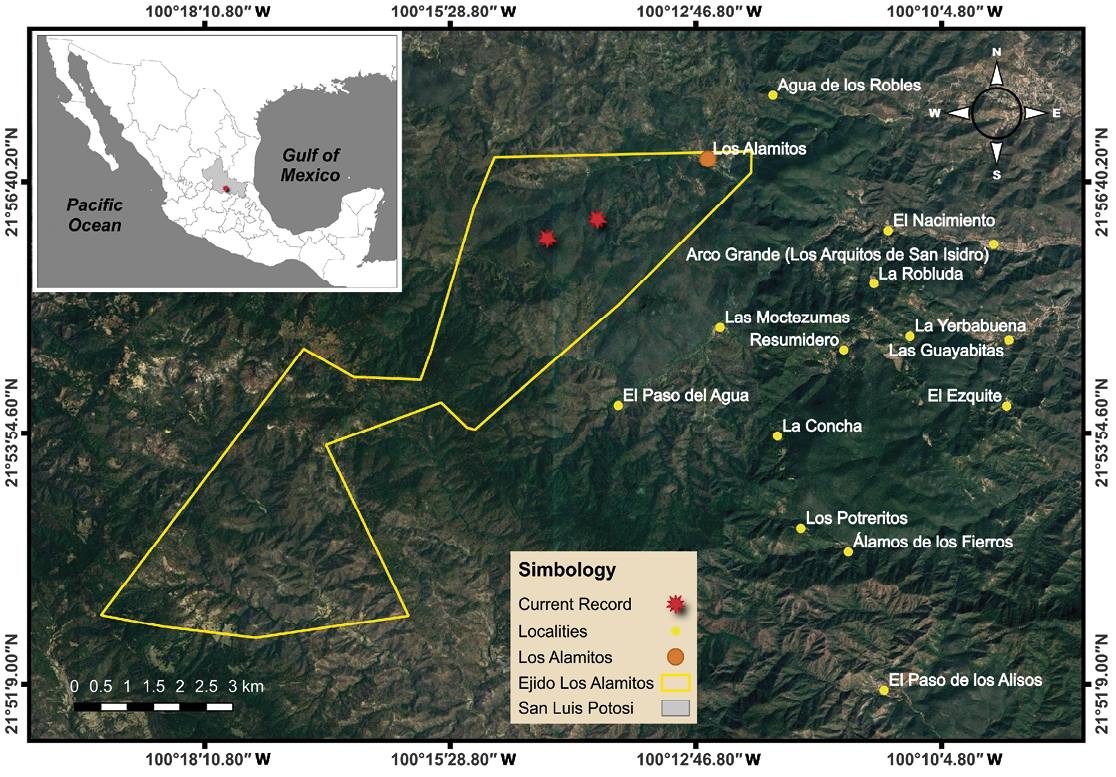
Figure 2. Record of Ursus americanus in “ejido” Los Alamitos, Central Region of San Luis Potosí, as well as previous sightings in other regions of the Sierra Madre Oriental.