THERYA NOTES 2026, Vol. 7:162-165
First record of melanism in the white-tailed antelope squirrel Ammospermophilus leucurus (Mammalia: Sciuridae)
Primer registro de melanismo en la ardilla antílope de cola blanca Ammospermophilus leucurus (Mammalia: Sciuridae)
Daniela Bernot-Simon1, Alejandra Cespedes-Gonzalez2, and Edgar Eduardo Becerril-García3*
1Independent Researcher. C. Sonora 650-22, 23060, La Paz. Baja California Sur, México. E-mail: danibernot92@gmail.com (D-BS)
2School of Biological Sciences, University of Oklahoma. Van Vleet Oval 730, 73019, Norman. Oklahoma, United States of America. E-mail: acespedesg@ou.edu (A-CG)
3Faculty of Social Sciences and Humanity, Department of Geography, Memorial University. Elizabeth Avenue 230, A1B 3X9, St. John’s. Newfoundland, Canada. E-mail: edgarbg@mun.ca (EE-BG)
*Corresponding author
The white-tailed antelope squirrel Ammospermophilus leucurus is a rodent species distributed from northwestern Mexico to southwestern United States. It is characterized by its small size and a light brown coloration with two white stripes on its back. It usually inhabits arid zones, from plains with xerophilous vegetation to mountainous cliffs. A field visit was carried out during midday on May 11th, 2023, in the volcanic area of Las Tres Virgenes within the El Vizcaino Biosphere Reserve, Baja California, Mexico. Specifically, the transect walked was within Del Azufre canyon, characterized by rocky walls and cliffs, as well as small caves. During the field walk, a melanistic individual of A. leucurus was observed between rocky substrates on the walls and debris of the canyon. The individual measured approximately 20 cm and exhibited vigilance in both horizontal and vertical positions. This observation represents the first documented case of melanism within the antelope squirrel genus Ammospermophilus. Further research, such as genetic or ecological analyses, can determine the frequency of melanism in this species as well as its influence on behaviour and survival.
Keywords: Melanistic; natural protected area; Rodentia; squirrels.
La ardilla antílope de cola blanca o juancito Ammospermophilus leucurus es una especie de roedor distribuida desde el noroeste de México hasta el suroeste de Estados Unidos. Se caracteriza por su tamaño pequeño y una coloración café claro con dos franjas blancas en el dorso. Habita generalmente zonas áridas, desde planicies con vegetación xerófila hasta acantilados montañosos. Se realizó una visita de campo al mediodía del 11 de mayo de 2023 en la zona volcánica de Las Tres Vírgenes, dentro de la Reserva de la Biosfera El Vizcaíno, Baja California, México. Específicamente, el transecto recorrido se localizó en el Cañón del Azufre, el cual se caracteriza por presentar paredes y acantilados rocosos, así como pequeñas cuevas. Durante el recorrido de campo se observó un individuo melánico de A. leucurus entre sustratos rocosos en las paredes y entre los detritos del Cañón del Azufre. El individuo presentó una longitud aproximada de 20 cm y mostró comportamiento vigilante tanto en posición horizontal como vertical. Esta observación constituye el primer caso documentado de melanismo dentro del género de ardillas antílope Ammospermophilus. Investigaciones adicionales, como análisis genéticos o ecológicos, podrían determinar la frecuencia del melanismo en esta especie y evaluar su influencia tanto en el comportamiento como en su supervivencia.
Palabras clave: Ardillas; área natural protegida; melanismo; Rodentia.
© 2026 Asociación Mexicana de Mastozoología, www.mastozoologiamexicana.org
The antelope squirrels of the genus Ammospermophilus (Sciuridae) evidence adaptive physiological and behavioral responses to extreme climate with low water availability (Hudson 1962; Belk and Smith 1991). These capacities are evident in the five species that constitute this genus, displaying resistance to hyperthermia and developed social skills for survival (DeCoursey et al. 1997; DeCoursey 2014). Among these, the white-tailed antelope squirrel, Ammospermophilus leucurus, is a model species for studying natural selection in the wild due to its various responses across different environments (DeCoursey 2014).
The white-tailed antelope squirrel is a diurnal omnivorous species that does not hibernate (Hall 1946). Its average lifespan is unknown, although individuals reproduce at approximately one year of age, and one individual lived up to five years and ten months in captivity (Kenagy and Bartholomew 1985). Ammospermophilus leucurus inhabits diverse environments, from plains with xerophilous vegetation to mountainous cliffs in the Neartic region, primarily in arid zones from southwest Oregon, United States, to the Baja California Peninsula, Mexico (Belk and Smith 1991). This squirrel is characterized by its greyish-brown and light-reddish coloration and two white lateral stripes on each side that extend from the shoulders to the anterior portion of the tail, which is long and flattened (Belk and Smith 1991; Álvarez-Romero and Medellín 2005).
The distribution of antelope squirrels in North America’s Nearctic region is influenced by diverse selective forces, including plate tectonic subduction and sea-level fluctuations, which shape the landscape and habitats where these squirrels are found (Belk and Smith 1991; Morrone 2019). In the volcanic complex of Las Tres Virgenes (27° 28’ 11” N, 112° 35’ 28” W), southern and northern population haplotypes are present in A. leucurus, setting them apart from other populations found in the Baja California Peninsula (Álvarez-Castañeda 2007).
Melanism is a genetic condition resulting in dark phenotypic pigmentation of the fur (Majerus and Mundy 2003; Kingsley et al. 2009). Although melanistic variants are conspicuous (Kingsley et al. 2009), the phenotype expression in rodents such as A. leucurus might be linked to multiple genes, including Agouti signalling protein (Agouti), attractin (Atrn), melanocortin-1 receptor (Mc1r), and mahogunin (Mgrn; Robbins et al. 1993; Bultman et al. 1994). Related ecological and physiological factors include higher thermoregulation capacities and protection from UV radiation, as observed in diverse species from arid environments (Best and James 1984, Belk and Smith 1991, Ward et al. 2002). The expression of melanism or any other abnormal pigmentation has not been documented across A. leucurus distribution or in any species of its genus (Thorington and Ferrell 2006; Medina and Medina 2019). Here, we report the first record of a melanistic variant within the geographical intersection of southern and northern populations of A. leucurus in Northwestern Mexico.
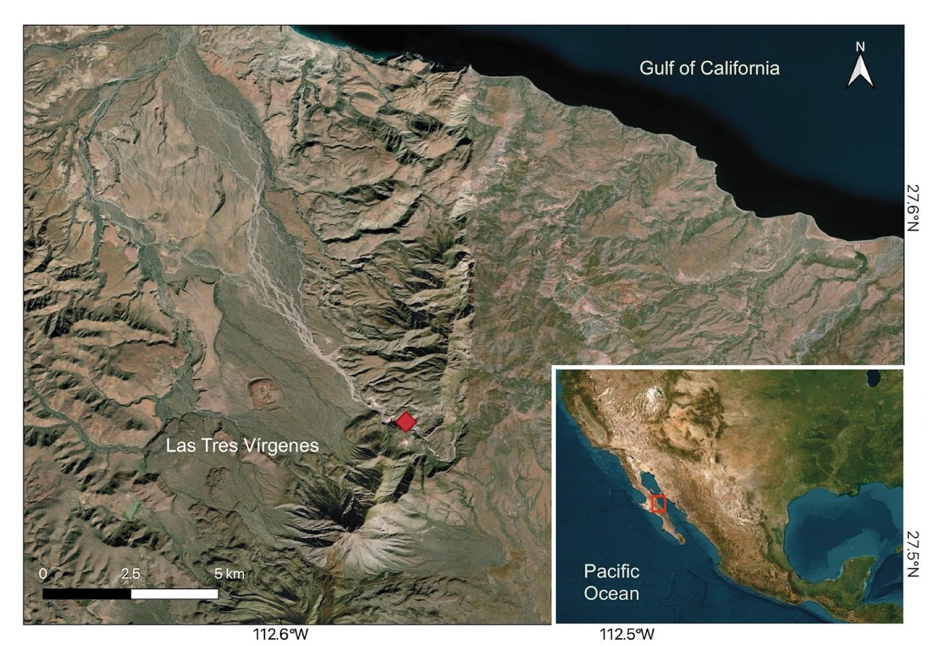
The record occurred in Del Azufre canyon (27° 32’ 36.66” N, 112° 34’ 26.12” W) in the Baja California Peninsula, Mexico (Southern Nearctic region; Morrone 2019; Figure 1). The study area is characterized by dry environments, low pluvial precipitation, xerophilous vegetation, and an average annual temperature of 18-22 °C (INEGI 2024). Del Azufre canyon forms part of the Las Tres Virgenes volcanic complex, located within the limits of El Vizcaino Biosphere Reserve at 720 meters above sea level (Avellán et al. 2019).
On May 11th, 2023, between 11:42 and 11:45 hr, a melanistic variant of A. leucurus was observed between rocky substrates on the walls and debris of Del Azufre canyon (Figure 1). Digital photographs and videos were obtained using Nikon D7100 (Nikon 55-350 mm lens) and D5600 (Tamron 18-400 mm lens) cameras. The weather conditions included a clear sky, high solar radiation, and a temperature of 28 °C. Estimated distance between the observers and the individual was 15 m. Camera settings for the Nikon D7100 included an exposure time of 1/640 s, f/5.6, IS0-400, and a focal length of 300 mm. Camera settings for the Nikon D5600 included an exposure time of 1/500 s, f/6.3, IS0-400, and a focal length of 400 mm.
The identification of A. leucurus was confirmed by the observation of distinct morphometric traits, such as two light lateral lines diagnostic of the species, as well as a comparison between photographs of the melanistic squirrel and individuals with normal pigmentation (Belk and Smith 1991; Álvarez-Romero and Medellín 2005; Figure 2). The melanistic individual, which measured approximately 20 cm, exhibited vigilance in both horizontal and vertical positions, possibly indicating heightened alertness when standing on its hind legs (Figure 2). No alarm calls or distinct, audible vocalizations were detected.
Among mammals, the Rodentia class exhibits the highest incidence of melanism (50 out of 113 species; Medina and Medina 2019; Bounaceur et al. 2023). Notably, this phenomenon is most prevalent in the Sciuridae family, particularly in species such as Sciurus carolinensis and Sciurus vulgaris (Medina and Medina 2019). In this context, the observation of melanism in A. leucurus opens a pathway to explore melanistic expression within Ammospermophilus squirrels, which could provide insights into the selective forces and evolutionary implications influencing the survival of this species (Riddle et al. 2000; Álvarez-Castañeda 2007; Whorley and Kenagy 2007). Identifying the molecular basis of phenotypic variation will also help elucidate the mechanisms underlying melanistic expression in A. leucurus (DeCoursey et al. 1997; DeCoursey 2014; Majerus and Mundy 2003; Kingsley et al. 2009).
Melanism has been reported in canyon areas where white and black bedrock converge (Majerus and Mundy 2003; Singaravelan et al. 2010), including the black-tailed rattlesnake (Crotalus molossus Prieto and Jacobson, 1968), pigeons (Columbidae; Obukhova 2001), whip-poor-wills (Antrostomus arizonae; Stager 1954), Albert’s squirrels (Sciurus aberti; Cahalane 1947), rock squirrels (Otospermophilus variegatus), black jackrabbits (Lepus insularis; Álvarez-Castañeda and Lorenzo, ٢٠١٧), and jaguars (Panthera onca; Dinets and Polechla 2005). In arid canyon environments with volcanic activity, such as Del Azufre, melanism in A. leucurus may be favored by several ecological factors, including predation pressure, shelter availability provided by sediment and debris, and the presence of shadows that enhance cryptic behavior (Hudson 1962; Whorley and Kenagy 2007; Avellán et al. 2019). Since A. leucurus does not undergo hibernation, a dark colouration could provide a survival advantage regarding metabolic heat retention during winter (Belk and Smith 1991).
Melanism in A. leucurus may reflect a broader genetic pool arising from admixture between the northern and southern populations, coupled with the unique ecological conditions of the region (Riddle et al., 2000; Álvarez-Castañeda, 2007; DeCoursey, 2014). However, given that melanism was observed in only a single individual, it remains unclear whether this represents a rare, stochastic occurrence or reflects broader evolutionary processes influencing the expression and frequency of melanism in this species. Further work integrating genetic analyses, ecological monitoring, and broader sampling across the species’ range will be essential to clarify the drivers of this observed phenotype, its frequency, and its evolutionary significance, if any.
We registered the first case of melanism in A. leucurus in a canyon characterized by rocky substrates and surrounded by volcanoes located in Baja California, Mexico. This observation may relate to the canyon’s shady environments and the mixing of northern and southern populations. However, given that melanism was documented in only a single individual, further studies — such as camera trapping or genetic analyses — are needed to determine whether this phenotype occurs at appreciable frequencies and whether it is associated with differential survival relative to normally pigmented individuals.
Acknowledgements
The authors express their gratitude to the Ejido Alfredo V. Bonfil community and to the family of Giovanni and María for their support. Special thanks to Giovanni, who guided us on the trail. D-BS thanks Idea Wild for the lens provided.
Literature cited
Álvarez-Castañeda, S. T., and Lorenzo, C. 2017. Phylogeography and phylogeny of Lepus californicus (Lagomorpha: Leporidae) from Baja California Peninsula and adjacent islands. Biological Journal of the Linnean Society 121:15–27.
Álvarez-Castañeda, S. T. 2007. Systematics of the antelope ground squirrel (Ammospermophilus) from islands adjacent to the Baja California peninsula. Journal of Mammalogy 88:1160–1169.
Álvarez-Romero, J., and Medellín, R. A. 2005. Ammospermophilus leucurus. Vertebrados superiores exóticos en México: diversidad, distribución y efectos potenciales. Instituto de Ecología, Universidad Nacional Autónoma de México. Bases de datos SNIB-CONABIO. Proyecto U020. Distrito Federal, México.
Avellán, D. R., et al. 2019. Geology of the late Pleistocene Tres Vírgenes Volcanic Complex, Baja California Sur (México). Journal of Maps 15:227–237.
Belk, M. C., and Smith, H. D. 1991. Ammospermophilus leucurus. Mammalian Species 368:1–8.
Best, T. L., and James, H. C. 1984. Rattlesnakes (genus Crotalus) of the Pedro Armendariz lava field, New Mexico. Copeia 1984:213–215.
Bounaceur, F., et al. 2023. First North African record of a melanistic rabbit, Oryctolagus cuniculus (Linnaeus, 1758). Mammalia 87: 511–513.
Bultman, S. J., et al. 1994. Molecular analysis of reverse mutations from nonagouti (a) to black-and-tan (a(t)) and white-bellied agouti (Aw) reveals alternative forms of agouti transcripts. Genes & Development 8:481–490.
Cahalane, V. H. 1947. Mammals of North America. The MacMillan Co., New York, USA.
Decoursey, P. J., et al. 1997. Circadian performance of suprachiasmatic nuclei (SCN)-lesioned antelope ground squirrels in a desert enclosure. Physiology & Behavior 62:1099–1108.
Decoursey, P. J. 2014. Survival value of suprachiasmatic nuclei (SCN) in four wild sciurid rodents. Behavioral neuroscience 128:240.
Dinets, P., and Polechla, P. J. 2005. First documentation of melanism in the jaguar (Panthera onca) from northern Mexico. Cat News (IUCN) 42:18.
Hernández, M. A. H., et al. 2019. Origin of fluids in Las Tres Vírgenes Geothermal Field. E3S Web of Conferences-EDP Sciences 98:12006.
Hudson, J. W. 1962. The role of water in the biology of the antelope ground squirrel Citellys leucurus. University of California Publications in Zoology 64:1–56
Instituto Nacional de Estadística y Geografía (INEGI). 2024. Baja California Sur, https://www.inegi.org.mx/. Accesed on 20 November 2025.
Kenagy, G. J., and Bartholomew, G. A. 1985. Seasonal reproduction patterns in five coexisting California desert rodent species. Ecological Monographs 55:371–398.
Kingsley, E. P., et al. 2009. Melanism in Peromyscus is caused by independent mutations in Agouti. PloS One 4:e6435.
Majerus, M. E., and Mundy, N. I. 2003. Mammalian melanism: natural selection in black and white. Trends in Genetics 19:585–588.
Medina, Y. K., and Medina, C. E. 2019. Primer registro de melanismo en Phyllotis limatus (Rodentia: Cricetidae), con una lista actualizada de mamíferos silvestres melánicos del mundo. Revista Peruana de Biología 26:509–520.
Morrone, J. J. 2019. Regionalización biogeográfica y evolución biótica de México: encrucijada de la biodiversidad del Nuevo Mundo. Revista mexicana de Biodiversidad 90:1–68.
Obukhova, N. Y. 2001. Geographic variation of color in the synanthropic Blue Rock Pigeon. Russian Journal of Genetics 37:649–658.
Prieto, A. A., and Jacobson, E. R. 1968. A new locality for Crotalus molossus molossus in Southern New Mexico. Herpetologica 24:339–340.
Riddle, B. R., et al. 2000. Cryptic vicariance in the historical assembly of a Baja California Peninsular Desert biota. Proceedings of the National Academy of Sciences 97:14438–14443.
Robbins, L. S., et al. 1993. Pigmentation phenotypes of variant extension locus alleles result from point mutations that alter MSH receptor function. Cell 72:827–834.
Singaravelan, N., et al. 2010. Spiny mice modulate eumelanin to pheomelanin ratio to achieve cryptic coloration in “Evolution Canyon,” Israel. PLoS One 5:e8708.
Stager, K. E. 1954. Birds of the Barranca de Cobre region of southwestern Chihuahua, Mexico. The Condor 56:21–32.
Thorington JR, R. W., and Ferrell, K. E. 2006. Squirrels: the animal answer guide. Johns Hopkins University Press, Baltimore, USA.
Ward, J. M., et al. 2002. The adaptive significance of dark plumage for birds in desert environments. Ardea 90:311–323.
Whorley, J. R., and Kenagy, G. J. 2007. Variation in reproductive patterns of antelope ground squirrels, Ammospermophilus leucurus, from Oregon to Baja California. Journal of Mammalogy 88:1404–1411.
Associate editor: José Fernando Moreira Ramírez
Submitted: February 05, 2026; Reviewed: April 28, 2026
Accepted: July 24, 2026; Published on line: August 20, 2026
DOI: 10.12933/therya_notes-25-247
ISSN 2954-3614
Figure 1. Location of “El Azufre” canyon (red diamond) in the volcanic complex “Las Tres Vírgenes” where observations of the melanistic variant of Ammospermophilus leucurus occurred.
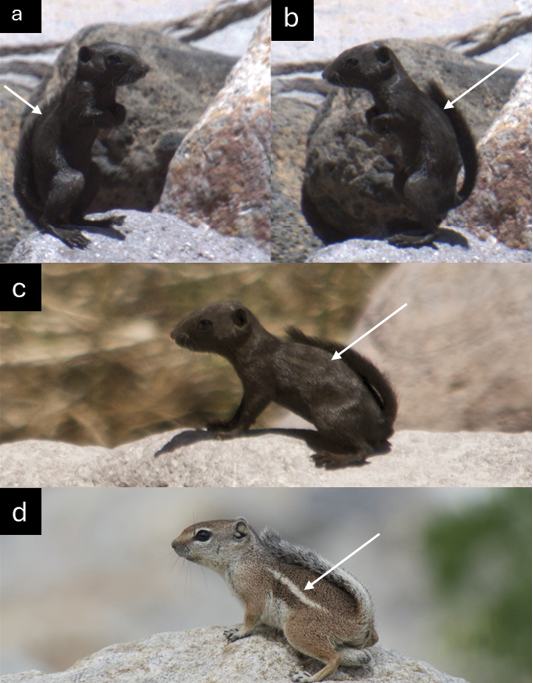
Figure 2. Right (a) and left (b,c) side of the melanistic individual of Ammospermophilus leucurus recorded in Las Tres Vírgenes, Baja California Sur, Mexico, May 2023. Comparison with and individual with normal pigmentation (d); Arrows indicate characteristic dorsal white line of the species.