THERYA NOTES 2026, Vol. 7:166-169
Diclidurus albus (Chiroptera: Emballonuridae) in Panama: new records and comments on its geographic distribution
Diclidurus albus (Chiroptera: Emballonuridae) en Panamá: nuevos registros y comentarios sobre su distribución geográfica
Nelson Guevara1*, Bryan Vargas1, 2, Mario Urriola3, Yanahais Berrocal1, 2, and Ailed Santos1
1Grupo de Investigación, Fundación Biomundi. Brisas del Lago, Los Pilones, 24 de diciembre, C. P. 07109, Provincia de Panamá. Ciudad de Panamá, Panamá. E-mail: nelson2295@hotmail.com (NG); bryan26a26@gmail.com (BV).
2Escuela de Biología, Facultad de Ciencias Naturales, Exactas y Tecnología, Universidad de Panamá, Campus Central Octavio Méndez Pereira. Vía Transístmica, C. P. 07096, Provincia de Panamá. Ciudad de Panamá, Panamá. E-mail: yanahaisberrocal20@gmail.com (YB); ailed.j.santos.o@gmail.com (AS).
3Fundacion Biodiversidad Tropical Panama (FUBITROPA). El Valle de Antón, C. 02005, Provincia de Coclé. Panama. E-mail: serpentariomaravillastropicales@hotmail.com (MU).
*Corresponding author
Diclidurus albus es un murciélago insectívoro de tamaño mediano, fácilmente distinguible por su pelaje blanco a grisáceo. Se considera una especie poco común a rara, con escasos registros documentados en Panamá, lo que ha limitado históricamente el conocimiento sobre su distribución geográfica en el país. Mediante observaciones directas y la recopilación sistemática de información, se compilan y analizan los registros históricos disponibles, así como la distribución actualizada de la especie en el territorio nacional. El 27 de diciembre de 2025 se registró la presencia de dos individuos de D. albus bajo el tejado externo de una vivienda tipo bohío, a una altura aproximada de 3 m sobre el nivel del suelo, constituyendo el undécimo registro en Panamá. Los registros de D. albus en Panamá se han concentrado históricamente en Colón, Panamá y Chiriquí, con un reporte insular en Coiba. Este estudio documenta el primer registro cercano a la región central, en bosque tropical seco. La escasez de registros se atribuye a limitaciones metodológicas más que a la ausencia real de la especie.
Palabras clave: Diclidurus albus, Bosque tropical seco, Murciélago fantasma del norte, Panamá Central, Panamá Oeste.
Diclidurus albus is a medium-sized insectivorous bat species, easily distinguishable by its white to grayish fur. It is considered an uncommon to rare species, with few documented records in Panama, which has historically limited knowledge about its geographic distribution in the country. Through direct observations and the systematic collection of information, available historical records are compiled and analyzed, as well as the updated distribution of the species within the national territory. On December 27, 2025, two individuals of D. albus were recorded under the external roof of a bohío-type dwelling, at a height of approximately 3 m above ground level, constituting the eleventh record in Panama. Records of D. albus in Panama have historically been concentrated in Colón, Panama, and Chiriquí, with one report from the island of Coiba. This study documents the first record close to the central region, in tropical dry forest. The scarcity of records is attributed to methodological limitations rather than the actual absence of the species.
Key words: Central Panama, Diclidurus albus, North ghost bat, Tropical dry forest, Western Panama.
© 2026 Asociación Mexicana de Mastozoología, www.mastozoologiamexicana.org
Diclidurus albus Wied-Neuwied, 1820 (Emballonuridae), commonly known as the Northern ghost bat, is a medium-sized insectivorous bat (total length 68–82 mm; forearm length 63–69 mm; weight 17–24 g), easily recognized by its white to grayish pelage, pinkish wing membranes, absence of wing sacs, and the presence of a conspicuous glandular sac located at the center of the uropatagium (Reid 2009). It is a species exclusive to the Neotropical region, distributed from Nayarit, Mexico, to eastern Brazil, from sea level up to approximately 1,700 m above sea level (Bonaccorso 2019).
This bat species is primarily associated with humid environments such as riparian forests and tropical rainforests, although it has also been recorded in modified landscapes, including plantations, forest clearings, and human settlements (Taylor and Tuttle 2019). It is generally observed solitarily or in small groups of up to four individuals during the reproductive season, roosting beneath palm leaves at heights ranging from 2 to 25 m (Ceballos and Medellín 1998). Although considered an uncommon to rare species, it is currently categorized as Least Concern by the IUCN, with a yet unknown population trend (Lim et al. 2016).
In Panama, D. albus is one of the least documented chiropteran species, with only seven confirmed records compiled by Tejera et al. (1999), mainly concentrated in the Panama Canal area and, to a lesser extent, in the province of Chiriquí. This lack of records hinders an accurate assessment of its current distribution within the country. In this note, we present a new record of D. albus for Panama and provide an updated synthesis of available historical records, with emphasis on its ecology and national-scale geographical distribution pattern.
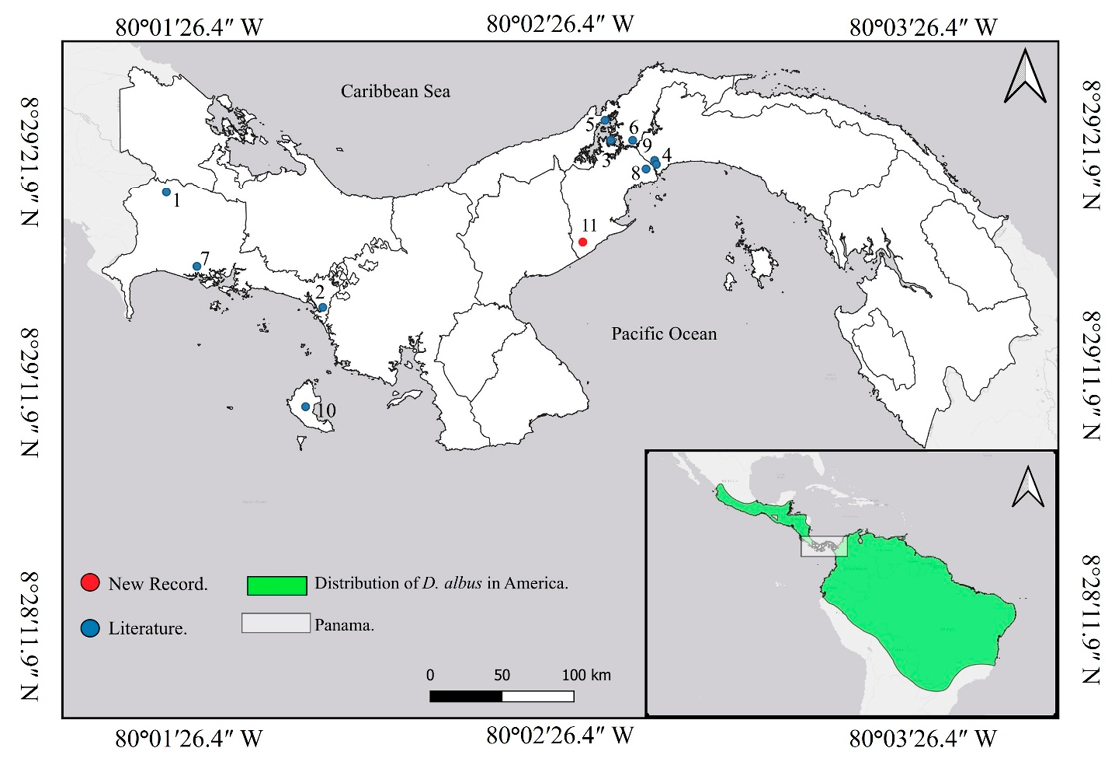
The record was obtained in the community of El Espino, San Carlos District, West Panama Province, Panama (8°29’11.9” N, 80°02’26.4” W; Figure 1). According to ANAM (2010), the region is embedded within a human-modified landscape with less than 10% natural forest cover, categorized as a productive land-use system. The capture site consisted of a previously deforested area historically used for cattle ranching. Vegetation is dominated by Poaceae grasslands interspersed with patches of early secondary growth, scattered shrubs, and open habitats. Additional plant assemblages included species of Asteraceae, several non-poaceous monocots, and cultivated plots of banana (Musaceae), citrus (Rutaceae), and legumes (Fabaceae). The local climate is classified as tropical, characterized by a pronounced dry season and mean annual temperatures ranging from 27 to 28 °C (ANAM 2010).
To provide historical context for the occurrence of D. albus within the study region and across Panama, we conducted a comprehensive review of published and unpublished records. Historical literature was examined through the holdings of the Simón Bolívar Library at the University of Panama and complemented with systematic searches of the scientific literature using combinations of the keywords “Diclidurus albus”, “Panama”, “specimen”, and “record”. Only peer-reviewed studies published in indexed scientific journals were considered. Additionally, we examined specimens and associated records housed in the Vertebrate Museum of the University of Panama (MUVP) and consulted records of bats collected in Panama and deposited in the National Museum of Natural History, Smithsonian Institution (USNM) and Natural History Museum, United Kingdom (NHMUK). These data were used to verify voucher specimens, validate historical records, and assess the spatial distribution of the species throughout the country.
On December 27, 2025, at 12:40 hr, two individuals of D. albus were observed roosting beneath the external roof of a traditional bohío-type dwelling, approximately 3 m above ground level (Figure 2). Both individuals were photographed using a Canon Rebel T6 camera equipped with a 75–300 mm zoom lens over a period of 35 minutes. The individuals were not captured to avoid disturbance, as residents indicated that the bats had been using the site as a roost for approximately two months, suggesting a high tolerance to human presence. Identification was based on direct observation and photographic comparison of a conspicuously white pelage and pinkish wing membranes, diagnostic characters that distinguish D. albus as the only species of the genus recorded in Panama.
In addition, there are ten other reported sightings of D. albus in Panama. Most of these involve individuals observed at their roosting sites (four locations) or detected through acoustic echolocation recordings (three locations). Only three reports involve collected specimens. However, in the latter cases, the capture method was not specified (Table 1).
According to Tejera et al. (1999), most historical records of D. albus in Panama are concentrated in the Panama Canal area (provinces of Colón and Panama) and in the province of Chiriquí, regions dominated by humid tropical forests with semideciduous vegetation (ANAM 2010). These data are complemented by a single island record from Coiba Island, while the present study represents the first confirmed report near the central region of Panama, between the provinces of Coclé and West Panama, a region characterized by climatic and vegetation conditions typical of tropical dry forests, according to ANAM (2010).
Although available records originate primarily from forested matrices, they are frequently located in landscapes with varying degrees of anthropogenic disturbance and in proximity to human settlements. In this context, D. albus has been reported using modified environments, including plantations, clearings, and urbanized areas, suggesting that habitat alteration does not necessarily constitute a limiting factor for its presence (Bonaccorso 2019). In contrast, the lack of records in Panama appears to be more closely related to methodological biases associated with its ecological behavior, particularly its high-altitude foraging activity, both within and above the forest canopy, reaching heights of over 25 m (Gómez-Corea et al. 2020). This behavior significantly reduces its detectability using conventional mist nets (LaVal and Rodríguez-Herrera 2002; Loza et al. 2018).
Although the species is expected to be widely distributed throughout the country, its presence has historically been underestimated due to limitations in both conventional and acoustic sampling methods (Denzinger et al. 2018). The integration of complementary strategies, such as daytime roost searches (Rengifo et al. 2012) and non-invasive photographic documentation of individuals with conspicuous diagnostic characters (Loeb et al. 2015), represents an effective alternative for improving detection and enhancing knowledge of the geographical distribution of D. albus in Panama.
Acknowledgments
To J. M. Aubert for informing us about the presence of the specimen on the roof of the hut on his private property.
Literature cited
Anam (AUTORIDAD NACIONAL DEL AMBIENTE) (EDS.). 2010. Atlas ambiental de la República de Panamá. Gobierno Nacional. Ciudad de Panamá, Panamá.
Bonaccorso, F. J. 2019. Diclidurus albus. Pp. 367 in Mammals of the World, volumen 9 (Wilson, D. E., and R. A. Mittermeier, eds.). Lynx Edicions. Barcelona, España.
Ceballos, G., and R. A. Medellin. 1988. Diclidurus albus. Mammalian Species 316:1–4.
Denzinger, A., et al. 2018. The role of echolocation strategies for niche differentiation in bats. Canadian Journal of Zoology 96:171–181.
Estrada-Villegas, S., et al. 2018. Bats and their bat flies: community composition and host specificity on a Pacific island archipelago. Acta Chiropterologica 20:161–176.
Gómez-Corea, W. N., et al. 2020. Diclidurus albus Wied-Neuwied, 1819 (Mammalia, Chiroptera): Geographic distribution in Honduras, with new records inferred from acoustic evidence and morphology. Caribbean Journal of Science 50:265–274.
Handley, C. O. JR. 1966. Checklist of the mammals of Panama. Pp. 753–793 in Ectoparasites of Panama (Wenzel, R. L., and V. T. Tipton, eds.). Field Museum of Natural History. Chicago, USA.
Jung, K., and E. K. V. Kalko. 2010. Where forest meets urbanization: foraging plasticity of aerial insectivorous bats in an anthropogenically altered environment. Journal of Mammalogy 91:144–153.
Kalko, E. K. V. 1995. Echolocation signal design, foraging habitats and guild structure in six Neotropical sheath-tailed bats (Emballonuridae). Symposia of the Zoological Society of London 67.
Laval, R. K., and B. Rodríguez-Herrera. 2002. Murciélagos de Costa Rica. Instituto Nacional de Biodiversidad (INBio). San José, Costa Rica.
Lim, B., et al. 2016. Diclidurus albus. The IUCN Red List of Threatened Species 2016: e.T6561A21986615. Accessed on 27 July 2026.
Loeb, S. C., et al. 2015. A plan for the North American bat monitoring program (NABat). United States Department of Agriculture. Washington, USA.
Loza, J., et al. 2018. First capture of Diclidurus albus Wied-Neuwied, 1820 (Mammalia, Chiroptera, Emballonuridae) from Nicaragua. Check List 14:1021–1025.
Reid, F. A. 2009. Mammals of Central America and Southeast Mexico. Oxford University Press. New York, USA.
Rengifo, E. M., et al. 2012. Características de refugios de algunas especies de murciélagos en la cuenca alta del río Itaya, Loreto, Perú. Revista Cuadernos de Herpetología y Mastozoología 5:20–34.
Taylor M., and Tuttle M. D. 2019. Bats: an illustrated guide to all species. Ivy Press. London, Reino Unido.
Tejera, V. H., et al. 1999. Nuevos registros del murciélago blanco Diclidurus albus (Chiroptera: Emballonuridae) en Panamá. Scientia (Panamá) 14:95–101.
Thomas, O. 1903. New mammals from Chiriqui. Annals and Magazine of Natural History, Series 7 11:376–382.
Associate editor: Cristian Kraker Castañeda
Submitted: January 13, 2026; Reviewed: July 15, 2026
Accepted:July 28, 2026; Published on line: August 14, 2026
DOI: 10.12933/therya_notes-25-248
ISSN 2954-3614
Figure 1. Historical records of Diclidurus albus in Panama. 1) Boquete-Chiriqui, 2) Tole-Chiriqui, 3) Barro Colorado Island, 4) Albrook-Panama, 5) Fort Gulick, 6) Colon-Gamboa, 7) Chiriqui-David, 8) Panama-Road Naval Station, 9) Colon-Gamboa, 10) Veraguas-Coiba National Park, 11) Cocle-El Espino.
Figure 2. Individuals of Diclidurus albus observed in the District of San Carlos, Province of West Panama, Panama. a) and b) represent different individuals.
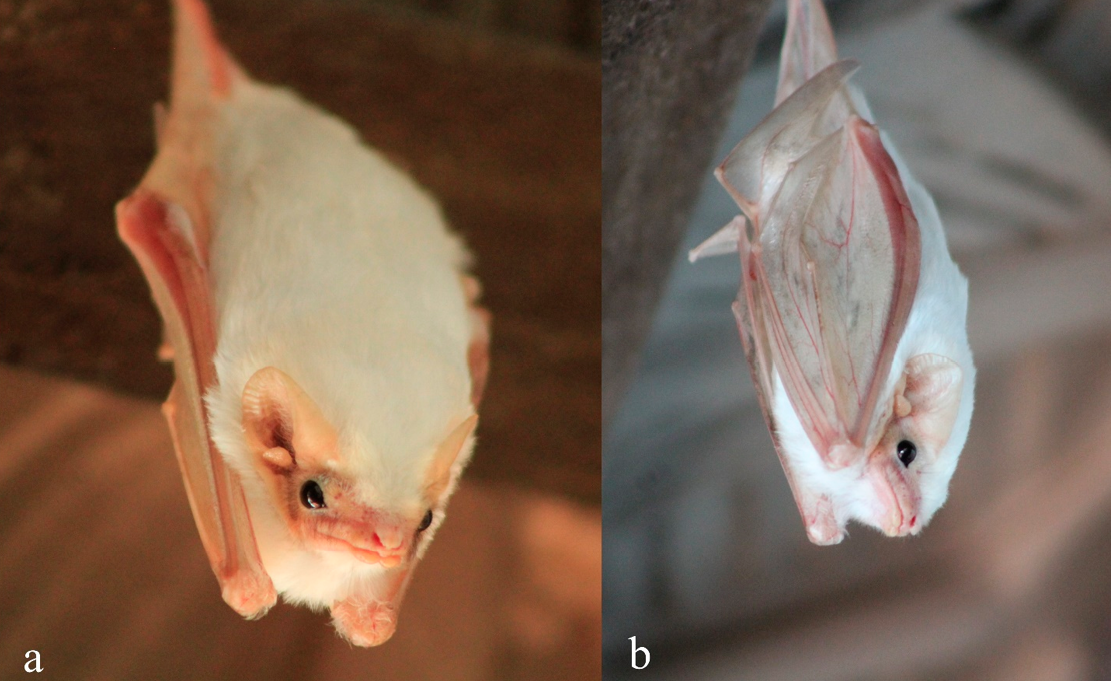
Table 1. Historical records of Diclidurus albus in Panama, in chronological order. Museums acronyms are provided in the text.
|
Record method |
Locality |
Geographic coordinate |
Source |
|
Collected specimen |
Chiriqui province, Boquete |
8°50′00.0″ N, 82°30’00.0” W |
Thomas (1903), NHMUK:3846313 (1903.3.3.2) |
|
Direct observation |
Chiriqui province, Tole, Pueblo Nuevo |
8°04’00.0” N, 81°41’00.0” W |
|
|
Ultrasonic detector |
Colon province, Barro Colorado Island |
9°09’00.0” N, 79°51’00.0” W |
|
|
Direct observation |
Panama province, Albrook |
8°59’00.0” N, 79°33’00.0” W |
|
|
Direct observation |
Colon province, Fuerte Gulick |
9°19’00.0” N, 79°52’00.0” W |
Handley (1966), USNM 317572 |
|
Direct observation |
Colon province, Gamboa |
9°07’00.0” N, 79°42’00.0” W |
Handley (1966), USNM 317573 |
|
Museum specimens |
Chiriqui province, David |
8°30’00.0” N, 82°35’00.0” W |
Tejera et al. (1999), MVUP 1073 |
|
Museum specimens |
Panama province, Rodman Naval Station, Panama Canal Zone |
8°57’00.0” N, 79°35’00.0” W |
Tejera et al. (1999), MVUP 1130 |
|
Ultrasonic detector |
Colon province, Gamboa |
Not registered |
Jung and Kalko (2010), recorded in 2004 |
|
Ultrasonic detector |
Veraguas province, Coiba National Park |
Not registered |
Estrada-Villegas et al. (2018), recorded in 2015 |
|
Direct observation |
West Panama Province, San Carlos, El Espino |
8°29’11.9” N, 80°02’26.4” W |
This study |