THERYA NOTES 2026, Vol. 7:204-208
Report of a probable case of Shope papillomavirus in a free-living rabbit (Sylvilagus sp.) in Mexico
Reporte de un caso probable de Papilomavirus de Shope en conejo (Sylvilagus sp.) de vida libre en México
Pedro Benjamín Dávila-Valdés1, Judith Aurora Saldaña-Esparza2, and David Ramiro Aguillón-Gutiérrez2*
1Centro de Educación Ambiental y Vigilancia Climática, Universidad Autónoma de Coahuila. México 57, Las Glorias, Arteaga, Coahuila, México. CP. 25354. Email: pdavila@uadec.edu.mx (PBD-V)
2Laboratorio de Bioindicadores. Centro de Investigación y Jardín Etnobiológico, Universidad Autónoma de Coahuila, Dr. Francisco González 37, Viesca, Coahuila, México. CP. 27480. Email: aurora.saldana@uadec.edu.mx (JASE); david_aguillon@uadec.edu.mx (DRAG).
*Corresponding author.
This paper presents a report of a probable case of Shope papillomavirus in a free-ranging rabbit (Sylvilagus sp.) in Mexico. This genus is distributed throughout the United States and Mexico. Shope papillomavirus has been reported in rabbits in the United States since the 1930s. On August 23, 2025, an excursion was carried out to photograph biodiversity in the Sierra del Tarillal, a mountane area belonging to the Sierra Madre Oriental, which is located on the border of the municipality of Arteaga, Coahuila and Santiago, Nuevo León, northern Mexico, with a pine-oak forest vegetation. On August 23, 2025, at 14:13 hr, with 25 °C and an elevation of 3,215 m above sea level, in the Sierra del Tarillal, a specimen of rabbit (Sylvilagus sp.) was photographed in its natural habitat, with a conical, horn-like protuberance that appears to emerge from the eyelid on the upper part of the right eye. This paper reports a probable case of Shope papillomavirus in a free-ranging rabbit (Sylvilagus sp.) in Mexico. Although it had already been reported the first case of this virus for Mexico, it was in a Sylvilagus floridanus specimen from a museum collection in the United States, which was collected in Jalisco in 1966.
Keywords: Arteaga; Coahuila; Lagomorpha; virus.
En este trabajo se presenta un reporte de un caso probable de Papilomavirus de Shope en conejo (Sylvilagus sp.) en vida libre en México. Este género se distribuye en Estados Unidos y México. El Papilomavirus de Shope es una enfermedad reportada en conejos en Estados Unidos desde la década de los 30´s del siglo pasado. El 23 de agosto de 2025 se realizó una excursión con el fin de fotografiar biodiversidad en la Sierra del Tarillal, una zona montañosa de la Sierra Madre Oriental, que se encuentra en la frontera entre los municipios de Arteaga, Coahuila y Santiago, Nuevo León, en el norte de México, con una vegetación de bosque de pino-encino. El 23 de agosto de 2025 a las 14:13 hr, con 25 °C y a una elevación de 3,215 m snm, en la Sierra del Tarillal, se fotografió un ejemplar de conejo (Sylvilagus sp.) en su hábitat natural, con una protuberancia de forma cónica, parecida a un cuerno, que parece surgir del párpado en la parte superior del ojo derecho. En este trabajo se reporta un caso probable de Papilomavirus de Shope en conejo (Sylvilagus sp.) en vida libre en México. Aunque ya se había reportado el primer caso de este virus en México, fue en un ejemplar de S. floridanus de una colección museográfica en Estados Unidos, que fue colectado en Jalisco, en 1966.
Palabras clave: Arteaga; Coahuila; Lagomorpha; virus.
© 2026 Asociación Mexicana de Mastozoología, www.mastozoologiamexicana.org
The rabbits (Sylvilagus sp., Order Lagomorpha, family Lepo-ridae) are distributed in the Americas, with two species occurring in the north-central part of Mexico, S. audubonii and S. floridanus (Vargas-Cuenca and Cervantes 2014). Like all other organisms, rabbits suffer from natural diseases that control their populations, and sometimes these diseases can be considered emerging (infectious illness that has newly appeared in a population) or re-emerging (is an old, known infectious illness that significantly decreased in numbers but is now returning, spreading to new places, or changing into forms that are harder to treat) in a particular location, also can be associated with anthropogenic factors, for example, introduced species or habitat loss, which causes an imbalance between the host and the environment (Aguirre et al. 2002, 2012). A relevant disease in rabbits is the Shope papillomavirus, that occurs frequently as a natural disease of Sylvilagus rabbits in the Midwestern United States extending from Minnesota and North Dakota to Texas (Brabb and Di Giacomo 2012). Shope (1932) reported a transmissible tumor-like disease in wild cottontail rabbits (genus Sylvilagus) and its experimental transmission to domestic rabbits (genus Oryctolagus). He defined it as a tumor (in a broad sense) since it formed local swellings consisting of a mass of new tissue. A year later, Shope and Hurst (1933) published a study in which the warts of papillomatosis in rabbits were described and histologically analyzed. They mention that the affected rabbits have between 1 and 10 warts on their bodies, that these have irregular shapes, that they can grow on the abdomen, neck, face and shoulders, and that they are keratinized and dark gray or black in color (Shope and Hurst 1933).
Papillomas induced in domestic rabbits with a virus obtained from white-tailed rabbits undergo progressive changes toward malignancy when they grow vigorously. Wild rabbits, the virus’s natural hosts, are remarkably resistant to its sustained activity compared to domestic rabbits. Although they often grow rapidly at first, white-tailed rabbit papillomas in most cases become relatively dormant, generally remit, and rarely become malignant (Rous and Beard 1935; Rous et al. 1936).
Shope rabbit papillomavirus (family Papovaviridae) is transmitted by arthropod (mosquitoes and fleas) bites, but horizontal transmission (spread of an infection, disease, or genetic material between individuals or cells in the same generation, rather than from parent to offspring) also occurs through direct contact (Fenner et al. 1977; Mohanty and Dutta 1983). The virus is specific to rabbit skin. Initially, small bumps appear on the skin, which keratinize, wrinkle, and eventually cornify, forming large “horns” in some cases (Merchant and Packer 1980; Larski, 1989). Recovery is accompanied by long-lasting immunity to the same virus. The appearance of the cornified warts is characteristic and requires little confirmation, although histopathological, molecular or virological analyses are necessary to confirm the diagnosis (Fenner et al. 1977; Merchant and Packer 1980; Mohanty and Dutta 1983; Larski 1989).
The lesions comprise small, pedunculated, grayish-white nodules or warts on the underside of the tongue or the floor of the mouth (oral papillomavirus). The second type, caused by the Shope papillomavirus and characterized by the presence of horny warts on the neck, shoulders, ears, face and abdomen, is primarily a naturally occurring disease of common rabbits that cause skin disorders (Manual Merck de Medicina Veterinaria 1993; Jepson 2011). The virus that causes oral papilloma is distinct from the one that causes Shope papilloma (which is also distinct from the virus that causes Shope fibroma). Skin tumors caused by the Shope papillomavirus never occur in the mouth. There is no treatment for either type of papilloma (Manual Merck de Medicina Veterinaria 1993; Jepson 2011).
There is currently extensive knowledge regarding Shope papillomavirus disease in rabbits, as—in addition to morphological, physiological, histological, and pathological aspects—advances have been made at the cytological genetic, and molecular levels. A wild-caught desert white-tailed rabbit (Sylvilagus audubonii) in Colorado presented with large, dark, pedunculated skin lesions on its abdomen, as well as cylindrical masses in its mouth. Morphologically, the masses were consistent with previous reports of virus-induced papillomas. Subsequent DNA analysis indicated a systemic infection with the white-tailed rabbit papillomavirus (Root et al. 2013).
Escudero-Duch et al. (2015) searched for S. floridanus papillomavirus (SfPV) in lagomorph specimens from the Museum of Natural History collection of the University of Kansas using molecular techniques such as PCR. They found 20 of 1,395 rabbits in the collection with symptoms of SfPV. Thirteen symptomatic individuals tested positive in molecular tests, including the first detection of Sylvilagus nuttallii. Some of these specimens came from Kansas, although further molecular detections were obtained from a specimen collected in Jalisco in 1966 (Sylvilagus floridanus subcinctus, KU NHM catalog #109096, number 2R, sex: male) (the first in Mexico), Nebraska, Nevada, New Mexico, and Texas (USA). The objective of this work was to document a case compatible with papillomatosis in free-living Sylvilagus sp. in Mexico.
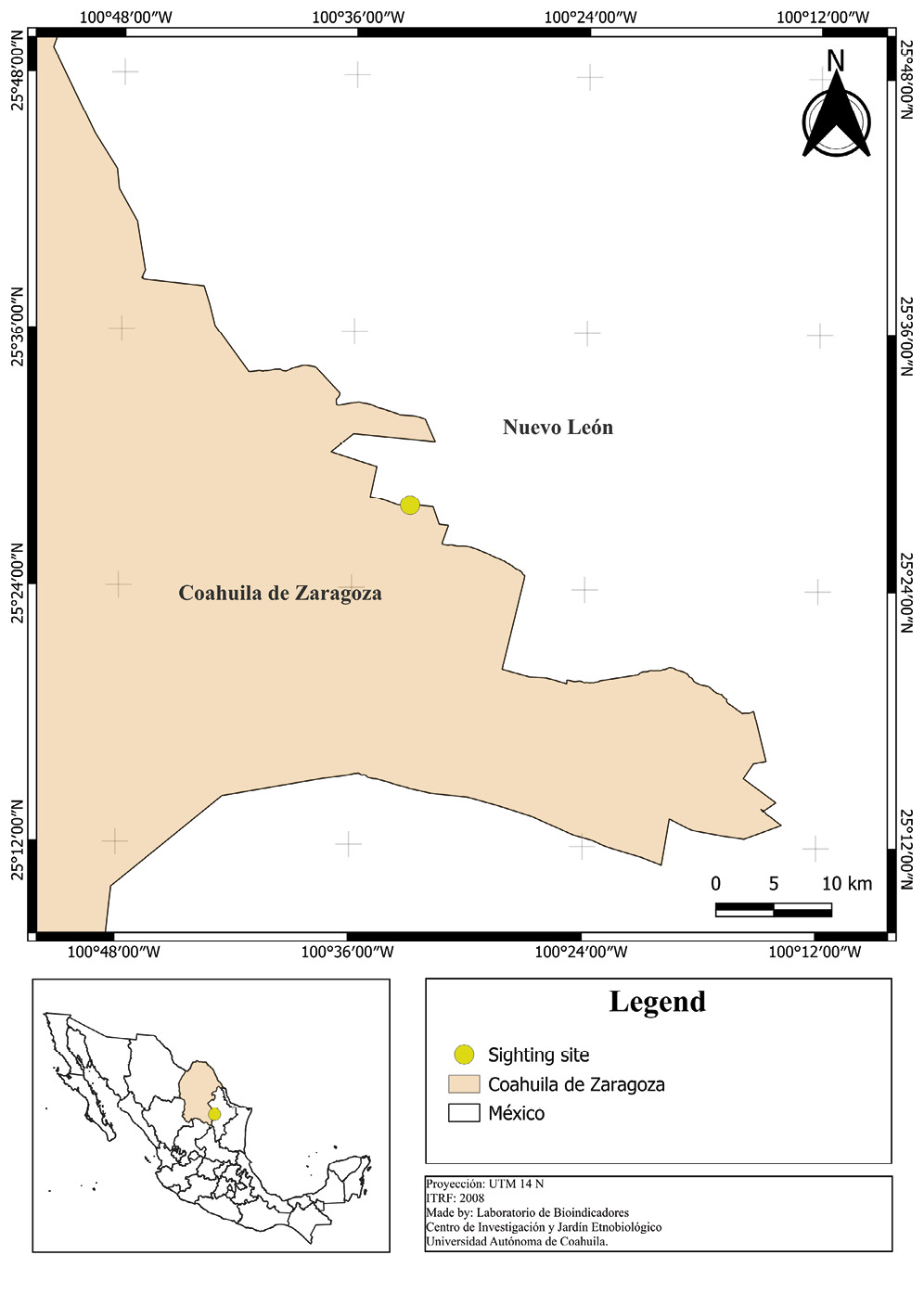
On August 23, 2025, an excursion was carried out to photograph biodiversity in the Sierra del Tarillal, a mountainous area belonging to the Sierra Madre Oriental, located on the border of the municipality of Arteaga, Coahuila and Santiago, Nuevo León, in northern Mexico (25°27´52.22” N 100°33´02.07” W), at a 3,215 m asl. (Figure 1). The vegetation of the site corresponds to a pine-oak forest with patches of grassland. There were no areas of cultivation or livestock activity in that place (Figure 2). The camera that was used was a Nikon Coolpix 1000. The observation of the rabbit was an opportunistic record (a piece of information or data gathered casually during routine activities rather than through planned, formal scientific study). The approximate distance to the rabbit was 20 m. The weather at that time was cloudy. At that time, it was not possible to track the individual nor were other specimens sought. As it was not possible to capture the specimen, histopathological or molecular studies could not be conducted.
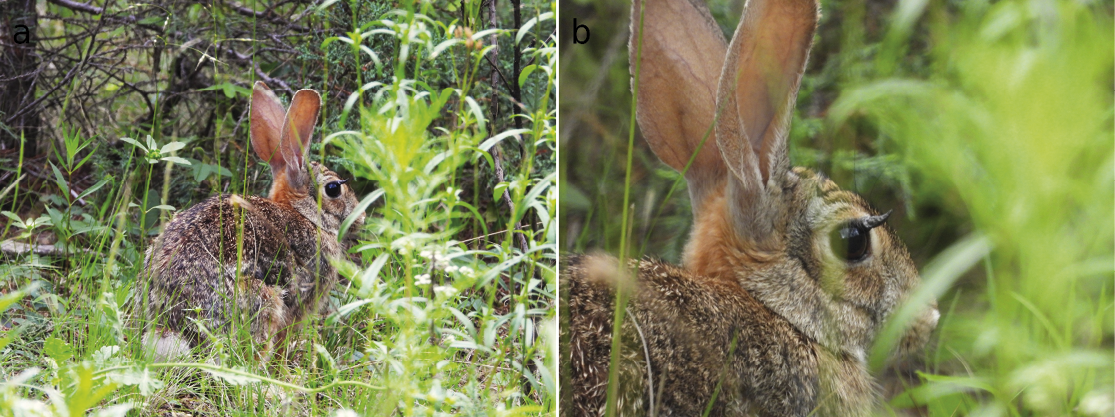
At 14:13 hr, with 25 °C and an elevation of 3,215 m above sea level, in the Sierra del Tarillal, an adult specimen of rabbit (Sylvilagus sp.) (approximately 20 cm high by 30 cm long) was photographed in its natural habitat, probably looking for food, with a conical, horn-like black protuberance (this sign is characteristic of the Shope papillomavirus) that appears to emerge from the eyelid on the upper part of the right eye (Figure 3). It was not possible to determine the sex of the specimen. At the time of observation, the specimen exhibited normal behavior and showed no apparent injuries other than the horn.
This paper reports a probable case of Shope papillomavirus in a free-ranging rabbit (Sylvilagus sp.) in Mexico. Although Escudero-Duch et al. (2015) reported the first case of this virus in a Sylvilagus floridanus specimen using molecular techniques, that specimen was from a museum collection in the United States (University of Kansas Natural History Museum (KU) collection) and was collected in Jalisco, Mexico in 1966. This means that those authors used a deceased organism, whereas in this paper we are referring to a live organism, in addition to the fact that that specimen was collected 60 years ago. During all this time there has been no other report of the disease in Mexico, and the closest reports have been in states bordering Mexico like Texas, although these are also reports from more than 60 years ago, since recent cases have been reported particularly for the state of Colorado (Colorado State University 2025).
It is also important to note that Escudero-Duch et al. (2015) reported two other specimens from the University of Kansas museum collection in the United States, originating from Mexico—one from Jalisco and the other from Nuevo León—which exhibited symptoms of the disease, but the virus was not detected by the molecular techniques used in their study. This suggests that possibly the disease has likely always existed in Mexico but had simply not been detected in living specimens. There is also the possibility that the disease has been spreading from the United States in recent times (causing the disease in the specimen reported in this work), since the specimens reported by Escudero-Duch et al. (2015) that come from Mexico were collected 60 years ago or more, between 1954 and 1966. There is also the possibility that some imported domestic rabbits spread the virus to free-living specimens.
Since we cannot assume that the observed lesion corresponds unequivocally to Shope Papillomavirus, it is important to mention that some possible differential diagnoses could correspond to skin tumors, abscesses, or trauma. Although the lesion cannot be identified 100% certainty, it is very characteristic and the diagnosis is fairly reliable (Escudero-Duch et al. 2015). The appearance of this disease in a wild rabbit in Mexico is an important event that should be considered by health authorities and those in charge of wildlife management. It is highly likely that other wild rabbits in Mexico carry this disease, so further research is planned to investigate its presence in the country’s wild rabbit population. As a first step, more visits to the site and surrounding areas are planned to photograph more specimens of wild rabbits. It is also suggested to conduct systematic, longitudinal studies to assess the status of the disease.
Understanding the epidemiology of these diseases is crucial for detecting potential population declines, preventing transmission to domestic rabbits, and designing better conservation programs for this biological group. Although no rabbit farms were observed in the vicinity of the study site, some do exist in relatively nearby places (50 km) such as the city of Saltillo, Coahuila. If any potential source of transmission of this disease is detected, it could be considered a threat and could be added to the management plans for protected natural areas near the site. Specific actions could include improving biosecurity conditions on rabbit farms, actively monitoring populations of wild rabbits and hares, and controlling or eradicating introduced animal populations.
Acknowledgments
We thank the editorial team for their constant support during the publication process and the reviewers whose valuable suggestions significantly enriched and improved this manuscript.
Literature cited
Aguirre, A. A., Ostfeld, R. S, and Daszak, P. 2012. New directions in conservation medicine. Oxford University Press. Oxford, USA.
Aguirre, A. A., Ostfeld, R. S., Tabor, G. M., House, C, and M. C. Pearl. 2002. Conservation medicine, ecological health in practice. Oxford University Press. Oxford, USA.
Brabb, T, and R. F. Di Giacomo. 2012. Viral diseases. Pp 365–413 in The Laboratory Rabbit, Guinea Pig, Hamster, and Other Rodents (Suckow M. A., Stevens K. A, and Wilson R. P. eds.). Academic Press. Boston, USA.
Colorado State University. 2025. Rabbits with horn-like growths: What pet owners should know. https://csuveterinaryhealth.org/rabbits-with-horn-like-growths-what-pet-owners-should-know/.
Escudero-Duch, C., Williams, R. A. J., Timm, R. M., Perez-Tris, J, And L. Benitez. 2015. A century of Shope Papillomavirus in museum rabbit specimens. Plos One 10:e0132172.
Fenner, F., Mcausland, B. R., Mims, C. A., Sambrook, J, And D. O. White. 1977. The biology of animal viruses. Mir. Moscow, Russia.
Jepson, L. 2011. Medicina de animales exóticos. Elsevier. Barcelona, Spain.
Larski, Z. 1989. Virología para veterinarios. Prensa Médica Mexicana. Ciudad de México, Mexico.
Manual Merck De Medicina Veterinaria. 1993. Océano. Barcelona, España.
Merchant, I. A, And R. A. Packer. 1980. Bacteriología y virología veterinarias. Acribia. Zaragoza, España.
Mohanty S. B, And S. K. Dutta. 1983. Virología veterinaria. Interamericana. Ciudad de México. Mexico.
Root J. J., Hopken M. W., Gidlewski T, And A. J. Piaggio. 2013. Cottontail Rabbit Papillomavirus Infection in a Desert Cottontail (Sylvilagus audubonii) from Colorado, USA. Journal of Wildlife Diseases 49:1060–1062.
Rous P, And J. W. Beard. 1935. The progression to carcinoma of virus-induced rabbit papillomas. Journal of Experimental Medicine 62:523–548.
Rous P., Kidd J. G, And J. W. Beard. 1936. Observations on the relation of the virus causing rabbit papillomas to the cancers deriving therefrom. Journal of Experimental Medicine 64:401-424.
Shope, R. E. 1932. A transmissible tumor-like condition in rabbits. Journal of Experimental Medicine 56:793-802.
Shope R. E, And E. W. Hurst. 1933. Infectious papillomatosis of rabbits with a note on the histopathology. Journal of Experimental Medicine 58:607-24.
Vargas-Cuenca J, and F. A. Cervantes. 2014. Audubon´s cottontail. Pp 111–140 in Mammals of Mexico (Ceballos, G. ed.). Johns Hopkins University Press. Baltimore, USA.
Associate editor: Itandehui Hernández Aguilar
Submitted: January 08, 2026; Reviewed: June 12, 2026
Accepted: August 28, 2026; Published on line: October 15, 2026
DOI: 10.12933/therya_notes-25-255
ISSN 2954-3614
Figure 1. Map of the observation site (Sierra El Tarillal - yellow dot) of the rabbit with probable Shope papillomavirus.
Figure 2. Landscapes of the Sierra El Tarillal with a mountain in the background (a) and with the pine-oak forest in the background (b).
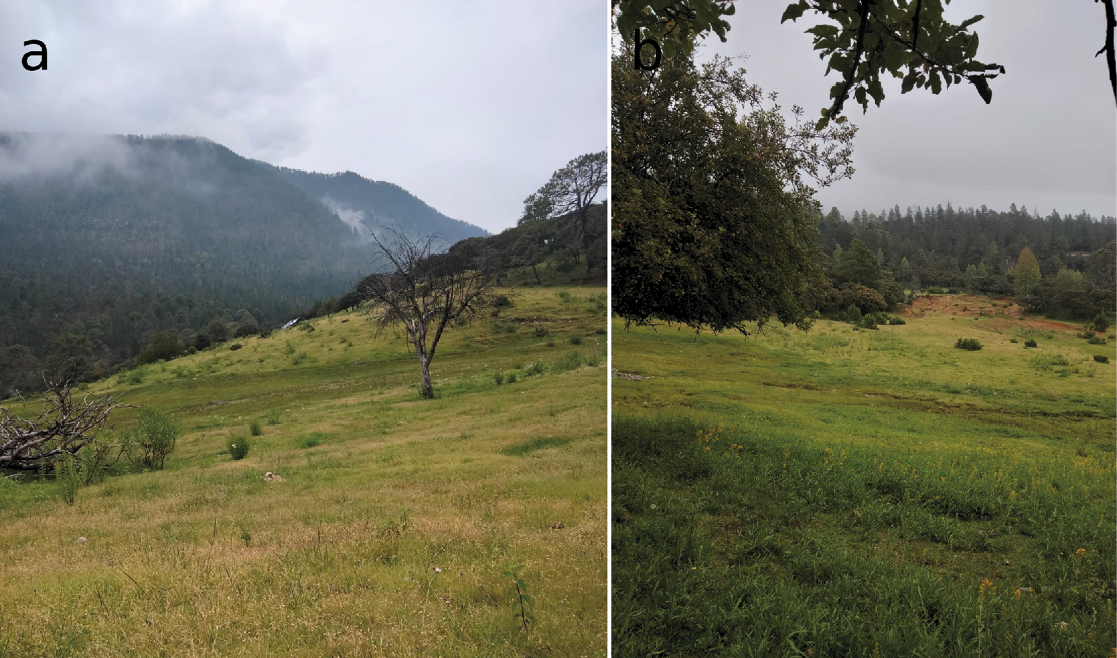
Figure 3. a) General view of the affected rabbit in its habitat. b) Close-up of the head.