THERYA NOTES 2026, Vol. 7: 102-107
First record of albinism in white-tailed deer Odocoileus virginianus in South America recorded in the Ecuadorian Andes
Primer registro de albinismo en venado de cola blanca
Odocoileus virginianus para Suramérica en los Andes del Ecuador
Elias Viteri-Basso1, 2 , Santiago Molina2, and Rebecca Zug2*
1Universidad San Francisco de Quito USFQ, Colegio de Ciencias Biológicas y Ambientales, Instituto de Biodiversidad Tropical IBIOTROP, Laboratorio de Zoología Terrestre, Quito 170901, Ecuador. E-mail: eliasaviteri@gmail.com (EV).
2Universidad San Francisco de Quito USFQ, Colegio de Ciencias Biológicas y Ambientales, Laboratorio de Carnívoros, Quito 170901, Ecuador. E-mail: rlzug@usfq.edu.ec (RZ), santi.molina.p@gmail.com (SM)
*Corresponding author.
The white-tailed deer Odocoileus virginianus is a widely distributed species across the Americas, inhabiting diverse temperate and tropical ecosystems. Both a lowland and highland subspecies occur in Ecuador. Color variation in vertebrates is mainly driven by changes in melanin concentration and can produce conditions like albinism, leucism, and melanism. Such pigmentation disorders have been reported in cervids worldwide but here we report the first case of albinism for O. virginianus in South America. The observation was made during a camera trap study conducted from October 2020 to February 2021 in Ecuador’s eastern Andes, approximately 50 km east of Quito, on private lands in páramo and montane forest ecosystems. An albino white-tailed deer, presumed to be female, was recorded once on January 8, 2021, at 3,969 m. in páramo habitat. Characterized by completely white fur, red eyes, and pink nose, hooves and ears. This individual represents the only record of albinism from 147 white-tailed deer detections during the study period. This is the first record of albinism in a white-tailed deer in Ecuador and South America. Albinism is rare in wild mammals and may affect survival, reproduction, and increase predation risk. This observation adds to and highlights color variations in Andean mammals, suggesting genetic constraints in populations.
Key words: Albinism, Andes, camera traps, Cervidae, color variations, Ecuador, genetic mutations, melanin, Odocoileus virginianus, white-tailed deer.
El venado de cola blanca Odocoileus virginianus es una especie ampliamente distribuida en América, habitando diversos ecosistemas. En Ecuador dos subespecies son reconocidas: los venados de la costa y andinos. Las anomalías de coloración, principalmente determinadas por cambios en la concentración de melanina, puede producir condiciones como albinismo, leucismo y melanismo. Estas variaciones se han registrado en cérvidos a nivel mundial, pero aquí reportamos el primer caso de albinismo para O. virginianus en Sudamérica. La observación se realizó en un estudio con 30 cámaras trampas entre octubre de 2020 y febrero de 2021, en los Andes orientales de Ecuador aproximadamente a 50 km de Quito, desarrollado en terrenos privados de páramo y bosque montano. Una presunta hembra de venado de cola blanca albino fue registrada una sola vez el 8 de enero de 2021, a 3,969 m en hábitat de páramo. Caracterizada por pelaje completamente blanco, ojos rojos y nariz, pezuñas y orejas rosadas, este individuo representa el único registro de albinismo entre 147 registros de venados de cola blanca durante el período de estudio. Este es el primer registro de un venado cola blanca albino en Ecuador y para Sudamérica. El albinismo es poco común en mamíferos silvestres y puede afectar su supervivencia, reproducción y aumentar su riesgo de depredación. Esta observación contribuye al conocimiento de las variaciones de color en mamíferos andinos, sugiriendo posibles limitaciones genéticas en sus poblaciones.
Palabras clave: Albinismo, Andes, cámaras trampa, cérvidos, Ecuador, melanina, mutaciones genéticas, Odocoileus virginianus, venado de cola blanca, variaciones de coloración
© 2026 Asociación Mexicana de Mastozoología, www.mastozoologiamexicana.org
The white-tailed deer Odocoileus virginianus is a widely distributed member of the Cervidae family, found across the Americas, from Canada to Peru and Bolivia. They occur in a variety of ecosystems, feed principally on plants, and are an important component of many trophic networks (Waller and Alverson 1997; Weber and Gonzales 2003; Ortega-S et al. 2011; McShea 2012; Tirira et al. 2017; Gallina-Tessaro et al. 2019; Tirira et al. 2019). Although some subspecies of O. virgnianus have been proposed for taxonomic revision or elevation, most continue to be recognized as subspecies throughout the species’ range (Molinari 2007; Mandujuano et al. 2010; Gallina-Tessaro et al. 2019; Tirira et al. 2019). In Ecuador, two subspecies are recognized: the Peruvian white-tailed deer (Odocoileus virginianus peruvianus), found in the lowlands of southwestern Ecuador, and the Andean white-tailed deer (Odocoileus virginianus ustus), found along the Andes in páramo ecosystems between 3,000 and 4,600 m (Tirira et al. 2017; 2019).
Color variation is widespread in vertebrates and is generally linked to differences in melanin concentrations in skin, fur, and feathers (van Grouw 2013; Lindgren et al. 2015; Galván et al. 2016). Melanin is a genetically regulated biopolymer derived from tyrosine. Eumelanin produces black, grey and brown tones, while pheomelanin generates yellow to reddish coloration (Prota 1992; Ito and Wakamatsu 2003; van Grouw 2006; 2013). These can be inhibited by genetic mutations influencing tyrosinase, leading to color alterations such as albinism, where body tissues lack pigmentation and eyes appear reddish due to visible blood vessels (Pawelek and Körner 1982; Hoekstra 2006; van Grouw 2006; Lindgren et al. 2015). Increased reporting of cases of albinism, melanism, and other pigmentation disorders in mammals show the need to understand their genetic and environmental drivers, as these have historically been linked to localized or limited populations and conditions (Hubbard et al. 2010; Mooring et al. 2020). Albinism, leucism, and melanism have been recorded in various cervid species around the world (Ribeiro and de Siqueira-Silva 2020; Guastalla et al. 2021; Pereria et al. 2023; Chaudhary et al. 2024), including reports of all three for white-tailed deer in the United States (Ryel 1963; Baccus and Posey 1999; D’ Angelo and Baccus 2007).
Here we report the first record of albinism in a white-tailed deer in Ecuador and for South America, specifically for the Andean subspecies, Odocoileus virginianus ustus, in the highlands of the country. This individual was recorded by camera traps and contributes to reports of color variations in deer, which are especially limited for tropical America.
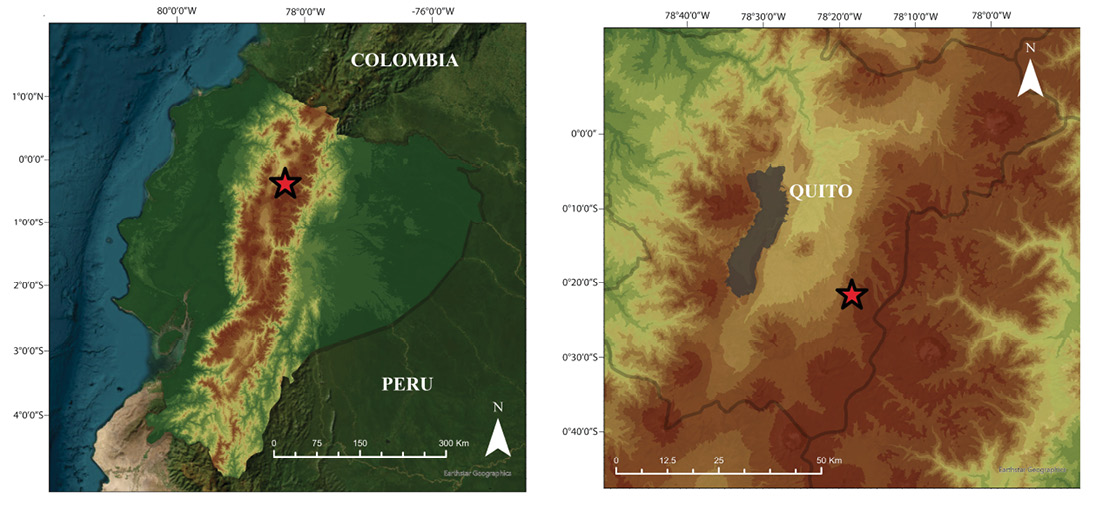
The observation came from a mammal-focused camera trap study in the eastern Andes region of northern Ecuador, approximately 50 km east of Quito’s urban area. The study was carried out on private lands with a mix of páramo ecosystems, upper montane forest, and agriculture areas (crops, livestock pastures). The study area was bordered to the north and south by roads, to the west by rural communities, and adjoined Cayambe-Coca National Park and Antisana Ecological Reserves to the north and northeast (Figure 1). From mid-October 2020 until late February 2021, 30 camera trap stations were monitored for a total of 3,229 camera trap days.
An albino white-tailed deer was recorded once on January 8, 2021, at 08:21 hr, moving through the páramo (0°21’28.7”S 78°18’16.9”W) at 3,969 m. The deer is recognized as albino because of the white fur over its entire body, red eyes, and pink nose, hooves, and ears (Figure 2). In comparison, the normal coloration of the species in this area is brown-gray with a black nose, hooves and eyes (Tirira 2017). Throughout the monitoring, we registered 147 events from white-tailed deer, with the albino individual appearing on only one occasion. The individual appeared to be alone and based on body size and lack of antlers, was likely a female.
To our knowledge, after an extensive literature review, this is the first reported record of an albino white-tailed deer in Ecuador and in South America. In cervids, color alterations such as albinism and leucism have been reported in South America for Mazama deer species (Ribeiro and de Siqueira-Silva 2020; Guastalla et al. 2021), and leucism was reported in the marsh deer Blastocerus dichotomus in Argentina (Pereria et al. 2023). Other anomalies observed in cervids include albinism in spotted deer Axis axis and in swamp deer Rucervus duvaucelii (Chaudhary et al. 2024). Color variations have been reported for white-tailed deer including melanism (Baccus and Posey 1999; D’ Angelo and Baccus 2007), albinism, and leucism (Ryel 1963). However, all reports come from the United States, which could be explained by large population sizes, a history of translocations, relaxed predation pressure due to predator decline, and variable genetic structure. These factor may increase both the prevalence of encounters and studies involving deer, as well as the likelihood of rare color morphs by increasing mutation rates, reducing selective pressures, and promoting local genetic drift or founder effects that favor their persistence (Ellsworth et al. 1994; Waller and Alverson 1997; Deyoung et al. 2003: Lang and Blanchong 2012; McShea 2012, Blanchong et al. 2013; Russell et al. 2017).
Albinism is a condition seen in many different vertebrate groups, including fish, amphibians, birds, and mammals of various sizes (Uieda 2000; Hoekstra 2006; Wang et al. 2007; van Grouw 2013; Lindgren et al. 2015). However, although widespread, it remains a rare color alteration in wild mammal populations (Pawelek and Körner 1982; Lindgren et al. 2015). This and other color alterations may arise from diet, environmental stressors, or, more commonly, from specific genetic mutations found in small or isolated populations (Hubbard et al. 2010). Because the individual reported here represents the first case of albinism in white-tailed deer from Ecuador, and in South America, the underlying cause of the condition in this population remains unknown. However, the record adds to growing evidence of color abnormalities in mammals from Ecuador’s western Andean slopes, where one case of albinism was reported for stump-tailed porcupine (Romero et al. 2018), cases of piebaldism have been reported in mountain coatis, brown-nosed coatis, black agoutis, and tayras (Viteri-Basso et al. 2024), and melanism has been recorded with high prevalence in clouded tiger cats and in tamanduas (Ríos-Alvear and Cadena-Ortiz 2019; Viteri-Basso et al. 2024). These abnormalities are likely the result of underlying genetic constraints. Such recurring observations may reflect naturally occurring genetic variations, but they also raise the possibility of reduced genetic diversity in certain highland mammal populations confined to isolated areas in the country (Brito and Valdivieso-Bermeo 2016; Cueva et al. 2024).
Color alterations such as albinism can impact probability of survival, reproductive success, and affect stress levels by increasing conspicuousness towards predators, reducing sexual competitiveness, or altering temperature regulation (van Grouw 2006; Peacock 2011; Abreu et al. 2013; Mooring et al. 2020; Streeting et al. 2023). For white-tailed deer in páramo populations, where grasses and shrubs are brown and green, albinism may affect their ability to hide from predators such as pumas Puma concolor, as well as human hunters who are considered the main conservation threat in Ecuador (Tirira 2011; Tirira et al. 2019). The páramo is also a high-altitude ecosystem with low temperatures but intense solar and UV exposure during daylight hours, along with strong diurnal temperature changes (Ramsay 2001; Madriñán et al. 2013; Cabay et al. 2025). These factors could put pigment deficient mammals under thermal regulation pressure or stress. Lack of melanin may also cause altered depth perception, increased sensitivity to light and poorer eyesight- all of which may affect foraging and vigilance (Pawelek and Körner 1982; Hoekstra 2006; Gronskov and Nielsen 2007; Gough 2008).
This first case of albinism in white-tailed deer in South America broadens our understanding of color variation in highland mammals and ungulates and provides valuable baseline data for future ecological and conservation studies. Apart from the rarity of this record, it highlights the importance of long-term monitoring in the páramo, where extreme environmental conditions and increasing anthropogenic pressures may affect both the causes and consequences of these such traits. As with other records of unusual coloration in Andean mammals, this observation underscores the need to include these phenotypic anomalies into bigger assessments of population health, genetic diversity, and species vulnerability, since they are usually linked (Hubbard et al. 2010; Brito and Valdivieso-Bermeo 2016), and ensuring that unique individuals such as this one can also inform strategies for conserving ecosystems of the Tropical Andes.
Acknowledgements
The authors would like to thank Fundación Jocotoco, FONAG, and the Ponce family for access to their land and support from their field staff during the data collection period. We would also like to thank fRI Research for their donation of camera traps. This study was funded by a Research & Conservation Grant from the International Bear Association and a COCIBA Research Grant from Universidad San Francisco de Quito.
Literature cited
Abreu, M. S. L., et al. 2013. Anomalous colour in Neotropical mammals: a review with new records for Didelphis sp. (Didelphidae, Didelphimorphia) and Arctocephalus australis (Otariidae, Carnivora). Brazilian Journal of Biology 73:185–194.
Baccus, J. T., and J. C. Posey. 1999. Melanism in white-tailed deer in central Texas. The Southwestern Naturalist 44:184–192.
Brito, J., and K. Valdivieso-Bermeo. 2016. First records of leucism in eight species of small mammals (Mammalia: Rodentia). Therya 7:483–489.
Cabay, M. J. C., et al. 2025. Modeling temperature in the Ecuadorian páramo through deep learning. IEEE Journal of Selected Topics in Applied Earth Observations and Remote Sensing.
Chaudhary, B., et al. 2024. A rare rendezvous: albino spotted deer and swamp deer in the Chitwan National Park, Nepal. Species 25:e5s1627.
Cueva, D. F., et al. 2024. Evidence of population genetic structure in Ecuadorian Andean bears. Scientific Reports 14:2834.
D’Angelo, G. J., and J. T. Baccus. 2007. First record of melanistic white-tailed deer in Pennsylvania. The American Midland Naturalist 157:401–403.
Ellsworth, D. L., et al. 1994. White-tailed deer restoration to the southeastern United States: evaluating genetic variation. The Journal of Wildlife Management 58:686–697.
Gallina-Tessaro, S., E. López-Tello, and S. Mandujano. 2019. Recent studies of white-tailed deer in the Neotropics. Pp. 1–22 in Ecology and Conservation of Tropical Ungulates in Latin America (S. Gallina-Tessaro, ed.). Springer. Cham, Suiza.
Galván, I., et al. 2016. Tropical bat as mammalian model for skin carotenoid metabolism. Proceedings of the National Academy of Sciences 113:10932–10937.
Gough, N. R. 2008. Why albinism impairs eyesight. Science Signaling 1:ec345.
Gronskov, K., J. Ek, and K. B. Nielsen. 2007. Oculocutaneous albinism. Orphanet Journal of Rare Diseases 2:43.
Guastalla, M. G., et al. 2021. The mysterious white deer: anomalous coloring in different Neotropical deer. Mammalian Biology 101:665–673.
Hoekstra, H. E. 2006. Genetics, development and evolution of adaptive pigmentation in vertebrates. Heredity 97:222–234.
Hubbard, J., et al. 2010. Vertebrate pigmentation: from underlying genes to adaptive function. Trends in Genetics 26:231–239.
Ito, S., and K. Wakamatsu. 2003. Quantitative analysis of eumelanin and pheomelanin in humans, mice, and other animals: a comparative review. Pigment Cell Research 16:523–531.
Lindgren, J., et al. 2015. Interpreting melanin-based coloration through deep time: a critical review. Proceedings of the Royal Society B: Biological Sciences 282:1813.
Madriñán, S., A. J. Cortés, and J. E. Richardson. 2013. Páramo is the world’s fastest evolving and coolest biodiversity hotspot. Frontiers in Genetics 4:192.
Mandujano, S., C. A. Delfín-Alfonso, and S. Gallina. 2010. Comparison of geographic distribution models of white-tailed deer Odocoileus virginianus (Zimmermann, 1780) subspecies in Mexico: biological and management implications. Therya 1:41–68.
McShea, W. J. 2012. Ecology and management of white-tailed deer in a changing world. Annals of the New York Academy of Sciences 1249:45–56.
Molinari, J. 2007. Variación geográfica en los venados de cola blanca (Cervidae, Odocoileus) de Venezuela, con énfasis en O. margaritae, la especie enana de la Isla de Margarita. Memoria de la Fundación La Salle de Ciencias Naturales 167:29–72.
Mooring, M., A. Eppert, and R. Botts. 2020. Natural selection of melanism in Costa Rican jaguar and oncilla: a test of Gloger’s rule and the temporal segregation hypothesis. Tropical Conservation Science 13:1–11.
Ortega-S., J. A., et al. 2011. Managing white-tailed deer: Latin America. Pp. 578–611 in Biology and Management of White-tailed Deer (D. G. Hewitt, ed.). CRC Press. Boca Raton, EE.UU.
Pawelek, J. M., and A. M. Körner. 1982. The biosynthesis of mammalian melanin: the regulation of pigment formation, the key to disorders such as albinism and piebaldism, may also offer some clues for the treatment of melanoma. American Scientist 70:136–145.
Peacock, K. 2011. The three faces of ecological fitness. Studies in History and Philosophy of Biological and Biomedical Sciences 42:99–105.
Pereira, J. A., et al. 2023. First records of pigmentation anomalies in the marsh deer at its southernmost stronghold: a warning message? European Journal of Wildlife Research 69:59.
Prota, G. 1992. Melanins and Melanogenesis. Academic Press. New York, EE.UU.
Ramsay, P. M. 2001. Diurnal temperature variation in the major growth forms of an Ecuadorian páramo plant community. Pp. 101–112 in The Ecology of Volcán Chiles: high-altitude ecosystems on the Ecuador-Colombia border.
Ribeiro, R., and D. H. de Siqueira-Silva. 2020. First report of complete albinism in Mazama americana (Erxleben, 1777) in the Biological Reserve of Tapirapé, Oriental Amazon, Brazil. Acta Scientiarum Biological Sciences 42:1–7.
Ríos-Alvear, G., and H. Cadena-Ortiz. 2019. Records of melanistic Tamandua tetradactyla (Pilosa, Myrmecophagidae) from Ecuador. Neotropical Biology and Conservation 14:339–347.
Romero, V., C. Racines-Márquez, and J. Brito. 2018. A short review and worldwide list of wild albino rodents with the first report of albinism in Coendou rufescens (Rodentia: Erethizontidae). Mammalia 82:509–515.
Russell, M. B., et al. 2017. Interactions between white-tailed deer density and the composition of forest understories in the northern United States. Forest Ecology and Management 384:26–33.
Ryel, L. A. 1963. The occurrence of certain anomalies in Michigan white-tailed deer. Journal of Mammalogy 44:79–98.
Streeting, L., et al. 2023. A leucistic platypus observed on the New England Tablelands of New South Wales. Australian Mammalogy 46:AM23027.
Tirira, D. G. 2011. Venado de cola blanca de páramo (Odocoileus virginianus ustus). P. 273 in Libro Rojo de los Mamíferos del Ecuador, 2nd ed. (D. G. Tirira, ed.). Fundación Mamíferos y Conservación, Pontificia Universidad Católica del Ecuador, Ministerio del Ambiente del Ecuador. Quito, Ecuador.
Tirira, D. G. 2017. Guía de campo de los mamíferos del Ecuador, 2nd ed. Ediciones Murciélago Blanco. Quito, Ecuador.
Tirira, D. G., et al. 2019. Tropical ungulates of Ecuador: an update of the state of knowledge. Pp. 1–22 in Ecology and Conservation of Tropical Ungulates in Latin America (S. Gallina-Tessaro, ed.). Springer. Cham, Suiza.
Uieda, W. 2000. A review of complete albinism in bats with five new cases from Brazil. Acta Chiropterologica 2:97–105.
Van Grouw, H. 2006. Not every white bird is an albino: sense and nonsense about colour aberrations in birds. Dutch Birding 28:79–81.
Van Grouw, H. 2013. What colour is that bird? The causes and recognition of common colour aberrations in birds. British Birds 106:17–29.
Viteri-Basso, E., et al. 2024. Shadows in the forest: uncovering unusual colouration records in mammals from the Ecuadorian Tropical Andes. Biodiversity Data Journal 12:e137463.
Waller, D. M., and W. S. Alverson. 1997. The white-tailed deer: a keystone herbivore. Wildlife Society Bulletin 25:217–226.
Wang, J., et al. 2007. The tyrosinase gene family and albinism in fish. Chinese Journal of Oceanology and Limnology 25:191–198.
Weber, M., and S. Gonzalez. 2003. Latin American deer diversity and conservation: a review of status and distribution. Écoscience 10:443–454.
Associate editor: Xavier López Medellín
Submitted: October 28, 2025; Reviewed: March 31, 2026
Accepted: April 04, 2026; Published on line: May 14, 2026
DOI: 10.12933/therya_notes-25-238
ISSN 2954-3614
Figure 1. Location of the camera trap observation of the albino white-tailed deer in the Andes region in Ecuador. Quito’s urban area is shaded grey.
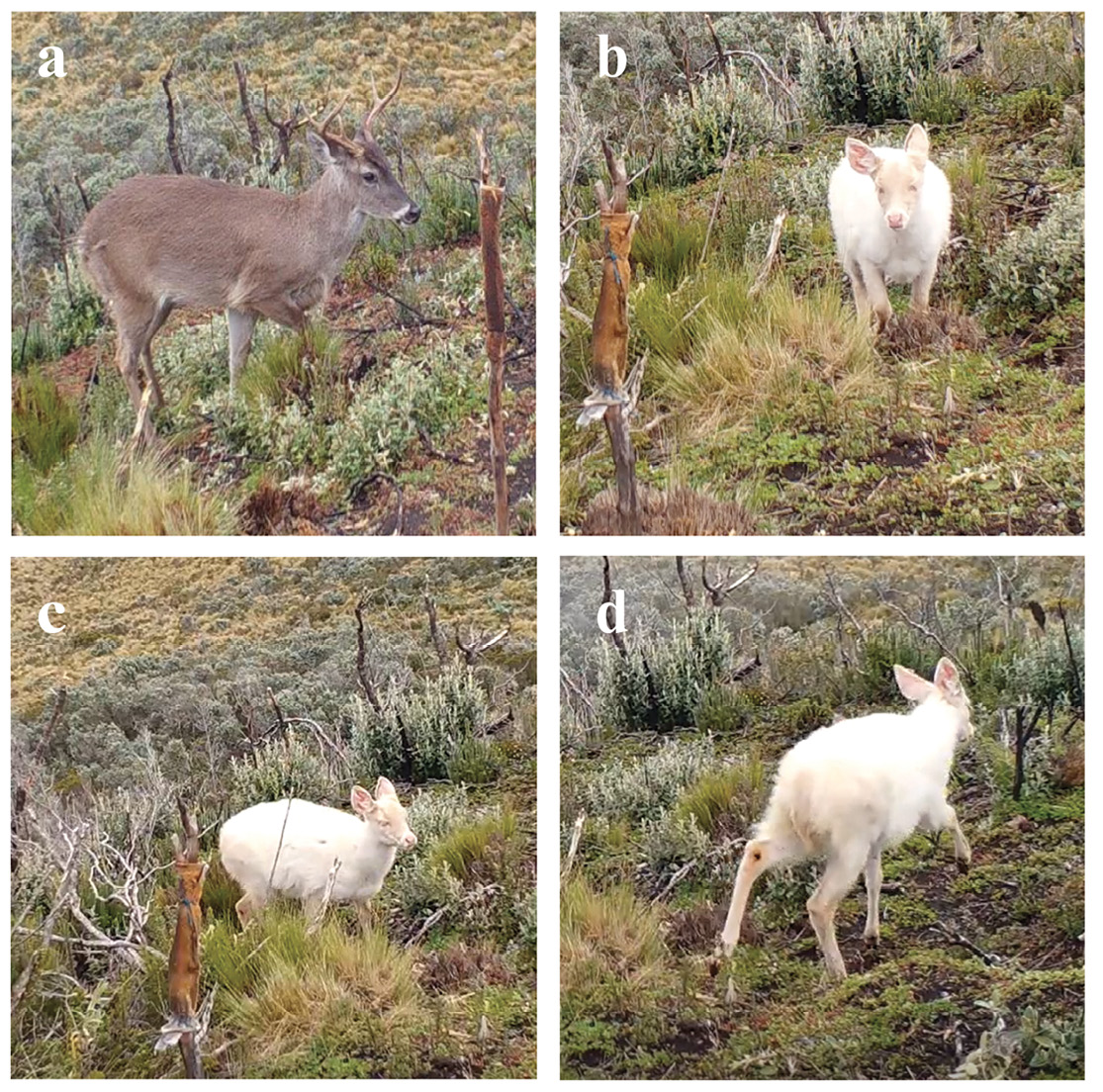
Figure 2. First record of an albino white-tailed deer, subspecies O. virginianus ustus, in the Andes region of northern Ecuador, recorded by a camera trap. a) Normal coloration of an adult individual of O. v. ustus captured in the same camera trap. b) Frontal view: note the white coloration of the body, pink coloration of nose and ears, and red eyes. c) Lateral view: note overall white coloration across body and pink ears. d) Posterior view of albino deer individual.