THERYA NOTES 2026, Vol. 7:58-66
Enhancing the knowledge of Herpailurus yagouaroundi
for its conservation in Morelos, México
Mejorando el conocimiento de Herpailurus yagouaroundi
para su conservación en Morelos, México
David Valenzuela-Galván1*, Floriely Castro-Campos2,3, Cuauhtémoc Chávez4, Adrián Rueda-Rosas5 y Juan Carlos Martínez-Montes5
1Centro de Investigación en Biodiversidad y Conservación (CIBYC), Universidad Autónoma del Estado de Morelos (UAEM), Av. Universidad No. 1001, Col. Chamilpa, CP 62209, Cuernavaca, Morelos, México. Email: dvalen@uaem.mx (DV-G).
2Doctorado en Ciencias Biológicas y de la Salud, Universidad Autónoma Metropolitana-Lerma, Av. de las Garzas #10, El panteón, 52005 Lerma de Villada, Méx., México. Email: floriely_1405@hotmail.com (FC-C).
3Fundación para el Manejo y la Conservación de la Vida Silvestre, A.C., Av. Unión. Manzana 32 Lote 22. Colonia Popular Santa Teresa. Delegación Tlalpan, México, Distrito Federal. C.P. 14160. Email: fmcovis@outlook.com (FC-C).
4Departamento de Ciencias Ambientales, División de Ciencias Biológicas y de la Salud, Universidad Autónoma Metropolitana-Lerma, Av. de las Garzas #10, El panteón, 52005 Lerma de Villada, Méx., México. Email: j.chavez@correo.ler.uam.mx (CCH).
5Maestría en Biología Integrativa de la Biodiversidad y la Conservación, CIBYC-UAEM, Av. Universidad No. 1001, Col. Chamilpa, CP 62209, Cuernavaca, Morelos, México. Email: adrian.ruedar@hotmail.com (AR-R); jc.jaguart@gmail.com (JCM-M)
*Corresponding author
The jaguarundi is one of the six wild feline species found in Mexico and is considered threatened, with population trends indicating a decline. It is a species difficult to capture, with very few recorded sightings. More studies on its ecology are needed. The data were obtained through photo-trapping samplings conducted at six ejidos (communal landholdings) within the Sierra de Huautla Biosphere Reserve (REBIOSH), in southern Morelos, from 2015 to 2022, using between 35 and 61 camera traps on each 30-60 day sampling periods. The cameras were deployed on sampling grids with a minimum separation of 500 m. We obtained 25 records of the species in 15 different sites within the REBIOSH. On average, its photographic capture rate in this protected natural area (PNA) was 0.63 ± 0.67 individuals per 1,000 trap days. Most of these new records were obtained in wide ravines within large fragments (ranging from 80 to over 1,500 ha) of preserved continuous dry forest, at altitudes below 1,200 m above sea level, and during the daytime. This increases knowledge of the species’ distribution in Morelos and provides evidence that, in the REBIOSH, this species has a persistent population with a wide distribution, especially in its southern and northeastern portions, although it is low in abundance. We provide concrete suggestions to help conserve it within this PNA and in the state of Morelos.
Keywords: Camera trapping; dry forest; endangered species; jaguarundi; photographic capture rate; protected natural area; Sierra de Huautla.
El jaguarundi es una de las seis especies de felinos silvestres presentes en México considerada como amenazada, y sus poblaciones van en decremento. Existen muy pocos registros de su presencia. Es necesario realizar más estudios sobre su ecología. Los datos se obtuvieron mediante muestreos con fototrampeo realizados en seis ejidos de la Reserva de la Biosfera Sierra de Huautla (REBIOSH), en el sur de Morelos, entre 2015 y 2022. Se utilizaron entre 35 y 61 cámaras trampa por cada período de muestreo de 30 a 60 días. Las cámaras se desplegaron espacialmente en cuadrículas de muestreo con una separación mínima entre ellas de 500 m. Se obtuvieron 25 registros de la especie en 15 sitios diferentes dentro de la REBIOSH. En promedio, su tasa de captura fotográfica en esta área natural protegida (ANP) fue de 0.63 ± 0.67 individuos/1,000 días trampa. La mayoría de estos nuevos registros se obtuvieron en el periodo diurno; en fototrampas ubicadas en cañadas amplias, dentro de fragmentos grandes (de 80 a más de 1500 ha) de selva seca conservada continua en elevaciones menores a 1,200 msnm. Los resultados contribuyen a incrementar el conocimiento sobre la distribución de la especie en Morelos y se evidencia una población residente de la especie dentro de la REBIOSH, con una amplia distribución, sobre todo en su porción sur y noreste, aunque con baja abundancia. Damos sugerencias concretas para contribuir a su conservación tanto dentro de esta ANP como en Morelos.
Palabras clave: Área natural protegida; especie amenazada; fototrampeo; jaguarundi; selva seca; Sierra de Huautla; tasa de captura fotográfica.
© 2026 Asociación Mexicana de Mastozoología, www.mastozoologiamexicana.org
The jaguarundi (Herpailurus yagouaroundi) is one of the six wild felid species in the country. It is a medium-sized animal that weighs 3-9 kg and measures 80 - 130 cm in total length (its tail accounts for 30-45 % of that length). It has a small, flat head with rounded ears. Its legs are short compared to its total length, and it has a short, coarse fur coat without markings throughout its life, with uniform coloration. However, the species shows notable coloration polymorphism with two main color morphs: one brown or reddish-brown and the other almost black or grayish.
It is distributed in tropical and subtropical zones, ranging from humid to dry, from northern Mexico to southern Brazil, Paraguay, Uruguay, and south through central Argentina (Caso et al. 2015). In Mexico, it occurs from Nuevo León to the Yucatán Peninsula, especially along the Pacific and Gulf coasts (Aranda and Caso 2014). It is not found in the Baja California Peninsula or in most of the Mexican highlands. It is considered threatened in Mexico (SEMARNAT 2019) and internationally as listed as Least Concern by the International Union for Conservation of Nature (IUCN; Caso et al. 2015), but with declining populations. Furthermore, its Central and North American populations are listed in Appendix I of CITES (Convention on International Trade in Endangered Species of Wild Fauna and Flora), as stated by Caso et al. (2015), meaning they are threatened with extinction and affected by trade.
The species is generally considered to have low abundances throughout its almost entire distribution range, with densities around 0.01-0.05 indviduals/km² or lower (Caso et al. 2015), for this reason, and also because of its evasive behavior it is difficult to study using both camera traps and box traps (Giordano 2016; Lombardi et al. 2022; Branney et al. 2023), which is mainly why it is a species with few observations.
For example, a search on the GBIF platform (Global Biodiversity Information Facility) conducted on 27 January 2026 returned 610 records for the species across the country (GBIF Occurrence Download https://doi.org/10.15468/dl.djjtnw) and only five for the state of Morelos (GBIF Occurrence Download https://doi.org/10.15468/dl.zpmxux). Thus, providing more data on its presence in areas with few previous records is essential, which is why we report new records for Morelos here, obtained in six ejidos within the Sierra de Huautla Biosphere Reserve (REBIOSH), through photo trapping conducted between 2015 and 2022.
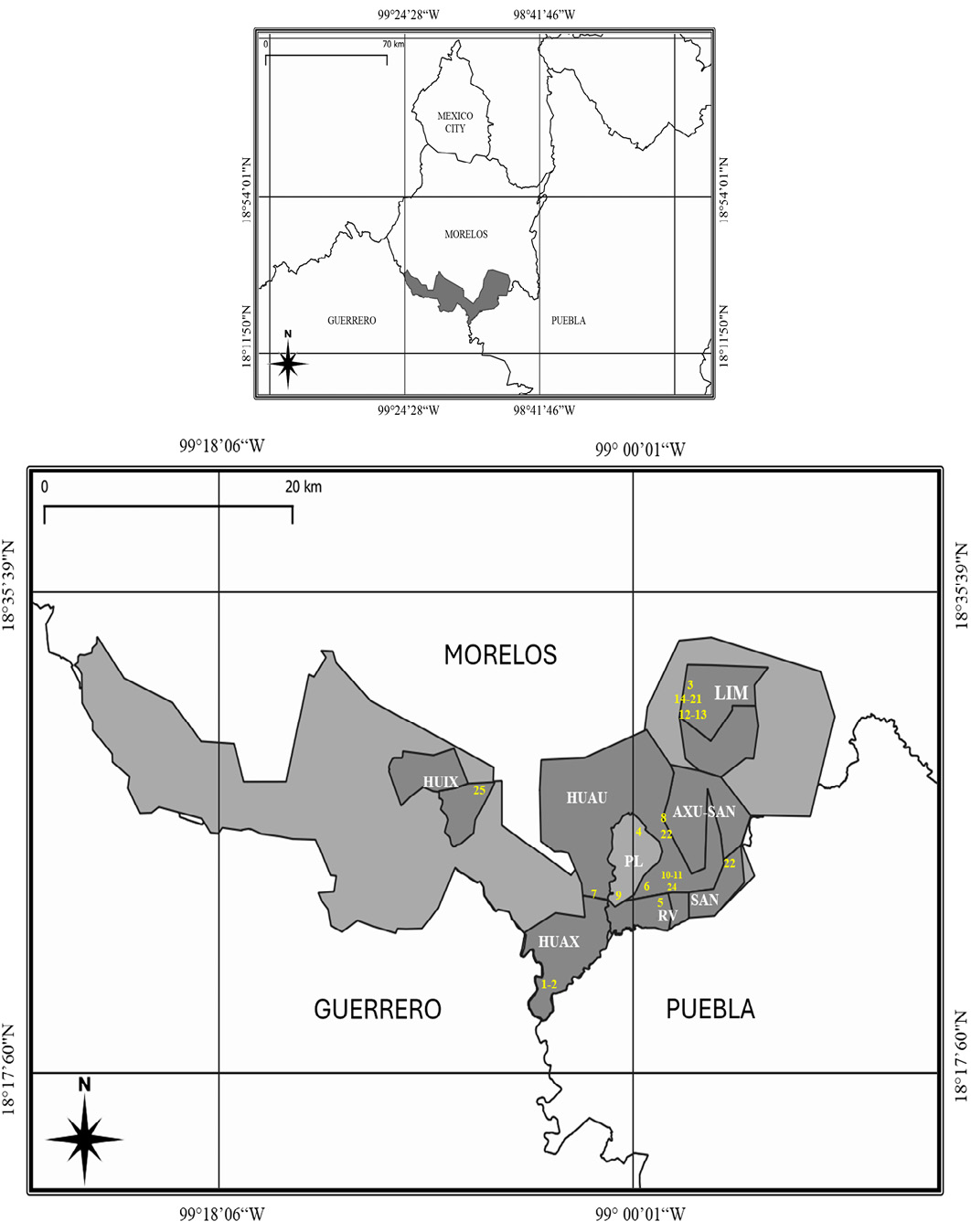
The REBIOSH is the largest protected natural area (PNA) in the state of Morelos, Mexico (Figure 1). It has received federal protection and international recognition as part of the UNESCO (United Nations Educational, Scientific and Cultural Organization) World Network of Reserves of the Man and Biosphere program since 2006. Decreed in 1999, it protects one of the most significant remnants of dry forest or tropical deciduous forest in central Mexico. It protects an area of 59,030 ha and is home to significant biological diversity, with more than 1,200 vascular plant species and over 380 vertebrate species, including 16 mammalian carnivores, and among them, all six wild feline species found in Mexico (CONANP 2005; Valenzuela-Galván et al. 2020).
Within its surface area or within its area of influence, there are 31 rural towns, with a total population of 24,646, according to data from the 2020 national population census conducted by the National Institute of Statistics and Geography (INEGI, by its acronym in Spanish). Of these, nearly 4,000 people reside within the PNA.
In 2009, we initiated wildlife monitoring in this PNA using camera traps, focusing on medium- to large-sized mammals. We used a variable number of cameras from different brands and models: Bushnell (Bushnell Outdoor Products 201 N 700 W, Hyde Park, UT 84318, USA; model Core DS-4K), Cuddeback (2256 American Blvd. De Pere, WI 54115, USA; models Attack Black Flash, Attack IR, C Black Flash, Capture, E2 long range IR and E3 Black Flash), DeerCam (DeerCam, Pak Falls, USA; model DC300), Forestry Suppliers (Forestry Suppliers, Inc. 205 West Rankin Street, Jackson, MS 39201, USA; model Wildlife Pro System, with analog camera), Moultrie (Moultrie Inc., Alabaster, AL, USA; models A-5, D444 and M880), Stealthcam (5250 Frye Road Irving, TX 75061, USA; model PX14), Reconyx (3828 Creekside Ln Holmen, WI 54636, USA; Hyperfire 2 model) and Wildview (Stealth Cam, LLC, Grand Prairie, Texas, US; Extreme and Infrared Extreme models).
Photo-trapping has been conducted in 11 ejidos within REBIOSH, covering almost 30,000 ha of the protected area. Between 35 and 61 camera traps were used per ejido (depending on availability) in each sampling period of 30 to 60 days (depending on logistical and financial constraints). Seven ejidos have been sampled in 2-4 different years, and four ejidos have been sampled in 5-10 different years. Sampling has been conducted during both the dry and rainy seasons.
The cameras were placed on tree trunks 40-100 cm above ground, in spatial arrangements corresponding to sampling grids with a minimum separation of 500 m between cameras. Most cameras were placed at sites in conserved dry forests, more than 600 m from villages. Each camera was configured to operate continuously throughout the sampling period, taking 2-3 photographs and a 20-30 second video per event (when the model permitted). The minimum time interval between detections was set to 1 minute.
We obtained the first photographic record of the jaguarundi in REBIOSH in 2015. From 2015 to 2022, we collected 67 photographic records of this species (in 2015, 2018, 2019, 2020, 2021, and 2022), with a total sampling effort of 29,985 trap days (ranging from 2,284 to 9,067 trap days per sample period). We recorded the jaguarundi in six of the 11 ejidos (Figure 1; Table 2): Ajuchitlán-Santiopa, Rancho Viejo, Huautla, Huixastla, and Huaxtla, all in the Municipality of Tlaquiltenango, and in El Limón de Cuauchichinola (Municipality of Tepalcingo).
These 67 photographic records correspond to 25 independent recordings, including individuals of both main color morphs (although the grayish form was more common) of the species (Figure 2), at 15 different recording sites. It was difficult to determine the sex or age of all the independent records. Still, among them, we identified individuals of both sexes and adults and juveniles (see Figure 2, where 2d shows an adult male and 2i shows a juvenile-like individual). The jaguarundi photographic capture rate in six samplings ranged from 0.20 to 1.99 individuals per 1,000 trap days, with a mean value (± standard deviation) of 0.63 ± 0.67.
The details of each of the 25 independent jaguarundi records, including date, time, altitude, location, and site, are presented in Table 2. Most recordings were obtained from cameras located in ravines and within large fragments (ranging from 80 to over 1,500 ha) of preserved dry forest at elevations below 1,200 m. Of these independent photographic records, 23 were taken during the day, between 07:43 and 17:51 h., and the other two were taken at night, at 20:33 and 23:08 hr.
Other wildlife species were recorded with the jaguarundi on the same cameras. They coincided in five or more sites: white-nosed coati (Nasua narica), chachalaca (Ortalis poliocephala), white-tailed deer (Odocoileus virginianus), coyote (Canis latrans), and gray fox (Urocyon cinereoargenteus). In four sites: raccoon (Procyon lotor), margay (Leopardus wiedii), and northern opossum (Didelphis virginiana). And between 1 and 3 sites: armadillo (Dasypus mexicanus), collared peccary (Dycotyles tajacu), northern cacomixtle (Bassariscus astutus), American hog-nosed skunk (Conepatus leuconotus), southern spotted skunk (Spilogale angustifrons), southern striped skunk (Mephitis macroura), bobcat (Lynx rufus), and puma (Puma concolor).
Our data provide evidence of the jaguarundi’s constant presence in the REBIOSH for at least seven years, suggesting a resident population, especially in the southern and northeastern areas of the reserve. However, the species ‘abundance was low, as indicated by the capture success rates for the species in each of the surveys in which it was recorded. Furthermore, the percentage of cameras that recorded jaguarundi was low, ranging from 0.4 % to 3.0 % of the total number of cameras used in each sampling (35-61).
The jaguarundi’s low photographic capture rate appears typical across its range. Harmsen et al. (2024) compiled these data for different countries where the species is present. They inferred that the species’ photographic capture rate ranges from 0.86 to 5.74 detections per 1,000 trap days (with an average of 2.34 across 13 countries in Mesoamerica and South America).
In Mexico, the jaguarundi’s photographic capture rate is also generally low, ranging from 0.23 to 3.76 independent records of the species per 1,000 trap days (see Table 1 for data and references). The REBIOSH capture rate falls at the lower end of the range reported across various locations in Mexico. However, this may partly be due to our sampling design, as most cameras were placed in large fragments of conserved dry forest. In contrast, fewer cameras were set in areas with mosaics of disturbed dry forest, agricultural areas, and secondary vegetation.
The jaguarundi tolerates moderate anthropogenic disturbances, preferring mosaics of tropical forests with small agricultural and grassland zones (Giordano 2016; Coronado-Quibrera et al. 2019), but it requires primary forest habitats. The main threat to the species is habitat loss and fragmentation, especially from large-scale agriculture and pasture. Also, when small towns are near their habitat, jaguarundis can prey on poultry and are commonly killed in retaliation (Caso et al. 2016).
Additionally, it has been shown to prefer areas near water at low elevations, and with higher total edge and more landscape patches (Coronado-Quibrera et al. 2019). The fact that most of our records were from ravines and below 1,200 m is consistent with the species’ preference for areas near water sources and at low altitudes, as reported by Coronado-Quibrera et al. (2019).
Furthermore, because the jaguarundi primarily consumes large sigmodontine rodents (e.g., Sigmodon spp.), which tend to be more abundant in agricultural or disturbed areas, the jaguarundi may frequently hunt in these areas (Giordano 2016). Regarding this, eight species of sigmodontine rats and mice have been reported in REBIOSH (CONANP 2005), and only three species are medium or large: Hodomys alleni (very rare in REBIOSH, with individuals weighing over 100 g); Peromyscus melanophrys (abundant in the area, with adult individuals weighing between 30 and 52 g), and Sigmodon mascotensis (formerly S. hispidus; Martínez-Chapital et al. 2017; not very abundant in REBIOSH, weighing 40-250 g).
Numerous studies on the rodent community confirm that medium- and large-sized sigmodontine rodents are rare in REBIOSH and are more abundant in sites with a certain degree of vegetation disturbance (Cadena 2003; Martínez-Garza et al. 2021; Chávez-Heredia 2024).
Therefore, it is possible that within REBIOSH, jaguarundi records could be obtained more frequently in transitional areas between forest and agricultural lands than within conserved tropical dry forest, where most of our cameras were located.
Within our records, there are individuals of both main color morphs of the species. The reddish form is considered the ancestral phenotype. The grayish form is a melanistic variant, and the frequency of each color morph varies across different biomes and habitats, with the grayish form being more common in dry forests. The reddish form is more abundant in open habitats (da Silva et al. 2016). On average across its distribution range, in dry forests, the grayish and reddish morphs account for 77 % and 23 % of individuals, respectively.
The grayish form may be advantageous in habitats such as tropical dry forests. Still, the reddish form might be of adaptive value in certain types of more open habitats (da Silva et al., 2016), as could be the case for the extensive agricultural lands beyond the northern limit of the REBIOSH polygon or in the middle portion of Morelos. Whether the reddish form is dominant at those sites remains to be explored.
As expected, since the species has been reported as diurnal, most of our records occurred during the day, and only two were at night. Several studies have reported a clear diurnal activity pattern for the species, with most records between 06:00 and 17:00 hr and scarce activity in the first hours of the night (Briones-Salas et al. 2016; Giordano 2016; Branney et al. 2023; Ruiz-Gutierrez et al. 2023). Even in human-modified environments, they do not alter their activity patterns when they overlap with those of humans (Cruz et al. 2018; Pardo et al. 2021).
In places where they coexist with the margay (as is the case of REBIOSH, where the margay is the most abundant wild felid), of very similar size and trophic niche to the jaguarundi, the patterns of both species differ significantly, with the margay restricting its activity almost entirely to the night, which appears to be a mechanism to reduce interspecific competition (Santos et al. 2019).
Records of other mammalian species at the same came-ras where the jaguarundi was photographed indicate a car-nivore community dominated by mesocarnivores. Although the puma, a potential predator of jaguarundi, was recorded, it is not abundant in the area, and jaguarundi may be only occasional prey in the puma’s diet (Magioli and Ferraz 2018).
Our results significantly increase the number of jaguarundi records in Morelos. Previously, there were very few records on the state. The only five records for the state reported on the GBIF (Global Biodiversity Information Facility) biodiversity data platform (GBIF Occurrence Download https://doi.org/10.15468/dl.zpmxux) include four photographic records in the i-Naturalist MX platform and a specimen that was hit by a car and collected in August 2009, on the Cuernavaca-Tepoztlán highway. The specimen was prepared for preservation and deposited in the CIByC-UAEM Mammal Collection (CMC-4004).
The records in the i-Naturalist MX platform are: 1) a jaguarundi documented in 2016 in Cuernavaca, Morelos; 2) an individual involved in a vehicular collision and rescued by personnel of the Federal Attorney’s Office for Environmental Protection (PROFEPA for its acronym in Spanish) in 2017 on land in the community of Bonifacio García, Tlaltizapán, that later was released (once recovered) inside the REBIOSH (https://www.gob.mx/profepa/prensa/rescata-y-libera-profepa-un-ejemplar-de-yaguarundi-en-morelos); 3)another jaguarundi individual involved in a vehicle collision on June 27, 2022, near kilometer 43 on the Siglo XXI highway, approximately 2 km south of Tlaltizapán, as recorded by Biologist Alan Pérez García. Finally, 4) one individual was photographed near an apantle (an irrigation canal) in agricultural lands of the ejido Palo Blanco-Organera, municipality of Axochiapan, close to the border with Puebla state.
In scientific literature, there are also a few records of the species reported for Morelos. For example, Vargas et al. (1992) examined the skeletal remains of an individual found north of the town of Ticumán, municipality of Tlaltizapán. Sánchez-Hernández and Romero-Almaráz (1995) observed an individual in Ajuchitlán, within the REBIOSH. Finally, Altamirano-Álvarez et al. (2009) documented the species in the community of El Paredón, in the municipality of Miacatlán.
There are also sporadic records in nearby areas. Notably, PROFEPA personnel, with the help of CIByC-UAEM personnel, rescued a jaguarundi cub drowning in an apantle in Tlaquiltenango municipality in May 2010 (https://www.launion.com.mx/morelos/zona-sur/noticias/5276-rescatan-a-un-jaguarundi-en-tlaquiltenango.html). They also rescued another cub in Emiliano Zapata municipality in August 2020 (https://www.facebook.com/watch/?v=1166557767041609). And more recently, personnel of the National Institute of Archaeology and History (INAH, for its Spanish acronym) reported the first sighting of the species at the archaeological site of Xochicalco in August 2025 (https://www.facebook.com/share/v/19HDoiTLU2/).
Therefore, the present study enhances our understanding of the species’ distribution in Morelos, indicating a persistent presence of jaguarundi at the REBIOSH over the years, suggesting a resident population with a broad distribution, particularly in the southern and northeastern portions, albeit with low abundance. This highlights the significance of REBIOSH for the conservation of Morelos’ biological diversity and, in this case, for protecting this threatened wild feline species. We believe that for the jaguarundi to remain in the REBIOSH and to contribute to its conservation in Morelos, it is necessary to continue monitoring its presence within the PNA and include sampling in areas with disturbed dry forest, secondary vegetation, and agricultural zones to assess whether its abundance increases in these more heterogeneous environments.
Also, we consider that a relevant issue for the conservation of the jaguarundi in this protected area, and across Morelos, should be to conduct detailed research on rural residents´ perceptions of the species in the region and to determine if there are any conflicts arising from the predation of poultry by the jaguarundi that could motivate hunting of its individuals in retaliation, given that predation of poultry is a known threat to the species (Caso et al. 2015; Giordano 2016; Flores-Armillas et al. 2020).
Finally, it is necessary to identify potential biological corridors through which this species could be moving toward nearby areas not yet protected, or even reaching other protected areas, such as the Sierra de Montenegro State Reserve (in whose vicinity it has been recorded). In these biological corridors, it will be crucial to implement Other Effective Area-based Conservation Measures (OECMs; Grupo de Trabajo de la UICN-CMAP sobre OMEC 2021), including, for example, Areas Voluntarily Set Aside for Conservation (ADVCs; https://advc.conanp.gob.mx/sample-page/).
Acknowledgments
We are grateful for the logistical support received from CIBYC-UAEM and the REBIOSH staff. For the photo-trapping reported here, we used equipment owned by CIBYC-UAEM and the UAM-Lerma. We are grateful for funding for field work and the purchase of consumables from various agencies, including PROMEP-SEP, CONANP grant programs, CONABIO (SIPECAM project), and the Foundation for the Management and Conservation of Wildlife A.C. In 2014, 2015, and 2019-2021, FCC received support from the then CONAHCYT (now SECIHTI) with master’s and doctoral scholarships, which partially enabled the development of the sampling. The field work was made possible thanks to the enthusiastic support and field expertise of numerous residents of the rural communities of REBIOSH. We also thank several volunteer students and researchers, including A. Salazar, M. Barrera, V. Chávez, N. Hernández, D. Martínez, C. Rodríguez, and D. Carreón, for their support in sampling and database development.
Literature cited
Aranda, M. and A. Caso. 2014. Herpailurus yagouaroundi (Lacépède, 1809). Jaguarundi. Pp. 498-499 in Mammals of Mexico (Ceballos, G., ed.). Johns Hopkins University Press, Baltimore.
Altamirano-Álvarez, T., et al. 2009. Mamíferos medianos y grandes de la comunidad El Paredón, Miacatlán, Morelos, México. Revista de Zoología 20:17–29.
Ávila-Nájera, D., et al. 2015. Estimación poblacional y conservación de felinos (Carnivora: Felidae) en el norte de Quintana Roo, México. Revista de Biología Tropical 63:799–813.
Branney, A., et al. 2023. Jaguars, ocelots, coatimundis… oh my: species composition and temporal overlap of a diverse carnivore guild in the Sierra of Tamaulipas, México. Global Ecology and Conservation 44:e02493.
Briones-Salas, M., et al. 2016. Abundancia relativa y patrones de actividad de los felinos silvestres en la selva de los Chimalapas, Oaxaca, México. Therya 7:123–134.
Briseño-Hernández, I. and E. J. Naranjo. 2021. Outstanding records of mammals from two protected areas of central Guerrero, México. Therya Notes 2:99–104.
Cadena, M. 2003. Efectos de la perturbación y estacionalidad en la comunidad de roedores en una selva baja caducifolia en Morelos, México. Tesis de Licenciatura. Escuela de Ciencias, Universidad de las Américas-Puebla.
Caso, A., de Oliveira, T. and S. V. Carvajal. 2015. Herpailurus yagouaroundi. The IUCN Red List of Threatened Species 2015:e.T9948A50653167. https://dx.doi.org/10.2305/IUCN.UK.2015-2.RLTS.T9948A50653167.en. Accessed on 14 September 2025.
Charre-Medellín, J. et al. 2015. Patrones de distribución de felinos silvestres (Carnivora: Felidae) en el trópico seco del Centro-Occidente de México. Revista de Biología Tropical 63:783–797.
Chávez-Heredia, V. 2024. Diferencias en la comunidad de roedores y en su carga de ectoparásitos en sitios de selva seca con integridad ecosistémica contrastante en el centro de México. Tesis de maestría. Maestría en Biología Integrativa de la Biodiversidad y la Conservación, Centro de Investigación en Biodiversidad y Conservación, Universidad Autónoma del Estado de Morelos. Cuernavaca, Morelos, México.
Comisión Nacional de Áreas Naturales Protegidas (CONANP). 2005. Programa de conservación y manejo de la Reserva de la Biosfera Sierra de Huautla. Comisión Nacional de Áreas Naturales Protegidas de la SEMARNAT. México, D.F.
Coronado-Quibrera, W. et al. 2019. Adaptabilidad del amenazado jaguarundi (Herpailurus yagouaroundi Schreber, 1777) a ambientes antropizados en San Luis Potosí, México. Acta Zoológica Mexicana (nueva serie) 35:1–15.
Cruz, P., et al. 2018. Effects of human impacts on habitat use, activity patterns and ecological relationships among medium and small felids of the Atlantic Forest. PLOS one, 13:e0200806.
Cruz-Jácome, O., et al. 2015. Riqueza y abundancia relativa de mamíferos medianos y grandes en una localidad en la Reserva de la Biosfera Tehuacán-Cuicatlán, Oaxaca, México. Therya 6:435–448.
Da Silva, L. G. et al. 2016. Biogeography of polymorphic phenotypes: Mapping and ecological modelling of coat colour variants in an elusive Neotropical cat, the jaguarundi (Puma yagouaroundi). Journal of Zoology 299:295–303.
Farías, V., et al. 2015. Primeros registros de 4 especies de felinos en el sur de Puebla, México. Revista Mexicana de Biodiversidad 86:1065–1071.
Flores-Armillas, V., et al. 2020. Human-wildlife conflicts in Mexico: Review of status and perspectives. Ecosistemas y Recursos Agropecuarios 7:1–10.
García-Padilla, B., et al. 2021. Abundance and activity of domestic and wild medium-sized mammals in a protected mangrove remnant, Puerto Vallarta, Mexico. Western North American Naturalist 81:285–292.
Giordano, A. J. 2016. Ecology and status of the jaguarundi Puma yagouaroundi: A synthesis of existing knowledge. Mammal Review 46:30-43.
Grupo de Trabajo de la UICN-CMAP sobre OMEC. 2021. Reconocimiento y reporte de otras medidas efectivas de conservación basadas en áreas. Gland, Suiza: UICN.
Harmsen, B., et al. 2024. Estimating species distribution from camera trap by-catch data, using jaguarundi (Herpailurus yagouaroundi) as an example. Diversity and Distributions 30:e13831.
i-Naturalist. 2026. Search for records of Herpailurus yagouaroundi, restricted to Morelos, Mexico. Accessed January 27, 2026. https://www.inaturalist.org/observations?place_id=7430&subview=table&taxon_id=197781.
INEGI. Censo de Población y Vivienda 2020. SNIEG. Información de Interés Nacional. Conjunto de indicadores de población y vivienda a nivel localidad de la entidad federativa de Morelos, provenientes del Censo de Población y Vivienda 2020 (https://www.inegi.org.mx/datosabiertos/).
Lombardi, J., et al. 2022. Status and distribution of jaguarundi in Texas and Northeastern México: Making the case for extirpation and initiation of recovery in the United States. Ecology and Evolution 12:e8642.
Martínez-Chapital, S. T., et al. 2017. Sigmodon mascotensis (Rodentia: Cricetidae). Mammalian Species 49:109–118.
Martínez-Garza, C., M., et al. 2021. Manejo y conservación de aves, roedores y murciélagos en paisajes agropecuarios permanentes en Sierra de Huautla, Morelos. Pp. 103–131 in: Manejo y conservación de fauna en ambientes antropizados (Mercado, N. y E. del Val, eds.). REFAMA/UAQ. Querétaro, México.
Méndez-Tun, J., et al. 2025. New records of jaguarundi (Herpailurus yaguaroundi) in the Selva Maya, Mexico. Revista Colombiana de Ciencia Animal-RECIA 17:e1087-e1087.
Pardo, L. E., et al. 2021. Effects of oil palm and human presence on activity patterns of terrestrial mammals in the Colombian Llanos. Mammalian Biology 101:775-789.
Ruiz-Gutiérrez, F., et al. 2015. Presencia, distribución y abundancia relativa de los felinos silvestres de la Sierra del Municipio de Petatlán, Guerrero, México. Comité Editorial de Revisores por Êrea de la Ciencia 28.
Ruiz-Gutiérrez, F., et al. 2023. Spatial and temporal coexistence of medium-sized felines and their potential preys in Sierra Madre del Sur of Guerrero, México. Therya 14:319–328.
Sánchez-Hernández, C. and M. L. Romero-Almaraz. 1995. Mastofauna Silvestre del Área de Reserva Sierra de Huautla (con énfasis en la región noreste). Centro de Investigaciones Biológicas, UAEM-FOMES, Cuernavaca, Morelos.
Santos, F., et al. 2019. Prey availability and temporal partitioning modulate felid coexistence in Neotropical forests. PloS one, 14:e0213671.
Secretaría de Medio Ambiente y Recursos Naturales (SEMARNAT). 2019. Modificación del Anexo Normativo III, Lista de especies en riesgo de la Norma Oficial Mexicana NOM-059-SEMARNAT-2010, Protección ambiental-Especies nativas de México de flora y fauna silvestres-Categorías de riesgo y especificaciones para su inclusión, exclusión o cambio-Lista de especies en riesgo, publicada el 30 de diciembre de 2010 en el Diario Oficial de la Federación.
Urrea-Galeano, L. A., et al. 2016. Registro de Puma yagouaroundi en la Reserva de la Biosfera Zicuirán-Infiernillo, Michoacán. Revista Mexicana de Biodiversidad 87:548–551.
Valenzuela-Galván, D., et al. 2020. Los mamíferos carnívoros de la Sierra de Huautla. Pp. 354–360 in La biodiversidad en Morelos: Estudio del Estado 2. Vol.2. CONABIO, México.
Vargas, Y. R. et al. 1992. Registro de felinos para el centro y sur del estado de Morelos, México. Revista de la Sociedad Mexicana de Historia Natural 43:97–99.
Associate editor: Jorge Ayala Berdón
Submitted: October 13, 2025; Reviewed: February 11, 2026
Accepted: February 27, 2026; Published on line: March 25, 2026.
DOI: 10.12933/therya_notes-25-234
ISSN 2954-3614
Figure 1. a) Location of the Sierra de Huautla Biosphere Reserve (REBIOSH; polygon shaded in gray) in the south of the state of Morelos, in central Mexico, bordering the states of Guerrero and Puebla. b) The ejidos (polygons shaded in dark gray) inside the REBIOSH (polygon shaded in light gray), where we obtained the 25 different records of jaguarundi (numbers in yellow correspond to the numbers in the Id column on Table 2). Ejidos: AXU-SAN = Ajuchitlán-Santiopa; LIM = El Limón de Cuauchichinola; HUAU = Huautla; HUAX = Huaxtla; HUIX = Huixastla; RV = Rancho Viejo; SAN = Santiopa; PL = private lands.
Table 1. Capture rates (independent records per 1,000 trap days) for jaguarundis reported in the literature across different sites in Mexico. CR = Capture rate (individuals/1000 traps day); IR = Independent records (separated at least 24 hours apart in the same chamber); SE = Total sampling effort reported in trap days; TF = Temperate forest; MF = Medium forest; DF = Dry forest; TS = Thorn scrub; MANG = Mangrove; SV = Secondary vegetation; AGR = Agricultural area; POF = Pine-oak forest; ACAH = Acahual; CS = Crassicaule scrub.
|
CR |
IR |
SE |
SITE |
VEGETATIION |
YEAR |
REFERENCE |
|
3.76 |
126 |
33,488 |
Northeast Mexico (northeast Nuevo León and Sierra de Tamaulipas) |
TF, DF, TS |
2008-2010 |
|
|
3.52 |
5 |
1,426 |
Estuary in Puerto Vallarta, Jalisco |
MANG |
2011-2012 |
|
|
2.80* |
4 |
2,669 |
Calakmul Biosphere Reserve, Campeche |
MF, DF |
2021-2023 |
|
|
1.73* |
15 |
8,669 |
Michoacán |
TF, DF, MF, SV |
2003-2013 |
|
|
1.7** |
47 |
27,014 |
Sierra Madre del Sur, Guerrero |
TF, DF, MF, SV, AGR |
2009-2018 |
|
|
1.50* |
33 |
11,702 |
Tehuacán-Cuicatlán Biosphere Reserve, Puebla-Oaxaca |
DF |
2012-2014 |
|
|
0.97 |
5 |
5,103 |
Sierra Madre del Sur, Guerrero |
POF, DF |
2018-2019 |
|
|
0.87* |
1 |
1,152 |
El Edén Ecological Reserve, Quintana Roo |
MF, ACAH |
2010 |
|
|
0.63 ± 0.67 |
25 |
27,789 |
Sierra de Huautla Biosphere Reserve, Morelos |
DF |
2009-2022 |
Present study |
|
0.44 |
4 |
9,000 |
Los Chimalapas, Oaxaca |
MF, SV |
2009-2013 |
|
|
0.29 |
1 |
3,486 |
Petatlán, Guerrero |
DF, TF, AGR |
2011 |
|
|
0.30 ± 0.40 |
1 |
3,300 |
Tehuacán-Cuicatlán Biosphere Reserve, Puebla-Oaxaca |
CS, DF |
2012 |
|
|
0.23* |
1 |
4,380 |
Zicuirán-Infiernillo Biosphere Reserve, Michoacán |
DF |
2013-2014 |
* = Capture rate inferred from reference data.
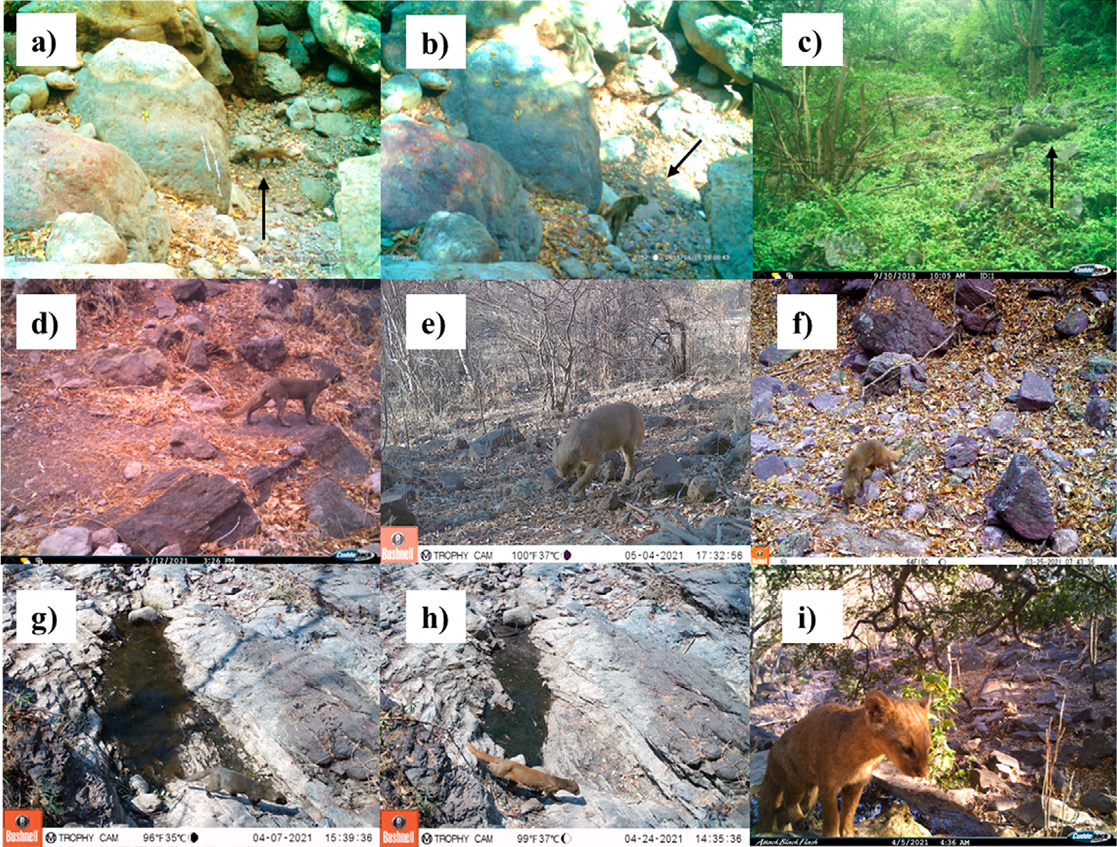
Figure 2. Some photo records of jaguarundi in the Sierra de Huautla Biosphere Reserve, Morelos: a) and b) Reddish and gray morph individuals, recorded in 2015 in Huaxtla; c) an individual of the gray morph recorded in Santiopa in 2019; d) and e) individuals recorded in Huautla in 2020 and 2021, respectively; f) a jaguarundi photographed in El Limón de Cuauchichinola in 2021; g) and h) individuals of the gray and reddish morphs, recorded in the same camera in a water pool in El Limón de Cuauchichinola in 2021; i) individual caught on a photo trap in Santiopa in 2021.
Table 2. Detailed data of the 25 independent jaguarundi records we report here for the Sierra de Huautla Biosphere Reserve in Morelos.
|
Id |
Date |
Hour |
Altitude (masl) |
Ejido / Municipality |
Site details |
Geographic coordinates |
|
1 |
22/03/2015 |
15:53 |
767 |
Huaxtla / Tlaquiltenango |
A ravine immersed in a fragment of preserved dry forest of approximately 600 ha |
18°21’19.39”N / 99°03’43.94”W |
|
2 |
05/04/2015 |
10:00 |
||||
|
3 |
13/01/2018 |
20:33 |
1,223 |
El Limón de Cuauchichinola / Tepalcingo |
A ravine within a fragment of preserved dry forest of approximately 1,200 ha |
18°32’8.41”N / 98°57’29.43”W |
|
4 |
01/08/2019 |
10:00 |
1,089 |
Huautla / Tlaquiltenango (on private lands used by Huautla) |
A fragment of preserved dry forest of approximately 80 ha, surrounded by fragments of disturbed dry forest and secondary vegetation |
18°26’55.09”N / 98°59’35.01”W |
|
5 |
30/09/2019 |
10:05 |
1,395 |
Santiopa / Tlaquiltenango |
A ravine descending the slope of a hill with preserved dry forest |
18°24’41.73”N / 98°57’41.54”W |
|
6 |
04/11/2020 |
16:31 |
1,025 |
Huautla / Tlaquiltenango |
A ravine in the middle of a fragment of preserved dry forest of approximately 400 ha |
18°24’47.28”N / 98°59’9.21”W |
|
7 |
16/11/2021 |
09:22 |
1,162 |
Rancho Viejo / Tlaquiltenango |
In a fragment of preserved dry forest of approximately 500 ha |
18°24’36.70”N / 99° 1’38.51”W |
|
8 |
20/11/2021 |
23:08 |
1,159 |
Axuchitlán-Santiopa / Tlaquiltenango |
In a secondary ravine on a hillside within a fragment of preserved dry forest of approximately 80 ha |
18°27’12.13”N / 98°58’42.74”W |
|
9 |
25/03/2021 |
07:43 |
1,047 |
Rancho Viejo / Tlaquiltenango (on private lands used by Rancho Viejo) |
In a ravine, between hillsides, within a fragment of preserved dry forest of approximately 750 ha |
18°24’39.44”N / 99° 0’23.96”W |
|
10 |
03/04/2021 |
14:24 |
1,167 |
Huautla / Tlaquiltenango |
In a ravine descending a hillside in a fragment of preserved dry forest of approximately 95 ha |
18°25’18.86”N / 98°57’59.80”W |
|
11 |
04/05/2021 |
09:01 |
||||
|
12 |
05/04/2021 |
17:32 |
1,225 |
El Limón de Cuauchichinola / Tepalcingo |
In very wide ravines, within a hilly area in a fragment of preserved dry forest of approximately 1,300 ha has |
18°31’22.73”N / 98°57’50.63”W |
|
13 |
11/04/2021 |
16:45 |
1,193 |
|||
|
14 |
07/04/2021 |
10:26 |
1,198 |
El Limón de Cuauchichinola / Tepalcingo |
In a wide ravine within a preserved dry forest fragment of more than 1,200 hectares |
18°31’46.71”N / 98°57’37.59”W |
|
15 |
07/04/2021 |
15:39 |
||||
|
16 |
12/04/2021 |
17:51 |
||||
|
17 |
13/04/2021 |
08:58 |
||||
|
18 |
24/04/2021 |
14:35 |
||||
|
19 |
30/04/2021 |
10:52 |
||||
|
20 |
02/05/2021 |
17:07 |
||||
|
21 |
08/05/2021 |
11:44 |
||||
|
22 |
05/04/2021 |
16:36 |
1,408 |
Santiopa / Tlaquiltenango |
On a hillside within a fragment of approximately 70 ha with disturbed dry forest and secondary vegetation |
18°26’0.74”N / 98°55’50.12”W |
|
23 |
12/05/2021 |
15:26 |
1,155 |
Huautla / Tlaquiltenango |
In a ravine running down a hillside in a fragment of preserved dry forest of approximately 80 ha |
18°27’0.91”N / 98°58’32.58”W |
|
24 |
13/05/2021 |
14:59 |
1,161 |
Ajuchitlán-Santiopa / Tlaquiltenango |
In a secondary ravine running down a hillside within a fragment of preserved dry forest of approximately 80 ha, at the edge of a disturbed dry forest zone |
18°25’17.76”N / 98°58’0.76”W |
|
25 |
08/08/2022 |
15:09 |
1,118 |
Huixastla / Tlaquiltenango |
In an area of disturbed dry forest |
18°28’37.01”N / 99° 6’43.15”W |