THERYA NOTES 2026, Vol. 7:255-259
New record of leucism in the North American
opossum (Didelphis virginiana) from Mexico
Nuevo registro de leucismo en el tlacuache
norteño (Didelphis virginiana) de México
Aldo Dávalos-Martínez1*, Marco Antonio Ramos-Chávez2 Luis Alberto Cayo-Cervantes2,
Edgar Iván Espinosa-Chavoya2, Martha Valeria Hernández-Vázquez2, and Victor Fernando Záizar-Gutiérrez1
1Centro Universitario de Ciencias Biológicas y Agropecuarias, Universidad de Guadalajara. Camino Ramon Padilla Sánchez 2100, C.P. 45200, Zapopan, Jalisco, México. E-mail: aldodavalosmartinez@gmail.com (ADM), victor.zaizar@cucba.udg.mx (VFZG).
2Unidad de Rescate de Fauna Silvestre, Ayuntamiento de Tlajomulco de Zúñiga. Rastro 8. C.P. 54640, Tlajomulco de Zúñiga, Jalisco, México. E-mail: marco.ramosch04@gmail.com (MARC), unasam@tlajomulco.gob.mx (LACC), ivanespinosachavoya@gmail.com (EIEC), tintanyvitola2440@hotmail.com (MVHV).
*Corresponding author
Presence or absence of melanin determine pigmentation and color pattern in mammals. Excess or deficit of melanin production generates coloration anomalies, one of the most common is leucism. Leucistic mammals have total or partial absence of pigmentation in the body except for maintaining eye color. The North American opossum, Didelphis virginiana, is a widely distributed marsupial present in northern and central America and that have adapted well to urban environments. Recently, the first record of leucism in the North American opossum was reported from Quintana Roo, Mexico. We perform wildlife rescue in the Guadalajara Metropolitan Area as part of the activities of the Tlajomulco de Zúñiga’s Wildlife Rescue Unit. This unit receives daily reports of wildlife in urban areas. On June 17, 2025, we received a call regarding a young D. virginiana wandering in the street. Herein we present the second record of leucism in D. virginiana, a young female from the Guadalajara Metropolitan Area in Jalisco. The individual was found in an urban environment and had signs of errant behavior and blindness. Although presence of this species in the region is common, living in urban areas could be a challenge and may cause genetic and nutritional problems that could be responsible for the coloration anomaly, affecting directly the individual’s survival. This record is the starting point of further research that can help us use wild mammals as bioindicators and generate local conservation strategies for urban wildlife.
Keywords: Didelphidae; color anomaly; hypomelanism; Jalisco; urban wildlife
La ausencia y presencia de melanina determina la pigmentación y patrón de coloración en mamíferos. El exceso o deficit de la producción de melanina genera anomalias de coloración, de las cuales una de la más comunes es el leucismo. Los mamíferos leucísticos tienen ausencia total o parcial de pigmentación en el cuerpo, con la excepción de que mantienen el color de los ojos. El tlacuache norteño, Didelphis virginiana, es un marsupial de amplia distribución en norte y centro América que se ha adaptado a ambientes urbanos. Recientemente, se publicó el primer reporte de leucismo para el tlacuache norteño con un individuo de Quintana Roo, México. Como parte de las actividades de la Unidad de Rescate de Fauna de Tlajomulco realizamos actividades de rescate de fauna. La unidad recibe reportes diarios de fauna silvestre en áreas urbanas. El 17 de Junio del 2025 recibimos el reporte de un individuo de D. virginiana juvenil que se encontraba en la calle. En este trabajo presentamos el segundo registro de leucismo en D. virginiana, una hembra juvenil del Área Metropolitana de Guadalajara en Jalisco. El individuo se encontró en un ambiente urbano y mostraba un comportamiento errante y ceguera. Aunque la presencia de esta especie es común en la region, vivir en áreas urbanas puede ser un reto y puede causar problemas genéticos y nutricionales que pueden ser responsables de la anomalía de coloración, afectando directamente la supervivencia del individuo. Este registro es un punto de partida para generar información sobre el uso de mamíferos silvestres como bioindicadores y realizar estrategías locales de manejo para la fauna urbana.
Palabras clave: Anomalía de coloración; Didelphidae; fauna urbana; hipomelanismo; Jalisco
© 2026 Asociación Mexicana de Mastozoología, www.mastozoologiamexicana.org
The presence and distribution of pigmentation in the skin, hair, and eyes determine color patterns in mammals (Abreu et al. 2013). Pigmentation depends on the presence or absence of melanin, and the excess or deficit of melanin production generates coloration anomalies. In mammals, the most common anomalies are albinism, leucism, piebaldism, and melanism (Ortiz-Hoyos et al. 2020). Anomalous pigmentation may be more prevalent in anthropic environments, due to elevated mutation rates caused by increased exposure to toxins and pollutants (Dubrova 2019).
Leucism is characterized by the total or partial absence of pigmentation in the body, causing white coloration, except for the eyes that retain its color (Henao-Fernandez et al. 2014), some authors consider it as a type of albinism (McCardle 2012). There are many factors that cause this condition, such as endogamy, nutritional problems, and contamination (Bensch et al. 2000). Independently of the reason, affected animals could serve as bioindicators of wildlife health in urban environments (Morales and Superina 2025).
Didelphis virginiana is a marsupial widely distributed in America, ranging from southern Canada to northern Costa Rica (Aranda-Sánchez 2012). This species is relatively small, nocturnal, and has high reproductive capacity. This makes it an urban species that has adapted well to perturbed areas, and it is thought to benefit from urbanization (Wright et al. 2012). From cities to small towns, opossums are commonly found in urban areas from western Mexico. Opossums from the Guadalajara Urban Area can be found inhabiting in streets and backyards, mainly looking for food in human waste.
Atypical colorations have been previously reported in opossums over the years. Smith (1940) reported one albino specimen of Didelphis sp. from the United States. McCardle (2012) reported several records of albinism in Didelphis virginiana in the United States. There are records of albinism, leucism, and xantochromism in Didelphis sp., Didelphis albiventris, and Didelphis aurita from Brazil (Abreu et al. 2013; Eckhardt et al. 2013; Vanstreels et al. 2021; Cotts et al. 2023; Morales and Superina 2025). Cuxim-Koyoc et al. (2019) and Tenorio-Rodríguez et al. (2024) respectively reported the only records of albinism and flavism known for Didelphis virginiana in Mexico. Ortiz-Hoyos et al. (2020) reported a leucistic Didelphis marsupialis from Colombia. Recently, the first record of leucism in D. virginiana was reported by a road-killed individual from Quintana Roo, Mexico (González-Gallina et al. 2025).
Although there’s plenty of literature records of coloration anomalies in vertebrates (McCardle 2012), the findings of these individuals in the wild are still considered rare, mainly due to the decrease of survival chances (Ortiz-Hoyos et al. 2020). Particularly, leucism in mammals is a rare condition and has been scarcely documented (Henao-Fernandez et al. 2014). Herein we report the second case of leucism in Didelphis virginiana from an urban area in western Mexico.
We perform wildlife rescue in the Guadalajara Metro-politan Area as part of the activities of the Tlajomulco’s Wildlife Rescue Unit (URFS). This unit receives daily reports of wildlife in urban areas. Citizens make the reports through direct communication with the unit or calling local government emergency numbers. The study area is the municipality of Tlajomulco de Zúñiga in central Jalisco. Although there are some natural areas in the municipality, there has been a lot of land use changes for housing development in the last decades.
We followed the descriptions and keys provided by Ceballos and Oliva (2006) and Álvarez-Castañeda et al. (2017) to determine the taxonomic identity of the individual. To define the age category, we followed Hartman (1928) and Petrides (1949).
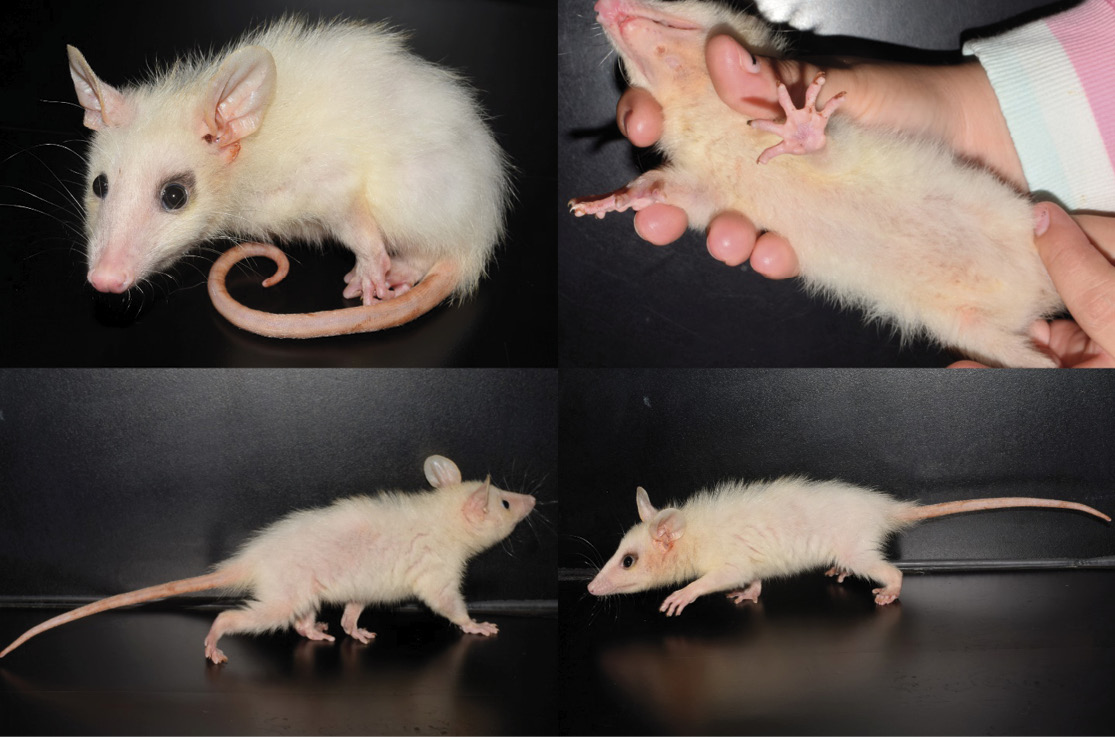
On June 17, 2025, as part of the wildlife rescue faculties of the URFS we received a report regarding a young female North American opossum (Figure 1) wandering in the urban area of La Alameda, Tlajomulco de Zúñiga, Jalisco (20°29’43.44” N, 103°15’7.92” W; 1,510 m asl) (Figure 2). We trapped the opossum by hand and moved it to the facilities of the URFS. Initial inspections revealed that the animal had a distinct coloration and an errant behavior, therefore we kept it to evaluate the possibility of relocating it.
The individual had a uniform white coloration in all parts of its body, apart from its eyes that were black and the surroundings of the left eye had a dark spot. Remarkably, this dark spot has been slowly diminishing as the young opossum sheds its hair. This color pattern is associated with the aberrant coloration named leucism. At the moment of the writing of this manuscript the animal had a total length of 33.9 cm (body length: 17.5 cm, tail length: 16.4 cm) and weighed 170 gr. The individual displayed an errant behavior, with difficulties to stay calm and unavailable to walk in a straight line. Upon further medical inspection, we found that the individual presented pupils displaced toward the venter. This condition corresponds to corectopia, a syndrome that has been associated with visual impairment; however, further research is needed.
The taxonomic identity of the individual was confirmed based on tail length. Didelphis virginiana has a tail that is equal to or shorter than its body length (Ceballos and Oliva 2006; Álvarez-Castañeda et al. 2017). Additionally, D. virginiana is the only species of the genus that inhabits Jalisco and western Mexico (Godínez et al., 2011). The locality of the individual reported herein is far from the zone of sympatry between D. virginiana and D. marsupialis in eastern and southern Mexico (Gardner 1973; Cervantes et al., 2010).
Albinism, leucism, flavism, and xanthochromism have been reported within Didelphis from disturbed environ-ments (Tenorio-Rodríguez et al. 2024; Morales and Superina 2025). To our knowledge, this is the second record of a leucistic D. virginiana in the literature and the first one from western Mexico. This record also represents the fourth color anomaly case for D. virginiana in Mexico (Cuxim-Koyoc et al. 2019). González-Gallina et al. (2025) discussed that survival of the individuals with hypopigmentation from the Yucatan Peninsula may be explained by the karstic substrate present in the region. In contrast, the soil conditions of western Mexico are very different, therefore their hypothesis does not apply to this case.
Urban environments represent a challenge for wildlife. Although living in cities decreases the risk of predation by natural predators, in this region is common to find dead opossums due to road killing by cars and attacks from people, dogs, and cats. In addition, leucism can affect the survival capacity of the individuals due to the increase of visibility to predators (Henao-Hernandez et al. 2024). The opossum reported herein measured 12 cm and weighed 86 gr at the time of the rescue, which corresponds to a juvenile of approximately three months of age (Hartman 1928; Petrides 1949), and it is possible that it had been recently separated from its mother. Also, the individual had an errant behavior that could be related to their apparent visual impairment. This may be correlated to the coloration anomaly, leucism is associated with pathological factors such as nervous and sensory defects, increase in disease susceptibility and lack of vision (Abreu et al. 2013; Silva-Caballero et al. 2024). It is uncertain to know if the opossum would survive on his own but considering the factors discussed herein the possibility is low.
Leucism and other coloration anomalies can be more common in small and isolated populations with high endogamy (Silva-Caballero et al. 2024). Cruz-Salazar et al. (2014) found that natural populations of D. virginiana from southern Mexico have little genetic differentiation, moderate values of genetic diversity, and high rates of inbreeding in small populations. Urban areas are a source of habitat fragmentation and can affect gene flow between populations, therefore, this may explain the presence of individuals with atypical colorations in the area. Alterations in diet are also a possible cause of the presence of these anomalies (Silva-Caballero et al. 2014, Cuxim-Koyoc et al. 2019; Ortiz-Hoyos et al. 2020; Britton and Davidowitz 2023). Morales and Superina (2025) suggested that their reported leucistic D. albiventris had a possible history of nutritional deficiencies, due to its poor body and coat condition. Opossums from the Guadalajara Metropolitan Area are commonly found inside trash cans, indicating that much of their diet depends on organic human waste, causing negative nutritional effects on the urban populations of D. virginiana.
The uncontrolled sprawl of urban areas in western Mexico also increases the urgency to study synanthropic wildlife. Animals affected by color anomalies could serve as bioindicators of wildlife health in urban-sylvatic environments (Morales and Superina 2025). In this region, opossums are one of the best models to understand the impact of human activities on animals. This work sets a starting point to further research that can be used to generate local management strategies for this and other mammal species that still use the city as their home.
Acknowledgments
We would like to thank our colleagues from the URFS and E. D. Kanter-Guerrero for their support reviewing and taking care of the opossum. The wildlife rescue activities reported herein are funded by the municipal government of Tlajomulco de Zúñiga to which we deeply thank. Permissions for capturing and relocating wildlife were granted by Secretaría de Medio Ambiente y Recursos Naturales and Procuraduría Federal de Protección al Ambiente through the program “Comités de Vigilancia Ambiental Participativa (CVAP)” (CVAP Unidad de Rescate de Fauna Silvestre de Tlajomulco, E14-097-VA-VS). We also thank S. A. Zavala-Pérez for her useful comments to the manuscript
Literature cited
Álvarez-Castañeda, S. T., T. Álvarez, and N. González-Ruiz. 2017. Guía para la identificación de los mamíferos de México. John Hopkins University Press. Baltimore, EE.UU.
Aranda-Sánchez, J. M. 2012. Manual para el rastreo de mamíferos silvestres de México. Comisión Nacional para el Conocimiento y Uso de la Biodiversidad. Ciudad de México, México.
Abreu, M. S. L., et al. 2013. Anomalous colour in Neotropical mammals: a review with new records for Didelphis sp. (Didelphidae, Didelphimorphia) and Arctocephalus australis (Otariidae, Carnivora). Brazilian Journal of Biology 73:185–194.
Bensch, S., et al. 2000. Partial albinism in a semi-isolated population of great reed warblers. Hereditas 133:167–170.
Britton, S., and G. Davidowitz. 2023. The effect of diet on melanin pigmentation in animals. Functional Ecology 37:206–217.
Ceballos, G., and G. Oliva. 2006. Los Mamíferos Silvestres de México. Comisión Nacional para el Conocimiento y Uso de la Biodiversidad. Fondo de Cultura Económica. Ciudad de México, México.
Cervantes, F. A., et al. 2010. DNA barcodes effectively indentify the morphologically similar Common Opossum (Didelphis marsupialis) and Virginia Opossum (Didelphis virginiana) from áreas of sympatry in Mexico. Mitochondrial DNA 21: 44–50.
Cotts, L., et al. 2023. The first record of partial xanthochromism in big-eared opossum, Didelphis aurita (Didelphimorphia, Didelphidae). Mammalia 87:583–586.
Cruz-Salazar, B., et al. 2014. Diversidad genética y abundancia relativa de Didelphis marsupialis y Didelphis virginiana en Chiapas, México. Revista Mexicana de Biodiversidad 85:251–261.
Cuxim-Koyoc, A., et al. 2020. Albinism in Didelphis virginiana (Kerr, 1792): the first reported case in Mexico. Mammalia 84:144–149.
Dubrova, Y. 2019. Albinism in Didelphis virginiana (Kerr, 1792): the first reported case in Mexico. Mammalia 84:144–149.
Eckhardt, L. G., et al. 2013. Colorações anômalas em Didelphis albiventris (Didelphimorphia, Didelphidae) em um fragmento de Mata Atlântica de interior no oeste do estado do Paraná, Brasil. Caderno de Pesquisa Série Biologia 25:58–67.
Gardner, A. L. 1973. The Systematics of the Genus Didelphis (Marsupialia: Didelphidae) in North and Middle America. Special Publication, The Museum, Texas Tech University. Vol. 4.
Godinez, E. G., N. González-Ruiz, and J. Ramírez-Pulido. 2011. Actualización de la lista de los mamíferos de Jalisco, México: implicaciones de los cambios taxonómicos. Therya 2:07–35.
González-Gallina, A., A. Jesús-de la Cruz, and M. G. Hidalgo-Mihart. 2025. Road-killed leucistic opossum (Didelphis virginiana Kerr 1792) in the municipality of Lázaro Cardenas, Quintana Roo, México. Therya Notes 6:94–100.
Hartman, C. G. 1928. The breeding season of the opossum (Didelphis virginiana) and the rate of intra-uterine and postnatal development. Journal of Morphology and Physiology 46:143–215.
Henao-Fernández, L., F. Sánchez, and S. J. Álvarez. 2024. Registro de leucismo en Dasyprocta fuliginosa (Rodentia: Dasyproctidae) en la Orinoquia colombiana. Mammalogy Notes 10:404.
McCardle, H. 2012. Albinism in wild vertebrates. Master of Science Thesis, Texas State University-San Marcos.
Morales, M. E., and M. Superina. 2025. First report of a color anomaly in a white-eared opossum Didelphis albiventris Lund, 1840 in an urban area of Mendoza, Argentina. Notas sobre Mamíferos Sudamericanos 7:e25.1132.
Ortiz-Hoyos, R. D., et al. 2020. Primer registro de leucismo en Didelphis marsupialis Linnaeus, 1758 (Didelphimorphia: Didelphidae) en Colombia. Galemys Spanish Journal of Mammalogy 32:64–68.
Petrides. G. A. 1949. Sex and Age Determination in the Opossum. Journal of Mammalogy 30:364–378.
Silva-Caballero, A., et al. 2014. Leucismo en el coatí de nariz blanca Nasua narica (Mammalia: Carnivora), en Quintana Roo, México. Therya 5:839–843.
Smith, D. M. 1940. Albinism in the opossum. Journal of Heredity 31:342.
Tenorio-Rodríguez, P. A., L. Cab-Sulub, and L. D. Moreno-Figueroa. 2024. First record of cinnamon coloration in opossum Didelphis sp. in México. Therya Notes 5:192–196.
Vanstreels, R. E. T., et al. 2021. Albinism in Brazilian common opossums (Didelphis aurita). Mammalia 85:452–454.
Wright, J. D., M. S. Burt, and V. L. Jackson. 2012. Influences of an urban environment on home range and body mass of Virginia opossums (Didelphis virginiana). Northeastern Naturalist 19:77–86.
Associate editor: Xavier López Medellín
Submitted: October 02, 2025; Reviewed: January 28, 2026
Accepted: June 03, 2026; Published on line: November 5, 2026
DOI: 10.12933/therya_notes-25-263
ISSN 2954-3614
Figure 1. Dorsal, ventral, and lateral photographs of the leucistic Didelphis virginiana rescued in an urban site from the Guadalajara Metropolitan Area, Jalisco, Mexico.
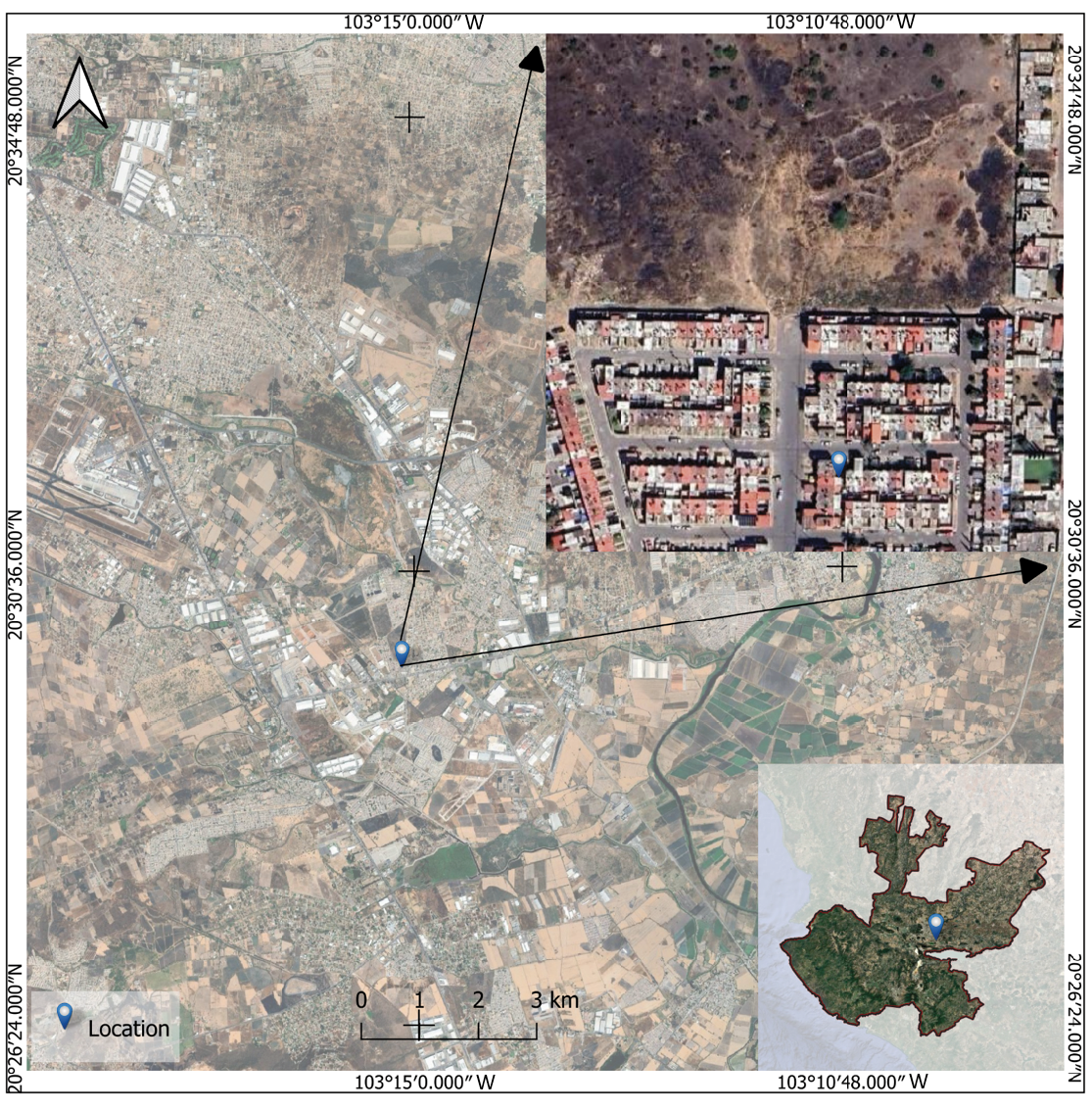
Figure 2. Geographic location of the leucistic Didelphis virginiana rescued in the Guadalajara Metropolitan Area, Jalisco, Mexico.