THERYA NOTES 2026, Vol. 7:238-244
First record of nematodes of the genus
Cylicospirura parasitizing Herpailurus yagouaroundi
(Carnivora: Felidae) from Hidalgo, México
Primer registro de nematodos del género
Cylicospirura parasitando a Herpailurus yagouaroundi
(Carnivora: Felidae) en Hidalgo, México
Marisol Moreno-Chavez1, Luis A. Alanis-Hernández2, Eduardo Yesua Barrera-Nava2, and Jorge Falcón-Ordaz1*
1Laboratorio de Morfología Animal, Centro de Investigaciones Biológicas, Universidad Autónoma del Estado de Hidalgo. Ciudad del Conocimiento, km 4.5 carretera Pachuca-Tulancingo, Col. Carboneras, C. P. 42181, Mineral de la Reforma. Hidalgo, México. E-mail: marisolmorenoc@msn.com (MM-CH); profe_7864@uaeh.edu.mx (JF-O).
2Laboratorio de Conservación Biológica, Centro de Investigaciones Biológicas, Universidad Autónoma del Estado de Hidalgo. Ciudad del Conocimiento, km 4.5 carretera Pachuca-Tulancingo, Col. Carboneras, C. P. 42181, Mineral de la Reforma. Hidalgo, México. E-mail: ursus.americanus.sp@gmail.com (LAA-H); ba472539@uaeh.edu.mx (EYB-N).
*Corresponding author
The study of helminths in Herpailurus yagouaroundi in México is scarce, with only the trematode Paragonimus mexicanus and the nematodes Ancylostoma sp. and Trichuris sp. previously recorded: the former found in the lungs of a captive specimen that died, and the latter in fecal samples. The objective of this study is to present new records of nematodes parasitizing the jaguarundi. A female H. yagouaroundi was recovered from as roadkill on the México–Tampico Highway in the municipality of Huejutla, Hidalgo. The feline’s viscera were examined, revealing eight nematodes in the stomach, which were fixed in 70 % ethanol for identification. Six adult nematodes were identified as Cylicospirura felineus, characterized by six tricuspid teeth at their oral openings, each lacking accessory teeth between them. The vulva of the female opens anterior to the esophago-intestinal junction. The larvae were identified as belonging to the genus Cylicospirura by the presence of teeth at their oral opening, with the vulva opening posterior to the esophago-intestinal junction. This represents the first record of the genus Cylicospirura in Mexico. The examination of roadkill specimens expands parasitological inventories, supports decision-making in wildlife conservation and health, and helps estimate prevalence, characterize lesions, and assess the risk of transmission between wildlife and domestic animals.
Key words: Cylicospirura felineus; helminths; Jaguarundi; larvae.
El estudio de helmintos en Herpailurus yaguaroundi en México es escaso, con solo el trematodo Paragonimus mexicanus y los nematodos Ancylostoma sp. y Trichuris sp. registrados previamente: el primero encontrado en los pulmones de un ejemplar muerto en cautiverio y los segundos en muestras fecales. El objetivo de este estudio es reportar nuevos registros de nematodos que parasitan al jaguarundi. Se recuperó una hembra de H. yaguaroundi de un animal atropellado en la carretera México-Tampico, en el municipio de Huejutla, Hidalgo. Se examinaron las vísceras del felino, encontrándose ocho nematodos en su estómago, fijados en alcohol al 70% para su posterior identificación. Se identificaron seis nematodos adultos como Cylicospirura felineus, caracterizados por seis dientes trifurcados en sus aberturas orales, cada uno sin accesorios dentales entre ellos. La vulva de la hembra se abre anterior a la unión esófago-intestinal. Las larvas se identificaron dentro del género Cylicospirura por la presencia de dientes en sus aberturas orales; la vulva se abre posterior a la unión esófago-intestinal. Este es el primer registro del género Cylicospirura en México. La revisión de organismos atropellados amplía los inventarios parasitológicos, respalda la toma de decisiones en conservación y salud de la fauna silvestre, y ayuda a estimar la prevalencia, caracterizar lesiones y evaluar el riesgo de transmisión entre fauna silvestre y animales domésticos.
Palabras clave: Cylicospirura felineus; helmintos; Jaguarundi; larvas
© 2026 Asociación Mexicana de Mastozoología, www.mastozoologiamexicana.org
Worldwide, a total of 42 felid species have been identified. In México, felids represent a group with a total diversity of six species, one of which is Herpailurus yagouaroundi (Ramírez-Pulido et al. 2014). Taxonomically, this species has undergone several revisions; although it was previously classified within the genus Puma, recent morphological and molecular analyses support its placement in Herpailurus (Johnson et al. 2006; Li et al. 2016). The jaguarundi is listed as ‘Least Concern’ by the International Union for Conservation of Nature (Caso et al. 2015), but in Mexico, it is categorized as ‘Threatened’ due to its low population densities under Mexican law (NOM-059-SEMARNAT-2010).
Herpailurus yagouaroundi is a medium-sized, diurnal felid with a slender and elongated body, a small head, a long tail, and dark or reddish coloration (Oliveira 1998). Its geographical distribution is Neotropical, ranging from southern Texas to southern Brazil, Paraguay and Argentina (Emmons and Feer 1997). In México, this species occurs along the Pacific and Atlantic slopes, from Sonora and Tamaulipas to southern Chiapas and the Yucatan Peninsula (Hall 1981; Oliveira 1998; Aranda 2005). This felid preys on a wide variety of animals, including invertebrates, reptiles, birds, small mammals and fish (Aranda 2005; Giordano 2016; Alanis-Hernández et al. 2024). However, it is considered an uncommon species, difficult to observe due to its cryptic and primarily diurnal habits (Aranda 2005; Ruiz-Gutiérrez et al. 2023). Despite its broad distribution, knowledge of its biology, ecology, and particularly its parasitic fauna remains limited.
Regarding parasitic helminths, records for H. yagoua-roundi are scarce. A few species of gastrointestinal nematodes have been reported, including members of the families Ancylostomatidae, Angiostrongylidae, Spiro-cercidae and Spiruridae (Vicente et al. 1997; Vieira et al. 2013, 2017; Wrublewski et al. 2018). In México, only three helminths have been recorded parasitizing H. yagoua-roundi: the trematode Paragonimus mexicanus and the nematodes Ancylostoma sp. (García-Prieto et al. 2012) and Trichuris sp. (data from the Colección Nacional de Helmintos, UNAM). These parasites are not only of taxonomic and ecological interest, but also provide valuable insights into transmission dynamics, the health status of wild populations, and interactions with other carnivores.
This study provides new insights into the helminth fauna of H. yagouaroundi in México by examination spe-cimens from the state of Hidalgo and documenting new parasitological records for the species.
A female of Herpailurus yagouaroundi was killed on the México-Tampico highway near the community of Machetla in the municipality of Huejutla, Hidalgo, México (21.063849° N, 98.496768°W) on 15 February 2023. This specimen was donated by personnel from the Office of the Procuraduria Federal de Protección al Ambiente (PROFEPA) to the Centro de Investigaciones Biológicas (CIB) of the Autonomous University of the State of Hidalgo (UAEH). The carcass was refrigerated before being prepared for taxidermy and examination of the viscera; the skin and skull were deposited in the Colección Mastozoológica of CIB of UAEH, under voucher number UAEH-CIB-M 2392, and the viscera were obtained for examination.
From the stomach of the felid, six adult worms (five male and one female) and two larvae were recovered and stored in 70 % ethanol for subsequent examination. For nematode identification, semi-permanent samples were mounted on temporary slides in a medium containing a glycerin–70 % ethanol mixture, to enable identification through sample clarification. Images and measurements were taken using a Zeiss Axio Lab microscope A 1, equipped with an Axiocam 5RCs. For scanning electron microscopy (SEM), two males were dehydrated through a graded series of ethanol (70 % - absolute), critical-point dried, coated with gold-palladium, and examined using a Hitachi S-2460 N scanning electron microscope (Hitachi, Tokyo, Japan) at 15 kV. Once the nematodes were identified, they were deposited in the Colección Nacional de Helmintos of the Universidad Nacional Autónoma de México [CNHE 12542 (Adults); CNHE 12543 (Larvae)].
Phylum Nematoda Cobb 1932
Order Spirurida Chitwood 1933
Superfamily Spiruroidea Oerley 1885
Family Spirocercidae Chitwood and Wehr 1932
Genus Cylicospirura Verves 1922
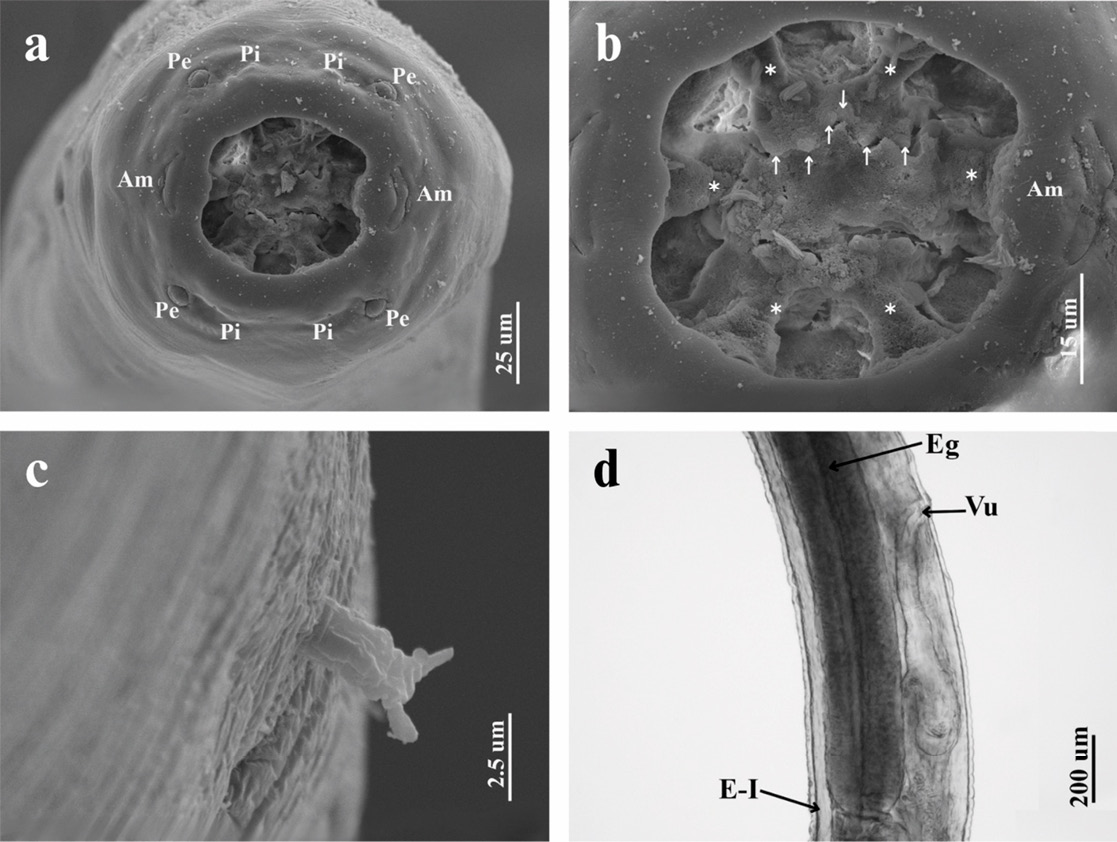
Adult nematodes were identified as Cylicospirura felineus (Chandler 1925). The organisms have a cylindrical body tapering at both ends, with a faintly hexagonal mouth opening with rounded edges. In an apical view, the mouth opening shows an outer circle of four external labial papillae and four larger cephalic papillae, adjacent to each other and aligned with the bases of the submedian large teeth. The species possesses six large teeth, two lateral and four submedian, each tooth with three apical cusps separated by a slit. Accessory teeth are absent in the oral cavity, and the amphids are aligned with the bases of the lateral teeth. (Figure 1a, b).
The esophagus is divided into an anterior muscular and a posterior glandular part. The muscular esophagus is long and slender, with a dilatation and valve near its junction with the buccal capsule. The glandular esophagus gradually increases in width posteriorly, reaching its widest part at the esophago-intestinal junction. Deirids small and bifid (Figure 1c).
The vulva in females is anterior to the esophago-intestinal junction (Figure 1d), while males possess four pairs of ventrolateral precloacal papillae, equidistant and pedunculated. No postcloacal papillae were observed (Figure 2a). Spicules are unequal and dissimilar, with the left spicule larger than the right (Figure 2b, c). Measurements of the specimens are presented in Table 1.
Remarks. We identified the specimens as C. felineus by having tricuspid teeth, the symmetrical rounded cusps appearing well developed in apical view, this species has been registered in felines from Africa, America, India and Indochina (Chandler 1925; Almeida et al. 2020; Gallas et al. 2014; Junker 2024; Sandground 1932; Pence et al. 1978).
Our specimens are similar to those parasitizing Puma concolor in Brazil and cats in India (Chandler 1925; Almeida et al. 2020), particularly in spicule length. In addition, they correspond to the specimens from P. concolor in terms of gubernaculum length in males and the distance from the vulva to the anterior region end (Table 1). However, our organisms differ from those found in cats in India in male esophagus length (4.2-4.5 vs 1.64-2.25 mm) and the distance from the vulva to the anterior end (3.0-3.5 vs 2.66 mm), which are greater in our specimens.
Specimens parasitizing Felis silvestris ocreata, Lynx canadensis and Leopardus geoffroyi, exhibit differences compared to the organisms found in Herpailurus yagoua-roundi in the present study. Spicule lengths are shorter in these species compared to those in H. yagouaroundi. The distance from the vulva to the anterior end is shorter in H. yagouaroundi (2.66 mm) than in F. silvestris ocreata (3.05-4.27 mm) and L. geoffroyi (2.99). In contrast,specimens para-sitizing L. canadensis show a distance from the vulva to the anterior end similar to the found in H. yagouaroundi.
Based on the taxonomically important morphological characteristics observed among different records of C. felineus, we suggest that this taxon may represent a species complex, as isolation by distance can influence species morphology (Relethford 2004). This is supported by the morphological differences identified between our record and those previously reported. However, DNA se-quencing would be necessary to accurately differentiate these lineages, given the species’ wide distribution across three continents (Africa, Asia, and the Americas) and its occurrence in multiple feline families.
Cylicospirura sp. Fourth stage larva. The two larvae collected from the stomach of H. yagouaroundi were identified only to the family level, Spirocercidae. Fourth-stage larva; body 15.06-15.9 (15.48 ± 0.59) long and 0.22-0.25 (0.23 ± 0.02) wide. Buccal capsule 0.12 (0.12 ± 0.0) long and 0.1 (0.1 ± 0.0) wide, with elongated cylindrical base; armed with cuticular teeth, (Figure 2d). Muscular esophagus 0.25 (0.25 ± 0.0) long. Glandular esophagus 1.95-2.00 (1.97 ± 0.04) long. Nerve ring and excretory pore not observed. Vulva at 4.0-4.2 (4.1 ± 0.14) from anterior extremity, located after the esophago-intestinal junction (Figure 2e, f). The tail is conical, the anus opened 0.10-0.15 (0.13 ± 0.04) from caudal end.
Remarks. Currently, there is only a description of the fourth-stage larva of C. felineus parasitizing F. silvestris ocreata in Algeria (Junker et al. 2024). The two specimens studied here exhibit the morphological characteristics of the genus Cylicospirura. However, they do not correspond to the adult C. felineus, as the vulva is located below the esophago-intestinal junction, whereas in the description given by Junker et al. (2024) of the vulva in a fourth-stage larva, it is located above this junction (1.688 mm from anterior extremity).
Only two species of Cylicospirura exhibit the vulva below the esophago-intestinal junction: C. arctica, which parasitizes Canis lupus familiaris and Vulpes lagopus in northern Russia, and C. barusi, which parasitizes Felis catus from India (Junker et al. 2013). However, the fourth-stage larva has not been described in either of these species. The specimens studied may represent a new species; however, we cannot confirm this due to the lack of adult specimens.
Nematodes of the genus Cylicospirura parasitize the digestive system of different carnivores worldwide. Currently, 12 species within the genus can be differentiated based on the morphology of the large teeth and the absence or presence of small accessory teeth (Junker et al. 2013, 2024). C. felineus has been observed to cause gastric nodules in the stomach walls of both wild or domestic hosts. Lesions caused by these nodules can result in chronic vomiting, weight loss, and, in severe cases, perforation or alteration of gastric motility (Almeida et al. 2020; Crossland et al. 2015; Ferguson et al. 2011). In felines such as P. concolor or Lynx rufus in Oregon, USA, a high prevalence of C. felineus was recorded (up to 562 nematodes per stomach), with numerous nodules observed (Ferguson et al. 2011). Examination of the digestive tract of a road-killed P. concolor, in Brazil revealed nodules containing nematodes identified as C. felineus, confirming the pathogenic nature of the species (Almeida et al. 2020).
The helminthological examination of felines and other road-killed animals offers significant advantages for understanding their parasitic fauna. Road-killed organisms provide access to species that are difficult to capture or that are protected by legislation. They also reduce sampling costs and risks, allowing for the collection of organs for comprehensive study, including parasitology, histopathology, biobanks, among other approaches (González-Gallina et al. 2018; Monge-Nájera 2019). In Brazil, there are concrete examples of studies on road-killed felines, including H. yagouaroundi, Leopardus pardalis, Panthera onca, and P. concolor. Eleven species of nematodes (e.g., Toxocara cati, Physaloptera praeputalis, among others), four cestodes (e.g., Taenia sp.), one digenean (Neodiplostomum sp.), and one acanthocephalan (Oncicola spp.) were recovered. Using road-killed specimens expands parasitological inventories, supporting decisions regarding wildlife conservation and health, as well as enabling estimates of prevalence, characterizing of lesions, and assessment of the risk of pathogen transmission between wildlife and domestic animals and vice versa (de Matos et al. 2023; de Quadros et al. 2014; Moraes et al. 2024).
Acknowledgments
We thank the personnel of the Office of the Federal Prosecutor for Environmental Protection (PROFEPA) for donating the jaguarundi specimen (Oficio: AC/SRN16/2023) to the Biological Conservation Laboratory of the CIB of the UAEH. Special thanks to G. Sánchez-Rojas for permitting the examination of the H. yagouaroundi viscera. We are also grateful to B. Mendoza-Garfias for her assistance in processing samples for the SEM photographs in the Laboratorio de Microscopía y Fotografía de la Biodiversidad I (IB-UNAM). Finally, we thank M.F. Aquino-Camacho for editing the figures.
Literature cited
Alanis-Hernández, L. A., et al. 2024. Stomach contents of a road-killed Jaguarundi Herpailurus yagouaroundi in Hidalgo, Mexico. Studies on Neotropical Fauna and Environment 59:112-1136.
Almeida, L. R. D., et al. 2020. Nodular and sclerosing gastritis caused by Cylicospirura felineus in a puma (Puma concolor). Revista Brasileira de Parasitologia Veterinária 29:e023519.
Aranda, M. 2005. Los felinos de México: biología y conservación. Comisión Nacional para el Conocimiento y Uso de la Biodiversidad (CONABIO). Ciudad de México, México.
Caso, A., et al. 2015. Herpailurus yagouaroundi. In IUCN 2025. The IUCN Red List of Threatened Species. Version 2015:e.T9948A50653167. www.iucnredlist.org. Accessed on 05 September 2025.
Chandler, A. C. 1925. The helminthic parasites of cats in Calcutta and the relation of cats to human helminthic infections. The Indian Journal of Medical Research 13:213-227.
Crossland, N. A., et al. 2015. First report of Cylicospirura felineus in a feral domestic shorthair cat in North America. Journal of Feline Medicine and Surgery. Open Reports 1:1-4.
de Matos, M. R., et al. 2023. Cylicospirura felineus in Puma (Herpailurus yagouaroundi) in southern Brazil-Macros-copic and microscopic aspects. Veterinary Parasitology: Regional Studies and Reports 40: 100858
de Quadros, R. M., et al. 2014. First report of the nematode Physaloptera praeputialis parasitizing a jaguarundi. Neotropical Biology and Conservation 9:187-190
Relethford, J. 2004. Global patterns of isolation by distance based on genetic and morphological data. Human Biology 76:499-513
Secretaría de Medio Ambiente y Recursos Naturales. 2019. Norma Oficial Mexicana NOM-059- SEMARNAT-2019. Protección ambiental-Especies nativas de México de flora y fauna silvestres-Categorías de riesgo y especificaciones para su inclusión, exclusión o cambio- Lista de especies en riesgo. Secretaría de Medio Ambiente y Recursos Naturales. México. 15 de agosto de 2019.
Emmons, L. and F. Feer. 1997. Neotropical rainforest mammals: a field guide. University of Chicago Press, Chicago, EE.UU.
Ferguson, J. A., et al. 2011. Cylicospirura species (Nematoda: Spirocercidae) and stomach nodules in cougars (Puma concolor) and bobcats (Lynx rufus) in Oregon. Journal of Wildlife Diseases 47:140-153.
Gallas, M., et al. 2014. Cylicospirura (Cylicospirura) felineus (Chandler, 1925) Sandground, 1932 (Nematoda, Spirocercidae) in Leopardus geoffroyi D’orbigny & Gervais, 1844 (Carnivora, Felidae): first report from the State of Rio Grande do Sul, Brazil. Neotropical Helminthology 8:349-355.
García-Prieto, L., et al. 2012. Helminth parasites of wild Mexican mammals: list of species, hosts and geographical distribution. Zootaxa 3290: 1-92.
González–Gallina, A. and M. G. Hidalgo-Mihart. 2018. A review of road-killed felids in Mexico. Therya 9: 147-159.
Giordano, A. J. 2016. Ecology and status of the jaguarundi Puma yagouaroundi: a synthesis of existing knowledge. Mammal Review 46:30-43.
Hall, R. E. 1981. The Mammals of North América. Jhon Wiley and Sons. New York, USA.
Johnson, W. E., et al. 2006. The late Miocene radiation of modern Felidae: a genetic assessment. Science 311:73-77.
Junker, K., et al. 2013. Two new species of Cylicospirura Vevers, 1922 (Nematoda: Spirocercidae) from carnivores in southern Africa, with validation of the related genera Gastronodus Singh, 1934 and Skrjabinocercina Matschulsky, 1952. Folia Parasitologica 60:339-352.
Junker K., et al. 2024. Further studies on the diversity of Cylicospirura Vevers, 1922 (Nematoda: Spirocercidae) in African carnivores, with description of a new species. Parasitology 151:692-707.
Li, G., et al. 2016. Phylogenomic evidence for ancient hybridization in the genomes of living cats (Felidae). Genome Research 26:1-11.
Monge-Nájera, J. 2019. Road kills in tropical ecosystems: A review with recommendations for better estimations and mitigation. Revista de Biología Tropical 67:349-362.
Moraes, I.d.S., et al. 2024. Gastrointestinal Helminths in Wild Felids in the Cerrado and Pantanal: Zoonotic Bioindicators in Important Brazilian Biomes. Animals 14:1622.
Oliveira, T. G. D. 1998. Herpailurus yagouaroundi. Mammalian Species 578:1-6.
Pence, D. B., et al. 1978. Spirocercid stomach worms (Nematoda: Spirocercidae) from wild felids in North America. Canadian Journal of Zoology 56:1032-1042.
Ramírez-Pulido, J. N., et al. 2014. List of recent land mammals of Mexico. Special Publications Museum of Texas Tech University 63:1-69.
Ruiz-Gutiérrez, F., et al. 2023. Spatial and temporal coexistence of medium-sized felines and their potential preys in Sierra Madre del Sur of Guerrero, México. Therya 14:319-328.
Sandground, J-H. 1932. Report on the nematode parasites collected by the Kelley-Roosevelts expedition to Indo-China with descriptions of several new species. Part 1. Parasites of birds. Part 2. Parasites of mammals. Zeitschrift fur Parasitenkunde 5:542-583.
Vicente, J. J., et al. 1997. Nematóides do Brasil. Parte V: Nematóides de Mamíferos. Revista Brasileira de Zoologia 14:1-452.
Vieira, F. M., et al. 2013. A new metastrongyloidean species (Nematoda) parasitizing pulmonary arteries of Puma (Herpailurus) yagouaroundi (É. Geoffroy, ١٨٠٣) (Carnivora:Felidae) from Brazil. Journal of Parasitology ٩٩:٣٢٧-٣٣١.
Vieira, F. M., et al. 2017. Parasitic nematodes of three species of wild carnivore mammals from Atlantic forest in the state of Minas Gerais, Brazil. Revista Mexicana de Biodiversidad 88:801-806.
Wrublewski, D. M., et al. 2018. Gastrointestinal parasites in Puma concolor, Puma yagouaroundi and Leopardus pardalis (Carnivora: Felidae) at the National Forest of Três Barras, SC, Brazil. Revista Acadêmica Ciência Animal 16:e16004.
Associate editor: Agustín Jimenez-Ruiz
Submitted: September 18, 2025; Reviewed: Sepember 17, 2026
Accepted: September 24, 2026; Published on line: October 30, 2026
DOI: 10.12933/therya_notes-25-260
ISSN 2954-3614
Figure 1. Female of C. felineus, a) Apical view of the cephalic region showing the arrangement of the four external labial papillae (Pe) and four internal papillae (Pi), in addition to the amphids (Am). b) Apical view of the cephalic region showing the arrangement of the internal labial teeth (*), each with three apical cusps (®). c) Deirid small and bifid. d) Images showing the glandular esophagus (Eg), vulva (Vu) and the esophagus-intestine junction (E-I).
Figure 2. Male of C. felineus, a) Caudal region showing the four pairs of ventrolateral precloacal papillae (®) and the gubernaculum (Gu). b) Unequal spicules, the left spicule (lS) larger than the right spicule (rS). c) The beginning of the right spicule (rS) and the gubernaculum (Gu) are shown. Fourth stage larva of Cylicospirura sp. d) Anterior region showing the oral opening, teeth (T) and buccal capsule (Bc). e) The distance from the vulva (Vu) to the esophagus-intestine junction (E-I) is shown. f) Vulva (Vu).
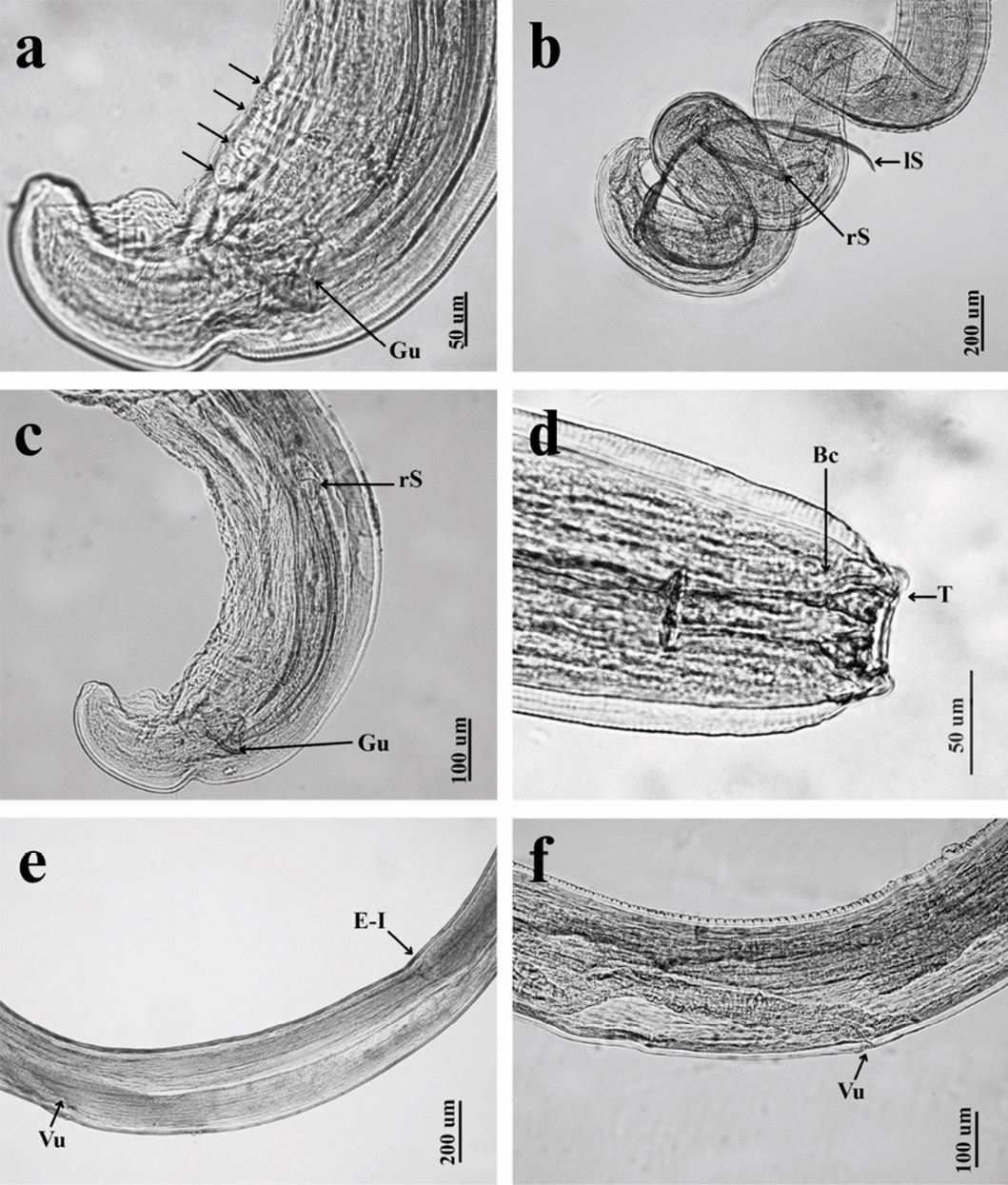
Table 1. Morphometric data of Cylicospirura felineus adults. Measurements are given in micrometers (μm) unless otherwise stated (mm), with the range, mean and standard deviation in parentheses. NM=Not measured.
|
Source. |
Present study |
|||||||||||
|
Host species. |
Cats |
Lynx canadensis |
Leopardus |
Puma cocolor |
Felis silvestris ocreata |
Herpailurus |
||||||
|
Locality. |
India |
Canada |
Brazil |
Brazil |
Algeria |
México |
||||||
|
No. of nematodes examined. |
n=¿? |
n=¿? |
n=20 |
n=20 |
n=1 |
n=1 |
n=5 |
n=4 |
n=1, 2 anterior and 3 posterior parts |
n=3, 1 anterior part |
n=5 |
n=1 |
|
Sex of nematodes. |
♂ |
♀ |
♂ |
♀ |
♂ |
♀ |
♂ |
♀ |
♂ |
♀ |
♂ |
♀ |
|
Body length (mm). |
18-22 |
24-30 |
11.8-19.2 |
13.8-23.8 |
NM |
13.91 |
16.18-19.16 (17.24±1.15) |
20.45-23.99 (22.17±1.67) |
20.8 |
16.7-21.2 |
11-21 (14.5±4.0) |
28 |
|
Body width. |
540 |
900 |
294-412 |
346-566 |
331.192 |
330 |
340-380 (360±20) |
510-550 (530±20) |
454 |
558-693 |
200-300 (240±50) |
400 |
|
Buccal capsule length. |
140 |
91-122 |
103-147 |
NM |
73.76 |
NM |
NM |
93-102 |
109-126 |
100-120 (100±8) |
130 |
|
|
Buccal capsule, maximum width. |
150 |
68-109 |
74-118 |
NM |
110.64 |
NM |
NM |
134-145 |
140-160 |
80-120 (100±10) |
100 |
|
|
Muscular esophagus length. |
362-467 |
442-530 |
NM |
390 |
270-630 (470±180) |
520-740 (630±90) |
474-564 |
509-620 |
270-450 (360±70) |
450 |
||
|
Glandular esophagus length (mm). |
2.3-3.2 |
3.13-4.12 |
NM |
1.46 |
2.87-3.54 (3.12±0.28) |
3.73-4.73 (4.39±0.45) |
3.49-3.5 |
3.61-4.51 |
1.37-1.8 (1.64±0.18) |
2.8 |
||
|
Total length of the esophagus (mm) |
4.2-4.5 |
4.6-5.3 |
2.66-3.66 |
3.57-4.63 |
1.85 |
3.14-4.17 |
4.25-5.47 |
3.96-4.06 |
4.11-5.13 |
1.64-2.25 |
3.25 |
|
|
Left spicule length (mm) |
2.5 |
1.45-1.99 |
1.39 |
2.26-2.60 (2.42±0.15) |
1.87-2.04 |
2.09-2.45 (2.28±0.16) |
||||||
|
Right spicule length |
500 |
362-453 |
300 |
480-660 (560±75) |
423-472 |
490-575 (510±30) |
||||||
|
Gubernaculum length |
59-68 |
46.1 |
70-80 (80±5) |
NM. |
70-150 (110±50) |
|||||||
|
Vulva from anterior end, distance (mm) |
3.0-3.5 |
2.4-3.77 |
2.99 |
2.1-4.06 (3.21±0.81) |
3.05-4.27 |
2.66 |
||||||
|
Anus distance to tail |
260 |
200 |
135-204 |
91-132 |
147.52 |
110.64 |
NM |
NM |
218-246 |
96-134 |
200 |
|