THERYA NOTES 2026, Vol. 7:215-220
Does the crab-eating fox (Cerdocyon thous) avoid the toxicity
of the giant toad (Rhinella horribilis)?
A case of apparent selective feeding in Colombia
¿Evita el zorro cangrejero (Cerdocyon thous) la toxicidad
del sapo gigante (Rhinella horribilis)?
Un caso de aparente alimentación selectiva en Colombia
Katherine Pérez-Gómez1*, Fernanda Tique-Bernal1, Camilo Fernandez-Rodríguez1, Andrés Felipe García-Londoño2, And Chad T. Beranek3,4
1Fundación Galictis, Gestión y Monitoreo de la Biodiversidad, C.P. 150002, Tunja, Colombia. E-mail: galictis.biodiversidad@gmail.com (KP - G); fernanda.tique29@gmail.com (FT - B); rcfernandez.rodriguez@gmail.com (CF - R).
2Fundación Bioethos, Bogotá, Colombia. E-mail: agarcialondono@gmail.com (AFG - L).
3Conservation Leaders Pty Ltd, Coonong Road, Gymea Bay 2227 NSW Australia. E-mail: chad.beranek@newcastle.edu.au (CTB).
4Conservation Science Research Group, University of Newcastle, University Drive, Callaghan, 2308 NSW Australia. E-mail: chad.beranek@newcastle.edu.au (CTB).
*Corresponding author
The crab-eating fox (Cerdocyon thous) is an opportunistic fox whose diet ranges from fruits to various vertebrates, whereas Rhinella horribilis is a toxic toad protected by cutaneous bufotoxins. Here we document and describe a novel predatory behavior of C. thous on R. horribilis in a tropical dry forest of the Colombian Caribbean. The predation event was recorded by using camera traps during a monitoring of the mammal community conducted through biosensor stations in the Tropical dry forest. Thirteen stations were installed, each positioned 30-40 cm above ground level. The Camera traps recorded a predation event in seven consecutive videos in which the fox was observed manipulating the toad by holding it by the limbs, carefully avoiding biting the head and dorsal region. Additionally, prior to consumption, the predator delivered several blows to the prey using neck movements. The consumption was selective, restricted to specific parts such as the hind limbs. The sequence revealed behaviors associated with sensory inspection and selective feeding, likely aimed at minimizing the risk of intoxication. This record constitutes the first detailed observation of this type of interaction between these two species in the Colombian tropical dry forest and suggests an adaptive strategy that enables C. thous to exploit chemically defended prey.
Keywords: Amphibians, behavior; camera trapping; toxins.
El zorro perro (Cerdocyon thous) es un cánido oportunista cuya dieta abarca desde frutos hasta diversos vertebrados, mientras que Rhinella horribilis es un sapo tóxico protegido por bufotoxinas cutáneas. En este estudio, documentamos y describimos un nuevo comportamiento depredador de C. thous sobre R. horribilis en un bosque seco tropical del Caribe colombiano. El evento de depredación fue documentado mediante cámaras trampa, en un monitoreo de la comunidad de mamíferos en estaciones biosensoras del bosque seco tropical, para el cual se utilizaron 13 cámaras trampa, ubicadas entre 30 - 40 cm a nivel del suelo. Se registró un único evento en una secuencia de siete videos consecutivos, en los que se observó que el zorro manipuló al sapo sujetándolo por las extremidades, evitando morder la cabeza y el dorso. El anfibio fue inmovilizado y aturdido mediante golpes controlados con el cuello del depredador. El consumo fue selectivo, limitado a partes específicas como las patas traseras. La secuencia mostró conductas de inspección sensorial y selección trófica, posiblemente orientadas a minimizar el riesgo de intoxicación. Este registro constituye la primera observación y descripción detallada de este tipo de interacción entre las dos especies en el bosque seco tropical colombiano y sugiere una estrategia adaptativa que permite a C. thous explotar presas defendidas químicamente.
Palabras clave: anfibios, comportamiento; dieta; fototrampeo; toxinas
© 2026 Asociación Mexicana de Mastozoología, www.mastozoologiamexicana.org
Camera traps have been used since the late 19 th century to study populations of mammals worldwide revealing a wide - range of previously undocumented behaviors and allowing unprecedented data collection to further ecological knowledge (Kucera and Barret 2011). Understanding the composition, distribution, occupancy, abundance, and density of medium and large mammal populations and communities has been one of the primary objectives since Chapman (1927) first used camera traps to document mammalian diversity in Barro Colorado Island, Panama. However, these devices allow us to go beyond presence only data to aid understanding species distribution, and into gaining ethological insights such as behaviors and specific trophic interactions, which are fundamental for biodiversity conservation (Trolliet et al. 2014; Caravaggi et al. 2017).
Predation on toxic prey by carnivorous mammals poses ecological and evolutionary challenges, with important implications for understanding behavioral and physiological adaptations related to avoiding and tolerating venom (van Thiel, et al. 2022; Glendinning 2007). The crab-eating fox (Cerdocyon thous Linnaeus 1766), is a mesopredator of the family Canidae (Order: Carnivora), commonly known as the “zorro-perro” in the Colombian Caribbean has a wide distribution throughout the Americas (Sillero-Zubiri 2009; Beisiegel et al. 2013; Ramírez-Chaves and Pérez 2015). This species is adapted to a wide range of habitats, from primary forests to heavily modified landscapes, with a generalist and opportunistic diet (Berta 1982; Emmons and Feer 1999; Delgado 2002; Delgado-V and Zurc 2007; Dutra-Vieira et al. 2021; Londoño-Raigosa et al. 2025). Its dietary plasticity allows to exploit seasonal resources and incorporate chemically defended prey, such as certain amphibians and reptiles (Bossi et al. 2019; Goebel et al. 2023; Couto et al. 2024). Regarding toads of the genus Rhinella (Anura: Bufonidae), are amphibians well adapted to terrestrial life and exhibit ecological plasticity, capable of thriving in both pristine and urban environments (Webb et al. 2014; Duque Amado and Megía-Palma 2024; Favio et al. 2025; Demartín et al. 2025). Rhinella horribilis (Wiegmann, 1833) is a widely distributed toxic anuran associated with open and anthropogenically altered environments east of the Eastern Cordillera (Cortés-Suárez 2017; Soria-Ortiz and Vázquez Domínguez 2025). These amphibians are notable for their granular cutaneous glands, particularly those located in the postorbital - supratympanic region, known as parotoid glands, which secrete bufotoxins that serve as a defense against predation (Toledo and Jared 1995; Gadelha and Soto-Blanco 2012).
Amphibians of the genus Rhinella have been recorded as prey of C. thous based on stomach content analyses, mainly in studies conducted in Brazil (Rocha et al. 2008; Bossi et al. 2019; Dutra-Vieira et al. 2021; Couto et al. 2024). A recent study documented the predation of R. marina by C. thous, describing how the predator manipulated the prey by the hind limbs (see Figure 1 in Goebel et al. 2023), possibly to avoid areas with higher toxin production, as is inferred here. Moreover, the authors did not provide additional details on this behavior prior or during consumption. A similar study reported the consumption of R. diptycha and R. icterica, highlighting patterns of anatomical selectivity, which supports the idea of a possible strategy to avoid the most toxic parts of these amphibians’ bodies (Couto et al. 2024). Nevertheless, records of predation on poisonous toads remain scarce, particularly about detailed behavioral observations (e.g., Goebel et al. 2023).
The ethological description of predation events provides valuable insights into the predator’s behavioral repertoire and its ability to exploit chemically defended prey (Skelhorn and Rowe 2007). In this context, the aim of this note is to report on the first recorded predation event of R. horribilis by C. thous in the Colombian Caribbean region and to provide a detailed description of the predator’s behavior and prey - handling strategy during consumption.
The event was recorded in a remnant of tropical dry forest in the municipality of La Jagua de Ibirico, Cesar Department, Colombia (09° 32’ 27.85’’ N, 073° 17’ 18.06’’ W, 205 m). The data presented in this study were collected during biodiversity monitoring activities conducted in biosensor and compensation areas within the Cesar mining corridor. The area is characterized by a landscape matrix dominated by cattle pastures interspersed with remnants of riparian vegetation, patches of fragmented terra firme forest, and shrublands. The local rainfall regime is bimodal - tetra seasonal, with monthly precipitation ranging from 105 to 116 mm and a mega thermal (warm) temperature regime (Rangel-Ch 2019).
Thirteen camera traps stations were installed and remained active between December 1, 2022, and April 26, 2023. Different models of camera traps were used, programmed in hybrid mode (2 photos and 1 video), and deployed along routes with high wildlife activity, following recommendations from standard protocols (Díaz-Pulido and Garrido 2012). All fauna detected on the camera traps were identified with the help of field identification guides (Emmons and Feer 1999; Suárez-Castro and Ramírez-Chaves 2015). Where required, experts were consulted. Anurans were identified using specialized field guides and confirmed by an expert herpetologist based on their morphological characteristics, size, and geographic distribution (Leenders 2016; Carvajal-C. et al. 2019; Acosta 2025). The audiovisual material supporting this research has been deposited in Zenodo (Pérez-Gómez and Fernández-Rodríguez 2025).
The predation event was recorded on March 21, 2023, between 03:53 and 03:58 hr, in a sequence of fourteen photographs and seven consecutive videos captured by a camera trap installed in a shrubland area. This allowed detailed documentation of the predatory behaviors of C. thous toward an individual of R. horribilis.
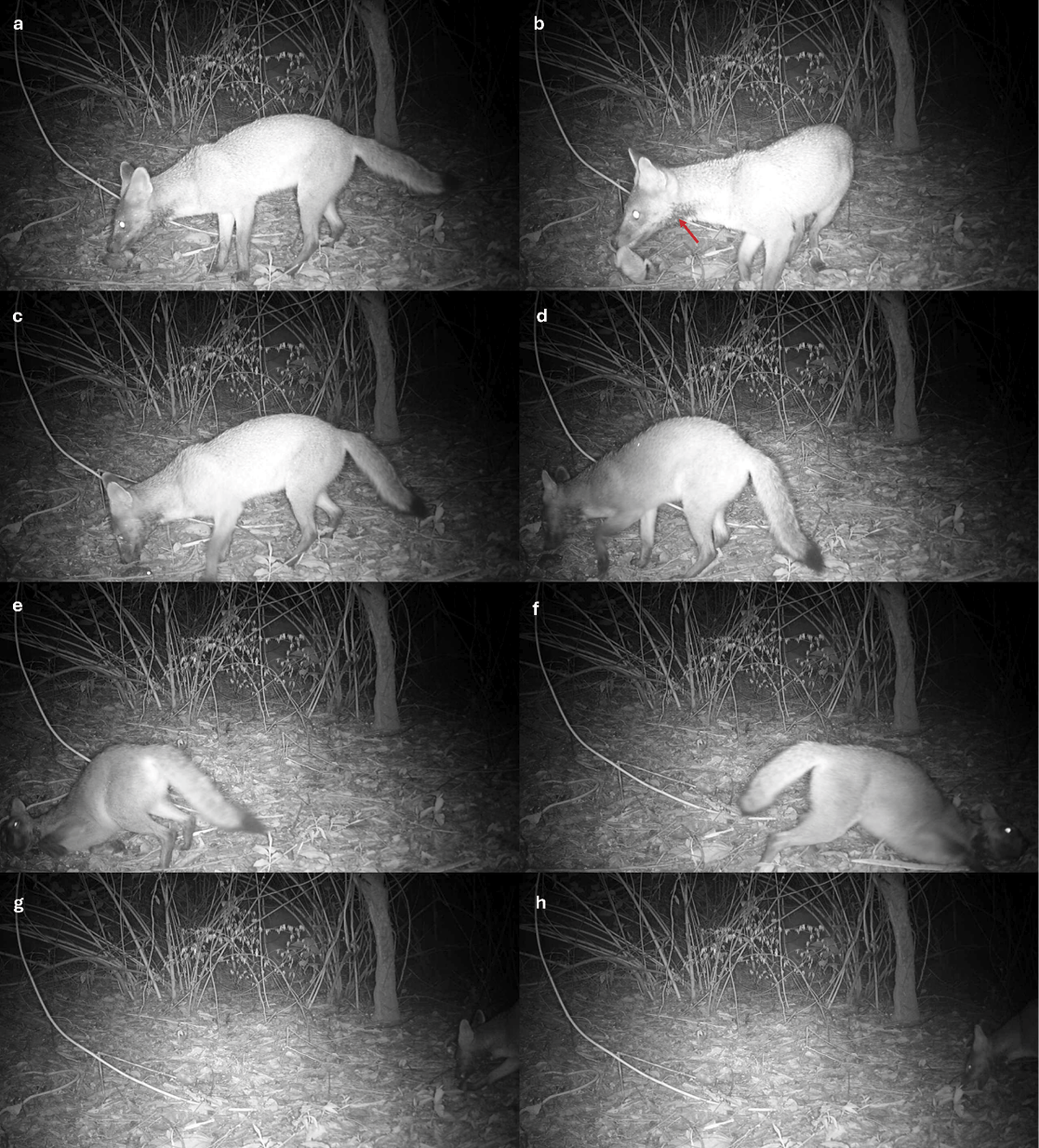
In the initial scenes, the fox was seen carrying the toad in its mouth, holding it by one of its forelimbs (Figure 1a-b). It then placed the toad on the ground (Figure 1c) and, through repetitive movements, twisted its neck over the prey (Figure 1d) and deliberately dropped its body in a controlled manner, delivering multiple blows (Figure 1e). Next, it inspected the toad, lifted it by one hind limb, walked a few steps, and placed it back on the ground, where it watched, sniffed, and engaged with it again (Figure 1f). This pattern is repeated several times, with a frequency of one to three blows per cycle. The sequence included episodes of olfactory exploration and visual assessment, as well as pauses during which the fox appears to closely observe the toad’s reactions. During these actions, the fox’s neck fur appears visibly wet (Figure 1a-d, the tip of pointer), suggesting dermal contact with bufotoxins, which are typically secreted from parotoid glands when threatened.
This behavior was consistently documented in the first three videos, each lasting 20 seconds. In the fourth video, the fox grasped the toad by a limb and pinned it against the ground using one of its forepaws, tensing its muscles in an apparent attempt to dismember it (Figure 1g). In the fifth and sixth videos, the fox continues feeding, selectively consuming the thighs while discarding the rest of the body (Figure 1h). Finally, in the seventh video, the fox persistently sniffed the remains of the toad before leaving the area.
Worldwide, several studies have reported the selective feeding of toads of the genus Rhinella, including R. marina, R. horribilis, R. diptycha, and R. icterica, by vertebrate pre-dators (Rocha et al. 2008; Cabrera-Guzman et al. 2014; Bossi et al. 2019; Parrot et al. 2019; Dutra-Vieira et al. 2021; Goebel et al. 2023; Couto et al. 2024; Cubas-Rodríguez et al. 2024; Negreiros Almeida et al. 2024). A study reported that, in one case, the consumption of R. diptycha occurred shortly after initial contact. However, in a second case, where another fox preyed on an individual of R. icterica, the fox was observed making small jumps and using its forepaws to immobilize the prey (Couto et al. 2024). In contrast to those reports, our observation demonstrates an elaborate behavioral pattern prior to consumption, in which the fox repeatedly strikes the toad using neck movements. This may represent a strategy to immobilize the prey, or a manipulation behavior intended to reduce toxin release.
Additional observations consistently describe a pattern of selective consumption, in which the ingestion of limbs and lower ventral regions of Rhinella species is prioritized, whereas the head and dorsal areas are avoided (Couto et al. 2024), where venom glands are concentrated (Toledo and Jared 1995). Couto et al. (2024) interpreted this type of selective feeding, which excludes internal organs and dorsal regions, as an adaptive strategy to minimize the risk of intoxication.
To date, there have been no reports of lethal intoxica-tion in C. thous following the consumption of bufonid toads, which may suggest partial physiological tolerance to bufotoxins or, more likely, high effectiveness in prey - handling and dietary selection strategies (Rocha et al. 2008; Gadelha and Soto-Blanco 2012; Goebel et al. 2023). In contrast, predatory species in Australia, such as dingoes (Canis lupus dingo Wozencraft, 2005) and certain carnivorous marsupials like the northern quoll (Dasyurus hallucatus Gould, J. 1842), and other native predators experience high mortality when coming into contact with R. marina (a South American invasive species in Australia) due to their lack of an evolutionary history of exposure to these toxins, and lack of learned behaviors to isolate and consume less toxic body parts of the toad (Shine 2010; Nelson et al. 2011; Cabrera-Guzmán et al. 2014; Indigo et al. 2023).
The behavior documented in this study contributes to existing knowledge by detailing the sequence of toxic prey handling by C. thous. This includes visual and olfactory exploration, abrupt movements prior to consumption, and selective ingestion. The neck - thrusting behavior observed before ingestion may represent an immobilization strategy not reported before by this species (e.g., Goebel et al. 2023; Couto et al. 2024). Likewise, the manipulation of prey by its limbs suggests a possible sensory evaluation process based on learned experience (Couto et al. 2024). These findings highlight the importance of conducting further studies to better understand the behavioral strategies employed by C. thous when facing chemically defended prey such as R. horribilis. More broadly, our observations highlight the need for further investigation to determine whether C. thous possesses physiological immunity to bufotoxins, or whether its selective feeding predation strategy toward toxic prey is entirely learned. Such research could shed light on how learned behaviors influence trophic dynamics in the presence of chemically defended prey.
Acknowledgments
We thank the Fundación para la Investigación y el Manejo de los Recursos Hidrobiológicos de la Región Caribe Colombiana “George Dahl” and Drummond Ltd. for facilitating access to the information used in this study. We also thank Thomas Viloria - Lagares, a herpetology expert in the Caribbean Region, for his valuable contributions in amphibian identification.
Literature cited
Acosta, A. R. 2025. Lista de los anfibios de Colombia/Check List Colombian Amphibians. V.15.2025. http://www.batrachia.com. Accessed on July 7 2025.
Beisiegel, B. M., et al. 2013. Avaliação do risco de extinção do Cachorro - do - mato Cerdocyon thous (Linnaeus, 1766) no Brasil. Biodiversidade Brasileira 3:138–145.
Berta, A. 1982. Cerdocyon thous. Mammalian Species 186:1–4.
Bossi, M. A. S., et al. 2019. Comparative trophic ecology of two sympatric canids in the Brazilian Pampa. Journal of Zoology 307:215–222.
Cabrera-Guzmán, E., et al. 2014. Predation on invasive cane toads (Rhinella marina) by native Australian rodents. Journal of Pest Science 88:143–153.
Caravaggi, A, et al. 2017. A review of camera trapping for conservation behaviour research. Remote Sensing in Ecology and Conservation 3:109–122.
Carvajal-C, J. E., et al. 2019. Amphibians of the Perijá massif, Colombia. Pp. 369–378 in Colombia Diversidad Biótica XVIII. Biodiversidad y territorio de la serranía de Perijá (Cesar - Colombia) (Rangel - Ch., J. O., et al., eds.). Universidad Nacional de Colombia - Instituto de Ciencias Naturales. Bogotá, Colombia.
Chapman, F. M. 1927. Who treads our trails? National Geographic Magazine 52:331–345.
Cortés-Suárez, J. E. 2017. Microhábitat use by the giant toad Rhinella horribilis in pastures in Villa de Leyva municipality, Boyacá, Colombia. Revista Biodiversidad Neotropical 7:253–257.
Couto, R. M. P., et al. 2024. A risky meal: predation on the toads Rhinella diptycha (Cope, 1862) and R. icterica (Spix, 1824) by crab-eating Foxes, Cerdocyon thous in Brazil. Herpetology Notes 17:453–457.
Cubas-Rodríguez, A. M., et al. 2024. Birds as predators of herpetofauna: record of seven cases from Costa Rica and Honduras. Herpetology Notes 17:517–520.
Delgado-V, C. A., and D. Zurc. 2007. Diet of the Crab-eating fox Cerdocyon thous (Carnivora: Canidae) in the Páramo de Belmira, Antioquia, Colombia. Brenesia 67:73–74.
Delgado-V, C. A., and D. Zurc. 2007. Diet of the crab-eating fox Cerdocyon thous. Brenesia 67:73–74.
Demartín, R. P., R. Ghirardi, and J. A. López. 2025. Influence of Natural and Artificial Habitats and Microhabitats on Urban Amphibian Diversity and Behavior. Diversity 17:292.
Díaz-Pulido, A., and E. P. Garrido. 2012. Manual de foto-trampeo: una herramienta de investigación para la conservación de la biodiversidad en Colombia. Instituto de Investigaciones de Recursos Biológicos Alexander von Humboldt y Panthera Colombia. Bogotá, Colombia.
Duque Amado, C., and R. M. Megia Palma. 2024. The Meso-american giant toad Rhinella horribilis as bioindicator of vegetation degradation in a tropical forest. Basic and Applied Herpetology 38:77–89.
Dutra-Vieira, F. M., et al. 2021. Diet of crab-eating fox (Cerdocyon thous) in two conservation units of the Amazon rainforest, Brazil. Brazilian Journal of Biology 84:e252093.
Emmons, L. H., and F. Feer. 1999. Neotropical rainforest mammals. A field guide. University of Chicago Press. Chicago, USA.
Favio, P., et al. 2025. Anuran responses to urbanization: evaluating life history traits of Rhinella arenarum in urban wetlands. Current Zoology 71:233–242.
Gadelha, I. C. N., and B. Soto - Blanco. 2012. Intoxicação de cães por sapos do gênero Rhinella (Bufo): revisão de literatura. Clínica Veterinária 17:46–54.
Glendinning, J. I. 2007. How do predators cope with chemically defended foods? The Biological Bulletin 213:252–266.
Goebel, L. G. A., et al. 2023. Predation record of Rhinella marina (Linnaeus, 1758) (Anura: Bufonidae) by Cerdocyon thous (Carnivora: Canidae) using camera trap in Vale do Paraíso, Rondonia, Brazil. Mammalogy Notes 9:362.
Indigo, N. L., et al. 2023. Can conditioned taste aversion be deployed at a landscape level to mitigate the impact of invasive cane toads on northern quolls? Wildlife Research 50:1046–1057.
Kucera, T. E., and R. H. Barrett. 2011. A History of Camera Trapping. Pp. 9 - 26 in Camera Traps in Animal Ecology (O’Connell, A. F., J. D. Nichols, and K. U. Karanth, eds.). Springer. Tokyo, Japan.
Leenders, T. 2016. Amphibians of Costa Rica: a field guide. Cornell University Press. Ithaca, NY, USA.
Londoño-Raigosa, M., D. Álvarez, and J. H. Castaño. 2025. Record of the crab-eating fox, Cerdocyon thous (Carnivora: Canidae) preying cultivated Oreochromis niloticus in Santa Rosa de Cabal, Risaralda, Colombia. Mammalogy Notes 11:475.
Negreiros Almeida, M. R., et al. 2024. Predation by the Pebas four - eyed opossums Philander pebas on the toad Rhinella margaritifera in the west Brazilian Amazon. Therya Notes 5:167–171.
Nelson, D. W., M. R. Crossland, and R. Shine. 2011. Behavioural responses of native predators to an invasive toxic prey species. Austral Ecology 36:605–611.
Parrott, M. L., et al. 2019. Eat your heart out: choice and handling of novel toxic prey by predatory water rats. Australian Mammalogy 42: 235–239.
Pérez-Gómez, K., and R. C. Fernández-Rodríguez. 2025. Notas sobre los mamíferos del Perijá (Colombia): Dieta de Cerdocyon thous. Zenodo. Mammal Diversity Database (v1) [Data set]. Zenodo. https://doi.org/10.5281/zenodo.17969934. Accessed on December 17, 2025.
Rangel - Ch, J. O. 2019. Clima integrado de la serranía de Perijá, Colombia. Pp. 93 - 128 in Colombia Diversidad Biótica XVIII. Biodiversidad y territorio de la serranía de Perijá (Cesar - Colombia) (Rangel - Ch., J. O., et al., eds.). Universidad Nacional de Colombia - Instituto de Ciencias Naturales. Bogotá, Colombia.
Ramírez-Chaves, H. E., and W. A. Pérez. 2015. New record of crab-eating fox Cerdocyon thous in Southwestern Colombia with comments on its distribution in Colombia and Ecuador. Canid Biology and Conservation 18:6–9.
Rocha, V. J., et al. 2008. Feeding habits of the crab-eating fox, Cerdocyon thous (Carnivora: Canidae), in a mosaic area with native and exotic vegetation in Southern Brazil. Revista Brasileira de Zoologia 25:594–600.
Shine, R. 2010. The ecological impact of invasive cane toads (Bufo marinus) in Australia. The Quarterly Review of Biology 85:253–291.
Sillero-Zubiri, C. 2009. Family Canidae (Dogs). Pp. 426 - 427 in Handbook of the Mammals of the World - Volume 1 Carnivores (Wilson, D. E., and R. A. Mittermeier, eds.). Lynx Edicions. Barcelona, Spain.
Skelhorn, J., and C. Rowe. 2007. Predators’ toxin burdens influence their strategic decisions to eat toxic prey. Current Biology 17:1479–1483.
Soria-Ortiz, g. j., and E. Vazquez-Dominguez. 2025. Landscape predictors of the genetic diversity and differentiation of four anuran species inhabiting anthropized environments. Landscape Ecology 40:148.
Suárez-Castro A. F. and H. E. Ramírez-Chaves (eds). 2015. Los carnívoros terrestres y semiacuáticos continentales de Colombia. Guía de Campo. Universidad Nacional de Colombia. Bogotá, Colombia.
Toledo, R. D., and C. Jared. 1995. Cutaneous granular glands and amphibian venoms. Comparative Biochemistry and Physiology Part A. Physiology 111:1–29.
Trolliet, F., et al. 2014. Use of camera traps for wildlife studies: a review. Biotechnology, Agronomy and Society and Environment 18:446–454.
van Thiel, J., et al. 2022. Convergent evolution of toxin resistance in animals. Biological Reviews 97:1823–1843.
Webb, J. K., et al. 2014. Behavioural flexibility allows an invasive vertebrate to survive in a semi-arid environment. Biology letters 10: 20131014.
Associate editor: Jorge Ayala Berdón
Submitted: August 04, 2025; Reviewed: June 01, 2026
Accepted: September 14, 2026; Published on line: October 9, 2026
DOI: 10.12933/therya_notes-25-257
ISSN 2954-3614
Figure 1. Frames illustrating key moments of the predation event of Rhinella horribilis by Cerdocyon thous in a tropical dry forest in the municipality of La Jagua de Ibirico, Cesar Department, Colombia: a and b, transport; c and d, prey inspection; e and f, striking with repetitive neck movements; g and h, consumption.