THERYA NOTES 2025, Vol. 6: 184-189
First photographic record of Puma concolor L. (Carnivora: Felidae) in Celaque Mountain National Park, Lempira, Honduras
Primer registro fotográfico de Puma concolor L. (Carnívora: Felidae) en Parque Nacional Montaña de Celaque, Lempira, Honduras
Kleyder Peñalva Morales1*, Hermes Vega Rodríguez2 and Walter Orellana Canales3
1Escuela de Ciencias Forestales, Universidad Nacional de Ciencias Forestales (UNACIFOR). Carretera principal CA-5, C. P. 12111, Siguatepeque, Comayagua, Honduras. E-mail: das_kleyderp@unacifor.edu.hn.
2Proyecto Conecta+, Secretaría de Recursos Naturales y Ambiente (SERNA). Carretera internacional CA-4, C. P. 41101, Santa Rosa de Copán, Copán, Honduras. E-mail: hermes.vega88@gmail.com.
3Departamento de Genética y Plantaciones – Banco de Semillas, Universidad Nacional de Ciencias Forestales (UNACIFOR). Carretera principal CA-5, C. P. 12111, Siguatepeque, Comayagua, Honduras. E-mail: w.orellana@unacifor.edu.hn.
*Corresponding author
The cougar, also known as mountain lion (Puma concolor, Linnaeus 1771), is one of the largest wild felines inhabiting the American continent. In Honduras, this species has been recorded in seven departments, according to various sources; however, its presence in Montaña de Celaque National Park had not been documented. The objective of this study was to confirm the presence of cougars in the core zone of the park using photographic records. Camera traps were used in the cloud forest of the core area of Montaña de Celaque National Park, municipality of San Manuel de Colohete, Lempira. Camera traps were installed at 2,414 m and operated for a period of 492 nights/camera; the captured images were analyzed to confirm the species based on morphological traits. Records of P. concolor were obtained in six photo captures. The photographic evidence confirms the presence of this species in the protected area. These records suggest a pattern of diurnal activity. The photographic record of P. concolor in the PNMC supports its presence in conserved cloud forests. The species, listed as Endangered in Honduras, is an important ecological indicator. Conserving its habitat is essential, as well as implementing continuous monitoring programs in protected areas. The confirmed presence of cougars in the PNMC reinforces the relevance of this protected area as a refuge for key fauna. This finding reinforces the need to strengthen conservation and surveillance actions in the park, with particular focus on prioritizing large carnivores as flagship species for the protection of ecosystems.
Keywords: biological corridor; Celaque; Honduras; Lempira; mammal; camera traps.
El puma o león de montaña (Puma concolor, Linnaeus 1771) es uno de los felinos silvestres de mayor tamaño que habitan en el continente americano. En Honduras esta especie se ha registrado en siete departamentos del país de acuerdo con diversas fuentes, pero su presencia en el Parque Nacional Montaña de Celaque no había sido documentada debidamente. Esta investigación tuvo como objetivo confirmar su presencia en la zona núcleo del parque mediante registros fotográficos. Se utilizaron cámaras trampa en el bosque nuboso correspondiente al área núcleo del parque, municipio de San Manuel de Colohete, Lempira. Las cámaras trampa fueron colocadas a 2,414 msnm las que permanecieron activas durante un periodo de 492 noches/cámara, analizando las imágenes obtenidas para confirmar morfológicamente la especie registrada. Se obtuvieron 6 registros mediante foto capturas del P. concolor desde el 3 de julio de 2024. Las evidencias fotográficas confirman la presencia de esta especie en el parque. Dichos registros también sugieren un patrón de actividad diurna. El registro fotográfico de P. concolor en el Parque Nacional respalda su presencia en bosques nubosos conservados. La especie, categorizada como en peligro de extinción en Honduras, representa un importante indicador ecológico. La conservación de su hábitat es esencial, al igual que la implementación de programas de monitoreo continuo en zonas protegidas. La presencia del puma en el parque refuerza el valor de esta área como refugio de fauna clave. Este hallazgo impulsa la necesidad de reforzar acciones de conservación y vigilancia en el parque, priorizando a los grandes carnívoros como especies bandera para la protección del ecosistema
Palabras clave. Corredor biológico; Celaque; Honduras; Lempira; Mamífero; Trampas cámara.
© 2025 Asociación Mexicana de Mastozoología, www.mastozoologiamexicana.org
The cougar (Puma concolor), also known as the mountain lion, is one of the largest mammals that is widely distributed in the American continent, from southern Canada to southern Chile and Argentina (Haag et al. 2009; Barceló et al. 2025), in an altitudinal range from sea level to more than 5800 meters (Currier 1983). The cougar is potentially distributed in 40 % of the Honduran territory (Portillo and Elvir 2022); however, it should be noted that the distribution of this feline in Honduras has not been determined with certainty. Puma concolor thrives in various habitats, including different types of forests, lowlands, and mountainous deserts. Although several studies indicate that cougars prefer habitats with dense understory, they also inhabit open environments with sparse vegetation cover (Nowell and Jackson 1996). The size of the area occupied by this species varies significantly across regions, being smaller in places where prey density is high (Sunquist et al. 2002).
Cougars play a central role in the biodiversity and balance of ecosystems, as they support the conservation and preservation of these habitats. This species significantly contributes to the balance of ecosystems by controlling prey populations, including deer, rabbits, and wild boars. Cougars help prevent the spread of diseases among herbivores and promote forest health by keeping the populations of these prey species at adequate levels (Pérez and Santos 2016; Morenno and Flores 2024).
Cougar records within protected areas in Honduras correspond to the Caribbean, west, and Moskitia regions (Portillo and Elvir 2013). The species has been recorded in the Opalaca Biological Reserve (D. Espinoza pers. comm), which is the closest record to the Montaña de Celaque National Park. There are additional records in the Azul Meámbar National Park (Midence 2019), the Misoco Biological Reserve (Alvarado et al. 2024), the Río Plátano Biosphere Reserve (Gonthier and Castañeda 2013), four localities of the La Unión corridor (Guinope, Oropolí, and Yuscarán): La Tigra National Park, Francisco Morazán, in the municipality of Aguanqueterique, La Paz, Honduras (Portillo and Elvir 2022), and the area of El Jilguero Biological Reserve (Sánchez et al. 2023).
The ability of cougars to adapt and coexist in areas with human presence makes them extremely vulnerable because they are surrounded by areas constantly modified by humans (Portillo and Elvir 2022). In Honduras, there is limited available information on the cougar. In the department of Lempira, and particularly in the Montaña de Celaque National Park, cougar records are scarce; consequently, there is a lack of knowledge about its distribution, abundance, and local threats. The Montaña de Celaque National Park is part of a mountainous complex of great ecological relevance, belonging to the Lempira Biological Corridor, which connects five protected areas in western Honduras, the study area: the Montaña de Puca Wildlife Refuge, the Pacayita Volcano Biological Reserve, the Opalaca Biological Reserve, and the Montaña Verde Wildlife Refuge. This biological corridor facilitates the connectivity of feline populations and their prey, making it a priority to generate information on the distribution of cougars within the area (UICN et al. 2021).
The main objective of the study was to document the presence of P. concolor in Cerro Guatemalía and Cerro de La Cruz, located within the jurisdiction of the municipality of San Manuel de Colohete, Lempira, in the core zone of the Montaña de Celaque National Park, Honduras.
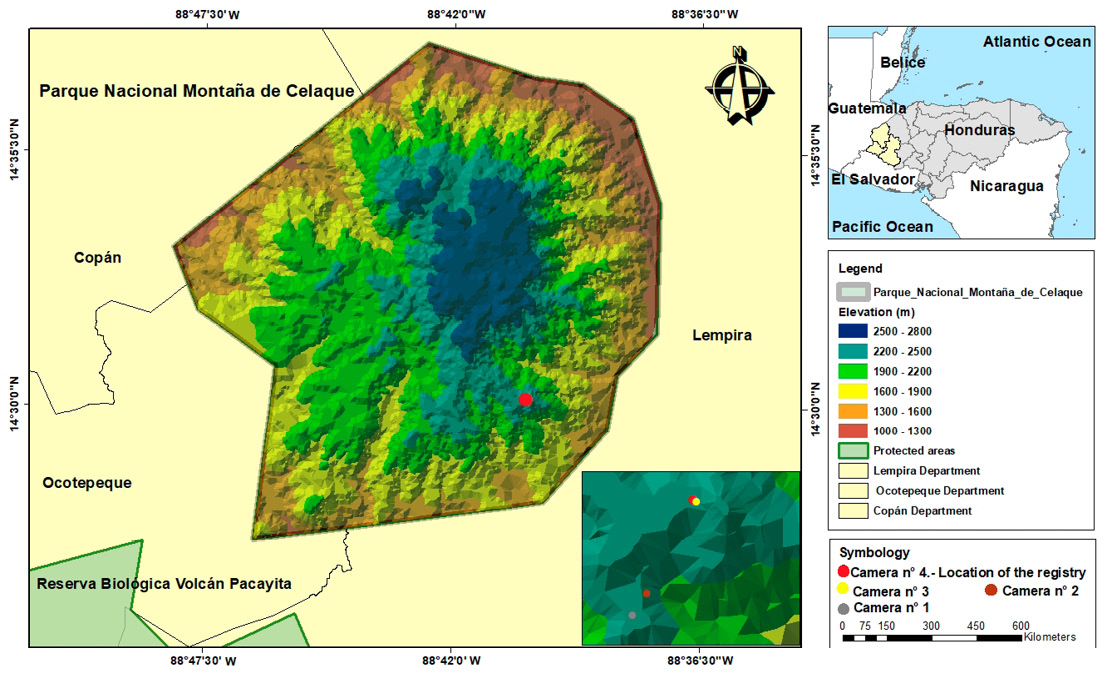
The study area is situated within the core zone of the Montaña de Celaque National Park (PNMC), in the southwestern region of Honduras (14°32 ́08” N; 88°42 ́26” W). The protected area encompasses an extension of 26 378.42 ha across 5 municipalities within the departments of Ocotepeque, Copán, and Lempira (Figure 1). This region has been recognized for its high biodiversity since its creation in 1987 (ICF 2016). According to the 2016–2027 management plan, the vegetation cover in the park comprises seasonal evergreen tropical forest, lower montane evergreen tropical forest, upper and lower montane evergreen tropical forests, mixed highland evergreen tropical forest, and agricultural systems (ICF and MAPANCE, 2016). The PNMC is home to rich biodiversity, with 67 species of continental mammals (Marineros and Martínez Gallegos 1998). Some studies have reported the presence of 18 species of flying mammals (bats) and 50 species of terrestrial mammals; 200 species of birds, 60 of them migratory; 27 species of amphibians and 45 species of reptiles; and unique ecosystems that are part of the habitat of multiple species of wildlife, which have become its main conservation targets (MAPANCE 2016).
As part of the study to determine the presence of P. concolor in the park, four camera traps (property of MAPANCE) were installed for a fourth-month period from 24 April to 24 August 2024. Two types of equipment were used: Moultrie camera model M999i 20MP with wireless connectivity, and SuntekCam camera model MINI 301, a mini camera for hunting tracking. These cameras were code-labeled to keep control of the stations; additionally, the geographical coordinates of each station were recorded. The cameras were distributed according to the area to be monitored and the topography of the terrain, leaving 0.5 to 1 km between them. The installation sites were selected based on the knowledge of the accompanying personnel who were familiar with the zone, and on indirect evidence, such as accounts from local inhabitants. Each camera trap was set to capture three images with a five-second interval between shots with a high-sensitivity motion sensor. The traps were installed on tree trunks at a height between 35 and 80 cm above the ground, depending on the topography, oriented to cover potential cougar transit routes.
The camera traps were in operation 24 hours a day throughout the study. For each capture, the camera recorded the percentage of battery or energy, temperature, and capture date and time. Camera traps were reviewed once a month.
In the study period, the sampling effort was 492 trap days, capturing six photographs that showed the presence of the cougar (P. concolor) at Station 2, located in Cerro Guatemalía, The records were obtained in a cloud forest altitude coniferous (>2000 meters above sea level), which comprises mixed vegetation with a dense understory where the dominant trees are Pinus pseudostrobus, Pinus hartwegii, Podocarpus oleifolius, Quercus cortesii, and Ocotea sp. The records of the species were captured 71 days after the camera traps were installed.
The first images of P. concolor were recorded on 3 July 2024, consisting of three photographs captured at approximately the same time, a few seconds apart (Figure 2) at 15:28 hr at an altitude of 2,414 meters above sea level (14°30’11.41” N; 88°40’23.02” W) in the core area of the PNMC, belonging to the Cerro Guatemalía site. The second record, including two photographs, was captured on 12 July 2024 at 12:11 hr at the photo trapping station where the first record was documented. The third record was obtained on 12 July 2024 at 6:43 hr. This same photo trapping station captured the presence of a raccoon, Procyon lotor (Linnaeus 1758), a potential prey, and a camera trap installed approximately 1 km from the site where P. concolor was recorded, captured images of two additional species: opossum, Didelphis marsupialis (Linnaeus 1758), and tepezcuintle, Cuniculus paca (Linnaeus 1766).
The cougar presented a mostly diurnal activity pattern along with a crepuscular activity pattern, as detailed in (Table 1).
The presence of cougar (P. concolor) in the Montaña de Celaque National Park represents a significant finding for the conservation of biodiversity in Honduras. This study provides the first photographic record of the cougar in the park, which is highly relevant because this species plays a crucial role in biodiversity conservation (Naughton-Treves et al. 2005; Pino-Del-Carpio et al. 2014).
In Honduras, the presence of five wild felines has been reported: jaguar (Panthera onca), cougar (P. concolor), ocelot (Leopardus pardalis), margay (Leopardus wiedii), and jaguarundi (Herpailurus yagouaroundi). The cougar is considered the second-largest feline in Honduras, and its presence in 6 protected areas has been documented using camera traps (Portillo and Elvir 2013). Four of the five feline species reported for the country have been recorded in the Montaña de Celaque National Park, including the cougar, the ocelot, the margay, and the yaguarundi (MAPANCE 2013). However, information on their ecology and population status is still limited, underscoring the need to strengthen monitoring efforts.
The ecological niche-partitioning mechanisms that enable felines to coexist are essential for supporting conservation strategies. Given their quiet and elusive behavior, the use of camera traps has become a strategic non-invasive technique for studying these species (Alberti et al. 2023). This type of research enables the identification of patterns of activity and habitat occupancy, as well as the evaluation of spatial and temporal interactions between felines that coexist in the same ecosystem (Reyes and Hernández 2011).
The six records obtained in the PNMC, Honduras, indicate that this area offers suitable conditions for cougar survival, such as forest cover and access to prey in its areas of activity (Elbroch and Wittmer 2012).
The records reported here underscore the great conservation potential within the park and highlight the importance of systematic wildlife monitoring programs. Likewise, ecological connectivity is essential for ensuring the viability of populations of large felines such as the cougar, as it facilitates gene flow and access to resources across diverse ecosystems. Therefore, it is essential to maintain or improve the five biological corridors that exist today: Guajiquiro-Goldfinch, Anillo Verde, Trifinio-Fraternidad Joya de las Américas, Joya de Los Lagos, and Lempira Biological Corridor (SERNA 2024). The Montaña de Celaque National Park is part of the latter, aimed at facilitating the movement of species, especially of felines, which require large areas for displacement (Macdonald et al. 2010).
In this context, it is worth noting that the photographic records closest to the Montaña de Celaque National Park correspond to the Opalaca Biological Reserve (D. Espinoza pers. comm), an area that is also part of the Lempira Biological Corridor. These significant findings confirm the functional connectivity between Celaque and other areas in western Honduras.
Since its creation in 1987, the PNMC has implemented various conservation actions, including the delimitation of core and buffer zones, regulation of extractive activities, and promotion of community environmental education programs (ICF 2016). In addition, local organizations such as MAPANCE have developed forest restoration and wildlife monitoring projects that utilize camera traps, thereby strengthening the knowledge of biodiversity in the park (MAPANCE 2013). These actions have contributed to reinforcing the Lempira Biological Corridor. However, a long-term systematic monitoring program is still needed to assess population trends and threats to this species.
The records of cougars in the park underscore the importance of strengthening conservation actions aimed at maintaining biological corridors, habitat management, and mitigating threats such as poaching and forest wildfires. Camera traps have proven to be an indispensable tool for research and monitoring felines, providing crucial information to support management decision-making and public policies. Ensuring connectivity and protecting suitable habitats will be key to ensuring the persistence of these top predators in western Honduras.
Acknowledgements.
To the MAPANCE association for its support in the fieldwork by providing equipment and logistics, together with its working group. To C. Calderón for his support in providing his own equipment for the research and accompanying us on the tours. To A. Romero and M. Moreno of the National Resource Guardians Program of Honduras Abel Romero and Santos Romero for their dedication in accompanying and guiding us on field trips, to M. Alemán for his willingness and guidance in the development of the work, as well as to A. Viera for his accompaniment in field work. Finally, I would like to express my sincere gratitude to the residents of the community of Naranjito, San Manuel de Colohete, Honduras, for their support and hospitality, which made the research possible.
Literature cited
Alberti, M. E., et al. 2023. Daily and seasonal activity patterns of a felid assemblage in a forest-grassland mosaic in southern Brazil. Iheringia. Série Zoologia 113:1–10
Alvarado, L., et al. 2024. Primer registro fotográfico de puma Puma concolor en la Reserva Biológica Misoco, Honduras. Notas sobre Mamíferos Sudamericanos 6:1–8
Barceló, G., et al. 2025. Human disturbance alters the foraging and spatiotemporal activity of a large carnivore. Oecologia 207:112–119
Beier, P. 1993. Determinación de áreas mínimas de hábitat y corredores de hábitat para pumas. Journal of Society for Conservation Biology, Conservation Biology 7:94–108
Currier, M. J. 1983. Felis concolor. Mammalian Species 200:1–7.
Elbroch, M., and H. U. Wittmer. 2012. Table scraps: inter-trophic food provisioning by pumas. Biology Letters, 8:776–779.
Ernest, H., et al. 2014. La conectividad genética fracturada amenaza a una población de pumas del sur de California (Puma concolor). Revista Plos One 9:e107985
Gonthier, D., and F. Castañeda. 2013. Censo de mamíferos grandes y medianos mediante cámaras trampa en el río Sikre, Reserva de la Biosfera del Río Plátano, Honduras. Tropical Conservation Science 6:584–591.
Haag, T., et al. 2009. Development and testing of an optimized method for DNA-based identification of jaguar (Panthera onca) and puma (Puma concolor) faecal samples for use in ecological and genetic studies. Genética 136:505–512.
Instituto de Conservación y Desarrollo Forestal, Áreas Protegidas y Vida Silvestre (ICF). 2016. Plan de Manejo del Parque Nacional Montaña de Celaque 2016–2028. Instituto Nacional de Conservación y Desarrollo Forestal, Áreas protegidas y Vida Silvestre, Gracias, Honduras. 87 pp.
Macdonald, D. W., A. J. Loveridge, and A. Rabinowitz, (eds) 2010. The Biology and Conservation of Wild Felids. Oxford University Press, Oxford, UK.
Mancomunidad de Municipios del Parque Nacional Montaña de Celaque (MAPANCE). 2013. Plan de investigación y monitoreo del Parque Nacional Montaña de Celaque (2013–2024). Mancomunidad de Municipios del Parque Nacional Montaña de Celaque, Instituto de Conservación Forestal y Proyecto USAID ProParque, Gracias, Honduras.
Marineros, L., and F. Martínez Gallegos. 1998. Guía de campo de los mamíferos de Honduras. Instituto Nacional de Ambiente y Desarrollo. Tegucigalpa, Honduras. 374 pp.
Mazzolli, M. 2012. Natural recolonization and suburban presence of pumas (Puma concolor) in Brazil. Ecology and the Natural Environment 4:344–362.
Midence, L. S. 2019. Registro del puma (Puma concolor) en el Parque Nacional Azul Meámbar, a través del uso de trampas cámaras. Scientia hondurensis 2:5–8.
Morenno, S., and M. M. Flores. 2024. Beneficios del puma (Puma concolor), como regulador de especies en Centroamérica. Revista Minerva 2:101–109.
Naughton-Treves, L., M. Buck Holland., and K. Brandon. 2005. The Role Of Protected Areas in Conserving Biodiversity and Sustaining Local Livelihoods. Annual Review of Environment and Resources 30:219–252.
Nowell, K., and P. Jackson. 1996. Wild cats: Status survey and conservation action plan. IUCN – The World Conservation Union, Gland, Switzerland.
Pérez, G., and A. Santos. 2016. Grandes Depredadores Impresionantes y… ¿protectores? Ciencia y Desarrollo 41:6–9.
Pino-Del-Carpio, A., et al. 2014. The biodiversity data knowledge gap: Assessing information loss in the management of Biosphere Reserves. Biological Conservation 173:74–79.
Portillo, H. O., and F. Elvir. 2022. Datos preliminares de los registros de Puma (Puma concolor) y su posible distribución en Honduras. Revista Mexicana de Mastozoología Nueva época 12:22–32.
Portillo, H., and F. Elvir. 2013. Distribución de Felinos Silvestres en Áreas Protegidas de Honduras. Revista Mexicana de Mastozoología Nueva época 3:1–10.
Reyes Portillo, H., y J. Hernández. 2011. Densidad del jaguar (Panthera onca) en Honduras: primer estudio con trampas cámara en La Mosquitia Hondureña. Latin American Journal of Conservation 2:45–50.
Sánchez, K., et al. 2023. Puma concolor: first photographic record in the El Jilguero Reserve Water Production Zone, Honduras. Therya Notes 4:242–248.
Secretaría de Recursos Naturales y Ambiente (2024). Hitos del Proyecto Conecta+. Secretaria de Energía, Recursos Naturales, Ambiente y Minas (SERNA), Tegucigalpa, Honduras.
Sunquist, M., F. Sunquist., and J. K. Marcella. 2002. Wild Cats of the World. University of Chicago Press, Chicago, EE. UU.
Uicn, Conecta+, and Sedc, C. G. 2021. Sistematización: Establecimiento del Corredor Biológico en La Reserva de Biosfera Cacique Lempira, Señor de las Montañas. International Union for Conservation of Nature, Tegucigalpa, Honduras.
Associate editor: Romeo A. Saldaña Vázquez
Submitted: May 14, 2025; Reviewed: September 18, 2025.
Accepted: September 24, 2025; Published on line: December 6, 2025
DOI: 10.12933/therya_notes-24-218
ISSN 2954-3614
Figure 1. Location of the camera trap at the site where six photographs were captured, evidencing the presence of a cougar (Puma concolor).
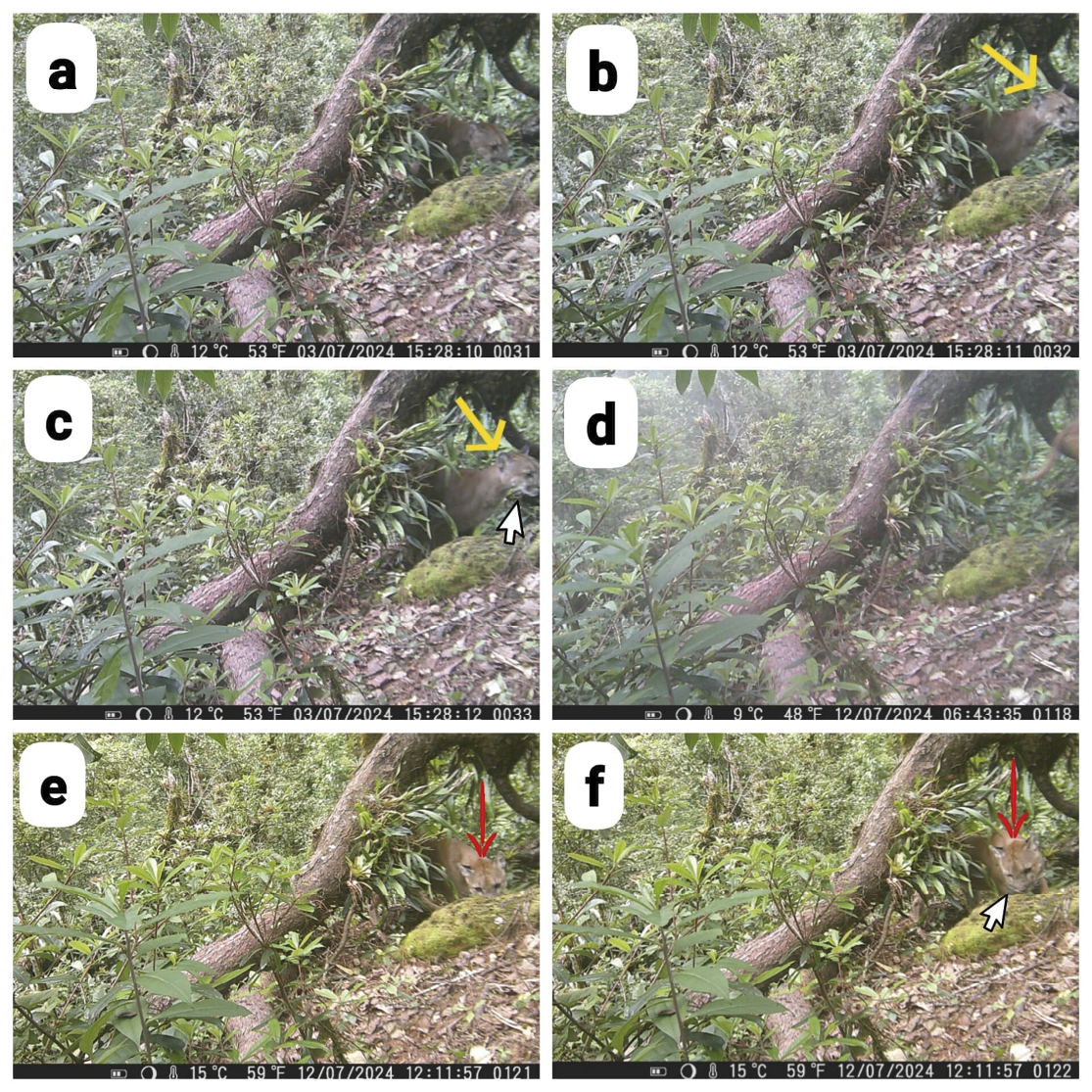
Figure 2. Records of Puma concolor showing that the same individual was captured in (a, b, c). (d) A partial image of one individual was recorded at 06:43 hrs., so it was impossible to confirm that it was the same individual recorded on the day at 12:11 hr. This individual shows coinciding traits (e and f) (yellow and red arrows); the records captured on 3 July and 12 July share similar characteristics, allowing us to infer that both correspond to the same individual.
Table 1. Records of Puma concolor on Cerro Guatemalía, San Manuel de Colohete, Lempira –Montaña de Celaque National Park, Honduras.
|
Date |
Time |
Vegetation type |
Geographic coordinates |
Observed activity |
|
|
N Latitude |
W Longitude |
||||
|
3/7/2024 |
15:28 hrs. |
Cloud forest |
14°50´27.97” |
88°67´27.45” |
Prowling |
|
3/7/2024 |
15:28 hrs. |
Cloud forest |
14°50´27.97” |
88°67´27.45” |
Prowling |
|
3/7/2024 |
15:28 hrs. |
Cloud forest |
14°50´27.97” |
88°67´27.45” |
Prowling |
|
12/7/2024 |
6:43 hrs. |
Cloud forest |
14°50´27.97” |
88°67´27.45” |
Part of one specimen was observed |
|
12/7/2024 |
12:11 hrs. |
Cloud forest |
14°50´27.97” |
88°67´27.45” |
Prowling |
|
12/7/2024 |
12:11 hrs. |
Cloud forest |
14°50´27.97” |
88°67´27.45” |
Prowling |