THERYA NOTES 2025, Vol. 6: 151-156
Record of margay (Leopardus wiedii) in a periurban Ecological Reserve in the central mountain region of Veracruz, Mexico
Registro de margay (Leopardus wiedii) en Reserva Ecológica periurbana en la zona montañosa del centro de Veracruz, México
Álvaro José Villafañe-Trujillo1*, and Christian Alejandro Delfín-Alfonso2
1Laboratorio de Zoología, Facultad de Ciencias Naturales, Campus Juriquilla, Universidad Autónoma de Querétaro. Av. de la Ciencias s/n, Santa Rosa Jáuregui, C P.76230, Santiago de Querétaro. Querétaro, México. E-mail: villafanetrujillo85@gmail.com (ÁJV-T).
2Laboratorio de Vertebrados, Instituto de Investigaciones Biológicas, Universidad Veracruzana. Av. Luis Castelazo Ayala s/n, Col. Industrial Ánimas, C. P. 91190, Xalapa de Enríquez. Veracruz, México. E-mail: cada7305@gmail.com (CAD-A).
*Corresponding author
Biodiversity worldwide is affected by human activities, species that inhabits in Protected Natural Areas are not exempt to human impact. Habitat resources are limited, species that requires large territories and a constant food availability cannot survive for long. The objective of this work is to point out and describe the occasional record of a specimen of margay (Leopardus wiedii) as a result from a systematic long-term survey in the periurban Ecological Reserve “La Martinica”, in the central mountainous area of the state of Veracruz (Mexico). For about 25 months (May 2021 to June 2023), a non-invasive survey focused on terrestrial and arboreal mammals was deployed in “La Martinica”. The camera traps were installed at ground (terrestrial stations) and in the canopy (arboreal stations), with an average distance of 300 m between them. The 24-hour cycles in which each camera operated correctly and uninterruptedly were considered 1 trap-day. After a sampling effort of 2,525 trap days, and an effective sampling area of 0.5 km2, in January 2023, at an altitude of 1,553 m, a specimen of margay was recorded in “La Martinica”. Due to the presence of other carnivores (exotic, introduced, and native) and the scarce mammal diversity at the study site (n =12 species), it is unlikely that a resident population of Leopardus wiedii inhabit in the region. The specimen was probably passing through during its dispersal. This record is the northernmost of the species obtained through systematic monitoring in the state of Veracruz.
Key words: Carnivore; feline; mammal; Neotropics; scansorial.
Globalmente la biodiversidad es afectada por actividades antrópicas, especies que habitan Áreas Naturales Protegidas no están exentas del impacto humano. Los recursos en un hábitat son limitados, especies que requieren una disponibilidad constante de recursos alimentarios y espaciales no pueden perdurar mucho tiempo. El objetivo de este trabajo es señalar y describir el registro ocasional de un espécimen de margay (Leopardus wiedii), resultado de un monitoreo extensivo en la Reserva Ecológica periurbana “La Martinica”, en la zona montañosa central del Estado de Veracruz (México). Durante poco más de 25 meses (Mayo 2021 a Junio 2023) se implementó un monitoreo no invasivo enfocado en mamíferos arborícolas y terrestres. Las cámaras-trampa se instalaron a nivel del suelo y en dosel, a una distancia promedio de 300 m entre ellas. Ciclos de 24 hr en que cada cámara funcionó correcta e ininterrumpidamente fueron considerados 1 día-trampa. Después de un esfuerzo de muestreo de 2,525 días-trampa, y un área efectiva de muestreo de 0.5 km2, en Enero de 2023, se registró un espécimen de margay en “La Martinica”. Debido a la presencia de otros carnívoros (exóticos- introducidos y nativos) y a la escasa riqueza mastozoológica en la localidad de estudio (n =12 especies), es poco probable que exista una población residente de Leopardus wiedii en la región. El espécimen probablemente estaba de paso durante su proceso de dispersión. El registro obtenido es el más septentrional de la especie obtenido mediante un monitoreo sistematizado en el estado de Veracruz.
Palabras clave: Carnívoro; escansorial; felino; mamífero; Neotrópico.
© 2025 Asociación Mexicana de Mastozoología, www.mastozoologiamexicana.org
The impacts of anthropogenic activities as the increase of human population, growth of human settlements, change in land use, generation of waste have altered the biotic and abiotic factors available to biodiversity (Vázquez and Gaston 2006), which implies unprecedented threats to multiple species of flora and fauna throughout the world. Despite several conservation efforts to establish Protected Natural Areas, these locations are also subject to intense anthropogenic pressure (Jones et al. 2018). One on the most critical threats to wildlife populations is the habitat loss (Wright 2005), due to the considerable resource requirements and low population densities mammalian carnivores could be specialty vulnerable to habitat destruction (Crooks et al. 2011).
Among the six species of felines recorded in Mexico, the margay (Leopardus wiedii) is the smallest, adult specimen weighs less than 5 kg (de Oliveira 1998), is also the only one physiologically adapted to arboreal life (Sunquist and Sunquist 2002). In Mexico, the species is classified as “Endangered” by the Norma Oficial Mexicana NOM-059 (SEMARNAT 2010). Human activities as agriculture, livestock raising, and infrastructure development are the principal threats to the species, as they fragment and reduce the available habitat (Ávila-Nájera et al. ٢٠٢٤).
Although the extensive distribution of L. wiedii across the American Continent its detection rates are universally low (Harmsen et al. 2021), for that reason, population dynamics studies of L. wiedii are scarce, the data are focused on estimates of relative abundance. Camera traps are one of the most versatile and widely used tools for survey terrestrial mammals, and demonstrate the presence of rarest or elusive terrestrial species (Wearn et al. 2013) in a locality. The objective of this work is to point out and describe the occasional camera-trap record of L. wiedii in the periurban Ecological Reserve “La Martinica”, located in the central mountainous area of the state of Veracruz (Mexico). Additionally, digital repositories of biological information were consulted in search of records of L. wiedii in the state of Veracruz (during the XXI Century) to determine the exceptionality of the photo-capture obtained.
The record obtained in January 2023 is the result of a long-term survey with camera traps focused on terrestrial and arboreal mammals, which began in May 2021 in the periurban Ecological Reserve “La Martinica” (19° 35’ 12.4’’ N, 96° 57’ 8.6’’ W; altitude between 1,550 to 1,650 m, and an area of 0.52 km2), located and partially surrounded by the municipality of Banderilla, Veracruz. The vegetation of the region is composed by tropical and subtropical humid broadleaf forests (Olson et al. 2001); within the Ecological Reserve there are disturbed remnants of mesophilic mountain forest. The climate is semi-warm-humid (Cfb, Kottek et al. 2006), the average annual rainfall is 1,100 to 1,600 mm, the temperature ranges from 18 °C to 24 °C, the dry season occurs between November and April, the rainy season occurs between May and October (INEGI 2010).
In January of 2023, five camera stations (composed by one camera trap) were installed within the vegetation of “La Martinica”, far from human trails (at a distance between six and 20 m). All the camera traps were set up to obtain only photographic records, the camera stations were unbaited, the distance between cameras was on average 300 m to avoid spatial overlapping between sampling areas. The terrestrial stations (n = 2; Model Terra8, Wildgame INNOVATIONS ®, Texas, EE. UU.), were installed at an average height of 50 cm due to the slope of the soil. The arboreal stations (n = 3; Model BTC-7A, Browning ®, Utah, EE. UU.) were installed at an average height of six meters. The 24-hour cycles in which each camera worked correctly and uninterruptedly were considered one trap-day; the effective sampling area of each camera station corresponded to a circle of 300 m in diameter (equals to an area of 0.07 km2; individual camera buffer method; Silver et al. 2004); the camera stations were relocated every 60 days to completely survey the area of “La Martinica”. In order to determine the exceptionality of the record, a search was carried out for sightings of L. wiedii in the state of Veracruz obtained during the XXI Century. The biological databases consulted were iNaturalist (https://www.inaturalist.org) and the Global Biodiversity Information System (GBIF; https://www.gbif.org). Only records that provided documentary evidence were included.
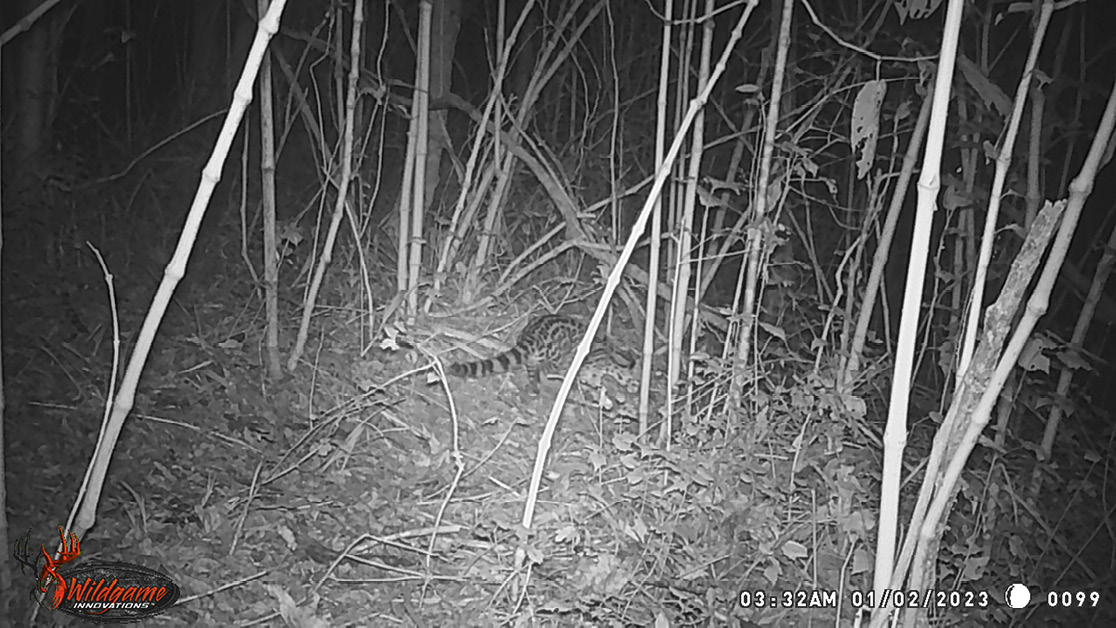
After a sampling effort of 2,525 trap-days, over a period of 18 months (of a total of 25 months), 50 different locations of camera stations (terrestrial stations n = 25; arboreal stations n= 25), and surveyed more than > 95 % of the surface of “La Martinica” (effective sampling area of 0.5 km2) a notable record of L. weidii was obtained in January 02 of 2023, at 03:32 hr (Figure 1). The species was identified by its size, thin shape, long-thick tail, and distinctive thick spotted pattern on its coat (Ávila-Nájera et al. 2024) these are specific characteristics of the species, that allow their differentiation from ocelot (larger and heavier body, big head, small eyes, large spots, slim-short tail; Leyhausen 1990; Ramírez-Barajas et al. ٢٠١٤).
The record was obtained from a terrestrial station, installed in a scrubland with abundant leathery colicwood trees (Myrsine coriacea), at an altitude of ١,٥٥٣ m. Due to the position of the specimen in the photograph, its sex is unknown due to it was not possible to observe genitals.
Form the biological databases consulted, 19 records of L. wiedii in the state of Veracruz were found between March 2016 and November 2023 (Table 1; Figure 2; there are no records available between 2000 and 2016); the records correspond to camera trap captures (n = 14), roadkill specimens (n = 2), and direct observations (n = 3). After compared the location between the records found with the one reported in this work, it was identified that the photo-capture obtained in “La Martinica” is the northernmost record of the species in the state of Veracruz.
Camera traps allows rare or elusive species to be recorded in an ecosystem, in some researches, the sampling effort invested to obtain records is relatively small (Rowcliffe et al. 2008), sometimes the capture frequency is related to the abundance and density of the target species in the study location. Researches that points out the presence of L. wiedii in localities throughout the species distribution are based upon different type of records: roadkill (Aguilar-López et al. 2015), dissected specimens (Tapia-Ramírez et al. 2013), or camera trap studies that required different survey efforts to obtain the first record of the species (between 61 and 3,220 trap-days). Those investigations documented between 1 and 10 individuals at the same locality: 2 records in 61 trap-days (mountain mesophyll forest with fragments of secondary vegetation, Puebla, Mexico; Hernández-Hernández et al. 2022); 4 records in 228 trap-days (cloud forest, Morelos, Mexico; Aranda and Valenzuela-Galván 2015); 1 record in 350 trap-days (tropical deciduous forest, Guanajuato, Mexico; Iglesias et al. 2008); 4 independent records from to 2 individuals in 796 trap-days (tropical deciduous forest, and surroundings from an oak forest, Nayarit, Mexico; Luja and Zamudio 2019), 5 independent records in 2,970 trap-days (high-altitude, humid and evergreen forests, Huanúco, Peru; Cossios and Ricra 2019); 85 records from 10 individuals in 3,220 trap-days (agricultural and pasture lands, primary and secondary forests, slopes of the Andes, Ecuador; Vanderhoff et al. 2011).
Although the margay is included in the list of species present in the state of Veracruz (González-Christen and Delfín-Alfonso 2016), the survey carried out in “La Martinica” required a sampling effort of 2,525 trap-days to obtain a single record; the trap-days from arboreal stations were included because L. wiedii is physiologically adapted to display arboreal activity (de Oliveira 1998; Domínguez-Castellanos and Ceballos 2005), for that reason is considered the most arboreal among the New World felid (Hodge 2014).
The record reported here is considered occasional, the entire survey lasted over 25 uninterrupted months in which the terrestrial mammal community present in the area was monitored, after the record of margay in the eighteenth month no additional traces (corpses, feces, footprints, and scratching posts) were documented. Therefore the existence of resident populations of L. wiedii within “La Martinica” is ruled out due to: 1) the survey in the region indicates a reduced abundance and richness of mammals, composed by of carnivores: Bassariscus astutus, Canis familiaris, Felis catus, Neogale frenata, Procyon lotor, Urocyon cinereoargenteus; cingulates: Dasypus novemcinctus; didelphids: Didelphis spp, Marmosa mexicana; lagomorphs: Sylvilagus floridanus; and rodents: Peromyscus spp, Sciurus aureogaster); so the margay have several competitors and low availability of preys, 2) L. wiedii has a preference for localities whose native vegetation has a dense cover (Morales-Delgado et al. 2021), this attribute does not occurs in “La Martinica”, the Reserve is fragmented, partially surrounded by the town of “Banderilla”, and the extraction of biodiversity for economic (obtain raw materials, or derivatives that are marketed), or subsistence purposes (edibles, or elements for medicinal use) is permanent. Therefore, it is speculated that the specimen was photographed during its dispersion process to a site with more favorable conditions.
The IUCN Red List of Threatened Species (de Oliveira et al. 2015) indicates that wild populations of L. wiedii are declining due to human-induced conversion of native forest habitats to agriculture, pasture, and urban development (de Oliveira et al. 2015). Although the state of Veracruz occurs within the species’ potential range (Morales-Delgado et al. 2021), availability of suitability habitat is low (<0.69) across most of the state. The status of L. pardalis populations occurring in the state of Veracruz is currently unknown.
The 19 records of L. wiedii in the state of Veracruz during the XXI Century corresponds to researches, opportunistic sightings, and reports of roadkill specimens. The photo capture from “La Martinica” along with the record reported for Vega de Alatorre (46 km away) in 2016 (direct observation, November 28, 2016; Table 1), are the northernmost records of the species within the state of Veracruz. It is necessary to design and implement studies focused on L. wiedii to generate ecological knowledge about the species that can be used for conservation strategies for the species and its habitat.
Acknowledgements
We thank the Consejo Nacional de Ciencia y Tecnología for the financial support of the Proyecto Ciencia de Frontera de CONACyT Clave 64358 “Funcionalidad Socio-Ecológica de Áreas Verdes Urbanas Neotropicales”, and for the Postdoctoral Fellowship provided. We also thank the authorities of Secretaria del Medio Ambiente del Estado de Veracruz (SEDEMA), the staff of Dirección de Medio Ambiente del H. Ayuntamiento de Xalapa-Enríquez, and the anonymous reviewers for providing observations and comments that allowed us to improve this document.
Literature cited
Aguilar-López, M., et al. 2015. Registros notables de mamíferos terrestres del estado de Hidalgo, México. Acta Zoológica Mexicana (nueva serie) 31:403-411.
Aranda, M., y D. Valenzuela-Galván. 2015. Registro notable de margay (Leopardus wiedii) en el bosque mesófilo de montaña de Morelos, México. Revista Mexicana de Biodiversidad 86:1110-1112.
Ávila-Nájera, D. M., et al. 2024. Margay. Pp 39.1–39.15 in Wild Furbearer Management and Conservation in North America (Hiller, T. L., et al., eds). Wildlife Ecology Institute. Montana, EE.UU.
Cossios, E. D., y A. Ricra-Zevallos. 2019. Diversidad y actividad horaria de mamíferos medianos y grandes registrados con cámaras trampa en el Parque Nacional Tingo María, Huánuco, Perú. Revista Peruana de Biología 26:325-32.
Crooks, et al. 2011. Global patterns of fragmentation and connectivity of mammalian carnivore habitat. Philosophical Transactions of the Royal Society B: Biological Sciences 366:2642-2651.
Domínguez-Castellanos, Y., y G. Ceballos. 2005. Un registro notable del tigrillo (Leopardus wiedii) en la reserva de la Biosfera Chamela-Cuixmala, Jalisco. Revista Mexicana de Mastozoología (Nueva Época) ٩:١٤٦-١٤٩.
González-Christen, A., y C. A. Delfín-Alfonso. ٢٠١٦. Los mamíferos terrestres de Veracruz, México y su protección. Pp. ٤٩٩-٥٣٤ en Riqueza y conservación de los mamíferos en México a nivel estatal (Briones-Salas, M., et al, eds.). Instituto de Biología, Universidad Nacional Autónoma de México, Asociación Mexicana de Mastozoología, Universidad de Guanajuato. Ciudad de México, México.
Harmsen, B. J., Saville, N. and R. J. Foster. 2021. Long-term monitoring of margays (Leopardus wiedii): Implications for understanding low detection rates. PLoS ONE 16: e0247536.
Hernández Hernández, J. C., Ramírez-Morales, J. L., y J. Cobos-Silva. 2022. Registros recientes del grisón (Galictis vittata) y el tigrillo (Leopardus wiedii) en la Sierra Nororiental de Puebla, México. Revista Mexicana de Mastozoología (Nueva Época) 12:49-54.
Hodge, A. M C. 2014. Habitat selection of the margay (Leopardus wiedii) in the eastern Andean foothills of Ecuador Mammalia 78:351-358.
iNaturaList. 2024. Una comunidad para Naturalistas. https://www.inaturalist.org/. Consultado el 22 de junio 2023.
Iglesias, J., et al. 2008. Noteworthy records of margay, Leopardus wiedii and ocelot, Leopardus pardalis in the state of Guanajuato, Mexico. Mammalia 72:347-349.
Instituto Nacional de Estadística y Geografía (INEGI). 2010. Compendio de Información Geográfica Municipal 2010. Xalapa, Veracruz de Ignacio de la Llave. (30087); Compendio de información geográfica municipal de los Estados Unidos Mexicanos. México 2010.
Jones K.R., et al. 2018. One-third of global protected land is under intense human pressure. Science 360:788–791.
Kottek, M., et al. 2006. World Map of the Köppen-Geiger climate classification updated. Meteorologische Zeitschrift 15:259-263.
Luja, V. H., y M. G. Zamudio. 2019. Nuevo registro de margay (Leopardus wiedii) en Nayarit, México. Revista Mexicana de Mastozoología (Nueva Época) ٩:٦٣-٦٥.
Morales-Delgado, L. M., Farías-González, V., y O. Téllez-Valdés. ٢٠٢١. Distribución potencial de Leopardus wiedii en las áreas naturales protegidas de México. Revista Mexicana de Biodiversidad ٩٢:١-١٢.
De Oliveira, T.G. ١٩٩٨. Leopardus wiedii. Mammalian species, No. 579. American Society of Mammalogists.
De Oliveira, T. G., et al. 2015. Leopardus wiedii. The IUCN Red List of Threatened Species 2015: e.T11511A50654216.
Leyhausen, P. 1990. Cats. Pp 576–632 in Grzimek’s encyclopedia of mammals (Parker, S. P., ed.). McGraw-Hill Publishing Company, New York, EE.UU.
Olson, D. M., et al. 2001. Terrestrial Ecoregions of the World: A New Map of Life on Earth. BioScience 51:933-938.
Ramirez-Barajas, P. J., Alava, D. P., y S. E. Moreira. 2014. Parecidos pero no iguales: Ocelote y Tigrillo, ¿Cómo diferenciarlos con foto-capturas? Hippocampus 4:8-11.
Rowcliffe J. M., et al. 2008. Estimating animal density using camera traps without the need for individual recognition. Journal of Applied Ecology 45:1228-1236.
Silver, S. C., et al. 2004. The use of camera-traps for estimating jaguar Panthera onca abundance using capture/recapture analysis. Oryx 38:148–154.
Secretaría de Medio Ambiente y Recursos Naturales (SEMARNAT). 2010. Norma Oficial Mexicana NOM-059-SEMARNAT-2010. México.
Sunquist, M. and F. Sunquist. 2002. Wild Cats of the World. The University of Chicago Press. 452 pp.
Tapia-Ramírez, G., et al. 2013. Registros notables de mamíferos (Mammalia) para los estados de Durango y Nayarit, México. Acta Zoológica Mexicana (nueva serie) 29:423-427.
Sistema Global de Información sobre Biodiversidad. 2024. Global Biodiversity Information Facility. https://www.gbif.org. Consultado el 22 de junio 2023.
Vanderhoff, E. N., et al. 2011. Abundance and activity patterns of the margay (Leopardus wiedii) at a mid-elevation site in the eastern Andes of Ecuador. Mastozoología Neotropical 18:271-279.
Vázquez, L. B., and K. J. Gaston. 2006. People and mammals in Mexico: Conservation conflicts at a national scale. Biodiversity and Conservation 15:2397-2414.
Wearn, O. R., et al. 2013. Assessing the status of wild felids in a highlydisturbed commercial forest reserve in Borneo and the implications for camera trap survey design. PLoS One 8: e77598.
Wright, S. J. 2005. Tropical forests in a changing environment. Trends in Ecology & Evolution 20:553-560.
Associated editor: Jorge Ayala Berdón
Submitted: May 2, 2025; Reviewed: June 5, 202
Accepted: July 1 2025, Published on line: November 19, 2025.
DOI: 10.12933/therya_notes-24-213
ISSN 2954-3614
Figure 1. Photo capture of Leopardus wiedii (margay) in “La Martinica” Ecological Reserve, obtained in January of 2023.
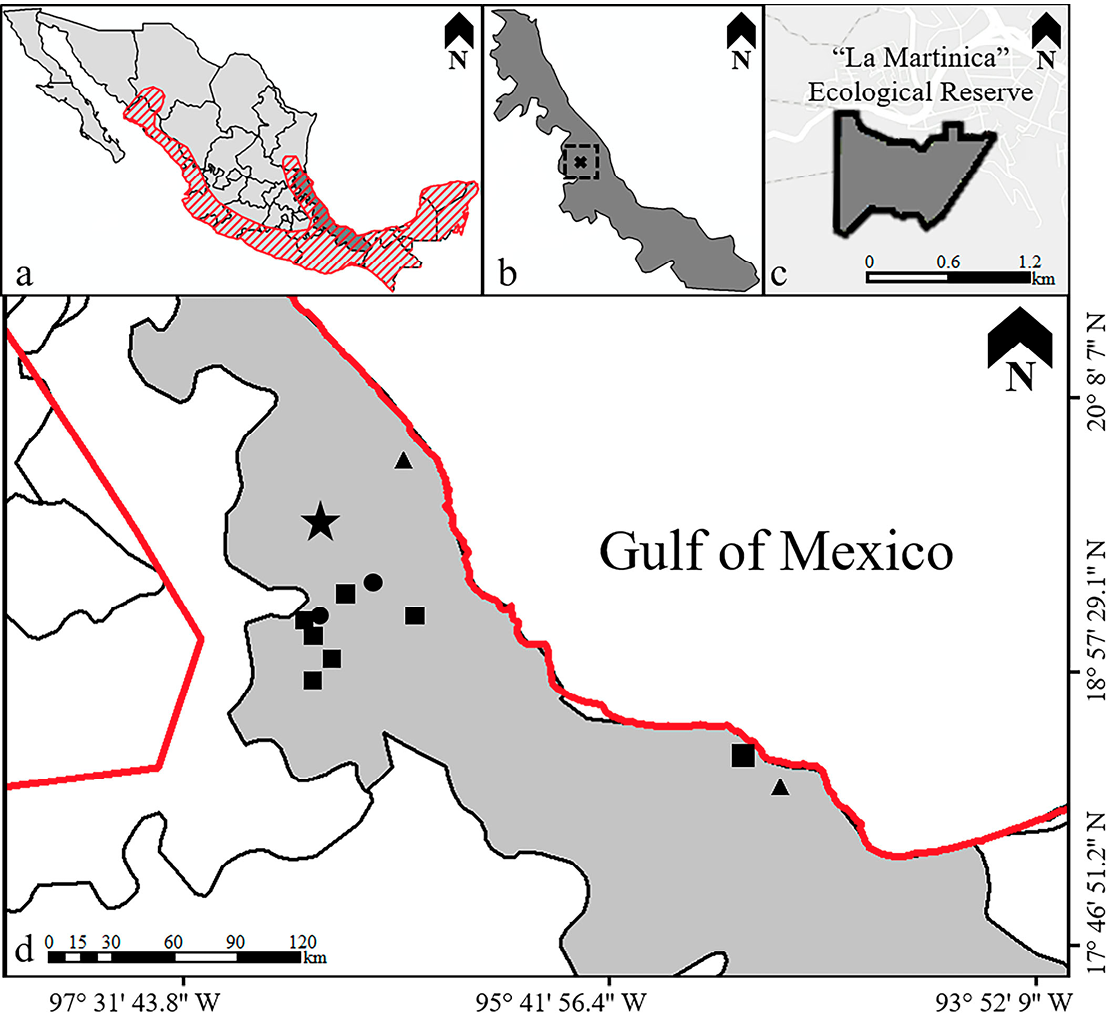
Figure 2. a) Distribution of Leopardus wiedii in México. b) Location of the study area in the state of Veracruz. c) Study area, “La Martinica” Ecological Reserve. d) Distribution of the records of Leopardus wiedii in the state of Veracruz obtained during XXI Century: ▲= Sighting, ● = Road-killed specimen, ★ = Photocapture in “La Martinica”. ■ = Photographic records.
Table 1. Records and sightings of Leopardus wiedii in Veracruz (Mexico) obtained between 2000 and 2023.
|
Record type |
Date |
Locality |
Latitude |
Longitude |
Vegetation |
Reference |
|
Camera-trap |
March 15, 2016 |
San Andrés Tuxtla |
18° 35’ 9’’ N |
95° 7’ 20.1’’ W |
Tropical and Subtropical Moist Broadleaf Forests |
|
|
August 27, 2019 |
Tenampa |
19° 16’ 43.1’’ N |
96° 50’ 25.9’’ W |
|||
|
August 28, 2019 |
Tenampa |
19° 16’ 43’’ N |
96° 50’ 25.9’’ W |
|||
|
December 31, 2020 |
Paso de Ovejas |
19° 11’ 0.3’’ N |
96° 32’ 22.6’’ W |
Tropical and Subtropical Dry Broadleaf Forests |
||
|
February 11, 2022 |
Huatusco |
19° 9’ 41.3’’ N |
97° 0’ 27’’ W |
Tropical and Subtropical Moist Broadleaf Forests |
||
|
February 21, 2022 |
Huatusco |
19° 9’ 41.2’’ N |
97° 0’ 27’’ W |
|||
|
February 21, 2022 |
Huatusco, |
19° 9’ 41.2’’ N |
97° 0’ 27’’ W |
|||
|
February 25, 2022 |
Huatusco |
19° 9’ 41.3’’ N |
97° 0’ 27’’ W |
|||
|
September 10, 2022 |
Huatusco |
19° 6’ 11.5’’ N |
96° 58’ 41.8’’ W |
|||
|
January 02, 2023 |
Banderilla |
19° 35’ 12.4’’ N |
96° 57’ 8.6’’ W |
This research |
||
|
February 14, 2023 |
Huatusco |
19° 9’ 53.7’’ N |
97° 0’ 29.1’’ W |
|||
|
February 15, 2023 |
Huatusco |
19° 9’ 53.7’’ N |
97° 0’ 29.1’’ W |
|||
|
February 18, 2023 |
Huatusco |
19° 9’ 53.7’’ N |
97° 0’ 29.1’’ W |
|||
|
June 03, 2023 |
Cordoba |
18° 54’ 36.2’’ N |
96° 58’ 38.4’’ W |
|||
|
September 27, 2023 |
Cordoba |
18° 59’ 45.3’’ N |
96° 53’ 51.1’’ W |
|||
|
Road-killed specimen |
April 22, 2021 |
Apazapan |
19° 19’ 43.6’’ N |
96° 42’ 57.4’’ W |
Tropical and Subtropical Dry Broadleaf Forests |
|
|
January 11, 2022 |
Sochiapa |
19° 11’ 13.9’’ N |
96° 57’ 13.6’’ W |
Tropical and Subtropical Moist Broadleaf Forests |
||
|
Direct observations |
October 31, 2016 |
Catemaco |
18° 26’ 17.7’’ N |
94° 57’ 44.3’’ W |
Tropical and Subtropical Moist Broadleaf Forests |
|
|
October 31, 2016 |
Ejido Adolfo López Mateos, Catemaco |
18° 26’ 14.4’’ N |
94° 57’ 53.5’’ W |
|||
|
November 28, 2016 |
Vega de Alatorre |
19° 50’ 53.6’’ N |
96° 35’ 5.7’’ W |