THERYA NOTES 2026, Vol. 7:75-80
First record of piebaldism in Corynorhinus townsendii
and mass occurrence of atypical coloration
in cave-dwelling bats in Northern Mexico
Primer registro de piebaldismo en Corynorhinus townsendii y ocurrencia masiva de coloración atípica en murciélagos cavernícolas en el norte de México
Nayelli Rivera-Villanueva1,2,3*, Hiroya Kidoguchi3, and Antonio Guzmán-Velasco1
1Laboratorio de Biología de la Conservación y Desarrollo Sostenible, Facultad de Ciencias Biológicas, Universidad Autónoma de Nuevo León. Pedro de Alba, Ciudad Universitaria, C.P. 66455. San Nicolás de los Garza, Nuevo León, México. E-mail: nayelli.riverav@gmail.com (ANR-V); anguve@gmail.com (AG-V).
2Centre for Biodiversity and Conservation Science, The University of Queensland, Brisbane, Queensland P.C. 4072, Australia.
3School of the Environment, The University of Queensland; Brisbane, Queensland P.C. 4072, Australia. E-mail: h.kidoguchi@student.uq.edu.au (HK).
*Corresponding author
Chromatic disorders are phenotypically aberrant pigmentation in the skin, fur, or other parts of the integumentary system. More research is needed to understand the prevalence, causes, and consequences of atypical coloration in mammals. In bats, chromatic anomalies are reported globally, but regions such as Northern Mexico remain underrepresented or lacking any data altogether. To start exploring the ecology of atypical coloration in bats, we recorded the number of bats presenting atypical coloration and its prevalence by setting mist nets to capture bats. Also, as supplementary information, the number of bats detected in each cave with an infrared video camera was recorded. This study was conducted in two caves: Santa Catarina Cave in Nuevo León and Muzquiz Cave in Coahuila, Mexico. We recorded the prevalence of atypical coloration, sex, reproductive stage, and age of all the captured bats. Here we report high levels of occurrence of atypically colored Tadarida brasiliensis, as well as the first report of piebaldism in Corynorhinus townsendii. The prevalence of atypical coloration as a white collar in T. brasiliensis in Santa Catarina cave ranged from 0% in August 2023 up to 86.46% in May 2024. For the Muzquiz cave, the prevalence of atypical coloration was 0.17% on December 13th-14th, 2024, with one bat. To our knowledge, this is the first study to report a mass occurrence of atypical coloration that incorporates population composition data about atypically patterned bats in Latin America, including an estimation of the number of bats in the caves and prevalence of atypical coloration. We propose that the next steps for studies on atypical coloration in bats should record as much data as possible when these cases are encountered, with at least data about their age, reproductive stage, and behaviour.
Key words: Albinism; chromatic disorder; Coahuila; Molossidae; Nuevo León; piebaldism; Vespertilionidae.
Los trastornos cromáticos son pigmentaciones fenotípicamente aberrantes en la piel, el pelaje u otras partes del sistema tegumentario. Se necesita más investigación para comprender la prevalencia, las causas y las consecuencias de la coloración atípica en mamíferos. En los murciélagos, se han registrado anomalías cromáticas a nivel mundial, pero regiones como el norte de México siguen estando subrepresentadas o carecen de datos en absoluto. Para explorar la ecología de la coloración atípica en murciélagos, registramos el número de murciélagos que la presentan y evaluamos su prevalencia mediante la captura con redes de niebla. Además, como información complementaria, se registró el número de murciélagos detectados en cada cueva con cámara infrarroja. Este estudio se realizó en dos cuevas: la Cueva de Santa Catarina en Nuevo León y la Cueva de Múzquiz en Coahuila, México. Se registró la prevalencia de coloración atípica, el sexo, la etapa reproductiva y la edad de todos los murciélagos capturados. En este estudio se reportan altos niveles de ocurrencia de Tadarida brasiliensis con coloración atípica, así como el primer reporte de piebaldismo en Corynorhinus townsendii. La prevalencia de coloración atípica como collar blanco en T. brasiliensis en la cueva de Santa Catarina varió del 0 % en agosto de 2023 al 86.46 % en mayo de 2024. En la cueva de Múzquiz, la prevalencia de coloración atípica fue del 0.17 % entre el 13 y el 14 de diciembre de 2024, con un solo murciélago. Hasta donde sabemos, este es el primer estudio que reporta una ocurrencia masiva de coloración atípica que incorpora datos de composición de la población sobre murciélagos con patrones de coloración atípicos en Latinoamérica, incluyendo una estimación del número de murciélagos en las cuevas además de la prevalencia de la coloración atípica. Proponemos que los próximos pasos para los estudios sobre coloración atípica en murciélagos deben registrar la mayor cantidad de datos posible cuando se detecten estos casos, incluyendo al menos datos sobre su edad, etapa reproductiva y comportamiento.
Palabras clave: Albinismo; alteración cromática; Coahuila; Molossidae; Nuevo León; piebaldismo; Vespertilionidae.
© 2026 Asociación Mexicana de Mastozoología, www.mastozoologiamexicana.org
DOI: 10.12933/therya_notes-25-235
ISSN 2954-3614
Chromatic disorders are phenotypically aberrant pigmentation in the skin, fur, or other parts of the integumentary system (Uieda 2000; Lucati and López-Baucells 2017). The definitions of the terms regarding chromatic disorders such as Piebaldism, Albinism, and Partial Albinism have been actively debated in the last decade (Zalapa et al. 2016). Here, we follow the terms and definitions by Lucati and López-Baucells 2017 and define Piebaldism as a chromatic disorder wherein the hypopigmentation occurs locally at either one or multiple parts of the body (Lucati and López-Baucells 2017). Generally, hypopigmentation in mammals is considered to have negative repercussions for the affected individuals, including increased susceptibility to certain disorders and conditions, being more conspicuous to predators, disrupted intraspecific interaction, and being rendered as unattractive for reproduction (Garipis & Hoffmann 2003; Caro 2005; Lucati and López-Baucells 2017). Despite the recent advancements in chromatic disorder research, the ecological functions of these conditions in mammals remain a subject of ongoing debate (Lucati and López-Baucells 2017). However, in bats, some authors claim that individuals exhibiting atypical coloration because of chromatic disorders are said to be unaffected by increased risks such as predation as they reach their reproductive maturity (Buys et al. 2002; Bravo-Salinas and Salas 2022). Notably, numerous reports document chromatic disorders in bats, with evidence confirming that affected individuals successfully mate and reproduce, including observations of pregnancy and lactation (Hernández-Mijangos et al. 2009; Marín-Vásquez et al. 2010; Sánchez-Hernández et al. 2010; García-Morales et al. 2012; López-Wilchis and León 2012; Zalapa et al. 2016; Biassi et al. 2017; Genelhú et al. 2022).
In bats, chromatic anomalies are reported globally (Lucati and López-Baucells 2017), and recent studies in Mexico have focused on examples of hypopigmentation such as albinism and piebaldism (Aguilar-López et al. 2021; Hernández-Aguilar et al. 2025). However, as visually shown in Lucati and López-Baucells (2017), the records of these anomalous colorations are geographically biased, with many regions remaining underrepresented or lacking any data altogether, such as Northern Mexico (Lucati and López-Baucells 2017). For instance, Northern Mexico is a notable region for research on bats, as karst formations are abundant, which provide crucial subterranean habitats such as caves (Elliot et al. 2023). Despite the ecological, cultural, and economic importance of cave-dwelling bats in Northern Mexico, bat surveys are limited, and more research effort is needed (Rivera-Villanueva et al. 2025).
To improve our baseline knowledge for the conservation of cave-dwelling bats in Northern Mexico, we have been monitoring several roosts to gather data about their richness, abundance, and population trends in Coahuila and Nuevo León states since 2019 to date. As an example of the lack of previous research efforts, we present the first report of piebaldism in Corynorhinus townsendii (Cooper 1837) and the first mass occurrence of atypical coloration of Tadarida brasiliensis (I. Geoffroy 1824), with 543 captured individuals exhibiting a white collar-like pattern. Plus, as a supplementary way to understand how many bats were in each cave, we did an infrared video camera recording.
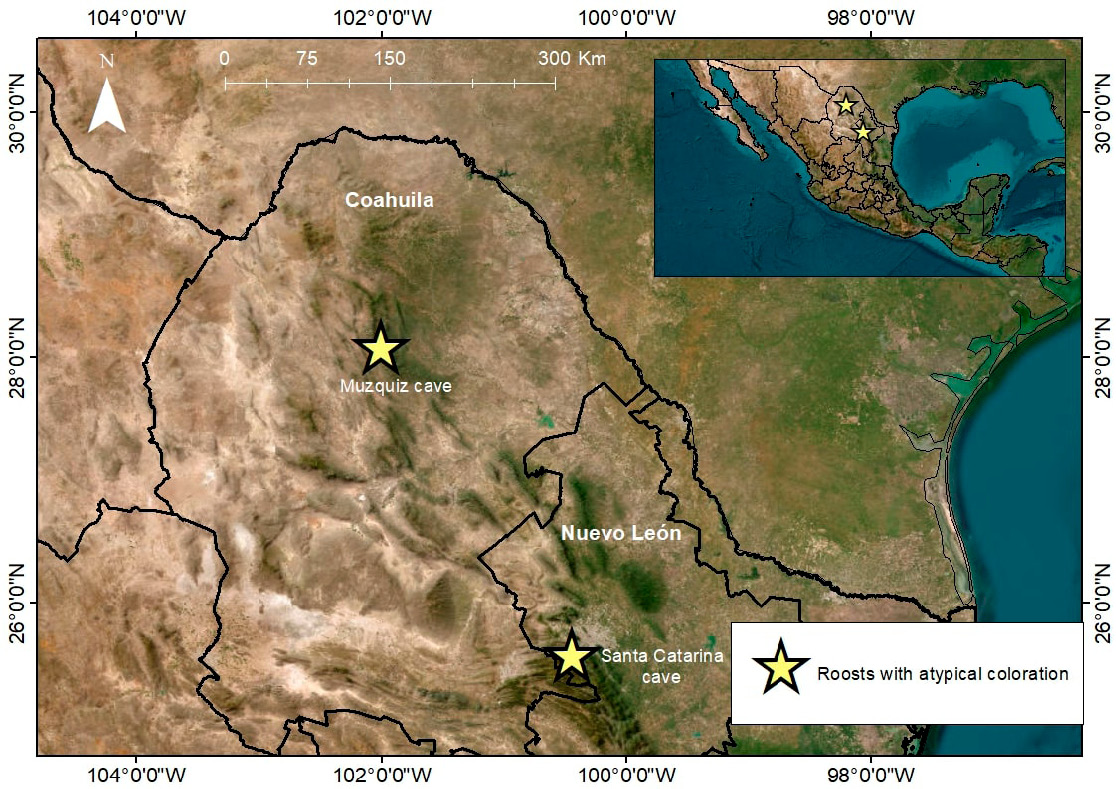
Our study sites were two caves in the Sierra Madre Oriental Mountain range in the municipalities of Muzquiz, Coahuila (28° 0’ 0” N, 103° 9’ 7.2” W) with 1,089 m, and Santa Catarina, Nuevo León states (26° 18’ 0” N, 101° 26’ 50.7084” W) with 1,128 m (Figure 1). The main vegetation type surrounding the cave in Coahuila is chaparral and submontane scrub in Nuevo León, Instituto Nacional de Estadística y Geografía (INEGI 2015). The main vegetation elements surrounding Santa Catarina cave are Helietta parvifolia, Ungnadia speciosa, and Celtis pallida. The main vegetation elements surrounding Muzquiz cave are Leucaena greggii, Quercus sp., and Mentzelia aspera. The site of the Muzquiz cave is characterized by a “BSohw” climate, semi-arid with a temperature between 18°C and 22°C, and Santa Catarina cave with a “BS1hw” climate, semi-arid with a mean annual temperature greater than 18°C, according to Köppen’s climate classification (García 1998). For the Santa Catarina cave, the fieldwork for this project was conducted on August 12th, 2023; September 15th, 2023; November 1st, 2023, and May 14th, 2024. For Muzquiz Cave, the fieldwork was conducted on December 13-14, 2024.
The aberrantly colored individuals were captured using two 6-meter mist nets and one 12-meter mist net in Santa Catarina Cave, and two 6-meter mist nets in Muzquiz Cave. The sampling effort for Santa Catarina cave was 1,224 net-hours, and for Muzquiz cave was 90 net-hours. We recorded the prevalence of atypical coloration, sex, reproductive stage, and age of all the captured bats. Prevalence was defined as the number of bats that presented the white collar divided by the number of bats captured. The bats were identified using the bat field guide of Medellín et al. (2008).
To obtain the supplementary count of bats in flight, a Sony HXR-NX30N video camera with infrared vision, along with a set of battery-powered lamps, was positioned 3 meters from the entrance of each cave. Afterwards, it was positioned to have a complete view of the floor and roof. The filming coverage was during the first three hours of activity, coinciding with mist-netting efforts. We started the recording 5-15 minutes before sunset to make sure that the emergence was recorded. The number of bats recorded by the video was manually counted later in Windows Media Player frame by frame. To minimize counting errors, we followed a modified Ammerman et al. (2025) approach. To avoid counting more than once each individual, we counted the number of bats that entered the screen view (considered an entrance to the roost) and the number of individuals that left the screen view (considered as an exit of the roost), but here, it was only considered the number of exits as the number of bats per cave. In both caves, all bats were assumed to be T. brasiliensis, although their size and shape were not distinguishable from other species. That is why we used the mist netting data as a cross-validation technique. Muzquiz cave is used mainly by T. brasiliensis, as has been confirmed by mist-netting we have recorded during the fieldwork of this article, with Mormoops megalophylla only present in small numbers in the winter season. For the Santa Catarina cave, T. brasiliensis is the most abundant species and has an estimated colony larger than 100,000 individuals, whereas C. townsendii has been captured only 5 times now of writing the article (Jimenez et al. 1999). To reduce stress and ensure that bats were handled ethically, we followed the guidelines of Sikes et al. (2016). All collection and handling of wildlife in this study followed the requirements of the General Wildlife Federal Law of Mexico (Ley General de Vida Silvestre) under collection permit SPARN/DGVS/09981/23. No bats were included as collection vouchers.
The prevalence of atypical coloration as a white collar in both males and females of T. brasiliensis in Santa Catarina cave ranged from 0% in August 2023 up to 86.46% (prevalence of 0.865) in May 2024 (Table 1; Figure 2). The peak of captures was in May 2024 with a total of 628 individuals of T. brasiliensis: 415 non-reproductive males, 210 non-reproductive females, and 3 pregnant females, all adults. Whereas the lowest number of captures was in August 2023 (Table 1). Due to technical difficulties, the number of bats detected with the infrared video camera was recorded only once per site.
In May 2024, in the Santa Catarina cave, a post-lactating female of C. townsendii with piebaldism in both wings was incidentally captured (Figure 2d). The forearm was measured with a caliper to be 42 mm, and weighed 10 g. The piebaldism expressed in this individual as marbled patches of depigmentation on the membrane of the wings between the 5th and the 2nd metacarpal.
For the Muzquiz cave, the prevalence of atypical colora-tion was only on December 13th-14th 2024, with one bat (0.17%) presenting the atypical coloration, with a prevalence of 0.0016. The estimation of bats recorded with the infrared video camera during the emergence goes from 324 in Santa Catarina cave to 6,584 bats in Muzquiz cave (Table 2).
In T. brasiliensis, the atypical patterning was uniform across the surveys; a band of distinct, white-colored fur at the ventral side of the neck (Figure 2a and c). Some of the individuals, however, only exhibited random spots of white fur (Figure 2b).
It is crucial to note that we do not aim to determine the cause and/or the function of aberrant coloration herein, but we aim to report the unusual events that were observed in an underrepresented area that may be of scientific interest. To our knowledge, this is the first study to report a mass occurrence of atypical coloration that incorporates population composition data about atypically patterned bats in Latin America, including an estimation of bats detected in the caves and the prevalence of atypical coloration. As there is no official definition of mass occurrence of atypical coloration, in our case, we use it when more than 50% of the captured bats present any chromatic disorder.
This interesting phenotypic aberrancy may be due to several factors, such as genetic and environmental influences, or a combination of these factors (Lucati and López-Baucells 2017). Moreover, more research is needed to understand the cause of the mass occurrence of this atypical patterning, as it was not clear from the efforts of this study, and all potential explanations are a matter of speculation. But we can note that our records of atypical colouration are higher than the ones presented in Hernández-Aguilar et al. (2025). Their highest report was in Natalus mexicanus, with 30% of piebaldism individuals. But in our case, our biggest record was on May 14th, 2024, where we recorded 543 of 628 (86.46%) individuals with piebaldism (Hernández-Aguilar et al. 2025).
However, interestingly, most aberrantly colored individuals are recorded in sheltered places such as mines and caves, which some authors link to mitigation of the negative effects of hypopigmentation by the visual obstruction provided by the darkness in these structures (Uieda 2000; Lucati and López-Baucells 2017; Rose et al. 2017). Albeit tree-roosting bats are also known to sometimes show chromatic disorders (Rose et al. 2017; Smith et al. 2019). Furthermore, bats’ nocturnal flight behavior renders them hidden from aerial predators that mostly rely on visual cues, thus atypical coloration potentially does not affect their survival (Lucati and López-Baucells 2017). As a result, chromatically aberrant individuals may successfully reproduce, generationally increasing their numbers (Lucati and López-Baucells 2017). Although the debate on the detrimental effect of hypopigmentation on bats’ survival remains inconclusive (López-Baucells et al. 2013), the presence of reproductively active individuals (e.g., scrotal testes observed in male T. brasiliensis and the piebald C. townsendii was in the post-lactating stage) raises questions regarding the extent to which these atypical coloration and patterning affect longevity and reproductive success in bats as reported (Marín-Vásquez et al. 2010).
As methodological clarifications, it should be noted that there were no additional measures to minimize miscounting when processing the video recordings. Furthermore, all detections from the video recording of the emergence were assumed as T. brasiliensis, as they are by far the most abundant species in the caves studied; although Muzquiz cave has recorded Mormoops megalophylla and Santa Catarina cave has six additional species, they are known to occur in much lower numbers (López-González et al. 2010). To highlight the effects of these methodological limitations of recording the emergence of T. brasiliensis in a cave with an entrance 16 meters wide, there were instances where the number of bats captured in mist nets exceeded the number detected by the infrared camera.
Lastly, we would like to emphasize that it is impossible to have a complete understanding of bats’ ecology or population dynamics without appropriate protection and conservation efforts for their roosts. These two roosts face many threats, such as disturbance, vandalism, and guano harvesting (Figure 3c-e), and do not have any conservation scheme. Moreover, subterranean habitats such as caves are priority targets for the conservation of bats, especially in Mexico, where almost half of the native bat species are cave-dwelling species (Frick et al. 2020).
Acknowledgements
We thank Fundación SimiPlaneta for funding the project “Rescatando a los murciélagos y sus cuevas”. Hábitats Resilientes A.C. for their support and the facilities to work in the field with bats and caves. This paper is dedicated to the memory of our friend H. Rodríguez Vela, who inspired us to pursue careers with bats and caves. He was a burst of light. We want to thank R. Quirino, T. Carrizales, O. Sol, and H. Gallardo who assisted in all fieldwork. We also thank the two anonymous reviewers who helped improve earlier versions of this note.
Literature Cited
Aguilar-López, M., et al. 2021. Noteworthy records of abnormal coloration in Mexican bats. Therya Notes 2:112-116.
Ammerman, L. K., et al. 2025. Long-term monitoring of Endangered Mexican long-nosed bats (Leptonycteris nivalis) and a test of an automated census approach. Journal of North American Bat Research 1: 11-29.
Bravo-Salinas, R., and Salas, J. A. 2022. Registro de desorden cromático en Trachops cirrhosus (Spix, 1823) (Chiroptera: Phyllostomidae) en la Amazonia del Ecuador. Revista Peruana de Biología 29: e23598.
Biassi, D. L., Neres, A. P., and D’Agostini, F. M. 2017. Registro de leucismo em Sturnira lilium (E. Geoffroy, 1810) (Chiroptera: Mammalia) no Sul do Brasil. Revista Brasileira de Biociências 15: 96-98.
Buys, J., Heijligers, H., and Dorenbosch, M. 2002. First record of an albino long-eared bat Plecotus auritus in The Netherlands. Lutra 44: 49-52.
Caro, T. 2005. The adaptive significance of coloration in mammals. BioScience 55: 125.
Elliott, W. R., et al. 2023. Human impacts on Mexican caves. Pp 377-414 in Mexican fauna in the anthropocene (Jones, R.W., Ornelas-García, C. P., Pineda-López, R., F Álvarez eds.) Springer. Cham, Switzerland.
Frick, W. F., Kingston, T., and Flanders, J. 2020. A review of the major threats and challenges to global bat conservation. Annals of the New York Academy of Sciences 1469: 5-25.
García, E. 1998. Comisión Nacional para el Conocimiento y Uso de la Biodiversidad (CONABIO). ‘Climas’ (clasificación de Koppen, modificado por García). Escala 1:1000000. México.
García-Morales, R., et al. 2012. Registro de leucismo en Sturnira ludovici y Artibeus jamaicensis (Phyllostomidae) en México. Chiroptera Neotropical 18: 1101-1105.
Garipis, N., And Hoffmann, K. P. 2003. Visual field defects in albino ferrets (Mustela putorius furo). Vision research 43: 793-800.
Genelhú, S. M., et al. 2022. First report of albinism in a lactating female of the chestnut long-tongued bat Lionycteris spurrelli Thomas, 1913 (Chiroptera, Phyllostomidae). Mammalia 86: 257-260.
Hernández-Mijangos, L. A., Horváth, A., and Canales, R. P. 2009. Observations on female bats transporting non-volant juveniles during flight. Chiroptera Neotropical 15: 472-476.
Hernández-Aguilar, I., Lorenzo, C., and Santos-Moreno, A. 2025. Pigmentation anomalies and lesions in bats from Oaxaca, Mexico. Mammalia 89: 81-89.
Instituto Nacional De Estadística y Geografía (INEGI). 2015. Guía para la interpretación de cartografía. Uso del suelo y vegetación Escala 1:250 000 Serie V.
Jimenez A., zuñiga-Ramos M. A., niño-Ramirez. 1999. Mamíferos de Nuevo León. Universidad Autónoma de Nuevo León. San Nicolas de los Garza, Mexico.
López-Baucells, A. et al. 2013. Hypopigmentation in vespertilionid bats: The first record of a leucistic soprano pipistrelle Pipistrellus pygmaeus. Barbastella 6: 64-70.
Lopéz-González, C., Rascón, J., and Hernández-Velázquez, D. F. 2010. Population structure of migratory Mexican free-tailed bats Tadarida brasiliensis mexicana (Chiroptera) in a Chihuahuan Desert roost. Chiroptera Neotropical 16: 557-566.
Lopez-Wilchis, R., and León, M. A. 2012. A noteworthy case of leucism in Artibeus lituratus (Chiroptera: Phyllostomidae) from Oaxaca, Mexico. Chiroptera Neotropical 18: 1111-1114.
Lucati, F., and López-Baucells, A. 2017. Chromatic disorders in bats: a review of pigmentation anomalies and the misuse of terms to describe them. Mammal Review 47:112-123.
Marín-Vásquez, A., Ortega-Rincón, M., and Ramírez-Chaves, H.E. 2010. Records of leucism in three species of Colombian bats: Carollia brevicauda, Artibeus jamaicensis and Lophostoma silvicolum (Phyllostomidae). Chiroptera Neotropical 16: 706-709.
Medellín, R. A., H. T. Arita, and O. Sánchez. 2008. Identificación de los murciélagos de México: clave de campo, Segunda edición. Consejo Nacional de Ciencia y Tecnología, Instituto de Ecología, UNAM. Mexico City, México.
Rivera-Villanueva, a. n., et al. 2025. White-nose syndrome: An emerging disease and a potential threat to Mexican bats. Biología y Sociedad 8: 1-12.
Rose, A., et al. 2017. New records of hypopigmentation in two neotropical phyllostomid bat species with different roosting habits (Uroderma bilobatum, Glossophaga soricina). Mammalia 81: 615-619.
Sánchez-Hernández, C., et al. 2010. Five albino bats from Guerrero and Colima, Mexico. Chiroptera Neotropical 16: 522-527.
Sikes, R. S. 2016. 2016 guidelines of the American Society of mammalogists for the use of wild mammals in research and education. Journal of Mammalogy 97: 663-688.
Smith, L. M., et al. 2019. High incidence of Hypopigmented marks in the endangered Florida bonneted bat. Journal of Fish and Wildlife Management 10: 410-418.
Zalapa, S. S., et al. 2016. Coloración atípica en murciélagos: frecuencia y fenotipos en Norte y Centroamérica e islas del Caribe y nuevos casos para México y Costa Rica. Revista Mexicana de Biodiversidad 87: 474-482.
Uieda W. 2000. A review of complete albinism in bats with five new cases from Brazil. Acta Chiropterologica 2: 97-105.
Associate editor: Romeo A. Saldaña Vázquez
Submitted: March 03, 2025; Reviewed: September 09, 2025
Accepted: September 25, 2025
Published on line: April 28, 2026
Figure 1. Map of the roosts with mass atypical coloration of cave-dwelling bats.
Table 1. Prevalence of atypical coloration of Tadarida brasiliensis and its captures per site. In parenthesis is the number of bats with the white-collar.
|
Roost name |
Date |
Prevalence |
Captures |
|
Santa Catarina cave |
August 12th, 2023 |
0.0 |
14 |
|
September 15th, 2023 |
0.0172 (1) |
58 |
|
|
November 1st, 2023 |
0.0 |
35 |
|
|
May 14th, 2024 |
0.865 (543) |
628 |
|
|
Muzquiz cave |
December 13-14th, 2024 |
0.0016 (1) |
600 |
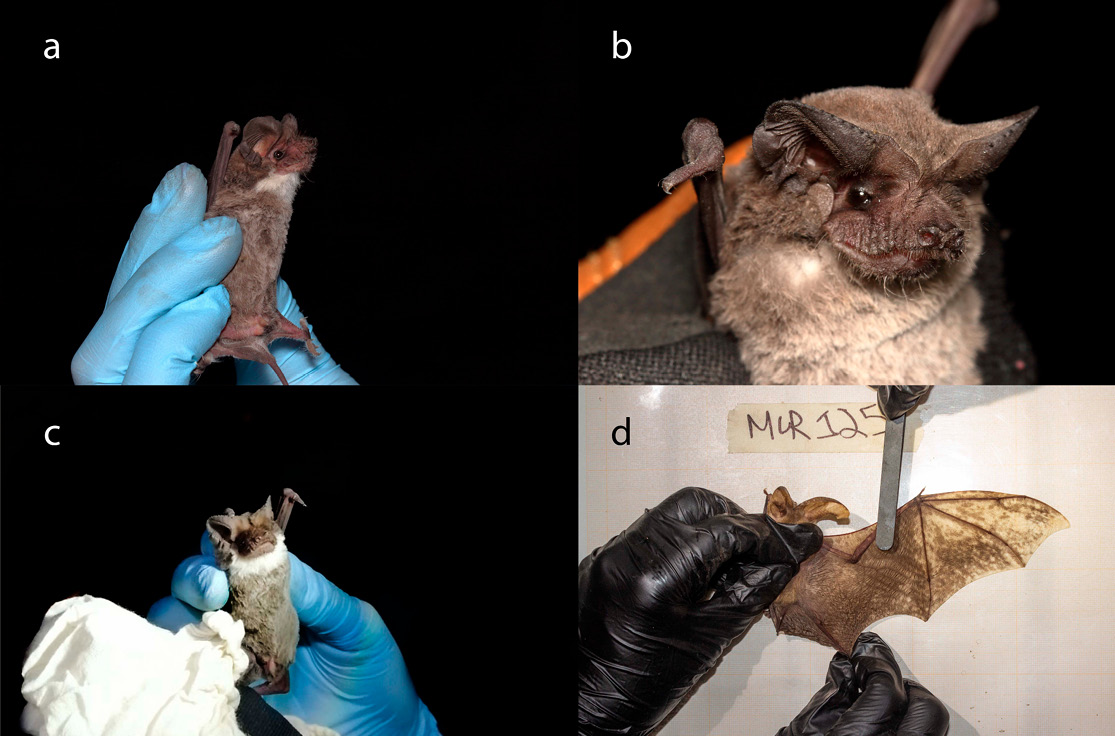
Figure 2. The captured bats with atypical colouration; a-c Tadarida brasiliensis exhibiting atypical colouration; d Piebald post-lactating female Corynorhinus townsendii.
Table 2. Number of bats detected with the infrared video camera. We considered entrances when we saw a bat flying towards the entrance of the main chamber and fully going inside and exit when we saw the bat going out of the field view and not coming back. Only the exits were considered as the colony size.
|
Roost name |
Date |
Entrances |
Exits |
|
Santa Catarina cave |
November 1st, 2023 |
282 |
324 |
|
Muzquiz cave |
December 13-14th, 2024 |
10,013 |
6,584 |
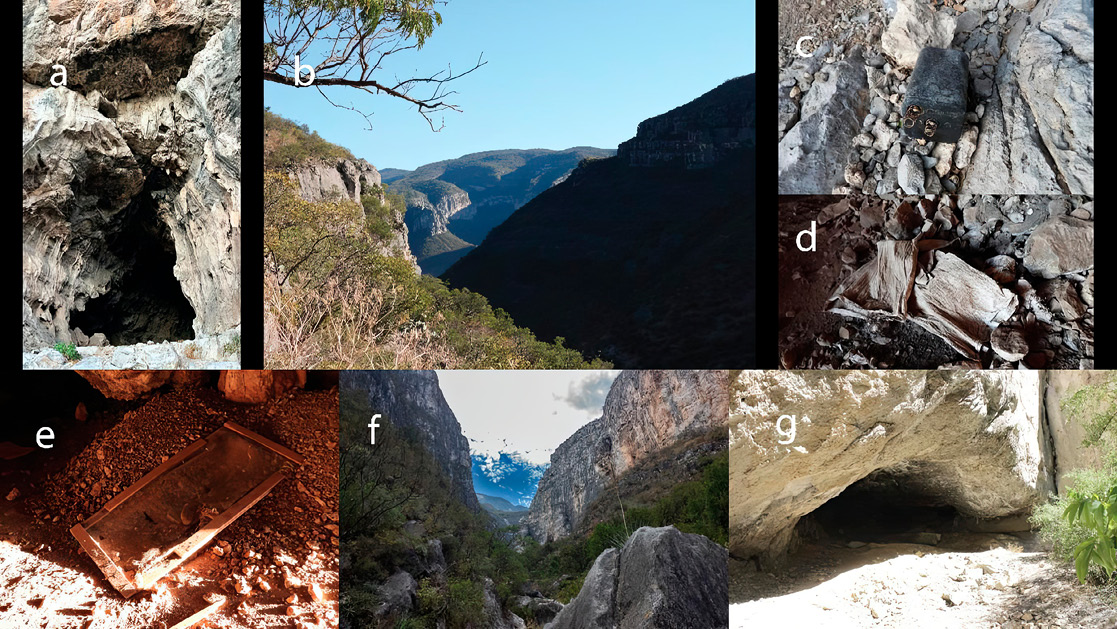
Figure 3. The Study sites and their surrounding habitats, a Muzquiz cave entrance; b Muzquiz cave surrounding habitat; c-d Abandoned waste at the cave; e Guano filtering equipment left by harvesters; f Santa Catarina surrounding habitat; g Santa Catarina cave entrance.