THERYA NOTES 2026, Vol. 7: 96-101
The Jaguarundi (Herpailurus yagouaroundi)
in Sonora, Northwestern México
El jaguarundi (Herpailurus yagouaroundi)
en Sonora, noroeste de México
Juan Pablo Gallo-Reynoso1*, Eric Hough2, Alfonso Gardea-Béjar1, Isai David Barba-Acuña1, Axhel Muñoz3,
Samuel Macías-Sánchez1, Antonio Orozco-Avitia1, Gerardo Carreón-Arroyo4, David MacKay5, and Saúl Amador-Alcalá4
1Centro de Investigación en Alimentación y Desarrollo, A. C. Unidad Guaymas. Carretera al Varadero Nacional km 6.6, Col. Las Playitas, C.P. 85480, Guaymas, Sonora, México. E-mail: jpgallo@ciad.mx (JPG-R); gardea@ciad.mx (AG-B); isai.barba@ciad.mx (IDB-A); macsanch@yahoo.com (SM-S); avitia65@ciad.mx (AO-A).
2Maricopa County Parks & Recreation Dept. N. U.S. Hwy. 60/89 48240 Morristown, AZ 85342. U.S.A. E-mail: thebirdwhisperer22@yahoo.com
3Sky Island Alliance. 3127 N Cherry Ave, Tucson, AZ 85719. E-mail: axhelbachata@gmail.com
4Naturalia, A. C. El Cajón No.9 Col. Santa Fe, C.P. 83249, Hermosillo, Sonora, México. E-mail: conservacion@naturalia.org.mx (G C-A); saul_alcala@naturalia.org.mx (SA-A).
5David Mackay E-mail: dmac@solipaso.com
*Corresponding author
Regionally called “onza” in Sonora, Herpailurus yagouaroundi, is listed as threatened under Mexican law NOM-059-ECOL-2010. Until now, there were no verified records of their occurrence in Sonora. Records were obtained opportunistically while monitoring other species or by direct observation of these felines while crossing highways in Sonora. Six jaguarundi records were confirmed in different areas of Sonora; some were found along vegetation of subdeciduous tropical forests with some columnar cacti and xeric scrub; others with a combination of subdeciduous tropical forest with oak forests in higher elevations. A skull and postcranial vertebrae were found, photographed, and identified (due to a lack of permits, the specimen was not collected). Also, a live individual was captured and videotaped on a ranch. These two records were obtained in the Área de Protección de Flora y Fauna Sierra de Álamos y Río Cuchujaqui, in Álamos, Sonora. Although strong efforts to obtain fauna records with camera traps in several areas of Sonora have been made in the past ten years, they have been unsuccessful in obtaining records of jaguarundi. However, jaguarundis have been confirmed in subdeciduous tropical forests across several vegetation communities.
Keywords: jaguarundi skull; subdeciduous tropical forests; southern Sonora; APFF Sierra de Álamos y Río Cuchujaqui.
Llamado regionalmente “onza” en Sonora, Herpailurus yagouaroundi se encuentra listado como especie amenazada en la Norma Oficial Mexicana NOM-059-ECOL-2010. Hasta ahora no había registros verificados de la presencia de la especie en Sonora. Se obtuvieron registros oportunistas durante el monitoreo de otras especies o mediante la observación directa de ejemplares de la especie al cruzar carreteras en Sonora. Se confirmaron seis registros en diferentes áreas, con vegetación de bosque tropical subcaducifolio, cactáceas columnares y matorral xerófilo, y en combinación con bosque de encino en las partes altas. Se encontraron, fotografiaron e identificaron un cráneo y vértebras posterocraniales (no se colectó el espécimen por falta del permiso correspondiente). También se obtuvo la filmación de un individuo capturado. Ambos en el Área de Protección de Flora y Fauna Sierra de Álamos y Río Cuchujaqui, en Álamos, Sonora. A pesar de los esfuerzos considerables realizados para obtener registros de la fauna mediante cámaras trampa en varias localidades de Sonora, estos han resultado infructuosos para registrar jaguarundis. Se confirma la presencia del jaguarundi tanto en el bosque tropical subcaducifolio como en otras combinaciones de comunidades de vegetación.
Palabras clave: Cráneo de jaguarundi; Bosque tropical subcaducifolio; Sur de Sonora; APFF Sierra de Álamos y Río Cuchujaqui.
© 2026 Asociación Mexicana de Mastozoología, www.mastozoologiamexicana.org
Jaguarundis (Herpailurus yagouaroundi) have a broad distribution in neotropical Mexico. This species is possibly the least studied feline in Mexico (Giordano 2016; Coronado-Quibrera et al. 2019). Regionally known as “onza” in Sonora, this feline is listed as threatened under Mexican law (NOM-059-ECOL-2010). At the same time, the IUCN Red List regards it as a species of “least concern”, due to its broad distribution in Latin America. However, it acknowledges that habitat loss is the cause of declining populations in some areas of their current distribution (Caso et al. 2015). We use the scientific name, Herpailurus yagouaroundi, as recommended by the IUCN. The subspecies in Sonora correspond to H. y. tolteca Thomas (1898) with type locality as Tatemales, Sinaloa.
Jaguarundis inhabit areas with a wide range of vegetation communities, including tropical evergreen forests, deciduous and sub-deciduous tropical forests, mangrove swamps, mountain mesophilic forests, xeric scrubs, and (occasionally) pine-oak forests (Aranda 2005). Leopold (1959) inferred its presence in the meadows and mountains west of the Sierra Madre Occidental in Sonora, based on records from southern Arizona by Hall and Kelson (1959). There are two old records from Sinaloa: Thomas (1898) in Tatemales, Allen (1906) near Escuinapa, and Armstrong et al. (1972) 15 mi NE of Choix; this is the closest one to the state line with Sonora. There is an anonymous record of a jaguarundi observed in the region of Alamos, Sonora, in 1982; however, no exact location was provided, nor was the observation confirmed by a specialist (Girmendonk 1994). Little (1938) reported an unconfirmed sighting near Canelo, in southern Arizona, that was never confirmed (Girmendonk 1994).
From March 1938 to March 1994, the Arizona Game and Fish Department reported 35 records of jaguarundis in Arizona, and likely two more in Sonora. Of these records, only 19 were deemed valid, but none were confirmed by photographs, osteological remains, skeletons, pelts, or by a feline specialist (Girmendonk 1994). Out of these 19 records, two were from Sonora; the first was of pups raised in captivity, which were (reportedly) captured in northern Sonora in early 1960 (Girmendonk 1994); however, Brown and López-González (1999) argued that the capture occurred in the State of Nayarit, south of Sinaloa. The second record is from Álamos in southern Sonora, based on a direct observation in 1982, which was not confirmed by a specialist (Girmendonk 1994). Other recent reports (until August 2017) are from central Sinaloa, including images of several individuals (in different color phases) captured on camera traps at Rancho Las Palomas, near the Meseta de Cacaxtla Flora and Fauna Protected Area (E. Lizárraga, pers. comm. 2016). Brown and López-González (1999) concluded that observations of jaguarundis in Arizona and Sonora were mistaken, or the specimens were wrongly identified; they argued that if jaguarundis exist in those states (Arizona and Sonora), they would occur in southernmost Sonora, the only region supporting the type of preferred habitat, which consists of subtropical deciduous forest (Aranda 2005). However, we present six records for the species in the State of Sonora across various habitats.
Records of jaguarundis were obtained through opportunistic sightings during faunal monitoring walks in the study areas. Additional records were collected along paved and dirt roads. Video and photographic evidence were obtained from biologists and conservationists visiting southern Sonora. Individuals observed were checked against published accounts of jaguarundis to confirm the species’ presence (Leopold 1959; Aranda 1981, 2005).
Substantial efforts to obtain faunal records with camera traps were conducted in several areas of Sonora: in the foothills of the Sierra Madre Occidental, municipality of Huachinera (30° 07’ 32.15” N, 109° 01’ 39.28” W, elevation 1196 m, 20 camera traps were placed during ten years (2015-2025) in riparian habitats and in areas with vegetation characterized by pine and oak forests at higher elevations, along with thornscrub and submontane areas dominated by juniper and oak. Near Nácori Chico (29° 28’ 56.54” N, 109° 07’ 39.79” W, elevation 650 m), another 20 camera traps were placed during seven years (2018-2024) on areas with a vegetation community corresponding to sub-deciduous tropical forest and xeric scrub. Also, at the Northern Jaguar Reserve (29° 29’ 22.34” N, 109° 11’ 49.50” W, elevation 594 m), 30 cameras were placed on the same vegetation community, together with oak forest, xeric scrub, and riparian vegetation for 15 years (2004-2019) (Amador-Alcalá et al. 2022; Amador-Alcalá et al. 2024). Sierra de Álamos at two different places, the first site (26° 56’ 42.74” N, 108° 41’ 39.97” W, elevation of 486 m) with a sub-deciduous tropical forest and the second site (27° 06’ 48.24” N, 108° 42’ 24.70” W, elevation 1,389 m), covered with an oak and pine forests. An average of 48 cameras were installed on both sites over 10 years (2015-2025).
Searching for records of the species in Sonora, and adjacent states: Sinaloa and Chihuahua in México; and Arizona in the United States, the Global Biodiversity Information Facility (GBIF) was accessed on 21 January 2026. GBIF jaguarundi occurrences were downloaded for northern Sinaloa. Although no records were found for Sonora and Chihuahua, neither from Arizona https://doi.org/10.15468/dl.cdhhwy.
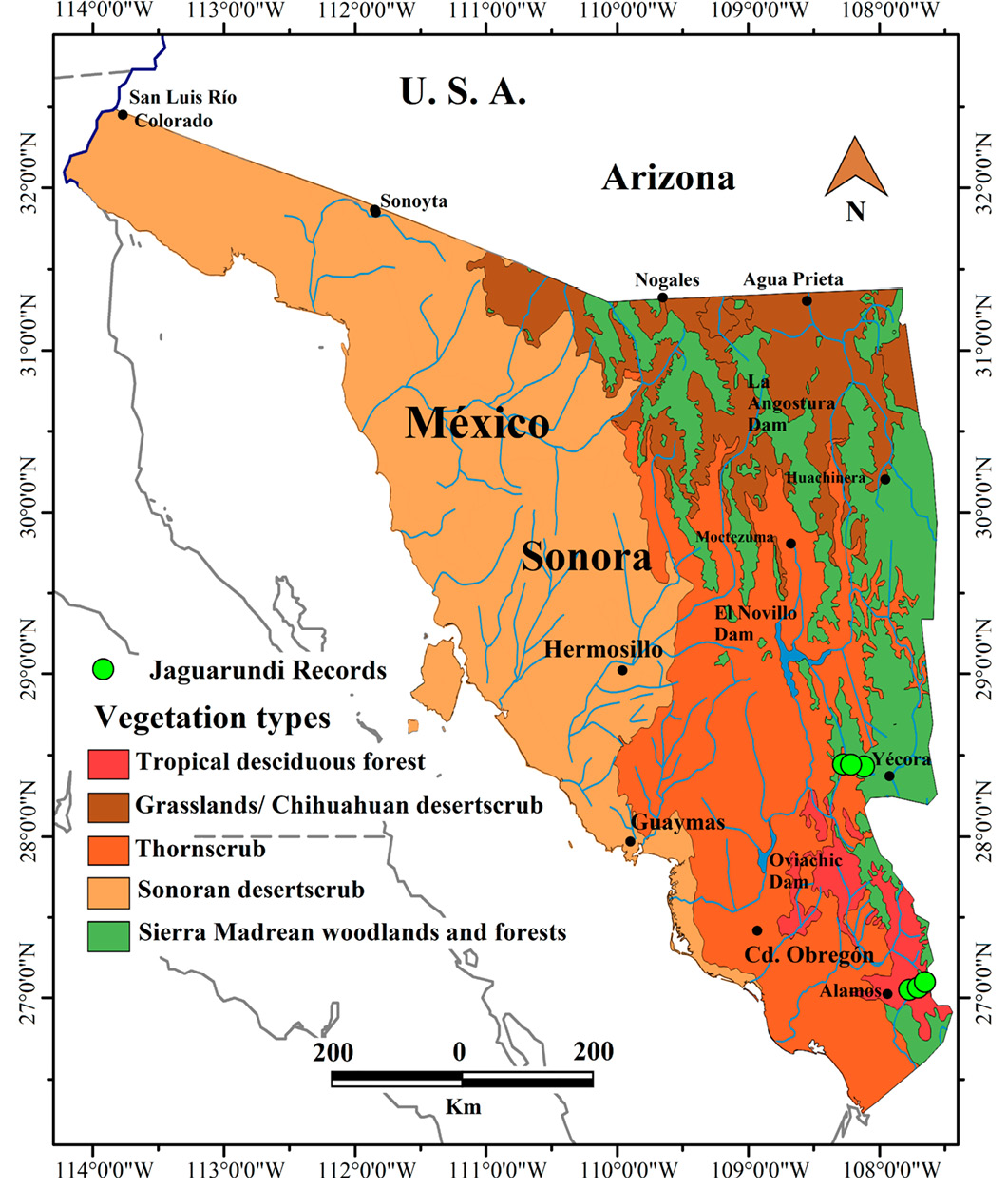
Record 1. On April 27, 2005, at 17:30 hr, one of us (J. P. G-R) and colleagues observed a jaguarundi crossing a dirt road in the surroundings of the Río Cuchujaqui, near Rancho Palo Injerto, within the Sierra de Álamos/Río Cuchujaqui Flora and Fauna Protected Area in southern Sonora (27° 00’ 44.96” N, 108° 45’ 40.37” W, elevation of 476 m). The habitat in the location is a subdeciduous tropical forest with some columnar cacti and xeric scrub. The individual had scent-marked a tree adjacent to the road, and its tracks were also observed.
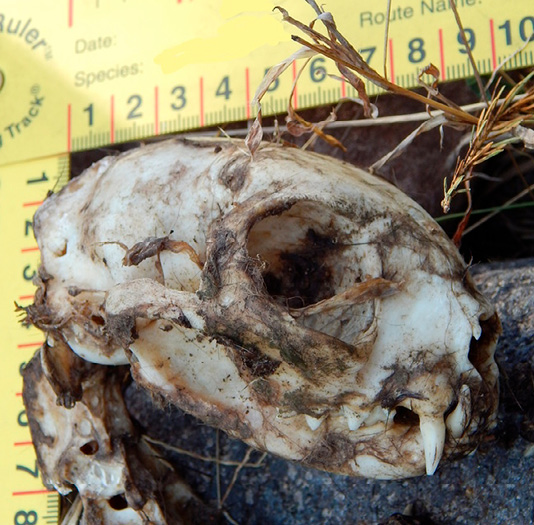
Record 2. On December 16, 2013, the skeletal remains of an onza (skull and some postcranial vertebrae) were found along the riverbed of Río Cuchujaqui by E. Hough and A. Muñoz, coauthors of this note (approximate location: 27° 03’ 24.77” N, 108° 41’ 33.33” W, elevation 496 masl), the skull was identified using mammal guides (Leopold 1959; Aranda 1981) and confirmed by a feline expert (M. Aranda). The skull and post-skeletal remains present tooth marks from either a predator that killed it or a scavenger that ate the remains after the feline died. The habitat at this location is a subdeciduous tropical forest, with a nearby semi-evergreen tropical canyon featuring sabinos (Taxodium mucronatum). This appears to be the first record of actual remains of the species found in Sonora (Figure 1).
Record 3. On September 16, 2018, at 11:20 hr, while descending the western flank of the Sierra Madre Occidental on Federal Highway 16 (which connects Yécora to Hermosillo) and after passing a junction that leads to Sahuaripa (28° 25’ 46.65” N, 109° 09’ 27.50” W, elevation 764 m), two jaguarundis were observed by us (J. P. G-R., S. M-S. and I. D. B-A.): a reddish-colored, mature (presumed) female accompanied by a grayish cub. Both felines were on the highway pavement, foraging on grasshoppers (Brachystola magna), which are locally abundant during the rainy season. The area is an ecotone between a sub-deciduous tropical forest and an oak forest.
Record 4. On October 14, 2018, at 14:00 hr, also descending the Sierra Madre on Federal Highway 16 and after leaving Tepoca en route to Hermosillo, we (A. G-B. and A. O-A.) observed an adult, grey-colored jaguarundi crossing the highway (28° 26’ 33.99” N, 109° 15’ 24.32” W, elevation 631 masl). The sighting occurred on a straight section of the road, in an area of shallow valleys and western-facing foothill slopes covered with sub-deciduous tropical forest, with patches of xeric scrub.
Record 5. In 2020, D. Mackay (pers. comm. to E. H. 2020), who lives in Álamos, shared a video of a live gray jaguarundi caught in a foot trap. The rancher who trapped the individual was interviewed and stated that the feline was caught to protect his chickens and other livestock. The fate of the feline is unknown, as well as the exact locality. This is the only known video of a live jaguarundi from Sonora (Figure 2).
Record 6. On July 28, 2023, in the evening hours, near the same section of Federal Highway 16 as in Record 4, a dark-colored, slender-bodied, long-tailed, and small-headed feline was briefly observed by one of us, A. O-A., at (28° 26’ 27.35” N, 109° 15’ 23.11” W, elevation 628 masl). It was larger than a domestic cat, but smaller than a bobcat. Therefore, it was identified as an adult jaguarundi. The surrounding vegetation corresponded to sub-deciduous tropical forest, suggesting that jaguarundis prefer this type of ecosystem in this part of Sonora. Supporting records 4 and 6, which are the closest, in an interview with local ranch hands in Tepoca, they report the presence of a feline known to them as “onza” that, although seldom seen, apparently lives in the region (pers. comm. to A. G-B. and A. O-A. 2023).
Substantial efforts to obtain camera-trap records of fauna in several areas of Sonora failed to yield any images of jaguarundis. The cameras captured multiple photos/videos of jaguars, mountain lions, ocelots, bobcats, and margays, but none of jaguarundis.
The records obtained extend the distribution range of jaguarundi into Sonora, from Armstrong’s et al. (1972) record in Choix, Sinaloa, to the northernmost of our records near Yécora, by 195 km (calculated as a straight line in Google Earth).
The distribution of jaguarundi in Sonora, as we found it, appears to follow the subdeciduous tropical forest, along the western slopes of the Sierra Madre Occidental, as concluded by Brown and López-González (1999). However, it is also associated with columnar cacti, xeric shrublands, and oak forests. Records were found at elevations of 400-700 m (Figure 3). In addition to the above records, the presence of the jaguarundi in Sonora has been previously reported in the literature as an occurrence possibility (Anderson et al. 1972; Caire 1978; Girmendonk 1994; Castillo-Gámez et al. 2010; Gallo-Reynoso et al. 2025) and by trustworthy accounts from biologists who have observed and reported its presence at several locations in the state (records included here). Aside from the skull found and the trapped jaguarundi, monitoring efforts by academics, governmental agencies (Comisión Nacional de Areas Naturales Protegidas), and non-governmental conservation organizations, which include camera trapping, have failed to produce indisputable video or photographic evidence of its presence in Sonora. Even though a considerable effort has been done to register large felines, mainly jaguars; a suitable change in camera trap methodology might be necessary, changes such as an adequate grid (500 m) and the general set-up of the camera traps, near water sources, cow watering troughs, and other watering sources built specifically for fauna such as those used at Rancho Las Palomas in Sinaloa. Also, setting up the cameras in suitable areas with vegetation communities described in this Research. All these adequations might help in the obtention of new records of jaguarundis in Sonora.
GBIF does not confirm any records of jaguarundi from Arizona and Sonora reported by (Girmendonk 1994; Grigione 2007). We reviewed the record cited by these authors from Alamos, Sonora, but it is only an anecdotal observation, which might be an actual record, but is not precisely located and is only referred to as “Alamos, Sonora”; the record was not confirmed by a feline specialist.
Although the record presented here of the skeletal remains of a jaguarundi (skull and some postcranial vertebrae) found along the Río Cuchujaqui is confirmed in the GBIF database. and iNaturalist. Records from the adjacent state of Chihuahua were not found in the GBIF database, whereas 29 records were found for Sinaloa, one of them near Sonora at the locality of Choix, which corresponds to those of Armstrong et al. (1972).
Despite local ranchers attesting to the presence of this elusive feline in several areas of Sonora, and regardless of intense field work, only the skull, post-cranial vertebrae and the video of the trapped jaguarundi have been identified as the only video/photographic records for the species, these two found in subdeciduous tropical vegetation with columnar cacti and xeric scrub, and, together with the five opportunistic observations, they conforms the recent records of jaguarundis in Sonora. To our knowledge, no other identifiable osteological remains, pelts, tracks, feces, or photographic evidence of jaguarundis have been obtained in Sonora.
There must be a more suitable area for jaguarundi distribution in Sonora. Their habitat in the eastern part of southern Sonora on the western slope of the Sierra Madre Occidental includes the ecotone between Sierra Madrean woodlands and forest, and sub-deciduous tropical forest with patches of columnar cacti and xeric thornscrub.
Acknowledgments
We thank E. Lizárraga for providing his records of jaguarundis from Rancho Las Palomas in Sinaloa for comparison with those reported herein. We are grateful to M. Aranda for assisting us in identifying the species of the skull found at Álamos. We thank L.T. Findley for reviewing and improving an early English manuscript draft. We thank two anonymous reviewers who improved this note.
Literature cited
Allen, J. A. 1906. Mammals from the states of Sinaloa and Jalisco, Mexico, collected by J. H. Batty during 1904 and 1905. Bulletin of the American Museum of Natural History 22:191–262.
Amador-Alcalá, S. A., et al. 2022. Abundance and home range of ocelot (Leopardus pardalis) in northwestern Mexico. Animal Biology 72:227–243.
Amador-Alcalá, S. A., et al. 2024. Abundance of the northernmost jaguar Panthera onca breeding population. Animal Biodiversity and Conservation 47:49–61.
Anderson, S. 1972. Mammals of Chihuahua, Taxonomy and distribution. Bulletin of the American Museum of Natural History 148:149–410.
Aranda, J. M. 1981. Rastros de los mamíferos silvestres de México. Manual de campo. Instituto Nacional sobre Investigación de Recursos Bióticos, Xalapa. Veracruz.
Aranda, J. M. 2005. Leoncillo, Jaguarundi. Pp. 358–359 in Los mamíferos silvestres de México (G. Ceballos and G. Oliva, eds.). CONABIO-Fondo de Cultura Económica, Ciudad de México.
Armstrong, D. M., J. Knox-Jones Jr., and C. Birney. 1972. Mammals from the Mexican State of Sinaloa. III. Carnivora and Artiodactyla. Journal of Mammalogy 53:48–61.
Brown, D. E., and C. A. López-González. 1999. Jaguarundi (Herpailurus yagouaroundi Geoffroy 1803) not in Arizona or Sonora. Journal of the Arizona-Nevada Academy of Sciences 3:155–157.
Caso, A., T. de Oliveira, and S. V. Carvajal. 2015. Herpailurus yagouaroundi. The IUCN Red List of Threatened Species 2015: e.T9948A50653167. Downloaded on 07 February 2026.
Caire, W. 1978. The Distribution and Zoogeography of the Mammals of Sonora, México. Ph. D. Dissertation. University of New México, Albuquerque.
Castillo-Gámez, R. A., et al. 2010. Mamíferos. Pp. 421–436 in Diversidad Biológica de Sonora. (F. Molina-Freaner & T.R. Van Devender. eds), Universidad Nacional Autónoma de México, Comisión Nacional para el Conocimiento y Uso de la biodiversidad. México.
Comisión Nacional para el Conocimiento y Uso de la Biodiversidad (CONABIO). 2024. iNaturalist: https://www.inaturalist.org/observations/66994516
Coronado-Quibrera, W. P., et al. 2019. Adaptability of the threatened Jaguarundi (Herpailurus yagouaroundi Schreber, 1777) to human-altered environments in San Luis Potosí, Mexico. Acta Zoológica Mexicana 35: e3502210.
Gallo-Reynoso J. P., et al. 2025. Biodiversidad y conservación de los mamíferos de Sonora, México. Pp. 483–526 en Riqueza y Conservación de los Mamíferos en México a Nivel Estatal, Volumen II (Sosa-Escalante, J. E., Y. Hortelano-Moncada, G. Sánchez-Rojas, M. Briones-Salas, and G. Magaña-Cota, eds.). Instituto de Biología, Universidad Nacional Autónoma de México, Asociación Mexicana de Mastozoología A. C. y Universidad de Guanajuato, Ciudad de México.
Giordano, A. J. 2016. Ecology and status of the jaguarundi Puma yagouaroundi: A synthesis of existing knowledge. Mammal Review 46:30–43
Girmendonk, A. L. 1994. Ocelot, jaguar and jaguarundi sighting reports: Arizona and Sonora, México. Non-game and Endangered Wildlife Program Technical Report 35. Unpublished report. Arizona Game and Fish Department, Phoenix, Arizona.
Grigione, M., A. Scoville, G. Scoville, and K. Crooks. 2007. Neotropical cats in Southeast Arizona and surrounding areas: Past and present status of jaguars, ocelots and jaguarundis. Mastozoología Neotropical 14:189–199.
Hall, E. R., and K. R. Kelson. 1959. The Mammals of North America. Ronald Press Company. New York.
Leopold, S. A. 1959. Fauna Silvestre de México. Leoncillo. Felis yagouaroundi (Pp. 546-549). Instituto Mexicano de Recursos Naturales Renovables, Ciudad de México.
Little, E. L. 1938. A record of the jaguarundi in Arizona. Journal of Mammalogy 19:500–501.
SEMARNAT (Secretaría de Medio Ambiente y Recursos Naturales). 2010. Norma Oficial Mexicana NOM-059-SEMARNAT-2010, Protección ambiental– Especies nativas de México de flora y fauna silvestres– Categorías de riesgo y especificaciones para su inclusión, exclusión o cambio– Lista de especies en riesgo. Diario Oficial de la Federación 23 de mayo de 2016.
Thomas, O. 1898. On new mammals from western Mexico and Lower California. The Annals and Magazine of Natural History, Serie 7 1:40–46.
Associate editor: Juan Carlos Serio Silva
Submitted: March 28, 2025; Reviewed: February 27, 2026
Accepted: April 21, 2026; Published on line: May 14, 2026
DOI: 10.12933/therya_notes-25-237
ISSN 2954-3614
Figure 1. Skull and post-cranial vertebrae of a Jaguarundi (Herpailurus yagouaroundi) from Álamos, Sonora in December 2013 (E. Hough. Photo) iNaturalist: https://www.inaturalist.org/observations/66994516.
Figure 2. Jaguarundi caught in a hunting trap on a ranch in Alamos, Sonora, in 2020. (Video courtesy of D. Mackay).
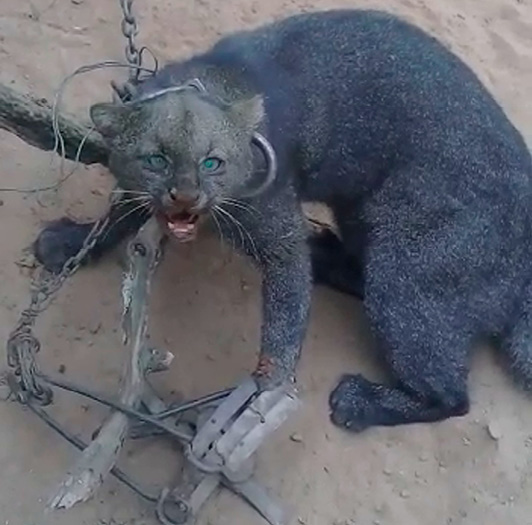
Figure 3. Distribution of the records of Jaguarundi (Herpailurus yagouaroundi) in Sonora according to vegetation type.