THERYA NOTES 2025, Vol. 6: 138-143
First record of alopecia in Artibeus jamaicensis and Choeronycteris mexicana (Chiroptera: Phyllostomidae) in Puebla, Mexico
Primer registro de alopecia en Artibeus jamaicensis y Choeronycteris mexicana (Chiroptera: Phyllostomidae) en Puebla, México
Laura Torres-Morales1*, Jesús Martínez-Vázquez1, Rosa María González-Monroy1, Diana López-Baltazar1 y Eduardo Martínez-Rodríguez1
1Laboratorio de Mastozoología, Facultad de Ciencias Biológicas, Benemérita Universidad Autónoma de Puebla. Blvd. Valsequillo y Av. San Claudio, edificio BIO-1 C.U. Col. Jardines de San Manuel, C.P. 72570, Puebla, Pue. E-mail: arualtm@hotmail.com (LT-M), jesus.martinez@correo.buap.mx (JM-V), rosa.gonzalez@correo.buap.mx (RMG-M), diana.lopzb@hotmail.com (DL-B), lalomart0618@gmal.com (EM-R)
*Autor de correspondencia
Alopecia refers to partial or total hair loss in mammals. It is an autoimmune disease that prevents hair follicle growth and causes hair loss. In this study, we report partial hair loss in three bats: two of the frugivorous species A. jamaicensis and one of the nectarivorous species C. mexicana, collected in the southern area of a protected area in the state of Puebla, Mexico. Bats with alopecia were observed in May and November 2024 during field trips of a project aimed at assessing the conservation status of bat species in the state of Puebla. Bats were captured at a site with low deciduous forest vegetation and mango and banana plantations in Atotonilco, municipality of Huehuetlán el Grande, Puebla. We captured 27 bats of different species. Among them, two adult females of A. jamaicensis without evidence of reproductive activity had partial or total alopecia in the abdominal area. Another individual, an adult male of C. mexicana with scrotal testes, presented with alopecia on the face, neck, and abdomen. This is the first report of alopecia in bats from Puebla, the third for A. jamaicensis in Mexico, and the first for C. mexicana in Mexico. In previous studies on bats in the state of Puebla, there have been no reports of alopecia. Alopecia in these individuals is likely due to environmental stress caused by anthropogenic activities in Atotonilco that probably affect nutritional processes.
Key words: frugivore, hair loss, nectarivore, Phyllostomidae.
La alopecia es la pérdida parcial o total de pelo en mamíferos, es una enfermedad autoinmune que evita el crecimiento del folículo piloso y causa la caída de pelo. En este estudio reportamos la pérdida parcial de pelo en tres murciélagos: 2 frugívoros de la especie Artibeus jamaicensis y 1 nectarívoro de la especie Choeronycteris mexicana, en el extremo sur de un área estatal protegida del estado de Puebla, México. Los murciélagos con alopecia se registraron en los meses de mayo y noviembre de 2024, durante las salidas de campo de un proyecto en el que se evalúo el estado de conservación de las especies de murciélagos del estado de Puebla. Las capturas de murciélagos se hicieron en un sitio con vegetación de selva baja caducifolia con plantaciones de mango y plátano en Atotonilco, municipio de Huehuetlán el Grande, Puebla, México. Se capturaron 27 murciélagos de diferentes especies. Entre ellos, 2 hembras adultas de A. jamaicensis sin evidencia de actividad reproductiva, presentaron alopecia parcial y total en la zona abdominal. Otro individuo, 1 macho adulto con los testículos escrotados de C. mexicana, presentó alopecia en el rostro, cuello y abdomen. Este reporte representa el primer registro de alopecia en murciélagos de Puebla, el tercer registro de A. jamaicensis y el primero de C. mexicana en México. En estudios previos efectuados con murciélagos del estado de Puebla no existen reportes de alopecia. Es probable que la alopecia en estos individuos se deba a estrés ambiental causado por las actividades antropogénicas que se llevan a cabo en Atotonilco, las cuales pueden interferir con los procesos nutricionales.
Palabras clave: frugívoro; nectarívoro; perdida de pelo; Phyllostomidae.
© 2025 Asociación Mexicana de Mastozoología, www.mastozoologiamexicana.org
Alopecia is partial or total hair loss in mammals (Corrales-Escobar and Saavedra-Rodríguez 2020). In bats, alopecia has been attributed to several causes, including reproductive stress, ectoparasites, urbanization, and the presence of fungi (da Silva et al. 2010; Monteiro et al. 2016; Nunes et al. 2017; Guedes et al. 2020). Worldwide, alopecia has been recorded in 38 species of bats belonging to the families Phyllostomidae (15), Vespertilionidae (13), Molossidae (5), Emballonuridae (2), Mormoopidae (2), and Pteropodidae (1) (Martin-Regalado et al. 2022; Hernández-Aguilar et al. 2023). The family Phyllostomidae, where the highest number of species with alopecia has been recorded, includes frugivorous species such as Artibeus jamaicensis and nectarivores such as Choeronycteris mexicana (Siles and Rios 2018; Nowak 1994; Freeman 1995).
The fruit bat A. jamaicensis is one of the species with the highest number of alopecia records, although only two correspond to Mexico. Of these, the first was in 73 individuals from Villahermosa, Tabasco, related to nutritional and endocrine alterations associated with urbanization (Bello-Gutiérrez et al. 2010); the second report refers to an individual from Córdoba, Veracruz, who exhibited a chest lesion that spread to other parts of his body, causing a bacterial or fungal infection (Hernández-Aguilar et al. 2024). A. jamaicensis is distributed from Sinaloa, Michoacán, and Tamaulipas in Mexico, southward to northwestern Colombia, the Greater and Lesser Antilles (south of Grenada), and southern Bahamas (Miller et al. 2016).
The crested bat, C. mexicana, is a nectivorous species distributed in the southwestern United States, Mexico (except for the Gulf slope and the Yucatan Peninsula), Honduras, and El Salvador (Solari 2018). There are no previous reports of alopecia in nectivorous species. Bats play a central ecological role: A. jamaicensis feeds on fruits and acts as a seed disperser, while C. mexicana is relevant in arid and semi-arid ecosystems of Mexico, where it pollinates key plants such as agaves and cacti (Galindo-González 1998; Gómez-Ruiz et al. 2015). This note reports three cases of alopecia in bats living in the state of Puebla, Mexico; two in individuals of A. jamaicensis and the first record of alopecia in C. mexicana.
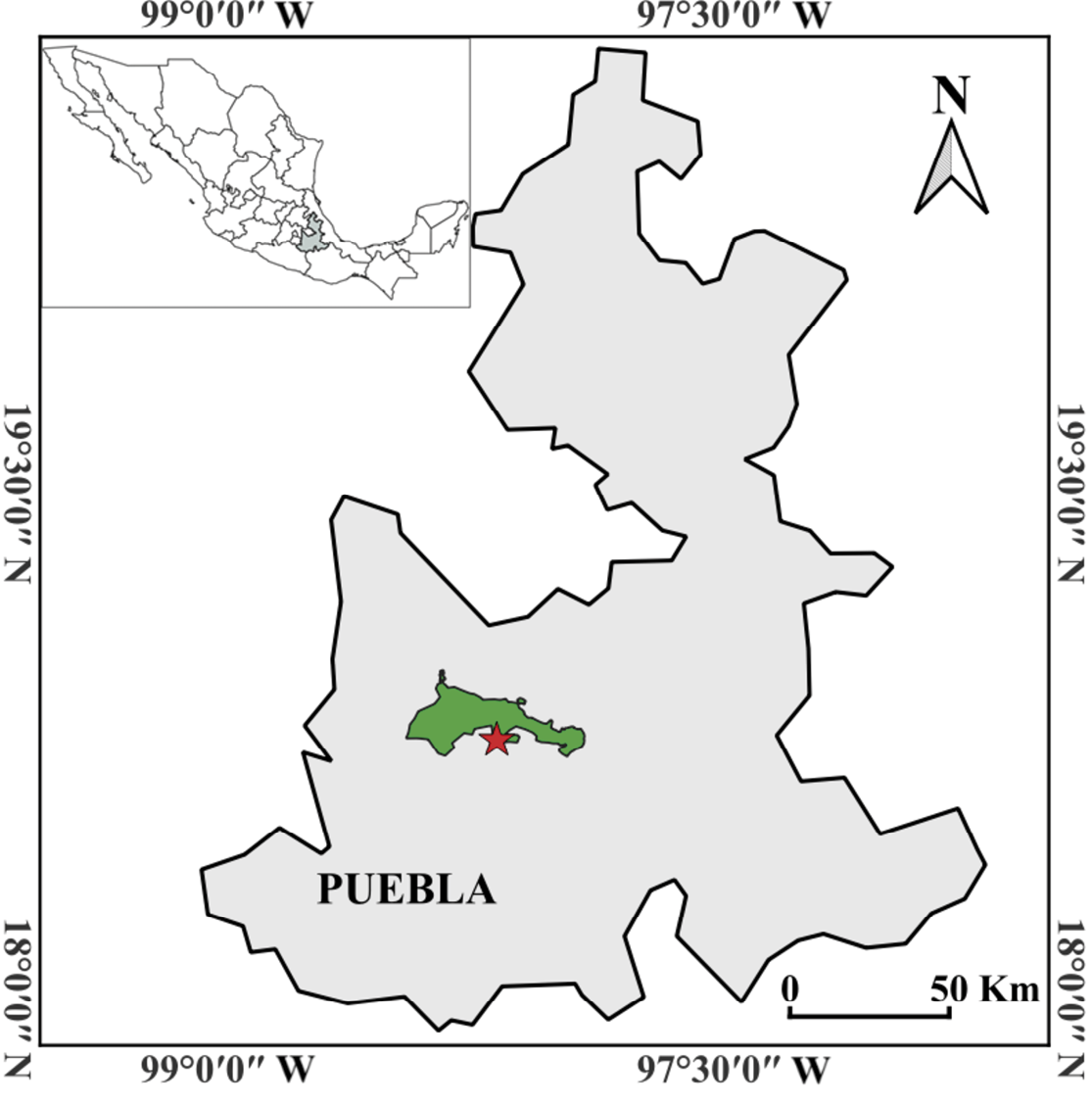
The cases of alopecia in bats reported here were recorded during field trips of a project aimed at evaluating the conservation status of bat species in the state of Puebla, Mexico. This project was carried out between September 2023 and August 2025. During field trips in May and November 2024, bats were captured in Atotonilco, a town in the municipality of Huehuetlán el Grande, in the southern area of the “Sierra del Tentzo” State Reserve (Official Newspaper of the State of Puebla, 2011). The town of Atotonilco is located 32 km south of Puebla City at coordinates 18°45’22.89” N and 98°10’33.32” W, at an altitude of 1353 meters above sea level, and is home to 22 inhabitants. The dominant vegetation in the study area is low deciduous forest, alternating with mango and banana plantations (Figure 1; INEGI 2020).
During the sampling, which lasted three nights, two mist nets measuring 2 m × 12 m and one measuring 2 m × 6 m were installed and left open from 6:00 p.m. to 11:30 p.m. The nets were placed in adjacent mango and banana plantations. The bats captured were handled following the proper handling protocols recommended for wild mammals (Sikes et al. 2011). For each captured bat, the parameters recorded were weight (g), forearm length (LA), and reproductive status. Bats were identified at the species level using the key of Medellín et al. (2007). All bats, including those showing alopecia, were released at the capture site after analysis. The permit to conduct this work was granted by SEMARNAT through the General Directorate of Wildlife under the memorandum SPARN/DGVS/05957/24 addressed to Dr. Jesús Martínez Vázquez. The incidence of alopecia in the affected species was calculated according to Bello-Gutiérrez et al. (2010), i.e., by dividing the number of individuals affected with alopecia of a given species by the total number of recorded individuals of that species.
In total, 27 bats belonging to 8 species were captured: Sturnira parvidens (n = 3 ♀ and 9 ♂), Choeroniscus godmani (n = 7 ♂), Artibeus jamaicensis (n = 3 ♀), Pteronotus parnellii (n = 1 ♂), Anoura geoffroyi (n = 1 ♂), C. mexicana (n = 1 ♂), Leptonycteris yerbabuenae (n = 1 ♂), and A. lituratus (n = 1 ♂). Of these, 3 individuals had alopecia. The 3 specimens of A. jamaicensis were adult females with no signs of reproductive activity, which were captured in a mango plantation on 2 May 2024. The weights of these females were 51 g, 46 g, and 48 g. The corresponding forearm length was 62 mm, 60 mm, and 62 mm. In two females, alopecia was observed in the ventral region of the body. In both, hair loss occurred in the thorax and abdomen, although it was more apparent in one of them (Figure 2a and 2b). The incidence of alopecia in this species was 66.7%. On the other hand, the specimen of C. mexicana was an adult male with scrotal testes, weighing 22 g, and with a forearm length of 44.4 mm. This individual was captured near a banana plantation on 6 November 2024, and alopecia was observed on the face, neck, and abdomen (Figure 2c-2e). The incidence of alopecia in this species was 100%.
In previous studies on bats in the state of Puebla, alopecia had not been reported in any species (Rojas-Martínez and Valiente-Banuet 1996; Valiente-Banuet et al. 1996; Valiente-Banuet et al. 1997a, b; Valiente-Banuet et al. 2007; Vargas-Miranda et al. 2008; Saldaña-Vázquez et al. 2021). In addition, three previous studies were conducted specifically in the municipality of Huehuetlán el Grande before our sampling, and none of them recorded alopecia in the bats analyzed (Santos-Reyes 2014; Cruz-Pérez 2015; Calvario-Carillo 2016). Therefore, the present report represents the first record of alopecia in A. jamaicensis in the state of Puebla and the third in Mexico; for C. mexicana, this report is the first record of alopecia for a nectarivorous bat in Puebla, in Mexico, and across its entire known range.
It is worth mentioning that C. mexicana is listed in the Threatened category in the Official Mexican Standard (NOM-059-SEMARNAT, 2010) and as Near Threatened by the International Union for Conservation of Nature (IUCN; Solari 2018) because it depends on fragile and threatened habitats (arid thorny shrublands, tropical deciduous forests), and with an estimated 30% decline in its populations over the past ten years due to human activities and the transformation of its natural habitat across its range (Solari 2018). For its part, C. mexicana plays a central ecological role in Mexico’s arid and semi-arid ecosystems by pollinating key plants such as agaves and cacti (Gómez-Ruiz et al. 2015).
In bats in captivity, alopecia has been attributed to poor nutrition, endocrine disruption (Olsson and Barnard 2009), and fungal infections (Robert 2016). In free-living bats, several causal factors have been suggested, including hormonal fluctuations related to reproduction (Haarsma and Van Alphen 2009; Hernández-Aguilar et al. 2023), volcanic ash ingestion (Pedersen et al. 2012), environmental stress associated with urbanization (Acosta 2016; Martin and Wolters 2022), ectoparasites (Corrales-Escobar and Saavedra-Rodríguez 2020), and fungal infections (de Souza-Suguiura et al. 2023; Hernández-Aguilar et al. 2024).
Our review of the specimens of A. jamaicensis and C. mexicana affected by alopecia in Atotonilco did not reveal the presence of ectoparasites that could have caused alopecia in these organisms. Unfortunately, we lacked the necessary materials and equipment to take samples for subsequent histological studies or cultures of fungi and bacteria, so it was not possible to identify any of these as the underlying cause of hair loss. The use of pesticides prohibited in other countries for pest and weed control in crops and fruit plantations in Huehuetlán el Grande, as well as the excessive use of chlorine in water bodies and recreational areas that attract tourists to Atotonilco (Marín and Marín 2020), could adversely affect the fauna of the region, including bats. This trend is alarming, as pesticides and herbicides have been reported to promote abnormalities and cancer, and insecticides are considered potent neurotoxic chemicals in humans (Bejarano 2017; Marín and Marín 2020). On the other hand, another possible cause of alopecia in the bat individuals observed in this study is the disruption of their natural environment, since a mining stockpile was established in 2023 (L. Marín pers. comm.), 160 m from the locality where the bats with alopecia were captured.
There is scarce information about the current status of the bat populations that inhabit the state of Puebla. The latest study addressing the conservation status of bat populations was published 17 years ago (Vargas-Miranda et al. 2018). The research work evaluating the current conservation status of bat species in the state of Puebla, of which this work belongs, is relevant because it is the first to record alopecia in two species of bats in Puebla and within the “Sierra del Tentzo” State Reserve. However, specific studies are needed to determine the underlying causes of alopecia in these bats.
Acknowledgments
The authors wish to thank the Faculty of Biological Sciences at the BUAP for allowing us to use its facilities for the analysis of information and the National Council of Humanities, Science, and Technology of Mexico (CONAHCYT) for the postdoctoral fellowship awarded to the first author (LTM). The authors are also grateful to Dr. Emma Gómez Ruíz for her valuable comments on the manuscript, to the authorities of the municipality of Huehuetlán el Grande, and to the Atotonilco cooperative for allowing us access to their territory to carry out the field work. María Elena Sánchez-Salazar translated the manuscript into English.
Literature Cited
Acosta, L. H. 2016. Primer registro de síndrome de alopecia en un murciélago de Bolivia. Kempffiana 12:48-53.
Bello-Gutiérrez, J., et al. 2010. Alopecia in bats from Tabasco, Mexico. Journal of Wildlife Diseases 46:1000-1004.
Calvario-Carrillo, E. 2016. Variación cromosómica de Choeronycters mexicana (Chiroptera: Phyllostomidae) de Santo Domingo Huehuetlán el Grande, Puebla. Tesis de Licenciatura. Benemérita Universidad Autónoma de Puebla, Puebla, México.
Corrales, E. J. D. y C. A. R. Saavedra. 2020. Primer registro de alopecia en Myotis nigricans (Chiroptera: Vespertilionidae) en la ciudad de Manizales, Colombia. Notas Sobre Mamíferos Sudamericanos 2:2-6.
Cruz-Pérez, V. 2015. Análisis cromosómico del murciélago Sturnira hondurensis de Huehuetlán el Grande, Puebla. Tesis de Licenciatura. Benemérita Universidad Autónoma de Puebla, Puebla, México.
da Silva, S. S. P., et al. 2010. Bionomia de morcegos em áreas urbanas: Parque Natural Municipal da Freguesia e Fazenda Marambaia no Município do Rio de Janeiro, RJ. Chiroptera Neotropical 16:25-28.
de Souza Suguiura, I. M., et al. 2023. Histopathological survey of free-ranging neotropical bats with dermatitis. Veterinary Pathology 60:369-373.
Freeman, P. W. 1995. Nectarivorous feeding mechanisms in bats. Biological Journal of the Linnean Society 56:439-463.
Galindo-González, J. 1998. Dispersión de semillas por murciélagos: su importancia en la conservación y regeneración del bosque tropical. Acta Zoológica Mexicana (n.s.) 73:57-74.
Gómez-Ruiz, E. P., et al. 2015. Conservación de murciélagos nectarívoros (Phyllostomidae: Glossophagini) en riesgo en Coahuila y Nuevo León. Therya 6:89-102.
González, B. F. 2017. Los plaguicidas altamente peligrosos en México. México.
Guedes, P. G., et al. 2020. Padrão reproductivo, dieta e parasitologia de Artibeus lituratus (Olfers, 1818) (Mammalia, Chiroptera) em parques urbanos do município do Rio de Janeiro (Rio de Janeiro, Brasil). Biotemas 33:1-16.
Haarsma, A. J., y J. van Alphen. 2009. Partial baldness in relation to reproduction in pond bats in the Netherlands. Lutra 52:83-95.
Hernández-Aguilar, I., A. Santos-Moreno, y C. Lorenzo. 2023. Alopecia in bats: a case study of four species from México. Acta Chiropterologica 25:159-167.
Hernández-Aguilar, I., et al. 2024. Record of alopecia in the bat Artibeus jamaicensis in Córdoba, Veracruz, México. Therya Notes 5:11-15.
Instituto Nacional de Estadística, Geografía e Informática (INEGI). 2020. Censo nacional de población y vivienda 2020-cuestionario básico. Ciudad de México, México. www.inegi.org.mx/programas/ccpv/2020/#Datos_abiertos. Consultado el 18 de diciembre 2024.
Marín, L., y L. A. R. Marín. 2020. En la puerta de entrada a la Mixteca Poblana: El patrimonio biocultural de los pueblos de la región de Hueheutlán El Grande. PACCMYC, Secretaría de Cultura, Ecocreando, México.
Martín-Regalado, C. N., S. C. Pedersen, y M. C. Lavariega. 2022. Alopecia in bats. Acta Chiropterologica 24:209-219.
Martin, C. O., y M. S. Wolters. 2022. Alopecia in a population of Rafinesque’s Big-eared Bats (Corynorhinus rafinesquii). The Southwestern Naturalist 67:59-62.
Medellín, R., H. Arita, y O. Sánchez. 2007. Identificación de los murciélagos de México, clave de campo. Instituto de Ecología, UNAM. Ciudad de México, México.
Miller, B., et al. 2016. Artibeus jamaicensis. En: IUCN 2016. The IUCN Red List of Threatened Species. Versión 3.1. www.iucnredlist.org. Consultado el 2 de enero 2025.
Monteiro, F. A., J. Gazarini, y C. R. Santana. 2016. Ocorrência de alopecia em morcegos filostomídeos (Chiroptera, Phyllostomidae). SaBios: Revista de Saúde e Biologia 11:85-89.
Nunes, H., F. L. Rocha, y P. Cordeiro-Estrela. 2017. Bats in urban areas of Brazil: roosts, food resources and parasites in disturbed environments. Urban Ecosystems 20:953-969.
Olsson, A., y S. Barnard. 2009. Alopecia. Pp. 111-120 in Bats in captivity: biological and medical aspects (S. M. Barnard, ed.). Logos Press, Washington, D. C.
Pedersen, S. C., et al. 2012. Sublethal pathology in bats associated with stress and volcanic activity on Montserrat, West Indes. Journal of Mammalogy 93:1380-1392.
Rojas-Martínez, A. E., y A. Valiente-Banuet. 1996. Análisis comparativo de la quiropterofauna del valle de Tehuacan-Cuicatlan, Puebla, Oaxaca. Acta Zoológica Mexicana (n.s.) 67:1-23.
Robert, J. 2016. Possible causes of hair loss in captive Dermanura tolteca bats. Tropical Ecology and Conservation [Monteverde Institute] 638.
Saldaña-Vázquez, R. A., S. Ortega-García, y C. Cornejo-Latorre. 2021. Servicios Ecosistémicos: La polinización en el estado de Puebla. Consejo Estatal de Ciencia del Estado de Puebla (CONCyTEP).
Santos-Reyes, M. V. 2014. Diversidad y abundancia de quirópteros en vegetación secundaria de Santo Domingo Huehuetlán el Grande, Puebla. Tesis de Licenciatura. Benemérita Universidad Autónoma de Puebla, Puebla, México.
Secretaría de Medio Ambiente y Recursos Naturales. 2010. Norma Oficial Mexicana NOM-059-SEMARNAT-2010, Protección ambiental-Especies nativas de México de flora y fauna silvestre-Categorías de riesgo y especificaciones para su inclusión, exclusión o cambio-Lista de especies en riesgo. Diario Oficial de la Federación. Ciudad de México, México. 30 de diciembre de 2010.
Sikes, R. S., W. L. Gannon, y American Society of Mammalogy. 2011. Guidelines of the American Society of Mammalogists for the use of wild mammals in research. Journal of Mammalogy 92:235-353.
Solari, S. 2018. Choeronycteris mexicana. En: IUCN 2018. In The IUCN Red List of Threatened Species. Versión 3.1. www.iucnredlist.org. Consultado el 18 de diciembre 2024.
Valiente-Banuet, A., et al. 1996. Ecological relationships between columnar cacti and nectar-feeding bats in Mexico. Journal of Tropical Ecology 12:103-119.
Valiente-Banuet, A., et al. 1997a. Pollination biology of two winter-blooming giant columnar cacti in the Tehuacan Valley, central Mexico. Journal of Arid Environments 37-331-341.
Valiente-Banuet, A., et al. 1997b. Pollination biology of two columnar cacti (Neobuxbaumia mezcalaensis and Neobuxbaumia macrocephala) in the Tehuacan Valley, Central Mexico. American Journal of Botany 84:452-455.
Valiente-Banuet, A., et al. 2007. Pollination biology of the hemiepiphytic cactus Hylocereus undatus in the Tehuacán Valley, Mexico. Journal of Arid Environments 68:1-8.
Vargas-Miranda, B., J. Ramírez-Pulido, y G. Ceballos. 2008. Murciélagos del estado de Puebla, México. Revista Mexicana de Mastozoología 12:59-112.
Associate editor: Itandehui Hernández Aguilar
Submitted: February 21, 2025; Reviewed: July 25, 2025.
Accepted: July 28, 2025; Published on line: December 6, 2025
DOI: 10.12933/therya_notes-24-211
ISSN 2954-3614
Figure 1. Geographic location of the new records of alopecia in A. jamaicensis and C. mexicana in Atotonilco, municipality of Huehuetlán el Grande, state of Puebla, Mexico (red star). The area corresponding to the “Sierra del Tentzo” State Reserve is marked in green.
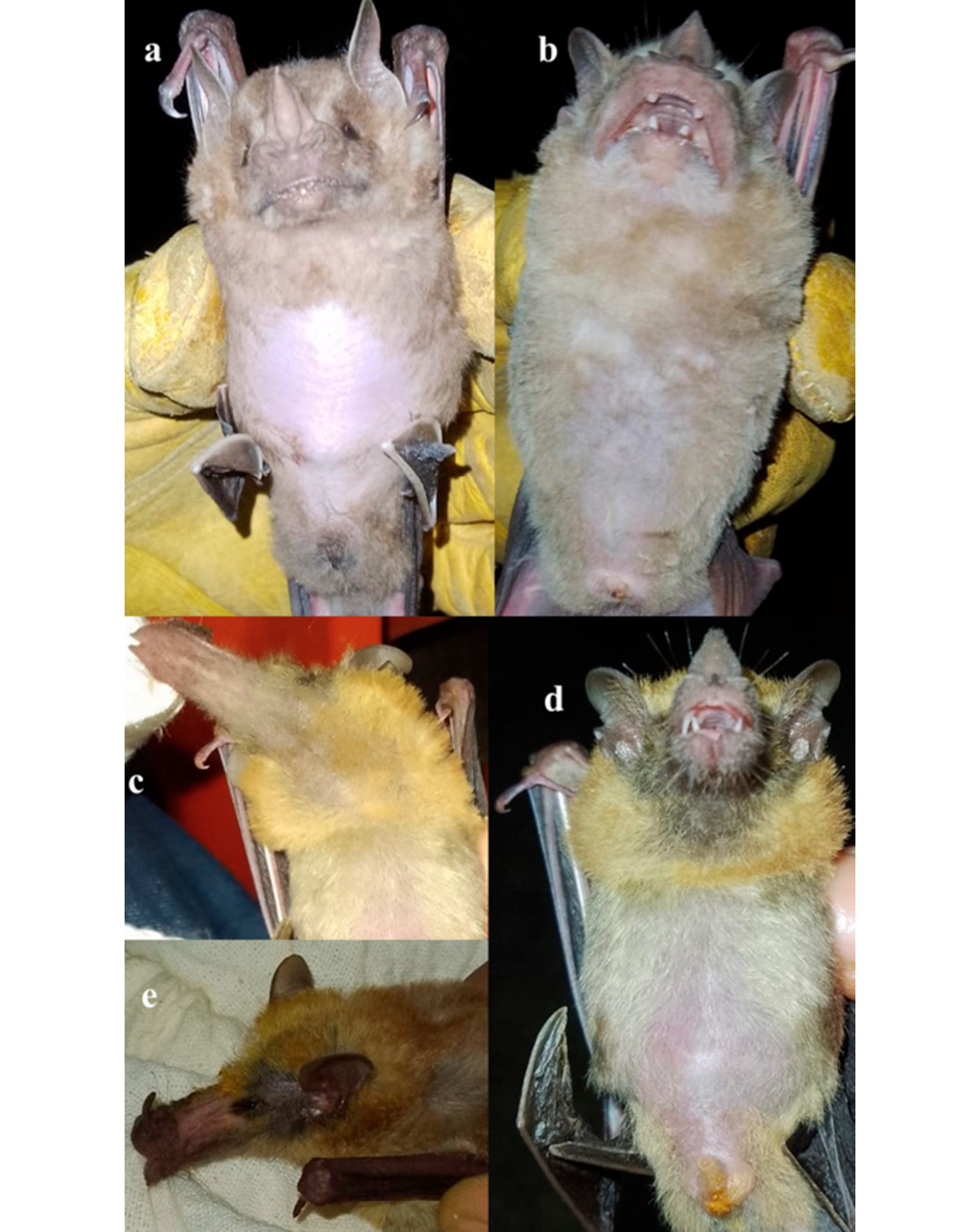
Figure 2. Alopecia in two bat species captured in Atotonilco, Huehuetlán el Grande, Puebla. (a and b) Adult females of A. jamaicensis with partial or total alopecia in the abdomen. (c, d, e) Adult male of C. mexicana with alopecia on the face, neck. and abdomen. Photographs: L. Torres-Morales.