THERYA NOTES 2026, Vol. 7:25-29
New records of hypopigmentation in two captive squirrel monkeys (Saimiri spp.) in Brazil and Colombia
Nuevos registros de hipopigmentación en dos monos ardilla (Saimiri spp.) en Brasil y Colombia
Roginey Silva e Silva1, Sebastián O. Montilla2, Cláudia Regina da Silva1, and Renato Richard Hilário3 *
1Laboratório de Mastozoologia, Instituto de Pesquisa Científicas e Tecnológicas do Estado do Amapá, Rod. Josmar Chaves Pinto, Km 10, Fazendinha, 68903-419, Macapá-AP, Brazil. E-mail: rogineyformal23@gmail.com (RSS); crsilva.ap@gmail.com (CRS).
2Laboratorio de Ecología de Bosques Tropicales y Primatología, Universidad de Los Andes, Cra. 1 #18a-12, La Candelaria, 111711, Bogotá, Colombia. E-mail: juansomontilla94@gmail.com (SOM).
3Departamento de Meio Ambiente e Desenvolvimento, Universidade Federal do Amapá, Rod. Josmar Chaves Pinto, Km 2, 68903-419, Macapá-AP, Brazil. E-mail: renatohilario@unifap.br (RRH).
*Corresponding author
Despite the increasing frequency of reports of primates with anomalous pigmentation in scientific literature, there is still a lack of knowledge about these disorders in many primate species. Here, we report two cases of hypopigmentation in squirrel monkeys (genus Saimiri) in Brazil and Colombia. We describe two cases of hypopigmentation in individuals that came to our attention opportunistically. The first individual had leucistic characteristics (completely depigmented pelage, but normally colored eyes) and was observed in Macapá, in the Brazilian Amazon. The other individual showed characteristics of albinism (depigmented pelage and eyes) and was recorded in Armenia, central Colombia. Neither individual showed agonism towards humans, likely being captive primates, which may have favored their survival into adulthood. Our records are the first with images and exact coordinates for species of the genus Saimiri. The relative lack of knowledge about hypopigmentation in animals highlights the need for more research focused on them. In this context, given that most primate species are diurnal and relatively easy to observe, studies on primates may help elucidate ecological aspects related to the fitness of hypopigmented individuals. Moreover, there appears to be a growing number of reports of primates from different species with these disorders, and our reports may contribute to increase the knowledge about hypopigmentation in wild animals.
Keywords: Albinism; Leucism; Melanin; Pigmentation disorders; Saimiri spp.
A pesar de la creciente frecuencia de registros de primates con pigmentación anómala en la literatura científica, todavía se conoce poco sobre estos trastornos en muchas especies. Aquí reportamos dos casos de hipopigmentación en monos ardilla (género Saimiri) en Brasil y Colombia.Describimos dos casos de hipopigmentación de individuos registrados de forma oportunista. El primer individuo presentó características de leucismo (pelaje completamente despigmentado, pero con los ojos de color normal) y fue observado en Macapá, en la Amazonia brasileña. El otro individuo presentaba características de albinismo (pelaje y ojos despigmentados) y fue registrado en Armenia, en el centro de Colombia. Ambos individuos mostraron una conducta no agonista hacia los humanos, por lo que, probablemente eran primates cautivos, lo que pudo haber favorecido su supervivencia hasta la edad adulta. Nuestros registros son los primeros que incluyen imágenes y coordenadas exactas de especies del género Saimiri. La escasez de conocimientos sobre la hipopigmentación en animales pone de manifiesto la necesidad de realizar investigaciones centradas en ellos. En este sentido, dado que la mayoría de las especies de primates son diurnas y relativamente fáciles de observar, los estudios futuros podrían ayudar a esclarecer aspectos ecológicos relacionados con la aptitud y el significado adaptativo de los individuos hipopigmentados. Además, parece que está aumentando el número de informes de primates de diferentes especies con estos trastornos y nuestros reportes pueden contribuir a una mejor comprensión de la hipopigmentación en animales salvajes.
Keywords: Albinismo; Leucismo; Melanina; Trastornos de pigmentación; Saimiri spp.
© 2026 Asociación Mexicana de Mastozoología, www.mastozoologiamexicana.org
The color of mammals is primarily related to the production of two types of melanin: eumelanin, which is responsible for colors ranging from brown to black, and pheomelanin, which produces red to yellow pigments (Sugumaran and Barek 2016). Abnormal changes in vertebrate coloration (e.g., hypopigmentation, anomalous pigmentation) are mainly caused by disturbances in the melanin biosynthesis, which affects pigment production, resulting in little or no pigmen-tation (Mikheil et al. 2017; Britton and Davidowitz 2023).
In vertebrates, although there is no consensus on the terminology, there are four types of hypopigmentation: albinism, leucism, piebaldism and hypomelanism (Abreu et al. 2013; Lucati and López-Baucells 2016). The most well-known condition is albinism, characterized by the complete loss of pigmentation in the skin, hair, feathers, and nails/claws. It also affects eye coloration, which may appear reddish or bluish, and can sometimes result in reduced visual acuity (Miller 2005; Grouw 2021). Leucism, in contrast, causes partial or complete loss of pigmentation in the skin and hair, but unlike albinism, it does not affect the eyes (Miller 2005; Abreu et al. 2013). In contrast, piebaldism causes a reduction in melanin only in small areas of the body (Fertl and Rosel 2008; Abreu et al. 2013). Finally, hypomelanism is characterized by beige, golden, yellowish or reddish, instead of whitish pigmentation (Lucati and López-Baucells 2016). Besides hypopigmentation disorders, there are also hyperpigmentation disorders, such as melanism and partial melanism (Lucati and López-Baucells 2016).
Hypopigmentation disorders have already been recorded in many species of Neotropical mammals (Abreu et al. 2013), including small flying mammals (Lucati and López‐Baucells 2016), rodents, and marsupials (García-Casimiro and Santos-Moreno 2020; Vanstreels et al. 2021; Barreto et al. 2023), and large species such as deer (Rodrigues et al. 1999; Oliveira 2009) and tapirs (Tokuda et al. 2021; Silva et al. 2022). In the case of non-human primates, Ramos-Luna et al. (2022) reviewed cases of 44 individuals from nine species (Alouatta palliata, Alouatta pigra, Alouatta guariba clamitans, Ateles geoffroyi, Callithrix jacchus, Callithrix penicillata, Cebus imitator, Saimiri boliviensis, Sapajus apella) and one hybrid (Callithrix jacchus x Callithrix penicillata) with anomalous pigmentation. In the same year (2022), five other cases were recorded for primates (Alouatta palliata - Barros-Diaz et al. 2022; Ateles chamek - Lange and Glynn 2022; Callithrix jacchus - Leandro-Silva et al. 2022; Aotus griseimembra - Montilla and Link 2022; Leontocebus nigricollis graellsi - Tirira and Prado-Lita 2022). Additionally, there are also unpublished cases, such as of a capuchin monkey (reported as Sapajus libidinosus) with leucistic characteristics was recorded on a citizen science website (Biofaces 2017), and a database of anomalous pigmentation in primates of Costa Rica (https://www.flickr.com/photos/184305184@N02/).
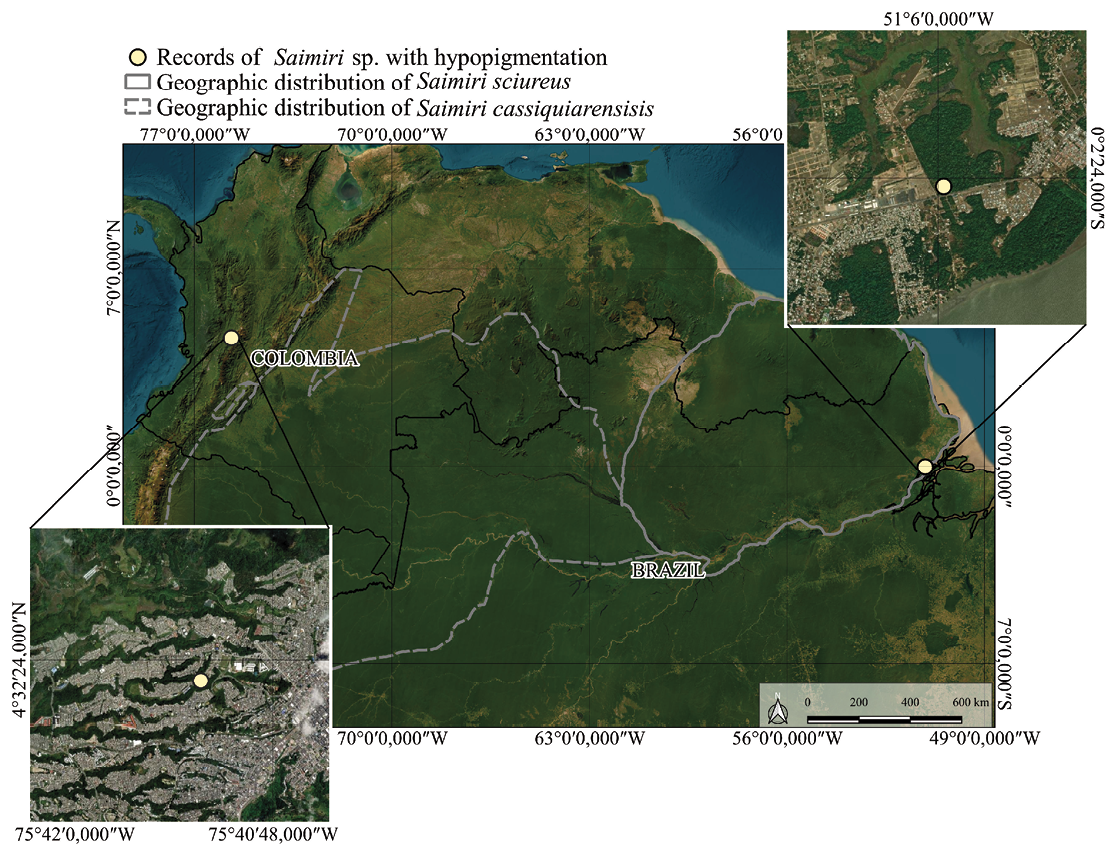
Despite the increasing frequency of reports of primates with anomalous pigmentation in scientific literature (Ramos-Luna et al. 2022), there are still only a few reports of anomalous pigmentation for many primate genera, including Saimiri. Here, we present two records of hypopigmentation in the genus Saimiri, involving captive individuals from distinct regions of South America (Figure 1).
We describe two cases of hypopigmentation in the genus Saimiri that came to our knowledge opportunistically. One of the records was made in the external area of the Public Veterinary Hospital of Macapá (0°02’27”S - 51°05’58”W - Figure 1), in the city of Macapá, Amapá state, in the Northeastern Extreme of the Brazilian Amazon. This area is adjacent to a urban park (Bioparque da Amazonia), with roughly 60 ha of forest. The site is within the distribution of Saimiri sciureus, although it is not possible to confirm the species identification of an individual that does not present the typical color pattern of the species.
The second record was made in the city of Armenia, in the department of Quindío, central Colombia (4°32’16”N - 75°41’13”W - Figure 1). This site is outside the normal distribution of the genus, being about 230 km away from the distribution limits of Saimiri cassiquiarensis (Paim et al. 2021 - Figure 1). Both hypopigmented individuals were photographed and the photos are available in a public repository (https://doi.org/10.6084/m9.figshare.30604529.v1).
A squirrel monkey individual (Saimiri sp.) with leucistic characteristics (i.e., completely depigmented skin and pela-ge, but normally colored eyes - Figure 2a) was recorded on May 30th, 2023, in the external area of the Public Veterinary Hospital of Macapá (see above). After being spotted by a local employee, the animal was retrieved by the park’s biologist (Geraldo Otávio Biondi Filho) and transferred to the Wildlife Rehabilitation Center (CETAS/IBAMA) in Macapá, where it remains in captivity. According to the biologist, the squirrel monkey showed signs of domestication, exhibiting neither aggression nor discomfort in the presence of humans. Therefore, it is likely that the animal had escaped from a property or had been abandoned in the area.
Another specimen of the genus (Saimiri sp.) was recorded by one of us (S.O.M.) on December 3, 2016, after the primate invaded a resident’s house in the city of Armenia, Central Colombia. This individual showed characteristics of albinism, given that in addition to the depigmented skin and pelage, the eyes were also depigmented (Figure 2b). Similarly to the previous case, this squirrel monkey did not show agonistic or repulsive behaviors towards humans, likely indicating it was a captive primate. According to local residents, the animal may have escaped from a nearby house that harbored wild animals for trade. Once it was clear that it was a wild animal, a report was made to environmental authorities (Colombian Ministry of Environment and Sustainable Development and the Regional Autonomous Corporation of Quindío). However, before any rescue took place, the individual disappeared from the observation site.
Our records are the first with images and exact coor-dinates for species of the genus Saimiri. Although Ramos-Luna et al. (2022) reported a case of hypopigmentation in Saimiri boliviensis in Peru, it was described through an image posted on Facebook, not providing the image and the location of the occurrence. Thus, there are at least three hypopigmentation occurrences for the genus Saimiri in Brazil, Colombia and Peru.
Hypopigmentation disorders are relatively rare and most previous reports are based on opportunistic observations, which hampers formal testing of their causes. However, some authors have proposed causes, such as exposure to chemical substances (e.g., sulfur - Galván et al. 2018), and inbreeding (Prado-Martínez et al. 2013). Reproduction among related individuals is often the result of population declines caused by habitat degradation and fragmentation (Fortes and Bicca-Marques 2008; Lange and Glynn 2022). However, considering that we could not determine where the hypopigmented animals reported here were born, we cannot assess whether inbreeding may be a cause of the disorder, nor point other possible causes of these disorders.
Although we classified the anomalies of the two individuals reported here as leucism and albinism, genetic analysis is necessary for more precise classification. For example, a capuchin monkey (Sapajus apella), which could visually be classified as leucistic, was genetically identified as having oculocutaneous albinism (Henriques et al. 2019). However, the individual recorded in Colombia escaped from captivity, and it has not yet been possible to conduct genetic analysis of the individual recorded in Brazil.
The relative lack of knowledge about hypopigmentation in animals highlights the need for more research focused on these animals. In this regard, since most primate species are diurnal and more easily observed, primate studies may clarify ecological aspects related to the fitness of animals with hypopigmentation. Considering the relative rarity of hypopigmentation cases, citizen science platforms, such as iNaturalist (https://www.inaturalist.org/) and Biofaces (https://www.biofaces.com/), may have an important role in making more records available and increasing people’s knowledge about hypopigmentation. Moreover, there appears to be a growing number of reports of primates from different species with these disorders, and our reports may contribute to a better understanding of the causes and consequences of these occurrences in wild animals.
Acknowledgements
We are grateful to the park ranger Edinéia Sacramento Gouveia, who informed us about the leucistic squirrel monkey and to the biologist Geraldo Otávio Biondi Filho, who rescued the animal and provided details about it. We also thank the biologist Aline Emanuele Oliveira de Souza for receiving us at the Wildlife Rehabilitation Center and for providing the photos of the animal. Finally, we thank Jessica Mayorga for reporting the albino squirrel monkey in her house and Luisa F. Arcila-Pérez, who helped in the expedition to check on the animal. RRH receives a Research Productivity Fellowship from the Brazilian National Council for Scientific and Technological Development (CNPq #302928/2025-1).
Literature cited
Abreu, M. S. L., et al. 2013. Anomalous colour in Neotropical mammals: a review with new records for Didelphis sp. (Didelphidae, Didelphimorphia) and Arctocephalus australis (Otariidae, Carnivora). Brazilian Journal of Biology 73:185–194.
Aximoff, I., et al. 2020. Anomalous pigmentation in invasive and native marmosets, Callithrix jacchus, Callithrix penicillata (Primates, Callitrichidae), and their hybrids in Brazil. Folia Primatologica 91:149–158.
Barreto, H. F., et al. 2023. Leucism in rodents: the first record for the mocó (Kerodon rupestris Wied-Neuwied, 1820), a rodent endemic to Brazil. Notas Sobre Mamíferos Sudamericanos 5:e23.6.3.
Barros‐Diaz, C., et al. 2022. Hypopigmentation in mantled howler monkeys Alouatta palliata (Gray 1849): First documented cases of whole‐body leucism in South America. Ecology and Evolution 12:e9628.
Biofaces. 2017. Macaco prego. https://www.biofaces.com/post/82206/macaco-prego/. Accessed on 16 May 2024.
Britton, S., and G. Davidowitz. 2023. The effect of diet on melanin pigmentation in animals. Functional Ecology 37:206–217.
Eppley, T. M., Hickey, J. R., and N. P. Nibbelink. 2010. Observation of albinistic and leucistic black mangabeys (Lophocebus aterrimus) within the Lomako-Yokokala Faunal Reserve, Democratic Republic of Congo. African Primates 7:50–54.
Espinal, M., et al. 2016. A case of albinism in the Central American spider monkey, Ateles geoffroyi, in Honduras. Mastozoología Neotropical 23:63–69.
Fertl, D., and P. E. Rosel. 2009. Albinism. Pp. 24–25 in Encyclopedia of marine mammals (W. F. Perrin, B. Wursig, and J. G. M. Thewissen, eds.). Academic Press, Chennai, India.
Fortes, V. B., and J. C. Bicca-Marques. 2008. Abnormal pelage color in an isolated population of Alouatta guariba clamitans Cabrera, 1940 in South Brazil. International Journal of Primatology 29:717–722.
Galván, I., et al. 2019. A recent shift in the pigmentation phenotype of a wild Neotropical primate. Mammalian Biology 94:66–68.
García-Casimiro, E., and A. Santos-Moreno. 2020. First record of albinism in the paca Cuniculus paca (Rodentia, Cuniculidae) in southeast Mexico. Neotropical Biology and Conservation 15:195–200.
Grouw, H. V. 2021. What’s in a name? Nomenclature for colour aberrations in birds reviewed. Bulletin of the British Ornithologists’ Club 141:276–299.
Henriques, L. D., et al. 2019. Behavioral and genetic color vision evaluation of an albino male capuchin monkey (Sapajus apella). Journal of Comparative Physiology A 205:529–536.
Lange, L. R., and S. Glynn. 2022. First case of albinism registered for Ateles chamek (Humboldt, 1812). Neotropical Primates 28:67–69.
Leandro-Silva, V., et al. 2022. Leucism in Callithrix jacchus (Primates: Callitrichidae) and Sciurus aestuans (Rodentia: Sciuridae) in the northeast of Brazil. Mammalia Notes 8:276–276.
Leroux, M., et al. 2022. First observation of a chimpanzee with albinism in the wild: Social interactions and subsequent infanticide. American Journal of Primatology 84:e23305.
Lucati, F., and A. López‐Baucells. 2016. Chromatic disorders in bats: a review of pigmentation anomalies and the misuse of terms to describe them. Mammal Review 47:112–123.
Miller, J. D. 2005. All about albinism. Missouri Conservationist 66:4–7.
Mikheil, D., et al. 2017. Coat color mutations, animals. Pp. 1–6 in Reference Module Life Sciences. Elsevier.
Montilla, S. O., and A. Link. 2022. Albinism in a wild Caribbean night monkey (Aotus griseimembra) in a fragmented landscape in Colombia. Therya Notes 3:14–17.
Oliveira, S. V. 2009. Registro de albinismo parcial em veado catingueiro Mazama gouazoupira (G. Fischer, 1814) (Artiodactyla, Cervidae) na Serra do Sudeste, Rio Grande do Sul, Brasil. Biodiversidade Pampeana 7:13–15.
Paim, F. P., et al. 2021. Saimiri cassiquiarensis. In: IUCN 2024. The IUCN Red List of Threatened Species. Version 2024.2. https://www.iucnredlist.org/species/160940148/192585552. Accessed on 20 August 2024.
Prado-Martinez, J., et al. 2013. The genome sequencing of an albino Western lowland gorilla reveals inbreeding in the wild. BMC Genomics 14:1–8.
Ramos-Luna, J., et al. 2022. Anomalous pigmentation in American primates: Review and first record of a leucistic black howler monkey in Southeast Mexico. Folia Primatologica 93:87–95.
Rodrigues, F. H., et al. 1999. Um albino parcial de veado campeiro (Ozotoceros bezoarticus, Linnaeus) no Parque Nacional das Emas, Goiás. Revista Brasileira de Zoologia 16:1229–1232.
Sánchez-Soto, S. 2018. Registros de sitios con presencia de Alouatta palliata (Gray)(Primates: Atelidae) en la Chontalpa, Tabasco, México. Revista Nicaraguense de Biodiversidad 37:3–18.
Silva-Júnior, J. S., et al. 2021. Saimiri sciureus. In: IUCN 2024. The IUCN Red List of Threatened Species. Version 2024.2. https://dx.doi.org/10.2305/IUCN.UK.2021-1.RLTS.T43968A192584742.en. Accessed on 24 April 2024.
Silva, M. L., et al. 2022. Dermatite seborreica em anta albina (Tapirus terrestris). Veterinária e Zootecnia 29:1–7.
Sugumaran, M., and H. Barek. 2016. Critical analysis of the melanogenic pathway in insects and higher animals. International Journal of Molecular Sciences 17:1753.
Tirira, D. G., and D. Prado-Lita. 2022. First records of leucism in Leontocebus nigricollis graellsi (Primates: Callitrichidae). Mammalia Aequatorialis 4:35–37.
Tokuda, M., et al. 2021. Albinism in lowland tapir (Tapirus terrestris): A case of an orphaned calf tapir from Atlantic Forest. Brazilian Journal of Mammalogy 90:e90202136.
Vanstreels, R. E. T., et al. 2021. Albinism in Brazilian common opossums (Didelphis aurita). Mammalia 85:452–454.
Associate editor: Juan Carlos Serio Silva
Submitted: May 12, 2025; Reviewed: December 17, 2025.
Accepted: January 01, 2026;
Published on line: February 11, 2026
DOI: 10.12933/therya_notes-25-227
ISSN 2954-3614
Figure 1. Map showing the location of the two records of Saimiri with abnormal pigmentation, and the geographic distribution of the two species possibly involved in these records: Saimiri sciureus (yellow - Silva-Júnior et al. 2021) and Saimiri cassiquiarensis (orange - Paim et al. 2021).
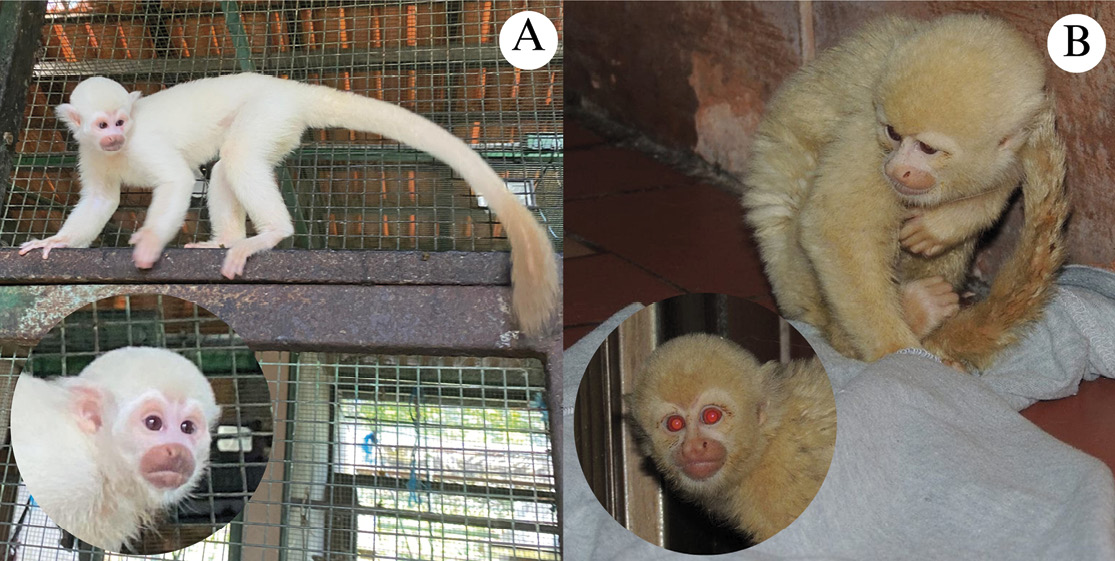
Figure 2. (a) Leucistic young male of Saimiri sciureus in captivity at the Wildlife Rehabilitation Center (CETAS/IBAMA) in Macapá, Amapá, Northern Brazil. Note the normal color of the eyes. (b) Albine individual of Saimiri sp., which was in a house in Armenia, Quindío, Central Colombia. Note the depigmented eyes. Photos: Aline E. O. de Souza and Sebastián O. Montilla.