THERYA NOTES 2025, Vol. 6: 207-211
First record of Gardnerycteris keenani in the North Pacific of Costa Rica and southern range extension of Artibeus inopinatus
Primer registro de Gardnerycteris keenani
en el Pacífico Norte de Costa Rica y extensión
del ámbito de distribución sur de Artibeus inopinatus
Marco Antonio Ramírez-Vargas1*, Gabriel Granados Madrigal2, Marck Leiva-Méndez1, and Rotney Piedra Chacón2
1Universidad Nacional. Avenida 1, Calle 9, Heredia, Costa Rica. E-mail: marjovi88@gmail.com (MARV), marck.leiva.mendez@est.una.ac.cr (MLM).
2Sistema Nacional de Áreas de Conservación. Área de Conservación Tempisque. Ruta Nacional 150, Avenida 21. Nicoya, Guanacaste, Costa Rica. E-mail: gabriel.granados@sinac.go.cr (GGM), rotney.piedra@sinac.go.cr (RPC).
*Corresponding author
The National Ecological Monitoring Program (PRONAMEC) of the National System of Conservation Areas (SINAC) in Costa Rica aims to generate scientific information for biodiversity management in Protected Wildlife Areas. In 2023, the first structured bat survey was conducted in 4 protected areas of the Tempisque Conservation Area (ACT), recording Gardnerycteris keenani for the first time in the North Pacific of Costa Rica and the southernmost record of Artibeus inopinatus. Between July and October 2023, 6 mist nets were set up in the Iguanita National Wildlife Refuge (RNVSI), Guanacaste. The nets were placed at two sites: “Sendero Manglar” and “Quebrada Grande”, covering mangroves and deciduous dry forests areas, accomplishing a survey effort of 101.6 net-hours. An adult male Gardnerycteris keenani was recorded on July 14 and an adult female Artibeus inopinatus on October 16, both in good health. The finding of Gardnerycteris keenani extends its known distribution in Costa Rica, while the discovery of Artibeus inopinatus reinforces its association with tropical dry forests. These records highlight the ecological importance of the RNVSI and reveal information gaps due to limited previous sampling efforts. The presence of these species underscores the need to continue monitoring programs to support management decisions, especially in the face of anthropogenic threats.
Key words: Culebra Bay: dry forest; ecological integrity; ecological monitoring national program; Tempisque Conservation Area.
El Programa Nacional de Monitoreo Ecológico (PRONAMEC) del Sistema Nacional de Áreas de Conservación (SINAC) de Costa Rica busca generar información científica para la gestión de la biodiversidad en Áreas Silvestres Protegidas. En 2023, se realizó el primer monitoreo estructurado de quirópteros en 4 áreas silvestres protegidas del Área de Conservación Tempisque (ACT), registrándose por primera vez Gardnerycteris keenani en el Pacífico Norte de Costa Rica y logrando el registro más austral de la distribución conocida de Artibeus inopinatus. Entre julio y octubre de 2023, se instalaron seis redes de niebla en el Refugio Nacional de Vida Silvestre Iguanita (RNVSI), Guanacaste. Las redes se colocaron en dos sitios: “Sendero Manglar” y “Quebrada Grande”, abarcando áreas adyacentes a un manglar dominado por Rhizophora mangle y áreas de bosque seco caducifolio secundario. El esfuerzo de muestreo consistió de 101.6. horas/red. Se registró un macho adulto de Gardnerycteris keenani el 14 de julio y una hembra adulta de Artibeus inopinatus el 16 de octubre, ambos en buen estado de salud. El hallazgo de Gardnerycteris keenani amplía su distribución conocida en Costa Rica, mientras que el de Artibeus inopinatus refuerza su asociación con bosques secos tropicales. Estos registros destacan la importancia ecológica del RNVSI y evidencian vacíos de información debido a limitados esfuerzos de muestreo previos. La presencia de estas especies subraya la necesidad de continuar con programas de monitoreo para apoyar decisiones de manejo, especialmente frente a amenazas antropogénicas.
Palabras clave: Área de Conservación Tempisque; Bahía Culebra; bosque seco; integridad ecológica; Programa Nacional de Monitoreo Ecológico.
© 2025 Asociación Mexicana de Mastozoología, www.mastozoologiamexicana.org
The National Ecological Monitoring Program (PRONAMEC) of the National System of Conservation Areas (SINAC) of Costa Rica was established as a national strategy in 2016 (SINAC 2021). Its objective is to generate and disseminate scientific information on the state of biodiversity conservation in the country, serving as a decision-making tool for the management of protected wildlife areas and their areas of influence. Under this program, during 2023, the first structured monitoring of chiropterans was conducted in four wildlife protected areas within the Tempisque Conservation Area (ACT; northwestern Costa Rica).
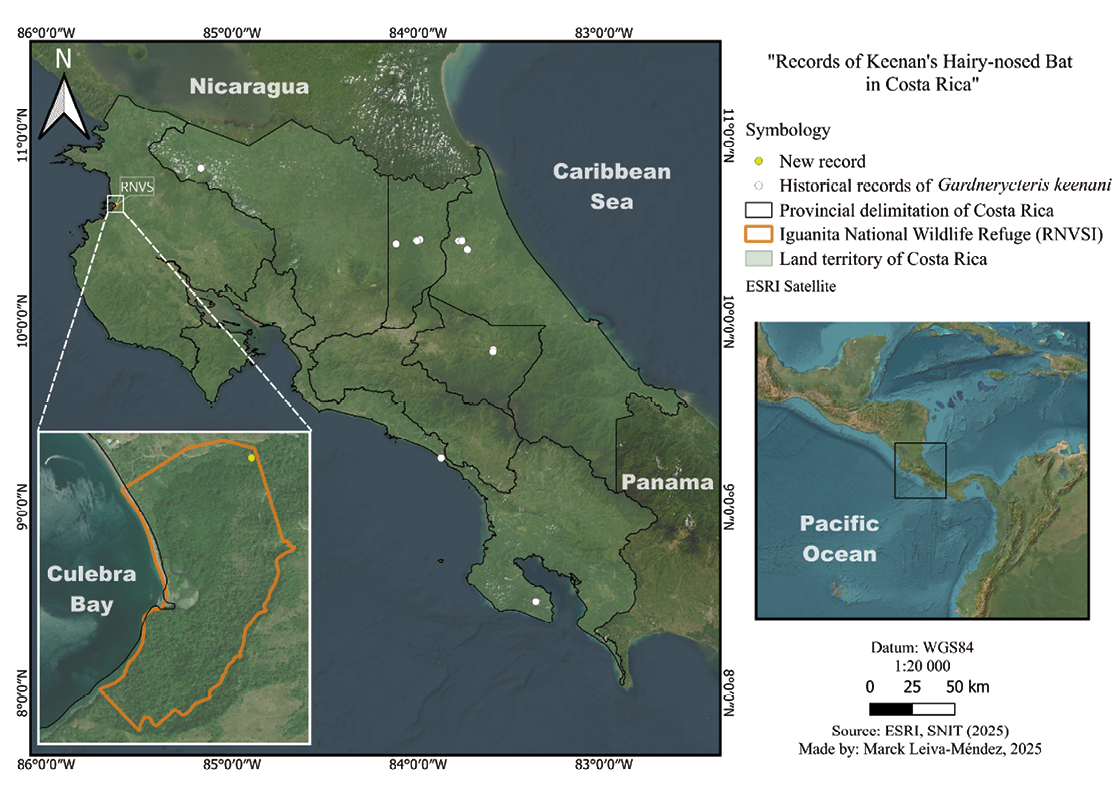
Gardnerycteris keenani is a phyllostomid bat belonging to the Phyllostominae subfamily. Globally, its distribution ranges from southern Mexico to eastern Brazil and northern Peru and Bolivia. In Costa Rica, it was previously classified as Mimon crenulatum (Hurtado and Pacheco 2014; Hurtado and D’Elía 2018; Mora and Ruedas 2023), with records limited to the Caribbean and southern Pacific lowlands (Rodríguez and Montero 2001; LaVal and Rodríguez 2002; Reid and Gómez 2022; GBIF 2023; MNCR 2025) (Figure 1). It is a gleaning insectivore that includes beetles, flies, moths, and lizards in its diet (LaVal and Rodríguez 2002). Like other species in the subfamily, G. keenani is sensitive to deforestation and other ecosystem disturbances, showing higher abundances in mature forests (Medellín et al. 2000; Medellín and Víquez 2014).
Artibeus inopinatus is a frugivorous phyllostomid bat belonging to the subfamily Stenodermatinae. Its known distribution includes only dry forest regions of the Pacific in Honduras, El Salvador, and Nicaragua and it is hypothetically considered for Guatemala (Webster and Knox 1983; Artavia et al. 2023). In Costa Rica, there are only two records of the species, both in the Santa Rosa National Park (North Pacific) (Artavia et al. 2023). Data on its natural history and conservation status are scarce (Webster and Knox 1983; Reid and Medina 2016); however, in Honduras it is considered an endangered species due to its restricted range and habitat loss (Portillo et al. 2019).
The Iguanita National Wildlife Refuge (RNVSI) is a protected wildlife area within the ACT, Costa Rica. It is located in the province of Guanacaste, within Bahía Culebra (Figure 1), having an area of 118.3 ha (SNIT 2025), of which 44,6 ha correspond to mangrove forest. The RNVSI is situated in a lowland region with flat to undulating topography ranging from 40 to 600 m, where vegetation is mostly deciduous, with small patches of evergreen or gallery forests, as well as wooded savannas limited by edaphic conditions (Zamora 2008).
Climatically, the region presents a drought pattern, with five dry months (SINAC 2022). Rainfall decreases from December to March, with peak precipitation periods occurring between May–June and August–October. The average annual rainfall ranges from 1,000 to 2,200 mm.
Between July and October 2023, six nylon mist nets (Avinet® Inc.), measuring 12 × 2.6 m with a 36 mm mesh size, were set up for capturing bats at two sites known as “Sendero Manglar” (10° 37’ 46.24” N; 85° 37’ 43.97” W) and “Quebrada Grande” (10° 37’ 56.99” N; 85° 37’ 22.25” W) within the RNVSI, between 17:30 and 22:00 hr. The first site is a trail crossing a mangrove area dominated by Rhizophora mangle and a secondary coastal dry forest area (SNIT 2025) dominated by Prosopis juliflora, Sterculia apetala, Enterolobium cyclocarpum, Guazuma ulmifolia and Canavalia maritima. The second site is located in a secondary forest, dominated by species such as G. ulmifolia, Handroanthus ochraceus, Lonchocarpus sp., Spondias mombin, Bombacopsis quinata, Vachellia collinsii, Bursera simarouba, Cordia alliodora and Gliricidia sepium, within 50 m of a riverbed that feeds a mangrove area (SNIT 2025).
Captured individuals were examined to record their forearm length using a digital caliper (Steren, 0.2mm precision), age (through the inspection of metacarpal epiphyseal fusion), and sex and reproductive condition by external examination of genitals and mammary glands. Species identification followed the field key of York et al. (2019) and Mora and Espinal (2021).
On July 14, an adult male G. keenani (Figure 2), with scrotal testes and a forearm length of 52 mm, was recorded. The individual appeared healthy and was released after examination. On October 16, an adult non-reproductive female A. inopinatus (Figure 3), with a forearm length of 48 mm, was recorded. The bat also appeared healthy and was released after examination.
The record of G. keenani extends the species’ known range in Costa Rica by approximately 230 km, from its southernmost record (MNCR 2025). While the record made in the RNVSI was in a predominantly deciduous forest, within one of the driest regions of the country, the historic southernmost record is from the humid Central Pacific lowland region (~400 m), which is a floristic ecotone where elements of the deciduous vegetation of the Pacific Northwest converge with vegetation from the more humid Pacific Southwest (Zamora 2008). Noteworthy, most of the northern records of the species in Costa Rica (MNCR 2025) are from the Caribbean plains, an area that exhibits practically no dry season during the year.
Another issue worth analyzing, is the fact that the captured G. keenani showed scrotal testes. As stablish by Krutzch (2000), the reproductive readiness of male bats is generally in synchrony with that of females. Also, as established by Heideman (2000), opportunistic reproduction may be rare in bats, because the relatively long gestation periods make it unlikely that a female could complete a full reproductive cycle (from follicle production to weaning) before good conditions have passed. Instead, most seasonally reproducing bats (e.g many Phyllostomids) probably react to cues that predict oncoming periods when environmental conditions permit successful reproduction. In accordance with the above, we suggest that the captured male may not be an occasional individual, but rather part of a potentially established population.
Regarding A. inopinatus, its known regional distribution primarily includes Central American Pacific tropical dry forests (Artavia et al. 2023), such as those found in Santa Rosa National Park, where the species was first recorded in Costa Rica (~30km north from the RNVSI record). Its presence in the RNVSI provides further evidence supporting an association of this species with seasonally dry tropical forests.
The discovery of two unrecorded species in the area, highlights the ecological importance of the Iguanita Wildlife Refuge. The documented records are relevant for increasing knowledge of the natural history of both species. By generating ecological information, keeping monitoring programs can improve management decisions for wildlife areas.
Acknowledgments
The data for this research were obtained within the framework of the project “Acquisition of specialized equipment, induction, and implementation of the Ecological Integrity Monitoring Plans for the Protected Wild Areas of the Tempisque Conservation Area,” carried out by the Foundation for the Development of the National University (FUNDAUNA), funded by the Second U.S.–Costa Rica Debt-for-Nature Swap and administered by the Costa Rica Forever Association. The principal investigator had the corresponding research permits in accordance with the relevant national legislation, as stated in resolution ACT-OR-DR-091-2023. Thanks are extended to Geographer A. Loria-Chaves for reviewing the cartographic material.
Literature cited
Artavia, E., et al. 2023. Primer registro del murciélago Artibeus inopinatus (Chiroptera: Phyllostomidae) en Costa Rica. Cuadernos de Investigación UNED 15: 174–178.
Global Biodiversity Information Facility (gbif). 2023. GBIF Occurrence download. Accessed via GBIF.org on October 2023.
Heideman, P.D. 2000. Environmental Regulation of Reproduction. Pp 469–495 in Reproductive Biology of Bats (Crichton, E. G and P. H. Krutzch, eds.). Academic Press, London, England.
Hurtado, N., and G. D’Elía. 2018. Taxonomy of the genus Gardnerycteris (Chiroptera: Phyllostomidae). Acta Chiropterologica 20: 99–115.
Hurtado, N., and V. Pacheco. 2014. Análisis filogenético del género Mimon Gray, 1847 (Mammalia, Chiroptera, Phyllostomidae) con la descripción de un nuevo género. Therya 5: 751–791.
Krutzch, P. 2000. Anatomy, Physiology and Cyclicity of the Male Reproductive Tract. Pp 92–137 in Reproductive Biology of Bats (Crichton, E. G. and P. H. Krutzch, eds.). Academic Press, London, England.
Laval, R., and B. Rodríguez. 2002. Murciélagos de Costa Rica. Editorial INBio, Santo Domingo de Heredia, Costa Rica.
Medellín, R., Equihua, M., and M. A. Amín. 2000. Bat diversity y abundance as indicators of disturbance in Neotropical rainforest. Conservation Biology 14:1666–1675.
Medellín, R. A., and L. R. Víquez. 2014. Los murciélagos como bioindicadores de la perturbación ambiental. Pp. 521–539 in Bioindicadores: guardianes de nuestro futuro ambiental (González, C., Vallarino, A., Perez, J. y A. Low, eds). Editorial S y G, Ciudad de México, México.
Mora, J. M., and L. Ruedas. 2023. Updated list of the mammals of Costa Rica, with notes on recent taxonomic changes. Zootaxa 5357: 451–501.
Mora, J., López, L. I., and M. Espinal. 2021. Clave de campo para la identificación de los murciélagos de Honduras. Notas sobre Mamíferos Sudamericanos 3: e21.6.1.
Museo Nacional de Costa Rica (mncr). 2025. Colección de Mastozoología (MNCR-M) [en línea]. Base de datos de Biodiversidad https://biodiversidad.museocostarica.go.cr/ [agosto 2025].
Portillo, H. O., Aguirre, Y., and J. Hernández. 2019. Registro de una población del murciélago frutero hondureño (Artibeus inopinatus) (David y Carter, 1964), en Nacaome, Valle, Honduras. Scientia hondurensis 2:71–75.
Reid, F., and A. Medina. 2016. Artibeus inopinatus. In: IUCN 2025. The IUCN Red List of Threatened Species. Version 2025-1. www.iucnredlist.org. Accessed on 20 September 2025.
Reid, F., and G. Gómez. 2022. Pocket guide to the mammals of Costa Rica. Cornell University Press, New York, EE.UU.
Rodríguez-Herrera, B., and J. Montero. 2001. Primer registro de Mimon crenulatum (Chiroptera: Phyllostomidae) en el Pacífico de Centroamérica. Brenesia 55-56:145–146.
Sistema Nacional de Áreas de Conservación (sinac). 2021. Protocolo grupo mamíferos: Proyecto desarrollo de indicadores de integridad ecológica y sus respectivos protocolos de monitoreo a nivel local para los ámbitos terrestres y de aguas continentales en 32 áreas silvestres protegidas de Costa Rica. Ministerio de Ambiente y Energía. Costa Rica.
Sistema Nacional de Áreas de Conservación (sinac). 2022. Diagnóstico del Refugio Nacional de Vida Silvestre Iguanita. Ministerio de Ambiente y Energía. Costa Rica.
Sistema Nacional de Información Territorial (snit). 2025. Infraestructura Nacional de Datos Espaciales de Costa Rica.
Webster, D., and J. Knox. 1983. Artibeus hirsutus and Artibeus inopinatus. Mammalian species 199: 1–3.
York, H., et al. 2019. Field key to the bats of Costa Rica and Nicaragua. Journal of Mammalogy 100: 1726–1749.
Zamora, A. 2008. Unidades fitogeográficas para la clasificación de ecosistemas terrestres en Costa Rica. Recursos Naturales y Ambiente 54:14–20.
Associate editor: Xavier López Medellín
Submitted: April 10, 2025; Reviewed: October 07, 2025.
Accepted: November 27, 2025; Published on line: December 9, 2025
DOI: 10.12933/therya_notes-24-224
ISSN 2954-3614
Figure 1. Historical records of Gardnerycteris keenani in Costa Rica and location of the Iguanita National Wildlife Refuge.
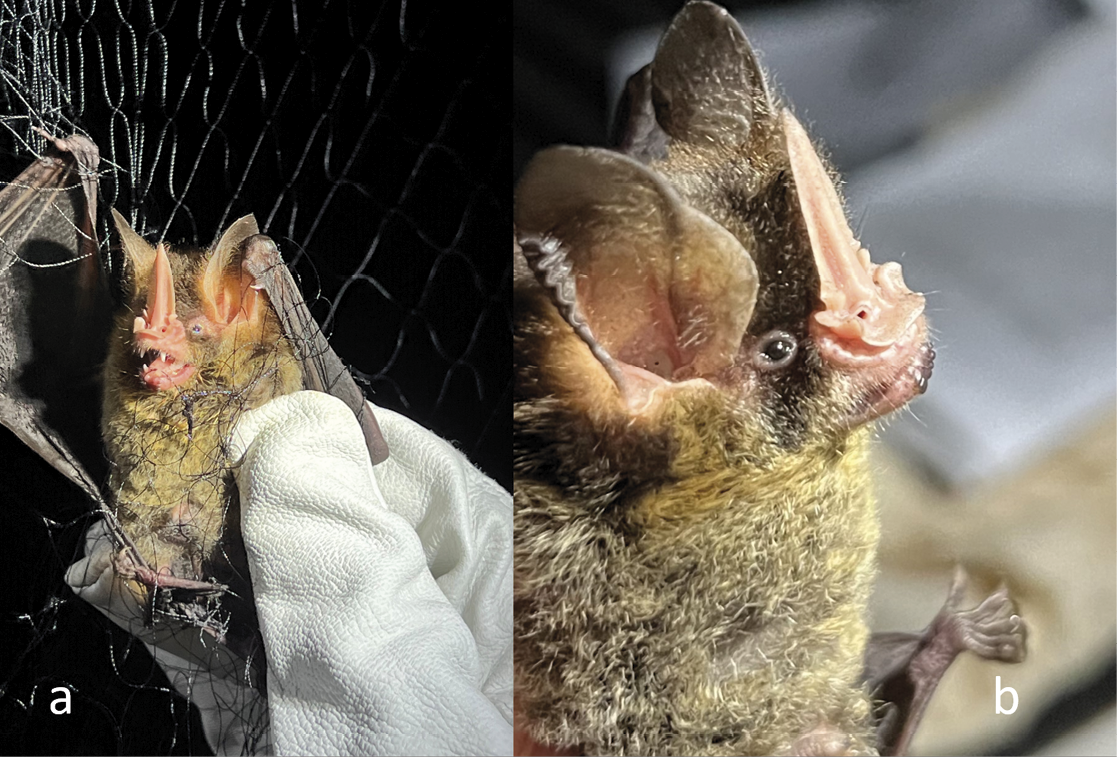
Figure 2. Gardnerycteris keenani captured at the Iguanita National Wildlife Refuge, Costa Rica. a) Frontal view of individual in mist net, b) close-up of lateral view.
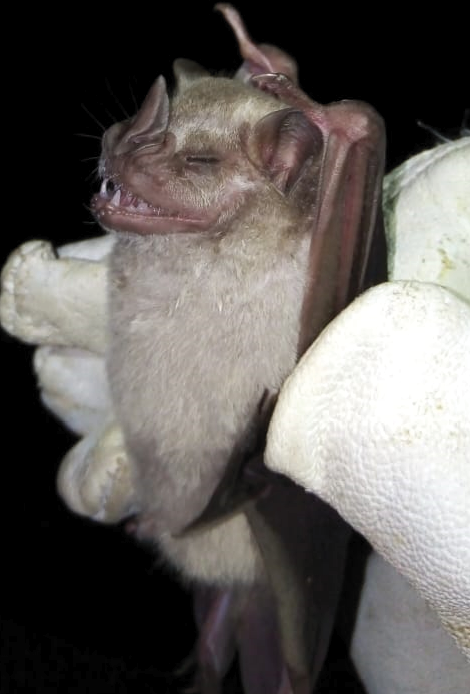
Figure 3. Artibeus inopinatus captured at the Iguanita National Wildlife Refuge, Costa Rica.