THERYA NOTES 2025, Vol. 6: 133-137
First record of nesting of a marsupial Tlacuatzin balsasensis (Didelphidae) in a wasp comb
Primer registro de anidación de un marsupial Tlacuatzin balsasensis (Didelphidae), en un nido de avispas
Aketzali Martínez-Martínez1, Diego Guerrero-Guerra1, Rosa María Gómez-Ugalde1*, Natalia Martín-Regalado2, and Mario C. Lavariega2
1Instituto Tecnológico del Valle de Oaxaca, Tecnológico Nacional de México. Carretera al ITAO s/n, C. P. 71233, San Jesús Nazareno. Santa Cruz Xoxocotlán, Oaxaca, México. E-mail: sagitario.ketza1998@gmail.com (AM-M); diegon.guerra95@gmail.com (DG-G); rosa.gu@voaxaca.tecnm.mx (RMG-U).
2Centro Interdisciplinario de Investigación para el Desarrollo Integral Regional Unidad Oaxaca, Instituto Politécnico Nacional. Hornos 1003, C. P. 71230. Santa Cruz Xoxocotlán, Oaxaca, México. E-mail: nataliamartinregalado@gmail.com, (NM-R); mlavarriegan@ipn.mx (MCL).
*Corresponding author
Mammals construct, reuse, or adapt nests for purposes such as maternity, rest, and protection from environmental factors. American marsupials can either construct their own nests or occupy those abandoned, but the use of wasp combs as structural support has not been previously observed. In this study, we document the construction of a nest by a small Neotropical marsupial utilizing a wasp comb as support. While carrying out field surveys at Yerba santa, Municipality of Yosondúa, Oaxaca, México, we were noticed by residents of a wasp nest. We went to the sighting site to measure the height of the branch supporting the nest. The nest was examined, measurements were taken (length, width, and diameter of the entrance), and photographic records were obtained of the small mammal inside. The wasp nest was located on a thin branch 4 m above the ground. It measured 25 cm in length and 15 cm in width, with an entrance opening of 7 cm positioned on the underside. Inside a single individual of a small marsupial was observed. The individual was identified as Tlacuatzin balsasensis based on its small size, brownish slightly gray dorsal fur and yellow buff underparts, and geographic range. The nest fitted to known descriptions of Tlacuatzin nests, as the size, entrance, and location above the ground. However, the base material consisted of wasp comb, an animal-built material. Wasp nests provide robust material that may also offer environmental protection and refuge from predators for the small marsupial. To our knowledge, this represents the first recorded instance of a mammal nesting in a wasp nest.
Key words: Behavior; Deciduous forests; Mixteca region; Oaxaca; Polybia; refuge.
Los mamíferos construyen, reutilizan o adaptan sus nidos para la maternidad, el descanso y la protección frente a factores ambientales. Los marsupiales americanos pueden construir sus propios nidos u ocupar los abandonados, pero el uso de panales de avispa no se había observado anteriormente. Documentamos la construcción de un nido por parte de un pequeño marsupial neotropical utilizando un panal de avispa. Durante muestreos de campo en Yerba Santa, Municipio de Yosondúa, Oaxaca, México, los habitantes del lugar nos notificaron de un nido de avispas. Después de inspeccionarlo, encontramos un pequeño mamífero en su interior. Se inspeccionó el nido, se tomaron medidas (largo, ancho y diámetro de la entrada) y se obtuvieron registros fotográficos del individuo. El nido de avispas se localizó sobre una rama delgada a 4 m del suelo. Medía 25 cm de largo por 15 cm de ancho, con una entrada de 7 cm posicionada en la parte inferior. En su interior se observó un individuo de un pequeño marsupial. El individuo fue identificado como Tlacuatzin balsasensis con base en su tamaño pequeño, pelaje dorsal ligeramente gris parduzco y partes inferiores de color beige amarillento y rango geográfico. El nido se ajusta a las descripciones conocidas, en cuanto al tamaño, entrada y ubicación sobre el suelo. Sin embargo, el material de base consistió en un panal de avispa, el cual proporciona un material resistente que también puede ofrecer protección ambiental y refugio contra los depredadores. Hasta donde sabemos, este es el primer caso registrado de un mamífero anidando en un panal de avispa.
Palabras clave: Comportamiento; Oaxaca; Polybia; refugio; región Mixteca; selva baja caducifolia.
© 2025 Asociación Mexicana de Mastozoología, www.mastozoologiamexicana.org
Marsupials use nests as shelters and to protect and lactate their young until they can provide themselves with food (Tyndale-Biscoe and Renfree 1987). Therefore, females build better-quality nests (Kimble 1997) and change nests less frequently than males (Reid 1997). For females, the search for appropriate nesting sites is vital to protect their numerous offspring and is more stressing for those species that lack a pouch (Astúa and Guilhon 2022). Marsupials can build nests (Kimble 1997) but more commonly exhibit opportunistic nesting behavior by appropriating and reconditioning the nests of other species (Hunsaker II and Shupe 1977; Monticelli and Gasco 2018). Therefore, the discovery of their nests is usually by chance (Armstrong and Jones 1971; Zarza et al. 2003).
The location of marsupial nests is related to the stratum they use (Pine 1981; O’Connor et al. 1982), for example, the semi-aquatic species Chironectes minimus (Zimmermann, 1780) usually makes underground cavities with entrances above the water level (Reid 1997); while the four-eyed opossum Metachirus nudicaudatus (É. Geoffroy Saint-Hilaire 1803), of terrestrial habits, builds nests with dry leaves intertwined with pieces of roots, which are spherical, and apparently without an entrance (Loretto et al. 2005). The descriptions of small marsupial nests agree that the nests are located more than 0.7 m above the ground, are spherical (approximately 20 cm in diameter), with openings of 3-4 cm at the bottom, and for their conditioning they use dry leaves (Hunsaker II and Shupe 1977; Husson 1978; Jiménez and Rageot 1979; Redford and Eisenberg 1992; Engstrom et al. 1994; Zarza et al. 2003). They can also use holes in banks of ground, branches, or cactus, and the use of abandoned bird nests is also common (Alonso-Mejía and Medellín 1992; Reid 1997). Additionally, the use of artificial nests (wooden boxes; Brito-Vera et al. 2022) has been recorded. In all cases, marsupial species seem to share the behavior of transporting organic material for nesting with the help of their tails (Redford and Eisenberg 1992; Kimble 1997; Pereira and Schlindwein 2016).
Ramírez-Pulido et al. (2014) recognize that nine species of marsupials inhabiting México. However, molecular genetic studies carried out by Arcangeli et al. (2018) on the genus Tlacuatzin Voss and Jansa, 2003 suggest that in México this taxon is formed by five phylogenetic clades in México, two of which are distributed in the state of Oaxaca: Tlacuatzin canescens (Allen 1893) and Tlacuatzin balsasensis Arcangeli et al. 2018
Tlacuatzin is an endemic taxon to México (Arcangeli et al. 2018); the species of this genus are small (20-60 g) and have mainly nocturnal, semi-arboreal, and solitary habits; they are considered omnivores, feeding mainly on insects and fruits and occasionally on small vertebrates (Zarza et al. 2003). These species frequent the ground more than others and in western México, the reproductive season runs from August to October, and they have 8 to 13 young (Reid 1997).
The nests of Tlacuatzin species have been described as spherical and constructed of dry leaves and twigs lined with plant remains (Nelson 1899; Armstrong and Jones 1971; Reid 1997; Zarza et al. 2003). The species Tlacuatzin insularis (Merriam, 1898), from the Islas Marías, nests in cactus, and abandoned nests of birds, such as orioles (Armstrong and Jones 1971; Zarza et al. 2003). In Chamela, Jalisco, the nests of Tlacuatzin sinaloae. have been found on trees (Cenostigma eriostachys (Benth.) Gagnon & G.P.Lewis, Bonellia macrocarpa subsp. pungens (A.Gray) B.Ståhl & Källersjö), shrubs (Neltuma juliflora (Sw.) Raf.) and cacti Opuntia excelsa Sánchez-Mej.), at ٠.٧٠-٥.٠ m above the ground (Zarza et al. 2003). In this note, we document the use and conditioning of a Polybia sp. wasp comb by the Tlacuatzin balsasensis for use as a nest.
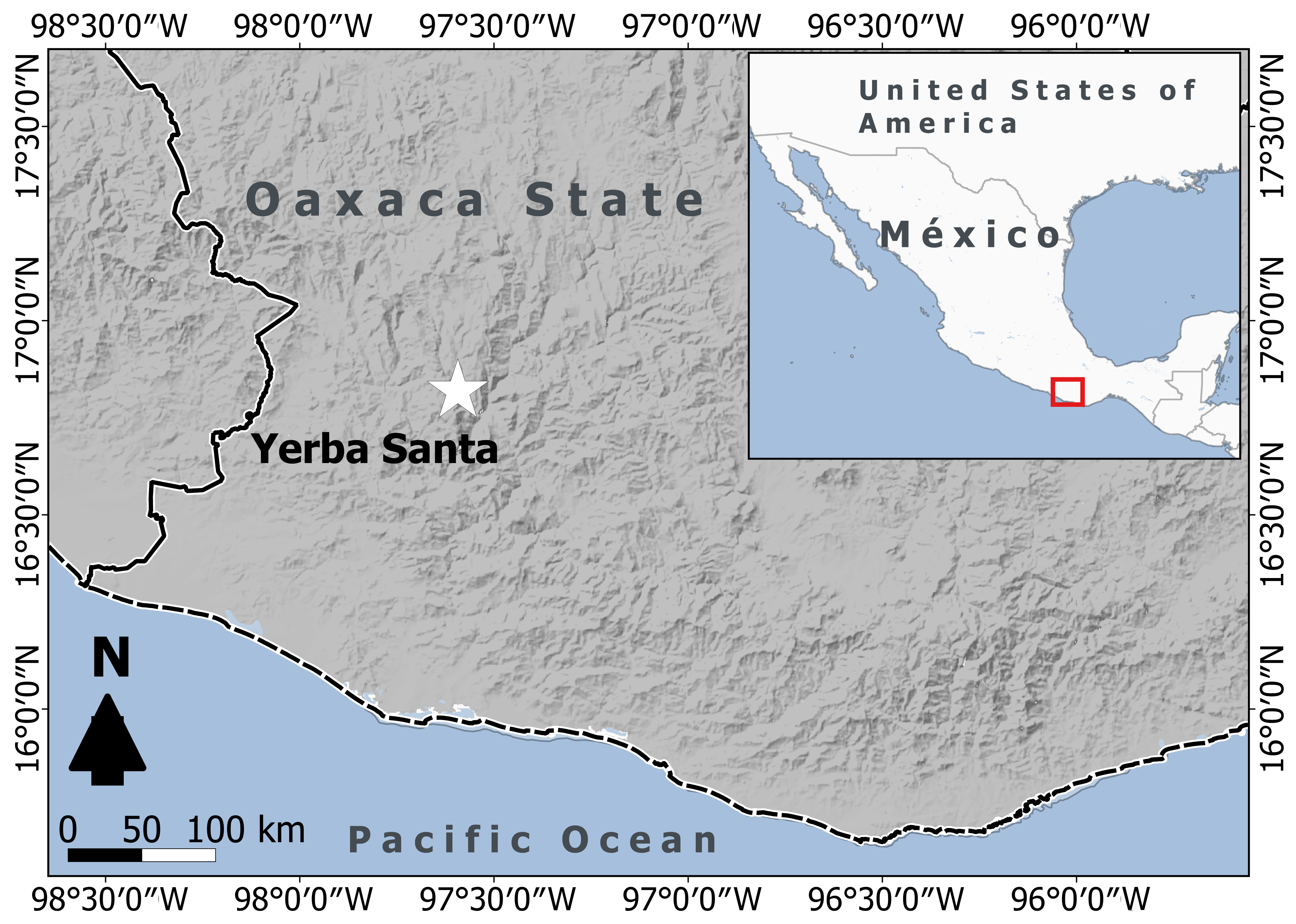
The record was carried out in the community of Yerba Santa in the Municipality of Santiago Yosondúa, in the Mixteca region, in the central west of the state of Oaxaca, México. Its geographical location is between the coordinates 16º 48’ N and 16º 49’ N, and 97º 34’ W and 97º 33’ W (Figure 1). It is located at a distance of 96.8 km SW from the City of Oaxaca. The topography is heterogeneous, with an altitudinal gradient that varies from 1,200 m in the lowest area to 1,750 m in the highest area. The site has tropical deciduous forests in the lower parts, while in the middle elevations, it changes to oak or oak-pine forests, and in the higher parts, there is pine forest.
During wildlife monitoring activities in Yerba Santa, local residents reported the accidental discovery of a wasp comb on a recently cut branch during clearing work. Based on this report, the following were carried out: (1) locating and georeferencing the site of the discovery; (2) measuring the height of the branch supporting the comb; (3) conducting a detailed examination of the comb, recording its morphometric variables in centimeters (length, width, and diameter of the entrance); and (4) photographing the resident specimen. Additionally, wasp remains present inside the nest were collected to determine their taxonomic identity. Taxonomic identification was performed through comparative morphological analysis of adult specimens collected at the site.
On March 5, 2021, the first author was notified of the remains of a wasp comb that had been removed from a tree during land-clearing activities. According to the report, the nest was extracted due to concerns over potential wasp. The Site inspection revealed that the wasp comb was suspended 4 meters above ground on a Lonchocarpus sp. branch; it had an opening underside, and inside an individual of opossum was discovered. The geographic coordinates of the record were 16°48’5.40” N, 97°35’14.28”W. The individual was determined as Tlacuatzin due to its small size and grayish fur color, instead of reddish as presented in Marmosa mexicana Merriam, 1897 (Zarza et al. 2003). As the specimen was not collected, morphometrics (e.g., skull dimensions, molar lengths) were unavailable. Species identification was therefore based on fur coloration and range criteria from Arcangeli et al. (2018) as T. balsasensis due to the specimen possessing a brownish slightly gray dorsal fur and yellow buff underparts (Figure 2) and near of the range of this species. The dimensions of the nest were: width 15 cm, length 25 cm, and diameter 15 cm; the opening of the nest was 7 cm in diameter. The exact depth of the nest is unknown, but it was observed that the individual could stay completely inside. The edges and interior of the nest were covered with leaves that partially separated the nest cells (Figure 2).
Videos and photographs of the species were obtained and subsequently, the nest was placed on a high branch of an Ehretia tinifolia L. tree near the location of the discovery to allow the animal to continue their cycle life.
When reviewing published information on the nests occupied by species of the genus Tlacuatzin, we found that these have been described as balls of dry leaves and twigs lined with crushed leaves and arranged in the fork of small trees and shrubs, or holes in cactus or branches (Nelson 1899; Armstrong and Jones 1971; Reid 1997). Nests have been found 0.9 to 2.4 m above the ground (Nelson 1899) and usually have a small opening on the underside. The nest described here was found 4 m above ground and in other characteristics, it conforms to previous descriptions, in terms of the flattened leaves lining the entrance and interior, and the position of the opening. However, the base material of the nest consisted mainly of wasp comb. The use of these combs had not previously been reported in nests of marsupials or other small mammals, so this is the first record of the use of wasp combs as a nesting site for a marsupial or any other mammal.
Both mammals and birds often resort to wasp combs in search of larvae as a food source (Jeanne 2009; Kratzer 2022). There are also mutualistic interactions, in which birds and wasps find benefit from building nests nearby (Hindwood 1955; Quinn and Ueta 2008). In Africa, it was found that vertebrates and wasps preferred artificial nests that were not previously occupied by the other species, suggesting that they avoided each other (Veiga et al. 2013). Brito-Vera et al. (2022) reported the use of artificial nest boxes with the presence of abandoned wasp nests by Marmosa simonsi Thomas 1899, but not utilizing the comb as in the present findings.
The nesting record that we present, together with the report by Brito-Vera et al. (2022), suggests that there is no rejection by small marsupials to occupy sites previously used by wasps as nests. On the other hand, the documented finding reinforces the conception of the opportunistic behavior of Tlacuatzin sp. to occupy pre-constructed sites as nesting and/or refuge sites (Armstrong and Jones 1971).
Finally, our nesting record of T. balsasensis in wasp combs represents the first documented report for the genus Tlacuatzin. However, further ecological studies are required to confirm if the use of this organic material is common in species of the Tlacuatzin genus and if it provides them with any nutrients or advantages over others plant materials or to deter predators.
Literature cited
Alonso-Mejía, A., and R. A. Medellín. 1992. Marmosa mexicana. Mammalian Species 421:1-4.
Arcangeli, J., J. E. Light, and F. A. Cervantes. 2018. Molecular and morphological evidence of the diversification in the gray mouse opossum, Tlacuatzin canescens (Didelphimorphia), with description of a new species. Journal of Mammalogy 99:138-158.
Armstrong, D. M., and J. K. Jones. 1971. Mammals from the Mexican State of Sinaloa. I. Marsupialia, Insectivora, Edentata, Lagomorpha. Journal of Mammalogy 52:747-757.
Astúa, D., and G. Guilhon. 2022. Morphology, form, and function in Didelphid Marsupials. Pp. 483-514 in American and Australasian Marsupials: An evolutionary, biogeographical, and ecological approach (Cáceres, N.C., and C.R. Dickman, ed.). Springer Charm. Berlin, Germany.
Brito-Vera, G.A., et al. 2022. Use of artificial nest boxes by two species of small, arboreal mammals in Ecuadorian tropical dry forest. Neotropical Biodiversity 8:108-111.
Engstrom, M. D., B. K. Lim, and F. A. Reid. 1994. Two small mammals new to the fauna of El Salvador. The Southwestern Naturalist 39:281-283.
Hindwood, K. A. 1955. Bird/wasp nesting associations. Emu-Austral Ornithology 55:263-274.
Hunsaker II, D., and D. Shupe. 1977. Behavior of New World Marsupials. Pp. 279-348 in The biology of marsupials (Hunsaker II, D., ed.). Academic Press. New York, U. S. A.
Husson, A. M. 1978. The mammals of Suriname. Zoölogische Monographieën Van Het Rijksmuseum Van Natuurlijke Historie 2:4-39.
Jeanne, R. L. 2009. Nest building. Pp. 688-691 in Encyclopedia of Insects (Resh, V. H., and R. T. Cardé, eds.). Academic Press. Cambridge, U. S. A.
Jiménez, J., and R. Rageot. 1979. Notas sobre la biología del monito del monte (Dromiciops australis Philippi 1893). Anales del Museo de Historia Natural 12:83-88.
Kimble, D. P. 1997. Didelphid behavior. Neuroscience & Biobehavioral Reviews 21:361-369.
Kratzer, C. A. 2022. The social wasps of North America. Owlfly Publishing. Frenchtown, U. S. A.
Loretto, D., E. Ramalho, and M. V. Vieira. 2005. Defense behavior and nest architecture of Metachirus nudicaudatus Desmarest, 1817 (Marsupialia, Didelphidae). Mammalia 69:417-419.
Monticelli, P. F., and A. Gasco. 2018. Nesting behavior of Didelphis aurita: twenty days of continuous recording of a female in a coati nest. Biota Neotropica 18:e20180550.
Nelson, E. W. 1899. Mammals of the Tres Marias Islands. North American Fauna 14:15-19.
O’Connor, B. M., F. S. Lukoschus, and K. T. M. Gieson. 1982. Two new species of Marmosopus (Acari: Astigmata) from rodents of the genus Scotinomys (Cricetidae) in Central America. Occasional Papers of the Musem of Zoology University of Michigan 703:1-22.
Pereira, L. R., and M. N. Schlindwein. 2016. Tail use by Didelphis albiventris (Didelphimorphia-Didelphidae) to carry vegetable material in a pine grove in the Southeastern Brazil. Current Ethology 15:16-18.
Pine, R. H. 1981. Reviews of the mouse opossums Marmosa parvidens Tate and Marmosa invicta Goldman (Mammalia: Marsupialia: Didelphidae) with description of a new species. Mammalia 45:55-70.
Quinn, J. L., and M. Ueta. 2008. Protective nesting associations in birds. Ibis 150:146-167.
Ramírez-Pulido, J., et al. 2014. List of recent land mammals of Mexico, 2014. Special Publications Museum of Texas Tech University 63:5-76.
Redford, K. H., and J. F. Eisenberg. 1992. Mammals of the neotropics: The Southern Cone. The University of Chicago. Chicago, U. S. A.
Reid, F. A. 1997. A field guide to the mammals of Central America and Southeast Mexico. Oxford University Press. New York, U. S. A.
Tyndale-Biscoe, C. H., and M. Renfree. 1987. Monographs on marsupial biology. Reproductive physiology of marsupials. Cambridge University Press. Cambridge, England.
Veiga, J. P., et al. 2013. Interphyletic relationships in the use of nesting cavities: mutualism, competition and amensalism among hymenopterans and vertebrates. Naturwissenschaften 100:827-834.
Zarza, H., G. Ceballos, and M. A. Steele. 2003. Marmosa canescens. Mammalian Species 2003:1-4.
Associate editor: José Manuel Mora Benavides
Submitted: January 16, 2025; Reviewed: August 11, 2025.
Accepted: September 3, 2025; Published on line: November 20, 2025.
DOI: 10.12933/therya_notes-24-210
ISSN 2954-3614
Figure 1. Geographical location of Yerba Santa, Municipality of Yosondúa, in the Mixteca region, State of Oaxaca, México.
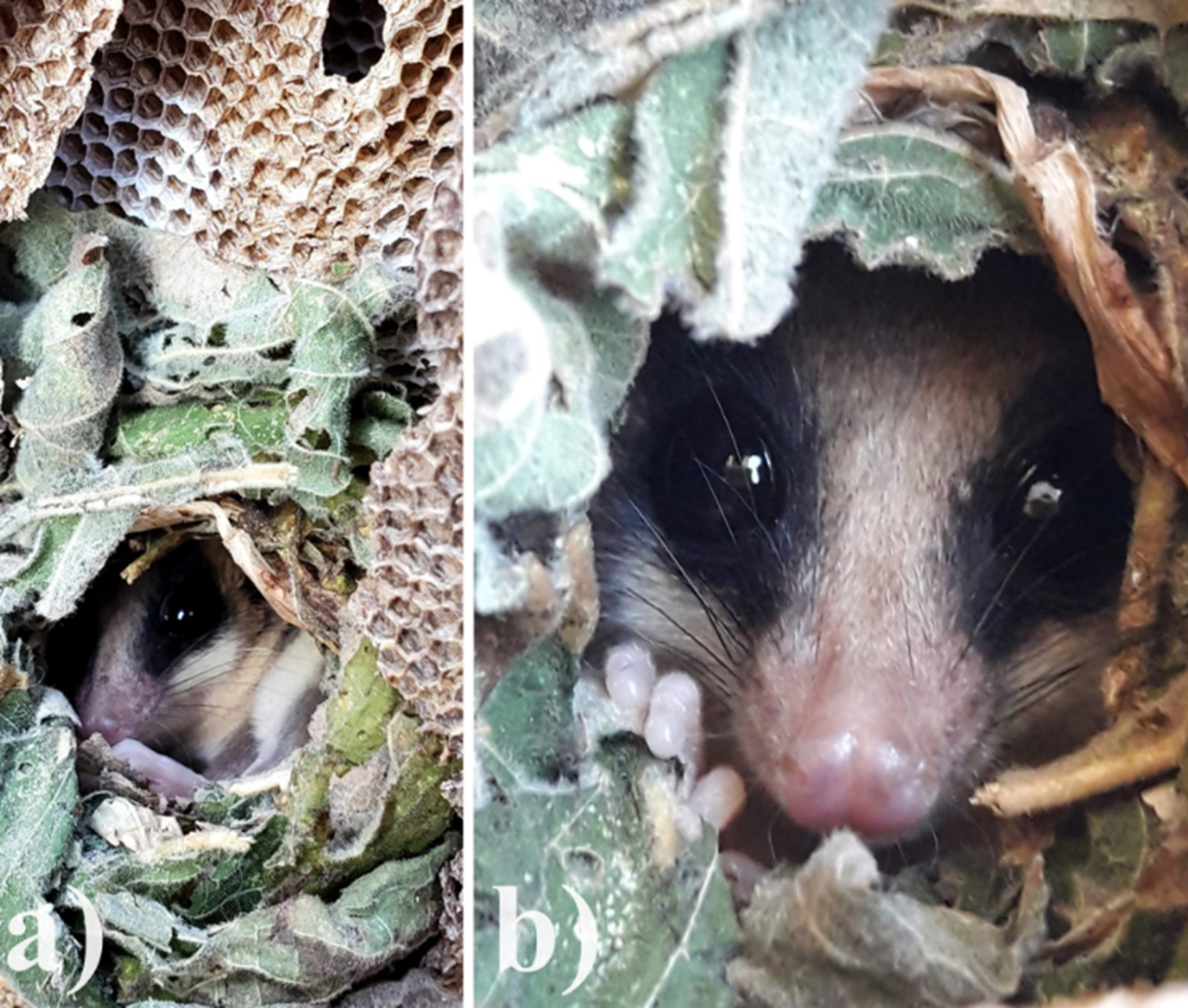
Figure 2. a) Individual of Tlacuatzin balsasensis. inside a wasp comb of Polybia sp.; b) close-up.